
#include <stdio.h>#include <math.h>#include <string.h>#include "math_graphics.h"#include "Axes.h"#include "GetProperty.h"#include "SetProperty.h"#include "BuildObjects.h"#include "DrawObjects.h"#include "Xcall1.h"#include "MALLOC.h"#include "sciprint.h"#include "clipping.h"#include "CurrentObjectsManagement.h"Include dependency graph for FeC.c:
Go to the source code of this file.
Functions | |
| static void PaintTriangle | __PARAMS ((double sx[], double sy[], double fxy[], int zxy[], double zlevel[], int fill[], BOOL with_mesh)) |
| static void PermutOfSort | __PARAMS ((int tab[], int perm[])) |
| static void FindIntersection | __PARAMS ((double sx[], double sy[], double fxy[], double z, int inda, int indb, integer *xint, integer *yint)) |
| void newfec | __PARAMS ((integer *xm, integer *ym, double *triangles, double *func, integer *Nnode, integer *Ntr, double *zminmax, integer *colminmax, integer *colout, BOOL with_mesh)) |
| void | initsubwin () |
| void | compute_data_bounds2 (int cflag, char dataflag, char *logflags, double *x, double *y, int n1, int n2, double *drect) |
| BOOL | update_specification_bounds (sciPointObj *psubwin, double *rect, int flag) |
| int | re_index_brect (double *brect, double *drect) |
| BOOL | strflag2axes_properties (sciPointObj *psubwin, char *strflag) |
| int | CreatePrettyGradsFromNax (sciPointObj *psubwin, int *Nax) |
| void | get_frame_in_pixel (integer WIRect[]) |
| int C2F() | fec (double *x, double *y, double *triangles, double *func, integer *Nnode, integer *Ntr, char *strflag, char *legend, double *brect, integer *aaint, double *zminmax, integer *colminmax, integer *colout, BOOL with_mesh, BOOL flagNax, integer lstr1, integer lstr2) |
| void | newfec (integer *xm, integer *ym, double *triangles, double *func, integer *Nnode, integer *Ntr, double *zminmax, integer *colminmax, integer *colout, BOOL with_mesh) |
| static void | PermutOfSort (int *tab, int *perm) |
| static void | PaintTriangle (double *sx, double *sy, double *fxy, int *zxy, double *zlevel, int *fill, BOOL with_mesh) |
| static void | FindIntersection (double *sx, double *sy, double *fxy, double z, int inda, int indb, integer *xint, integer *yint) |
| void newfec __PARAMS | ( | (integer *xm, integer *ym, double *triangles, double *func, integer *Nnode, integer *Ntr, double *zminmax, integer *colminmax, integer *colout, BOOL with_mesh) | ) |
| static void FindIntersection __PARAMS | ( | (double sx[], double sy[], double fxy[], double z, int inda, int indb, integer *xint, integer *yint) | ) | [static] |
| static void PaintTriangle __PARAMS | ( | (double sx[], double sy[], double fxy[], int zxy[], double zlevel[], int fill[], BOOL with_mesh) | ) | [static] |
| void compute_data_bounds2 | ( | int | cflag, | |
| char | dataflag, | |||
| char * | logflags, | |||
| double * | x, | |||
| double * | y, | |||
| int | n1, | |||
| int | n2, | |||
| double * | drect | |||
| ) |
| int CreatePrettyGradsFromNax | ( | sciPointObj * | psubwin, | |
| int * | Nax | |||
| ) |
Definition at line 587 of file Plo2dn.c.
References AllocAndSetUserLabels(), AllocUserGrads(), sciSubWindow::axes, sciSubWindow::FRect, FreeUserGrads(), FreeUserLabels(), GraduateWithNax(), sciSubWindow::logflags, AXES::nbsubtics, pSUBWIN_FEATURE, sciGetZooming(), sciSubWindow::SRect, TRUE, AXES::u_nxgrads, AXES::u_nygrads, AXES::u_xgrads, AXES::u_xlabels, AXES::u_ygrads, and AXES::u_ylabels.
Referenced by fec(), plot2dn(), xgray(), and xgray1().
00588 {
00589   double xmin = 0, xmax = 0;
00590   double ymin = 0, ymax = 0;
00591   int nbtics_x = Nax[1];
00592   int nbtics_y = Nax[3];
00593   int nbsubtics_x = Nax[0];
00594   int nbsubtics_y = Nax[2];
00595
00596   sciSubWindow * ppsubwin = pSUBWIN_FEATURE (psubwin);
00597
00598   if(sciGetZooming(psubwin) == TRUE) {
00599     xmin= ppsubwin->FRect[0];
00600     ymin= ppsubwin->FRect[1];
00601     xmax= ppsubwin->FRect[2];
00602     ymax= ppsubwin->FRect[3];
00603   }
00604   else {
00605     xmin = ppsubwin->SRect[0];
00606     ymin = ppsubwin->SRect[2];
00607     xmax = ppsubwin->SRect[1];
00608     ymax = ppsubwin->SRect[3];
00609   }
00610
00611   /* x graduations */
00612   ppsubwin->axes.u_xgrads  = FreeUserGrads (ppsubwin->axes.u_xgrads);
00613   ppsubwin->axes.u_xlabels = FreeUserLabels(ppsubwin->axes.u_xlabels,
00614                                             &ppsubwin->axes.u_nxgrads);
00615
00616   ppsubwin->axes.u_nxgrads = nbtics_x;
00617   ppsubwin->axes.u_xgrads = AllocUserGrads(ppsubwin->axes.u_xgrads, nbtics_x);
00618
00619 /*   GraduateWithNax(ppsubwin,xmin,xmax,xoutmin,xoutmax,nbtics_x,nbsubtics_x,  */
00620 /*                ppsubwin->axes.u_xgrads, ppsubwin->axes.u_nxgrads); */
00621
00622   GraduateWithNax(ppsubwin,&xmin,&xmax,nbtics_x,ppsubwin->axes.u_xgrads);
00623
00624   ppsubwin->axes.u_xlabels = AllocAndSetUserLabels(ppsubwin->axes.u_xlabels,
00625                                                    ppsubwin->axes.u_xgrads,
00626                                                    ppsubwin->axes.u_nxgrads,
00627                                                    ppsubwin->logflags[0]);
00628
00629   /* y graduations */
00630   ppsubwin->axes.u_ygrads  = FreeUserGrads (ppsubwin->axes.u_ygrads);
00631   ppsubwin->axes.u_ylabels = FreeUserLabels(ppsubwin->axes.u_ylabels,
00632                                             &ppsubwin->axes.u_nygrads);
00633
00634   ppsubwin->axes.u_nygrads = nbtics_y;
00635   ppsubwin->axes.u_ygrads = AllocUserGrads(ppsubwin->axes.u_ygrads, nbtics_y);
00636
00637   /*   GraduateWithNax(ppsubwin,ymin,ymax,youtmin,youtmax,nbtics_y,nbsubtics_y,  */
00638 /*                ppsubwin->axes.u_ygrads, ppsubwin->axes.u_nygrads); */
00639
00640   GraduateWithNax(ppsubwin,&ymin,&ymax,nbtics_y,ppsubwin->axes.u_ygrads);
00641
00642   ppsubwin->axes.u_ylabels = AllocAndSetUserLabels(ppsubwin->axes.u_ylabels,
00643                                                    ppsubwin->axes.u_ygrads,
00644                                                    ppsubwin->axes.u_nygrads,
00645                                                    ppsubwin->logflags[1]);
00646
00647   /* Subtics storage here */
00648   ppsubwin->axes.nbsubtics[0] = nbsubtics_x +1;
00649   ppsubwin->axes.nbsubtics[1] = nbsubtics_y +1;
00650
00651   return 0;
00652 }
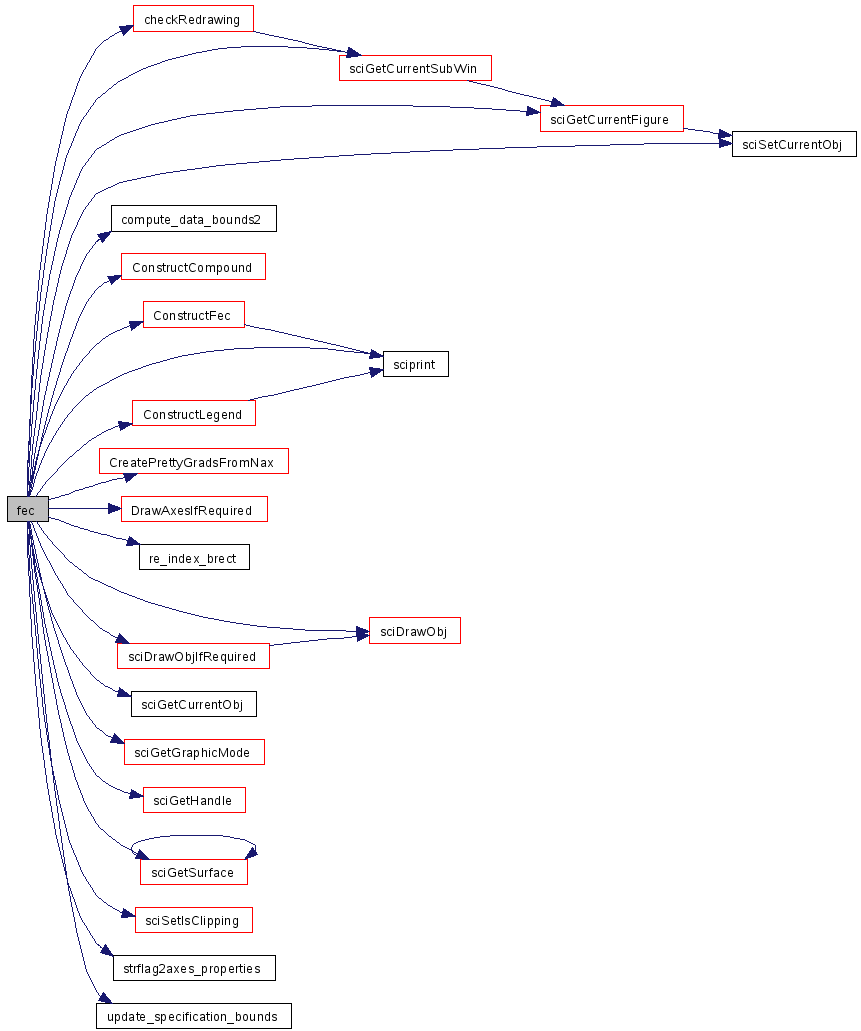
Here is the call graph for this function:

Here is the caller graph for this function:

| int C2F() fec | ( | double * | x, | |
| double * | y, | |||
| double * | triangles, | |||
| double * | func, | |||
| integer * | Nnode, | |||
| integer * | Ntr, | |||
| char * | strflag, | |||
| char * | legend, | |||
| double * | brect, | |||
| integer * | aaint, | |||
| double * | zminmax, | |||
| integer * | colminmax, | |||
| integer * | colout, | |||
| BOOL | with_mesh, | |||
| BOOL | flagNax, | |||
| integer | lstr1, | |||
| integer | lstr2 | |||
| ) |
Iso contour with grey level or colors for a function defined by finite elements ( f is linear on triangles ) we give two versions of the function :
modified by Bruno Pincon 01/02/2001 for gain in speed and added possibilities to set zmin, zmax by the user and also to set the first and last color of the colormap (Bruno.Pincon@iecn.u-nancy.fr)
Drawing the Legends
construct Compound
Definition at line 75 of file FeC.c.
References checkRedrawing(), compute_data_bounds2(), ConstructCompound(), ConstructFec(), ConstructLegend(), CreatePrettyGradsFromNax(), DrawAxesIfRequired(), FALSE, Max, Min, n1, NULL, pSUBWIN_FEATURE, re_index_brect(), sciDrawObj(), sciDrawObjIfRequired(), sciGetCurrentFigure(), sciGetCurrentObj(), sciGetCurrentSubWin(), sciGetGraphicMode(), sciGetHandle(), sciGetSurface(), sciprint(), sciSetCurrentObj(), sciSetIsClipping(), strflag2axes_properties(), TRUE, update_specification_bounds(), and x.
Referenced by Objfec().
00078 {
00079   integer n1=1;
00080
00081   /* Fec code */
00082
00083
00084   long hdltab[2];
00085   int cmpt=0,styl[2];
00086   sciPointObj *pptabofpointobj;
00087   sciPointObj  *psubwin;
00088   double drect[6];
00089
00090   BOOL bounds_changed = FALSE;
00091   BOOL axes_properties_changed = FALSE;
00092
00093
00094   psubwin = sciGetCurrentSubWin();
00095
00096   checkRedrawing() ;
00097
00098
00099
00100   /* Force psubwin->is3d to FALSE: we are in 2D mode */
00101   if (sciGetSurface(psubwin) == (sciPointObj *) NULL)
00102   {
00103     pSUBWIN_FEATURE (psubwin)->is3d = FALSE;
00104     pSUBWIN_FEATURE (psubwin)->project[2]= 0;
00105   }
00106   else
00107   {
00108     pSUBWIN_FEATURE (psubwin)->theta_kp=pSUBWIN_FEATURE (psubwin)->theta;
00109     pSUBWIN_FEATURE (psubwin)->alpha_kp=pSUBWIN_FEATURE (psubwin)->alpha;
00110   }
00111
00112   pSUBWIN_FEATURE (psubwin)->alpha  = 0.0;
00113   pSUBWIN_FEATURE (psubwin)->theta  = 270.0;
00114
00115   /* Force psubwin->axes.aaint to those given by argument aaint*/
00116   /*****TO CHANGE F.Leray 10.09.04     for (i=0;i<4;i++) pSUBWIN_FEATURE(psubwin)->axes.aaint[i] = aaint[i]; */
00117
00118   /* Force "cligrf" clipping */
00119   sciSetIsClipping (psubwin,0);
00120
00121   /* Force  axes_visible property */
00122   /* pSUBWIN_FEATURE (psubwin)->isaxes  = TRUE;*/
00123
00124   if (sciGetGraphicMode (psubwin)->autoscaling) {
00125     /* compute and merge new specified bounds with psubwin->Srect */
00126     switch (strflag[1])  {
00127       case '0':
00128         /* do not change psubwin->Srect */
00129         break;
00130       case '1' : case '3' : case '5' : case '7':
00131         /* Force psubwin->Srect=brect */
00132         re_index_brect(brect, drect);
00133         break;
00134       case '2' : case '4' : case '6' : case '8':case '9':
00135         /* Force psubwin->Srect to the x and y bounds */
00136         /* compute_data_bounds(0,'g',x,y,n1,*Nnode,drect); */
00137         compute_data_bounds2(0,'g',pSUBWIN_FEATURE(psubwin)->logflags,x,y,n1,*Nnode,drect);
00138         break;
00139     }
00140     if (!pSUBWIN_FEATURE(psubwin)->FirstPlot &&
00141       (strflag[1] == '7' || strflag[1] == '8' || strflag[1] == '9')) { /* merge psubwin->Srect and drect */
00142         drect[0] = Min(pSUBWIN_FEATURE(psubwin)->SRect[0],drect[0]); /*xmin*/
00143         drect[2] = Min(pSUBWIN_FEATURE(psubwin)->SRect[2],drect[2]); /*ymin*/
00144         drect[1] = Max(pSUBWIN_FEATURE(psubwin)->SRect[1],drect[1]); /*xmax*/
00145         drect[3] = Max(pSUBWIN_FEATURE(psubwin)->SRect[3],drect[3]); /*ymax*/
00146     }
00147     if (strflag[1] != '0')
00148       bounds_changed = update_specification_bounds(psubwin, drect,2);
00149   }
00150
00151   if(pSUBWIN_FEATURE (psubwin)->FirstPlot == TRUE) bounds_changed = TRUE;
00152
00153   axes_properties_changed = strflag2axes_properties(psubwin, strflag);
00154
00155   pSUBWIN_FEATURE (psubwin)->FirstPlot = FALSE; /* just after strflag2axes_properties */
00156
00157   /* F.Leray 07.10.04 : trigger algo to init. manual graduation u_xgrads and
00158   u_ygrads if nax (in matdes.c which is == aaint HERE) was specified */
00159
00160   pSUBWIN_FEATURE(psubwin)->flagNax = flagNax; /* store new value for flagNax */
00161
00162   if(pSUBWIN_FEATURE(psubwin)->flagNax == TRUE){
00163     if(pSUBWIN_FEATURE(psubwin)->logflags[0] == 'n' && pSUBWIN_FEATURE(psubwin)->logflags[1] == 'n')
00164     {
00165       pSUBWIN_FEATURE(psubwin)->axes.auto_ticks[0] = FALSE; /* x and y graduations are imposed by Nax */
00166       pSUBWIN_FEATURE(psubwin)->axes.auto_ticks[1] = FALSE;
00167
00168       CreatePrettyGradsFromNax(psubwin,aaint);
00169     }
00170     else{
00171       sciprint("Warning : Nax does not work with logarithmic scaling\n");}
00172   }
00173
00174   if(bounds_changed == TRUE || axes_properties_changed == TRUE)
00175   {
00176     sciDrawObj(sciGetCurrentFigure());
00177   }
00178   /*      EraseAndOrRedraw(psubwin);  /\*  inhibit EraseAndOrRedraw for now F.Leray 20.12.04 *\/ */
00179
00180   sciSetCurrentObj (ConstructFec
00181     ((sciPointObj *)
00182     sciGetCurrentSubWin(),
00183     x,y,triangles,func,*Nnode,*Ntr,zminmax,colminmax,colout, with_mesh));
00184
00185   /* retrieve the created object : fec */
00186   pptabofpointobj = sciGetCurrentObj();
00187   hdltab[cmpt]=sciGetHandle(pptabofpointobj);
00188   cmpt++;
00189   sciDrawObjIfRequired(sciGetCurrentObj ());
00190   DrawAxesIfRequired(sciGetCurrentObj ()); /* force axes redrawing */
00192   if ((int)strlen(strflag) >=1  && strflag[0] == '1')
00193   {
00194     n1=1; styl[0]=1;styl[1]=0;
00195     sciSetCurrentObj (ConstructLegend
00196       (sciGetCurrentSubWin(),
00197       legend, strlen(legend), n1, styl, &pptabofpointobj));
00198
00199     /*       sciSetMarkSizeUnit(sciGetCurrentObj(),2); /\* force switch to tabulated mode : old syntax *\/ */
00200
00201     /* removed JB Silvy 12/05 */
00202     /* fec object has no mark properties */
00203     /*sciSetIsMark(pptabofpointobj, TRUE);*/
00204     /*sciSetMarkStyle (pptabofpointobj, *styl);*/
00205
00206
00207     sciDrawObjIfRequired(sciGetCurrentObj ());
00208     DrawAxesIfRequired(sciGetCurrentObj ()); /* force axes redrawing */
00209     hdltab[cmpt]=sciGetHandle(sciGetCurrentObj ());
00210     cmpt++;
00211   }
00212   sciSetCurrentObj(ConstructCompound (hdltab, cmpt));
00215   return(0);
00216
00217 }
Here is the call graph for this function:
Here is the caller graph for this function:

| static void FindIntersection | ( | double * | sx, | |
| double * | sy, | |||
| double * | fxy, | |||
| double | z, | |||
| int | inda, | |||
| int | indb, | |||
| integer * | xint, | |||
| integer * | yint | |||
| ) | [static] |
Definition at line 608 of file FeC.c.
Referenced by PaintTriangle().
00610 {
00611   double alpha;
00612   alpha = (z - fxy[inda])/(fxy[indb] - fxy[inda]);
00613   *xint = inint((1 - alpha)*sx[inda] + alpha*sx[indb]);
00614   *yint = inint((1 - alpha)*sy[inda] + alpha*sy[indb]);
00615 }
Here is the caller graph for this function:

| void get_frame_in_pixel | ( | integer | WIRect[] | ) |
Definition at line 596 of file Plo2dEch.c.
Referenced by newfec().
00597 {
00598   /* ajout bruno */
00599   WIRect[0] = Cscale.WIRect1[0];
00600   WIRect[1] = Cscale.WIRect1[1];
00601   WIRect[2] = Cscale.WIRect1[0] +  Cscale.WIRect1[2];
00602   WIRect[3] = Cscale.WIRect1[1] +  Cscale.WIRect1[3];
00603 }
Here is the caller graph for this function:

| void initsubwin | ( | ) |
Definition at line 431 of file InitObjects.c.
00432 {
00433   sciPointObj  * psubwin  ;
00434   sciSubWindow * ppSubWin ;
00435
00436
00437   Cscale2default();
00438   psubwin = sciGetCurrentSubWin();
00439   ppSubWin = pSUBWIN_FEATURE (psubwin) ;
00440
00441
00442   initSubWinSize( psubwin  ) ;
00443
00444   clearUserData( psubwin ) ;
00445
00446   reinitSubWin( psubwin ) ;
00447
00448   (ppSubWin->axes).axes_visible[0] = FALSE;
00449   (ppSubWin->axes).axes_visible[1] = FALSE;
00450   (ppSubWin->axes).axes_visible[2] = FALSE;
00451
00452   (ppSubWin->axes).reverse[0] = FALSE;
00453   (ppSubWin->axes).reverse[1] = FALSE;
00454   (ppSubWin->axes).reverse[2] = FALSE;
00455
00456   ppSubWin->axes.rect = BT_OFF;
00457   ppSubWin->axes.ticscolor = -1;
00458   ppSubWin->axes.subint[0] =  1;
00459   ppSubWin->axes.subint[1] =  1;
00460   ppSubWin->axes.subint[2] =  1;
00461   ppSubWin->axes.limits[0]  = 0;
00462
00463 }
| void newfec | ( | integer * | xm, | |
| integer * | ym, | |||
| double * | triangles, | |||
| double * | func, | |||
| integer * | Nnode, | |||
| integer * | Ntr, | |||
| double * | zminmax, | |||
| integer * | colminmax, | |||
| integer * | colout, | |||
| BOOL | with_mesh | |||
| ) |
Definition at line 219 of file FeC.c.
References C2F, dr(), frame_clip_off(), frame_clip_on(), FREE, get_frame_in_pixel(), i, j, L, MALLOC, Max, Maxi(), Min, Mini(), NULL, PaintTriangle(), PD0, PermutOfSort(), PI0, sciprint(), sx, and sy.
Referenced by drawFecEntity().
00221 {
00222   /*   code modified by Bruno 01/02/2001
00223    *   a new modif (Bruno 04 nov 2004 from an idea of Jpc): adding the
00224    *   colout to choose the colors when the zminmax levels are
00225    *   crossed (and the color 0 correspond to no painting at all these zones)
00226    *   a new modif (Bruno 08 nov 2004 from an idea of Jpc): adding with_mesh to see or not the mesh
00227    */
00228
00229   integer nz,i,j,k;
00230   integer verbose=0,whiteid,narg;
00231
00232   double *zlevel, dz, zmin, zmax, fxy[3], sx[3], sy[3];
00233   int *zone, *fill, kp, perm[3], zxy[3], color_min, color_max, col_under_min, col_upper_max;
00234   integer ii[3];
00235
00236   /* pour le pre-cliping */
00237   integer WIRect[4];
00238   double Fxmin, Fxmax, Fymin, Fymax;
00239
00240   frame_clip_on();
00241
00242   /*   choice between zmin and zmax given by the user or computed
00243    *   with the min and max z values. In matdes.c I have put
00244    *   zminmax[0]= zminmax[1]=0 if the user don't give this argument
00245    */
00246   if ( zminmax[0]==zminmax[1] )
00247     {
00248       zmin=(double) Mini(func,*Nnode); zmax=(double) Maxi(func,*Nnode);
00249     }
00250   else
00251     {
00252       zmin = Min( zminmax[0] , zminmax[1] ); zmax = Max( zminmax[0] , zminmax[1] );
00253     };
00254
00255
00256   /*   choice for the colormap (in case of a user 's choice
00257    *   verify the parameter). For the automatic choice I have
00258    *   put colminmax[0]=colominmax[1]=1 in matdes.c
00259    */
00260   C2F(dr)("xget","lastpattern",&verbose,&whiteid,&narg,
00261           PI0,PI0,PI0,PD0,PD0,PD0,PD0,0L,0L);
00262   nz=whiteid;
00263   if ( colminmax[0] == 0  &&  colminmax[1] == 0 )  /* automatic choice (see matdes.c) */
00264     {
00265       color_min = 1;
00266       color_max = nz;
00267     }
00268   else if ( colminmax[0] < 1 || colminmax[1] > nz || colminmax[0] > colminmax[1] )
00269     {
00270       sciprint("\n\r fec : colminmax badly choosen ! ");
00271       return;
00272     }
00273   else
00274     {
00275       color_min = colminmax[0];
00276       color_max = colminmax[1];
00277     };
00278
00279   /*   choice for the "out" colors (for the automatic choice I have
00280    *   put colout[0]= colout[1]=-1 in matdes.c)
00281    */
00282   if ( colout[0] < -1 || colout[0] > nz || colout[1] < -1 || colout[1] > nz )
00283     {
00284       sciprint("\n\r fec : colout badly choosen ! "); return;
00285     }
00286
00287   if ( colout[0] == -1 )  /* automatic choice */
00288     col_under_min = color_min;
00289   else
00290     col_under_min =  colout[0];
00291
00292   if ( colout[1] == -1 )  /* automatic choice */
00293     col_upper_max = color_max;
00294   else
00295     col_upper_max =  colout[1];
00296
00297   /*
00298    *  1/ the purpose of the first part is to to compute the "zone" of each point :
00299    *
00300    *    - the array zlevel are the boundaries between the differents zones :
00301    *
00302    *        zlevel[0] = zmin, zlevel[nz] = zmax
00303    *     and zlevel[i] = zmin + i*(zmax-zmin)/nz
00304    *
00305    *     - if  zlevel[j-1] <= func[i] < zlevel[j]  then zone[i] = j
00306    *       if func[i] > zmax  then zone[i] = nz+1
00307    *       if func[i] < zmin  then zone[i] = 0
00308    *     - the zone j is filled with color fill[j] with
00309    *       fill[j] = -(j-1 + color_min) if 1 <= j <= nz
00310    *       fill[0] = color attributed for fill[1]     ---> this behavior may be changed ...
00311    *       fill[nz+1] = color attributed for fill[nz] --/
00312    */
00313
00314   /* allocations for some arrays ... */
00315   nz = color_max - color_min + 1;
00316   zone   = MALLOC( *Nnode * sizeof(int)    ) ;
00317   zlevel = MALLOC( (nz+1) * sizeof(double) ) ;
00318   fill   = MALLOC( (nz+2) * sizeof(int)    ) ;
00319   if ( (zone == NULL) || (zlevel == NULL) || (fill  == NULL))
00320   {
00321     sciprint("fec: malloc No more Place\n");
00322     return;
00323   }
00324
00325   /* compute the fill array (fill = - num color) */
00326   fill[0] = -col_under_min;
00327   fill[1] = -color_min;
00328   for ( i = 2 ; i <= nz ; i++ ) fill[i] = fill[i-1] - 1;
00329   fill[nz+1] = -col_upper_max;
00330
00331   /* compute the zlevels */
00332   dz = (zmax - zmin)/nz;
00333   for (i = 0 ; i < nz ; i++) zlevel[i] = zmin + i*dz;
00334   zlevel[nz] = zmax;
00335
00336   /* finaly compute the zone of each point */
00337   for ( i = 0 ; i < (*Nnode) ; i++ )
00338     {
00339       if ( func[i] > zmax )
00340         zone[i] = nz+1;
00341       else if ( func[i] < zmin )
00342         zone[i] = 0;
00343       else
00344         zone[i] = (int) (floor( (func[i] - zmin)/dz ) + 1);
00345     };
00346
00347   /*
00348    *  2/ loop of the triangles : each triangle is finally decomposed
00349    *  into its differents zones (polygons) by the function PaintTriangle
00350    */
00351
00352   get_frame_in_pixel(WIRect);
00353   Fxmin = (double) WIRect[0];  Fymin = (double) WIRect[1];
00354   Fxmax = (double) WIRect[2];  Fymax = (double) WIRect[3];
00355
00356   for ( j = 0 ; j < *Ntr ; j++)
00357     {
00358       double xmin, xmax, ymin, ymax;
00359       /* retrieve node numbers and functions values */
00360       for ( k = 0 ; k < 3 ; k++ )
00361         {
00362           ii[k] = (integer) triangles[j+(*Ntr)*(k+1)] - 1;
00363           zxy[k] = zone[ii[k]];
00364         }
00365
00366       /* get the permutation perm so as zxy[perm] is sorted */
00367       PermutOfSort(zxy, perm);
00368
00369       /* apply the permutation to get the triangle 's vertices
00370          in increasing zone (zxy[0] <= zxy[1] <= zxy[2]) */
00371       for ( k = 0 ; k < 3 ; k++ )
00372         {
00373           kp = perm[k];
00374           sx[k]  = xm[ii[kp]];   sy[k]  = ym[ii[kp]];
00375           fxy[k] = func[ii[kp]]; zxy[k] = zone[ii[kp]];
00376         };
00377
00378       /* essai de pre-clipping tous les triangles en dehors de la zone
00379          d'affichage ne seront pas traités */
00380       xmin = xmax = sx[0]; ymin = ymax = sy[0];
00381       if ( sx[1] < sx[2] )
00382         {
00383           xmin = Min(xmin,sx[1]); xmax = Max(xmax,sx[2]);
00384         }
00385       else
00386         {
00387           xmin = Min(xmin,sx[2]); xmax = Max(xmax,sx[1]);
00388         }
00389       if ( sy[1] < sy[2] )
00390         {
00391           ymin = Min(ymin,sy[1]); ymax = Max(ymax,sy[2]);
00392         }
00393       else
00394         {
00395           ymin = Min(ymin,sy[2]); ymax = Max(ymax,sy[1]);
00396         }
00397
00398       if ( xmax > Fxmin  &&  ymax > Fymin  &&  xmin < Fxmax  &&  ymin < Fymax )
00399       {
00400         /* call the "painting" function */
00401         PaintTriangle(sx, sy, fxy, zxy, zlevel, fill, with_mesh);
00402       }
00403     }
00404
00405   FREE( zone   ) ;
00406   FREE( zlevel ) ;
00407   FREE( fill   ) ;
00408
00409
00410   frame_clip_off();
00411 }
Here is the call graph for this function:

Here is the caller graph for this function:

| static void PaintTriangle | ( | double * | sx, | |
| double * | sy, | |||
| double * | fxy, | |||
| int * | zxy, | |||
| double * | zlevel, | |||
| int * | fill, | |||
| BOOL | with_mesh | |||
| ) | [static] |
Definition at line 441 of file FeC.c.
References C2F, dr(), FindIntersection(), inint, L, ncont, nr, PD0, and PI0.
Referenced by newfec().
00443 {
00444   /*
00445      arguments :
00446      ---------
00447      sx, sy : vertices coordinates of a triangle (Pi=(sx[i],sy[i]) i=0,1,2)
00448      fxy    : fxy[i], (i=0,1,2) value of an affine function on the vertex Pi
00449      zxy    : zone of Pi : zxy[i]=j if  zlevel[j-1] <= fxy[i] < zlevel[j]
00450      zlevel : a (0..nz) vector given the boundaries for color filling
00451      fill   : fill[j] is the color pattern associated with zone[j]
00452
00453      purpose : this function decompose the triangle into its different
00454      -------   zones (which gives polygones) and send them to the
00455      graphic driver. This is something like the shade function
00456      (see Plo3d.c) but a little different as in shade
00457      a color is directly associated with each vertex.
00458   */
00459
00460   int nb0, edge, izone, color;
00461   integer ncont,nr, zero=0, resx[5],resy[5];
00462   integer xEdge2, yEdge2, xEdge, yEdge;
00463
00464   if ( zxy[0] == zxy[2] )   /*  case of only one color for the triangle : */
00465     {
00466       resx[0]=inint(sx[0]); resx[1]=inint(sx[1]);  resx[2]=inint(sx[2]);
00467       resy[0]=inint(sy[0]); resy[1]=inint(sy[1]);  resy[2]=inint(sy[2]);
00468       color = fill[zxy[0]]; nr = 3;
00469       if ( color != 0 )
00470       {
00471         C2F(dr)("xliness","str",resx,resy,&color,(ncont=1,&ncont),&nr,
00472                 PI0,PD0,PD0,PD0,PD0,0L,0L);
00473       }
00474       if ( with_mesh )
00475       {
00476         C2F(dr)("xliness","str",resx,resy,&zero,(ncont=1,&ncont),&nr,
00477                 PI0,PD0,PD0,PD0,PD0,0L,0L);
00478       }
00479       return;
00480     }
00481
00482   /*
00483      at least 2 colors for painting the triangle : it is divided in elementary
00484      polygons. The number of polygons is npolys = zxy[2]-zxy[0]+1.
00485
00486      P2           as zxy[0] <= zxy[1] <  zxy[2] or
00487      Notations/Hints :       /\              zxy[0] <  zxy[1] <= zxy[2]
00488      edge2  /  \ edge1    from a previus sort. All the polygons
00489      /    \         have 2 points on edge2, the others points
00490      /______\        are on edge0 and/or edge1. I name the 2 ends
00491      P0        P1      points on each poly PEdge2 and Pedge, they are
00492      edge0         the 2 first points of the next poly. I start
00493      from P0 to form the first poly (a triangle or
00494      a 4 sides depending if zxy[0]=zxy[1]), then the 2, 3, .., npolys - 1 (if they exist)
00495      and finally the last one which comprise the P2 vertex.  In some special cases
00496      we can have a degenerate poly but it doesn't matter !
00497   */
00498
00499   nb0 = zxy[1]-zxy[0]; /* number of intersection points on edge 0 */
00500
00501   /*----------------------------+
00502     |   compute the first poly    |
00503     +----------------------------*/
00504
00505   resx[0]=inint(sx[0]); resy[0]=inint(sy[0]); nr = 1; edge = 0;
00506   if ( nb0 == 0 )  /* the intersection point is on Edge1 but */
00507   {              /* the next point of the poly is P1 */
00508     resx[1] = inint(sx[1]);
00509     resy[1] = inint(sy[1]);
00510     nr++;
00511     edge = 1;    /* the next intersection points will be on edge1 */
00512   }
00513   else
00514   {
00515     nb0--;
00516   }
00517   /* the intersection point on edge (0 or 1) : */
00518   FindIntersection(sx, sy, fxy, zlevel[zxy[0]], edge, edge+1, &xEdge, &yEdge);
00519   resx[nr] = xEdge;
00520   resy[nr] = yEdge;
00521   nr++;
00522   /* the last point of the first poly (edge 2) : */
00523   FindIntersection(sx, sy, fxy, zlevel[zxy[0]], 0, 2, &xEdge2, &yEdge2);
00524   resx[nr] = xEdge2;
00525   resy[nr] = yEdge2;
00526   nr++;
00527   color = fill[zxy[0]];
00528   if ( color != 0 )
00529   {
00530     C2F(dr)("xliness","str",resx,resy,&color,(ncont=1,&ncont),&nr,
00531             PI0,PD0,PD0,PD0,PD0,0L,0L);
00532   }
00533
00534   /*------------------------------------+
00535     | compute the intermediary polygon(s) |
00536     +------------------------------------*/
00537
00538   for ( izone = zxy[0]+1 ; izone < zxy[2] ; izone++ )
00539   {
00540     resx[0] = xEdge2;
00541     resy[0] = yEdge2;          /* the 2 first points are known */
00542     resx[1] = xEdge ;
00543     resy[1] = yEdge ;
00544     nr      = 2     ;
00545     if ( edge == 0 )   /* the intersection point is perhaps on edge 0 */
00546     {
00547       if (nb0 == 0 )  /* no it is on edge 1 but the next point of the poly is P1 */
00548       {
00549         resx[2] = inint(sx[1]);
00550         resy[2] = inint(sy[1]);
00551         nr++;
00552         edge = 1;          /* the next intersection points will be on edge1 */
00553       }
00554       else
00555       {
00556         nb0--;
00557       }
00558     }
00559     /* the intersection point on edge (0 or 1) : */
00560     FindIntersection(sx, sy, fxy, zlevel[izone], edge, edge+1, &xEdge, &yEdge);
00561     resx[nr]=xEdge; resy[nr]=yEdge; nr++;
00562     /* the last point of the first poly (edge 2) : */
00563     FindIntersection(sx, sy, fxy, zlevel[izone], 0, 2, &xEdge2, &yEdge2);
00564     resx[nr]=xEdge2; resy[nr]=yEdge2; nr++;
00565     color = fill[izone];
00566     if ( color != 0 )
00567     {
00568       C2F(dr)("xliness","str",resx,resy,&color,(ncont=1,&ncont),&nr,
00569               PI0,PD0,PD0,PD0,PD0,0L,0L);
00570     }
00571   }
00572
00573   /*-----------------------+
00574     | compute the last poly  |
00575     +-----------------------*/
00576   resx[0] = xEdge2;
00577   resy[0] = yEdge2;         /* the 2 first points are known */
00578   resx[1] = xEdge;
00579   resy[1] = yEdge;
00580   nr = 2;
00581   if ( edge == 0 )  /* the next point of the poly is P1 */
00582   {
00583     resx[2]=inint(sx[1]);
00584     resy[2]=inint(sy[1]);
00585     nr++;
00586   } ;
00587   /* the last point is P2 */
00588   resx[nr] = inint(sx[2]);
00589   resy[nr] = inint(sy[2]);
00590   nr++;
00591   color = fill[zxy[2]];
00592   if ( color != 0 )
00593   {
00594     C2F(dr)("xliness","str",resx,resy,&color,(ncont=1,&ncont),&nr,
00595             PI0,PD0,PD0,PD0,PD0,0L,0L);
00596   }
00597
00598   if ( with_mesh )
00599     {
00600       resx[0]=inint(sx[0]); resx[1]=inint(sx[1]);  resx[2]=inint(sx[2]);
00601       resy[0]=inint(sy[0]); resy[1]=inint(sy[1]);  resy[2]=inint(sy[2]);
00602       nr = 3;
00603       C2F(dr)("xliness","str",resx,resy,&zero,(ncont=1,&ncont),&nr,
00604               PI0,PD0,PD0,PD0,PD0,0L,0L);
00605     }
00606 }
Here is the call graph for this function:

Here is the caller graph for this function:

Definition at line 418 of file FeC.c.
Referenced by newfec().
00419 {
00420   /*
00421    * get the permutation perm[3] which sort the array tab[3] in increasing order
00422    */
00423   perm[0]=0; perm[1] = 1; perm[2] = 2;
00424   if ( tab[1] < tab[0] )
00425     {
00426       perm[1]=0 ; perm[0] = 1;
00427     };
00428   if ( tab[2] < tab[perm[1]] )
00429     {   /* sort not finish */
00430       if ( tab[2] < tab[perm[0]] )
00431         {
00432           perm[2] = perm[1]; perm[1] = perm[0]; perm[0] = 2;
00433         }
00434       else
00435         {
00436           perm[2] = perm[1] ; perm[1] = 2;
00437         };
00438     };
00439 }
Here is the caller graph for this function:

| int re_index_brect | ( | double * | brect, | |
| double * | drect | |||
| ) |
| BOOL strflag2axes_properties | ( | sciPointObj * | psubwin, | |
| char * | strflag | |||
| ) |
| BOOL update_specification_bounds | ( | sciPointObj * | psubwin, | |
| double * | rect, | |||
| int | flag | |||
| ) |
 1.5.1
1.5.1