
#include "ObjectStructure.h"Include dependency graph for PloEch.h:
This graph shows which files directly or indirectly include this file:

Go to the source code of this file.
Data Structures | |
| struct | wcscalelist |
| struct | scalelist |
Defines | |
| #define | Min(x, y) (((x)<(y))?(x):(y)) |
| #define | XDouble2Pixel(x) ((Cscale.logflag[0] == 'n') ? ( XScale(x)) : ( XLogScale(x))) |
| #define | YDouble2Pixel(y) ((Cscale.logflag[1] == 'n') ? ( YScale(y)) : ( YLogScale(y))) |
| #define | WScale(w) inint (Cscale.Wscx1 * (w)) |
| #define | WLogScale(x, w) inint (Cscale.Wscx1 * (log10 (((x) + (w)) / (x)))) |
| #define | HScale(h) inint (Cscale.Wscy1 * (h)) |
| #define | HLogScale(y, h) inint (Cscale.Wscy1 * (log10 ( ((y) + (h)) / (y) ) )) |
| #define | WDouble2Pixel(x, w) ((Cscale.logflag[0] == 'n') ? ( WScale(w)) : ( WLogScale(x,w))) |
| #define | HDouble2Pixel(y, h) ((Cscale.logflag[1] == 'n') ? ( HScale(h)) : ( HLogScale(y,h))) |
| #define | XPi2LogR(x) exp10( XPi2R(x)) |
| #define | YPi2LogR(y) exp10( YPi2R(y)) |
| #define | XPixel2Double(x) (( Cscale.logflag[0] == 'l') ? XPi2LogR(x) : XPi2R(x)) |
| #define | YPixel2Double(y) (( Cscale.logflag[1] == 'l') ? YPi2LogR(y) : YPi2R(y)) |
| #define | XDPi2LogR(x) exp10( XDPi2R(x)) |
| #define | YDPi2LogR(y) exp10( YDPi2R(y)) |
| #define | XDPixel2Double(x) (( Cscale.logflag[0] == 'l') ? XDPi2LogR(x) : XDPi2R(x)) |
| #define | YDPixel2Double(y) (( Cscale.logflag[1] == 'l') ? YDPi2LogR(y) : YDPi2R(y)) |
| #define | TRX(x1, y1, z1) ( Cscale.m[0][0]*(x1) +Cscale.m[0][1]*(y1) +Cscale.m[0][2]*(z1)) |
| #define | TRY(x1, y1, z1) ( Cscale.m[1][0]*(x1) +Cscale.m[1][1]*(y1) +Cscale.m[1][2]*(z1)) |
| #define | TRZ(x1, y1, z1) ( Cscale.m[2][0]*(x1) +Cscale.m[2][1]*(y1) +Cscale.m[2][2]*(z1)) |
| #define | GEOX(x1, y1, z1) XScale(TRX(x1,y1,z1)) |
| #define | GEOY(x1, y1, z1) YScale(TRY(x1,y1,z1)) |
| #define | TX3D(x1, y1, z1) Cscale.Wscx1*(TRX(x1,y1,z1)-Cscale.frect[0]) +Cscale.Wxofset1 ; |
| #define | TY3D(x1, y1, z1) Cscale.Wscy1*(-TRY(x1,y1,z1)+Cscale.frect[3])+Cscale.Wyofset1 ; |
Typedefs | |
| typedef wcscalelist | WCScaleList |
| typedef scalelist | ScaleList |
Functions | |
| void | ShowScales (void) |
| int C2F() | Nsetscale2d (double WRect[4], double ARect[4], double FRect[4], char *logscale, integer l1) |
| int | getscale2d (double WRect[4], double FRect[4], char *logscale, double ARect[4]) |
| void | set_scale (char flag[6], double subwin[4], double frame_values[4], integer aaint[4], char logflag[3], double axis_values[4]) |
| int | zoom (void) |
| int | zoom_box (double *bbox, int *x_pixel, int *y_pixel) |
| void | unzoom (void) |
| void | unzoom_one_axes (sciPointObj *psousfen) |
| void | scizoom (double bbox[4], sciPointObj *pobj) |
| int | XScale (double x) |
| int | XLogScale (double x) |
| int | YScale (double y) |
| int | YLogScale (double y) |
| double | XPi2R (int x) |
| double | YPi2R (int y) |
| double | XDPi2R (double x) |
| double | YDPi2R (double y) |
| void | getPixelCoordinates (sciPointObj *pSubWin, double coord3d[3], int pixCoord[2]) |
| int | PixelWidth2d (sciPointObj *parentSubWin, double posX, double width) |
| int | PixelHeight2d (sciPointObj *parentSubWin, double posY, double height) |
| void | rectangleDouble2Pixel (sciPointObj *parentSubWin, double ulPoint[3], double userSize[2], int edgesX[4], int edgesY[4]) |
| void | Plo2d2RealToPixel (integer *n1, integer *n2, double *x, double *y, integer *xm, integer *ym, char *xf) |
| void | Plo2d3RealToPixel (integer *n1, integer *n2, double *x, double *y, integer *xm, integer *ym, char *xf) |
| void | Plo2d4RealToPixel (integer *n1, integer *n2, double *x, double *y, integer *xm, integer *ym, char *xf) |
| int C2F() | echelle2d (double x[], double y[], integer x1[], integer yy1[], integer *n1, integer *n2, char dir[], integer lstr) |
| void C2F() | echelle2dl (double x[], double y[], integer x1[], integer yy1[], integer *n1, integer *n2, char *dir) |
| void C2F() | rect2d (double x[], integer x1[], integer *n, char *dir) |
| void C2F() | ellipse2d (double x[], integer x1[], integer *n, char *dir) |
| void C2F() | axis2d (double *alpha, double *initpoint, double *size, integer *initpoint1, double *size1) |
| int | get_window_scale (integer i, double *subwin) |
| void | del_window_scale (integer i) |
| void | Cscale2default (void) |
| void | set_window_scale_with_default (int i) |
Variables | |
| WCScaleList | Cscale |
Definition at line 101 of file PloEch.h.
Referenced by getStringBox(), rectangleDouble2Pixel(), and sciClip().
Definition at line 136 of file PloEch.h.
Referenced by DrawMerge3d(), fac3dn(), sciGetAxisBox(), and SetEch3d1().
| #define TX3D | ( | x1, | |||
| y1, | |||||
| z1 | ) | Cscale.Wscx1*(TRX(x1,y1,z1)-Cscale.frect[0]) +Cscale.Wxofset1 ; |
| #define TY3D | ( | x1, | |||
| y1, | |||||
| z1 | ) | Cscale.Wscy1*(-TRY(x1,y1,z1)+Cscale.frect[3])+Cscale.Wyofset1 ; |
Definition at line 100 of file PloEch.h.
Referenced by getStringBox(), rectangleDouble2Pixel(), and sciClip().
Definition at line 89 of file PloEch.h.
Referenced by boundingbox_1(), cleararea_1(), displaystring_1(), drawarc_1(), drawArcEntity(), drawTextEntity(), fillarc_1(), fillrectangle_1(), getPixelClipping(), getPixelCoordinates(), getStringBox(), getTextBoundingBox(), Objstring(), rectangleDouble2Pixel(), sciClip(), sciIsClicked(), xstringb_1(), and zoom_box().
Definition at line 118 of file PloEch.h.
Referenced by computeLabelAutoPos(), getChampDataBounds(), and zoom_box().
Definition at line 90 of file PloEch.h.
Referenced by boundingbox_1(), cleararea_1(), displaystring_1(), drawarc_1(), drawArcEntity(), drawTextEntity(), fillarc_1(), fillrectangle_1(), getPixelClipping(), getPixelCoordinates(), getStringBox(), getTextBoundingBox(), Objstring(), rectangleDouble2Pixel(), sciClip(), sciIsClicked(), xstringb_1(), and zoom_box().
Definition at line 119 of file PloEch.h.
Referenced by computeLabelAutoPos(), getChampDataBounds(), and zoom_box().
| typedef struct wcscalelist WCScaleList |
| void C2F() axis2d | ( | double * | alpha, | |
| double * | initpoint, | |||
| double * | size, | |||
| integer * | initpoint1, | |||
| double * | size1 | |||
| ) |
meme chose mais pour axis
Definition at line 1014 of file Plo2dEch.c.
References Abs, Cscale, M_PI, wcscalelist::Wscx1, wcscalelist::Wscy1, XScale(), and YScale().
Referenced by drawaxis_1().
01019 {
01020   double sina ,cosa;
01021   double xx,yy,scl;
01022   /* pour eviter des problemes numerique quand Cscale.scx1 ou Cscale.scy1 sont
01023    *  tres petits et cosal ou sinal aussi
01024    */
01025   if ( Abs(*alpha) == 90 )
01026     {
01027       scl=Cscale.Wscy1;
01028     }
01029   else
01030     {
01031       if (Abs(*alpha) == 0)
01032         {
01033           scl=Cscale.Wscx1;
01034         }
01035       else
01036         {
01037           sina= sin(*alpha * M_PI/180.0);
01038           cosa= cos(*alpha * M_PI/180.0);
01039           xx= cosa*Cscale.Wscx1; xx *= xx;
01040           yy= sina*Cscale.Wscy1; yy *= yy;
01041           scl= sqrt(xx+yy);
01042         }
01043     }
01044   size1[0] = size[0]*scl;
01045   size1[1]=  size[1]*scl;
01046   size1[2]=  size[2];
01047   initpoint1[0]= XScale(initpoint[0]);
01048   initpoint1[1]= YScale(initpoint[1]);
01049 }
Here is the call graph for this function:

Here is the caller graph for this function:

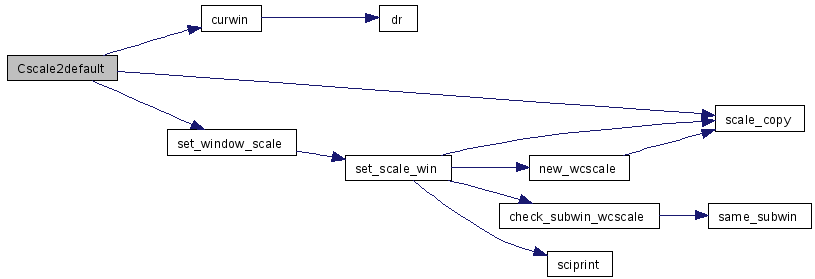
| void Cscale2default | ( | void | ) |
Definition at line 105 of file Plo2dEch.c.
References Cscale, curwin(), Defscale, scale_copy(), and set_window_scale().
Referenced by CleanPlots(), InitMissileXgc(), and initsubwin().
00106 {
00107   scale_copy(&Cscale,&Defscale);  set_window_scale(curwin(),&Cscale);
00108 }
Here is the call graph for this function:
Here is the caller graph for this function:

| void del_window_scale | ( | integer | i | ) |
Definition at line 281 of file Plo2dEch.c.
References DeleteWCScale(), FREE, scalelist::next, NULL, scalelist::scales, The_List, and scalelist::Win.
Referenced by CleanPlots(), and DeleteSGWin().
00282 {
00283   ScaleList *loc, *loc1;
00284   /* check head of The_List */
00285   if ( The_List == NULL) return ;
00286   if ( The_List->Win == i)
00287     {
00288       loc1= The_List ;
00289       The_List = The_List->next;
00290       DeleteWCScale(loc1->scales);
00291       FREE(loc1);
00292       return;
00293     }
00294   loc1= The_List;
00295   loc = The_List->next;
00296   while ( loc != NULL)
00297     {
00298       if ( loc->Win == i )
00299         {
00300           loc1->next = loc->next;
00301           DeleteWCScale(loc->scales);
00302           FREE(loc);
00303           return ;
00304         }
00305       else
00306         {
00307           loc1 = loc;
00308           loc  = loc->next;
00309         }
00310     }
00311 }
Here is the call graph for this function:

Here is the caller graph for this function:

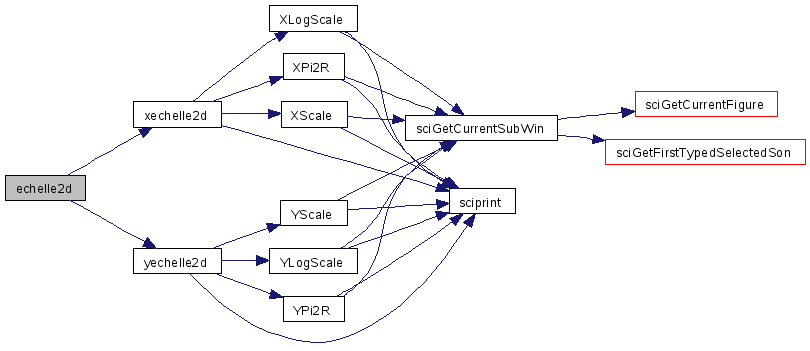
| int C2F() echelle2d | ( | double | x[], | |
| double | y[], | |||
| integer | x1[], | |||
| integer | yy1[], | |||
| integer * | n1, | |||
| integer * | n2, | |||
| char | dir[], | |||
| integer | lstr | |||
| ) |
Definition at line 860 of file Plo2dEch.c.
References C2F, n, xechelle2d(), and yechelle2d().
Referenced by boundingbox_1(), displaynumbers_1(), drawarrows_1(), drawGrayplotEntity(), drawpolyline_1(), drawPolylineEntity(), drawpolylines_1(), drawpolymark_1(), drawsegments_1(), fillpolyline_1(), fillpolylines_1(), I3dRotation(), Objstring(), sci_xchange(), xclick_1(), xclick_2(), xclick_any_1(), xgetmouse2(), xgetmouse_1(), and xset_1().
00869 {
00870   int n=(*n1)*(*n2);
00871   C2F(xechelle2d)(x,x1,&n,dir,lstr);
00872   C2F(yechelle2d)(y,yy1,&n,dir,lstr);
00873   return(0);
00874 }
Here is the call graph for this function:
Here is the caller graph for this function:

| void C2F() echelle2dl | ( | double | x[], | |
| double | y[], | |||
| integer | x1[], | |||
| integer | yy1[], | |||
| integer * | n1, | |||
| integer * | n2, | |||
| char * | dir | |||
| ) |
Definition at line 884 of file Plo2dEch.c.
References Cscale, i, inint, sciprint(), wcscalelist::Wscx1, and wcscalelist::Wscy1.
Referenced by boundingbox_1(), cleararea_1(), computeRealArrowSize(), drawarc_1(), drawarrows_1(), fillarc_1(), fillrectangle_1(), Objstring(), xset_1(), and xstringb_1().
00891 {
00892   integer i;
00893   if (strcmp("f2i",dir)==0)
00894     {
00895       for ( i=0 ; i < (*n1)*(*n2) ; i++)
00896         {
00897           x1[i]=inint( Cscale.Wscx1*( x[i]));
00898           yy1[i]=inint( Cscale.Wscy1*( y[i]));
00899         }
00900     }
00901   else if (strcmp("i2f",dir)==0)
00902     {
00903       for ( i=0 ; i < (*n1)*(*n2) ; i++)
00904         {
00905           x[i]=x1[i]/Cscale.Wscx1;
00906           y[i]=yy1[i]/Cscale.Wscy1;
00907         }
00908     }
00909   else
00910     sciprint(" Wrong dir %s argument in echelle2d\r\n",dir);
00911 }
Here is the call graph for this function:

Here is the caller graph for this function:

meme chose mais pour transformer des ellipses
double to integer (pixel) direction
Definition at line 915 of file Plo2dEch.c.
References Cscale, i, inint, sciprint(), wcscalelist::Wscx1, wcscalelist::Wscy1, XPi2R(), XScale(), YPi2R(), and YScale().
Referenced by drawarcs_1(), and fillarcs_1().
00916 {
00917   integer i;
00918   if (strcmp("f2i",dir)==0)
00919     {
00921       for ( i=0 ; i < (*n) ; i=i+6)
00922         {
00923           x1[i  ]= XScale(x[i]);
00924           x1[i+1]= YScale(x[i+1]);
00925           x1[i+2]= inint( Cscale.Wscx1*( x[i+2]));
00926           x1[i+3]= inint( Cscale.Wscy1*( x[i+3]));
00927           x1[i+4]= inint( x[i+4]);
00928           x1[i+5]= inint( x[i+5]);
00929         }
00930     }
00931   else if (strcmp("i2f",dir)==0)
00932     {
00933       for ( i=0 ; i < (*n) ; i=i+6)
00934         {
00935           x[i]=   XPi2R(x1[i]);
00936           x[i+1]= YPi2R( x1[i+1] );
00937           x[i+2]= x1[i+2]/Cscale.Wscx1;
00938           x[i+3]= x1[i+3]/Cscale.Wscy1;
00939           x[i+4]= x1[i+4];
00940           x[i+5]= x1[i+5];
00941         }
00942     }
00943   else
00944     sciprint(" Wrong dir %s argument in echelle2d\r\n",dir);
00945 }
Here is the call graph for this function:

Here is the caller graph for this function:

Definition at line 123 of file Plo2dEch.c.
References get_scale_win(), L, Max, and The_List.
Referenced by DeleteSGWin(), Nsetscale2d(), and SwitchWindow().
00124 {
00125   return get_scale_win(The_List,Max(0L,i),subwin);
00126 }
Here is the call graph for this function:

Here is the caller graph for this function:

| void getPixelCoordinates | ( | sciPointObj * | pSubWin, | |
| double | coord3d[3], | |||
| int | pixCoord[2] | |||
| ) |
convert the coordinates of a 2d or 3d point to its pixel coordinates.
| pSubWin | SubWindow in which the point is, might be either in 2d or 3d. | |
| coord3d | Coordinates of the point in the axes. If the subwin is in 2d, only the first two coordinates are used. |
Definition at line 1846 of file Plo2dEch.c.
References pSUBWIN_FEATURE, ReverseDataFor3D(), trans3d(), XDouble2Pixel, and YDouble2Pixel.
Referenced by drawTextEntity(), and getTextBoundingBox().
01847 {
01848
01849   if ( pSUBWIN_FEATURE (pSubWin)->is3d )
01850   {
01851     int n = 1 ;
01852
01853     double xvect = coord3d[0] ;
01854     double yvect = coord3d[1] ;
01855     double zvect = coord3d[2] ;
01856
01857     ReverseDataFor3D(pSubWin,&xvect,&yvect,&zvect,n);
01858     trans3d(pSubWin,n,&(pixCoord[0]),&(pixCoord[1]),&xvect,&yvect,&zvect ) ;
01859   }
01860   else
01861   {
01862     pixCoord[0] = XDouble2Pixel( coord3d[0] ) ;
01863     pixCoord[1] = YDouble2Pixel( coord3d[1] ) ;
01864   }
01865 }
Here is the call graph for this function:

Here is the caller graph for this function:

| int getscale2d | ( | double | WRect[4], | |
| double | FRect[4], | |||
| char * | logscale, | |||
| double | ARect[4] | |||
| ) |
Definition at line 571 of file Plo2dEch.c.
References wcscalelist::axis, Cscale, wcscalelist::frect, i, wcscalelist::logflag, and wcscalelist::subwin_rect.
Referenced by sci_xgetech(), SetEch3d1(), and updateScale3d().
00572 {
00573   integer i;
00574   static double ten=10.0;
00575   logscale[0] = Cscale.logflag[0];
00576   logscale[1] = Cscale.logflag[1];
00577   for ( i=0; i < 4 ; i++)
00578     {
00579       WRect[i]=Cscale.subwin_rect[i];
00580       FRect[i]=Cscale.frect[i];
00581       ARect[i]=Cscale.axis[i];
00582     }
00583   if (logscale[0]=='l')
00584     {
00585       FRect[0]=pow(ten,FRect[0]);
00586       FRect[2]=pow(ten,FRect[2]);
00587     }
00588   if (logscale[1]=='l')
00589     {
00590       FRect[1]=pow(ten,FRect[1]);
00591       FRect[3]=pow(ten,FRect[3]);
00592     }
00593   return(0);
00594 }
Here is the caller graph for this function:

| int C2F() Nsetscale2d | ( | double | WRect[4], | |
| double | ARect[4], | |||
| double | FRect[4], | |||
| char * | logscale, | |||
| integer | l1 | |||
| ) |
Definition at line 464 of file Plo2dEch.c.
References wcscalelist::axis, ConstructSubWin(), Cscale, curwin(), wcscalelist::flag, wcscalelist::frect, get_window_scale(), wcscalelist::logflag, NULL, pSUBWIN_FEATURE, same_subwin(), sciGetCurrentFigure(), sciGetCurrentSubWin(), sciIsExistingSubWin(), sciprint(), sciSetCurrentObj(), sciSetSelectedSubWin(), set_scale(), set_window_scale(), and wcscalelist::subwin_rect.
Referenced by sci_xsetech().
00469 {
00470   /* if some arguments are null pointer we set them to
00471    * the corresponding Cscale value.
00472    * this is only important for StoreNEch which do not work with null arguments
00473    */
00474   /* char flag[] = "tfffff";*/ /* flag to specify which arguments have changed*/
00475   /* 14/03/2002*/
00476   sciPointObj *masousfen;
00477
00478   char flag[7];
00479   strcpy(flag,"tfffff");
00480
00482   if ( WRect != NULL)
00483     {
00484       /* Ajout djalel */
00485
00486       if (( masousfen = sciIsExistingSubWin (WRect)) != (sciPointObj *)NULL)
00487         sciSetSelectedSubWin(masousfen);
00488       else if ((masousfen = ConstructSubWin (sciGetCurrentFigure(), 0)) != NULL)
00489       {
00490         /* F.Leray Adding here 26.03.04*/
00491         sciSetCurrentObj(masousfen);
00492         sciSetSelectedSubWin(masousfen);
00493         pSUBWIN_FEATURE (masousfen)->WRect[0]   = WRect[0];
00494         pSUBWIN_FEATURE (masousfen)->WRect[1]   = WRect[1];
00495         pSUBWIN_FEATURE (masousfen)->WRect[2]   = WRect[2];
00496         pSUBWIN_FEATURE (masousfen)->WRect[3]   = WRect[3];
00497       }
00498
00499       /* a subwindow is specified */
00500       flag[1]='t';
00501       if (! same_subwin( WRect, Cscale.subwin_rect))
00502         {
00503           /* we are using a new subwin we keep current state
00504            * in scale list
00505            */
00506           set_window_scale(curwin(),&Cscale);
00507           /* now we try to extract a previous scale with WRect as subwin
00508            * which becomes the new Cscale if it is found
00509            */
00510           if ( get_window_scale(curwin(),WRect) == 0 )
00511             {
00512               /* this is the first time WRect is used : we reset Cscale flag
00513                * Note also that if FRect is also specified in this call
00514                * Cscale.flag will be set to 1 bellow
00515                */
00516               Cscale.flag = 0;
00517             }
00518         }
00519     }
00520   else WRect = Cscale.subwin_rect;
00521   if (FRect != NULL)
00522   {
00523     masousfen=sciGetCurrentSubWin();
00524     pSUBWIN_FEATURE (masousfen)->SRect[0]   = FRect[0];
00525     pSUBWIN_FEATURE (masousfen)->SRect[2]   = FRect[1];
00526     pSUBWIN_FEATURE (masousfen)->SRect[1]   = FRect[2];
00527     pSUBWIN_FEATURE (masousfen)->SRect[3]   = FRect[3];
00528   }
00529   if ( FRect != NULL) flag[2]='t'; else FRect = Cscale.frect;
00530
00531
00532   if (ARect != NULL)
00533   {
00534     masousfen=sciGetCurrentSubWin();
00535     pSUBWIN_FEATURE (masousfen)->ARect[0]   = ARect[0];
00536     pSUBWIN_FEATURE (masousfen)->ARect[1]   = ARect[1];
00537     pSUBWIN_FEATURE (masousfen)->ARect[2]   = ARect[2];
00538     pSUBWIN_FEATURE (masousfen)->ARect[3]   = ARect[3];
00539   }
00540
00541   if ( ARect != NULL) flag[5]='t'; else ARect = Cscale.axis;
00542   if ( logscale != NULL) flag[4] ='t'; else logscale = Cscale.logflag;
00543   if ( flag[4] == 't' && flag[2] == 't' )
00544     {
00545       if (logscale[0]=='l')
00546         {
00547           if ( FRect[0] <= 0 || FRect[2] <= 0 )
00548             {
00549               sciprint("Warning: negative boundaries on x scale with a log scale \n");
00550               FRect[0]=1.e-8;FRect[2]=1.e+8;
00551             }
00552           FRect[0]=log10(FRect[0]);
00553           FRect[2]=log10(FRect[2]);
00554         }
00555       if (logscale[1]=='l')
00556         {
00557           if ( FRect[1] <= 0 || FRect[3] <= 0 )
00558             {
00559               sciprint("Warning: negative boundaries on y scale with a log scale \n");
00560               FRect[1]=1.e-8;FRect[3]=1.e+8;
00561             }
00562           FRect[1]=log10(FRect[1]);
00563           FRect[3]=log10(FRect[3]);
00564         }
00565     }
00566   set_scale(flag,WRect,FRect,NULL,logscale,ARect);
00567   return(0);
00568 }
Here is the call graph for this function:

Here is the caller graph for this function:

| int PixelHeight2d | ( | sciPointObj * | parentSubWin, | |
| double | posY, | |||
| double | height | |||
| ) |
Convert a length from user coord. to pixels in 2D. This function is similar to HDouble2Pixel, but also use the logmode in 3D.
| parentSubWin | Axes in which the length is computed. | |
| posY | Y coordinate of where the distance is transformed (only used in log mode). | |
| height | converted height in user coord. |
Definition at line 1867 of file Plo2dEch.c.
References HLogScale, HScale, and pSUBWIN_FEATURE.
Referenced by drawTextEntity(), and getTextBoundingBox().
01868 {
01869   if ( pSUBWIN_FEATURE( parentSubWin )->logflags[1] == 'l' )
01870   {
01871     return HLogScale( posY, height ) ;
01872   }
01873
01874   return HScale( height ) ;
01875
01876 }
Here is the caller graph for this function:

| int PixelWidth2d | ( | sciPointObj * | parentSubWin, | |
| double | posX, | |||
| double | width | |||
| ) |
Convert a length from user coord. to pixels in 2D. This function is similar to WDouble2Pixel, but also use the logmode in 3D.
| parentSubWin | Axes in which the length is computed. | |
| posX | X coordinate of where the distance is transformed (only used in log mode). | |
| height | converted width in user coord. |
Definition at line 1878 of file Plo2dEch.c.
References pSUBWIN_FEATURE, WLogScale, and WScale.
Referenced by drawTextEntity(), and getTextBoundingBox().
01879 {
01880   if ( pSUBWIN_FEATURE( parentSubWin )->logflags[0] == 'l' )
01881   {
01882     return WLogScale( posX, width ) ;
01883   }
01884
01885   return WScale( width ) ;
01886
01887 }
Here is the caller graph for this function:

| void Plo2d2RealToPixel | ( | integer * | n1, | |
| integer * | n2, | |||
| double * | x, | |||
| double * | y, | |||
| integer * | xm, | |||
| integer * | ym, | |||
| char * | xf | |||
| ) |
Definition at line 1958 of file Plo2dEch.c.
References i, j, XLogScale(), XScale(), YLogScale(), and YScale().
Referenced by drawPolylineEntity().
01959 {
01960   integer i,j;
01962   if ((int)strlen(xf) >= 3 && xf[2]=='l')
01963   {
01964     for ( i=0 ; i < (*n2) ; i++)
01965       for (j=0 ; j< (*n1) ; j++)
01966         ym[2*i+1+2*(*n2)*j]= ym[2*i+2*(*n2)*j]= YLogScale(y[i+(*n2)*j]);
01967   }
01968   else
01969   {
01970     for ( i=0 ; i < (*n2) ; i++)
01971       for (j=0 ; j< (*n1) ; j++)
01972         ym[2*i+1+2*(*n2)*j]= ym[2*i+2*(*n2)*j]= YScale(y[i+(*n2)*j]);
01973   }
01974
01976   switch (xf[0])
01977   {
01978   case 'e' :
01980     if ((int)strlen(xf) >= 2 && xf[1]=='l')
01981       for (j=0 ; j< (*n1) ; j++)
01982       {
01983         for ( i=1 ; i < (*n2) ; i++)
01984         {
01985           xm[2*i+2*(*n2)*j]= XLogScale(i+1.0);
01986           xm[2*i-1+2*(*n2)*j]=xm[2*i+2*(*n2)*j];
01987
01988         }
01989         xm[2*(*n2)*j]= XScale(0);
01990         xm[2*(*n2)-1+ 2*(*n2)*j]= xm[2*(*n2-1)+ 2*(*n2)*j];
01991       }
01992     else
01993       for (j=0 ; j< (*n1) ; j++)
01994       {
01995         for ( i=1 ; i < (*n2) ; i++)
01996         {
01997           xm[2*i+2*(*n2)*j]= XScale((i+1.0));
01998           xm[2*i-1+2*(*n2)*j]=xm[2*i+2*(*n2)*j];
01999
02000         }
02001         xm[2*(*n2)*j]= XScale(1.0);
02002         xm[2*(*n2)-1+ 2*(*n2)*j]=        xm[2*(*n2-1)+ 2*(*n2)*j];
02003       }
02004       break ;
02005   case 'o' :
02006     if ((int)strlen(xf) >= 2 && xf[1]=='l')
02007       for (j=0 ; j< (*n1) ; j++)
02008       {
02009         for ( i=1 ; i < (*n2) ; i++)
02010         {
02011
02012           xm[2*i+2*(*n2)*j]= XLogScale(x[i]);
02013           xm[2*i-1+2*(*n2)*j]=xm[2*i+2*(*n2)*j];
02014         }
02015         xm[2*(*n2)*j]= XLogScale(x[0]);
02016         xm[2*(*n2)-1+ 2*(*n2)*j]= xm[2*(*n2-1)+ 2*(*n2)*j];
02017       }
02018     else
02019       for (j=0 ; j< (*n1) ; j++)
02020       {
02021         for ( i=1 ; i < (*n2) ; i++)
02022         {
02023           xm[2*i+2*(*n2)*j]= XScale(x[i]);
02024           xm[2*i-1+2*(*n2)*j]=xm[2*i+2*(*n2)*j];
02025
02026         }
02027         xm[2*(*n2)*j]= XScale(x[0]);
02028         xm[2*(*n2)-1+ 2*(*n2)*j]= xm[2*(*n2-1)+ 2*(*n2)*j];
02029       }
02030       break;
02031   case 'g' :
02032   default:
02033     if ((int)strlen(xf) >= 2 && xf[1]=='l')
02034       for (j=0 ; j< (*n1) ; j++)
02035       {
02036         for ( i=1 ; i < (*n2) ; i++)
02037         {
02038           xm[2*i+2*(*n2)*j]= XLogScale(x[i+(*n2)*j]);
02039           xm[2*i-1+2*(*n2)*j]=xm[2*i+2*(*n2)*j];
02040
02041         }
02042         xm[2*(*n2)*j]= XLogScale(x[(*n2)*j]);
02043         xm[2*(*n2)-1+ 2*(*n2)*j]= xm[2*(*n2-1)+ 2*(*n2)*j];
02044       }
02045     else
02046       for (j=0 ; j< (*n1) ; j++)
02047       {
02048         for ( i=1 ; i < (*n2) ; i++)
02049         {
02050           xm[2*i+2*(*n2)*j]= XScale(x[i+(*n2)*j]);
02051           xm[2*i-1+2*(*n2)*j]=xm[2*i+2*(*n2)*j];
02052
02053         }
02054         xm[2*(*n2)*j]= XScale(x[(*n2)*j]);
02055         xm[2*(*n2)-1+ 2*(*n2)*j]= xm[2*(*n2-1)+ 2*(*n2)*j];
02056       }
02057       break;
02058   }
02059 }
Here is the call graph for this function:

Here is the caller graph for this function:

| void Plo2d3RealToPixel | ( | integer * | n1, | |
| integer * | n2, | |||
| double * | x, | |||
| double * | y, | |||
| integer * | xm, | |||
| integer * | ym, | |||
| char * | xf | |||
| ) |
Definition at line 2061 of file Plo2dEch.c.
References sciSubWindow::FRect, i, j, sciSubWindow::logflags, pSUBWIN_FEATURE, sciGetCurrentSubWin(), XLogScale(), XScale(), YLogScale(), and YScale().
Referenced by drawPolylineEntity().
02062 {
02063   integer i,j;
02065   double y_zero = 0.;
02066   sciPointObj *  psubwin =  sciGetCurrentSubWin();
02067   sciSubWindow * ppsubwin = pSUBWIN_FEATURE(psubwin);
02068
02069   if(ppsubwin->logflags[1]=='l')
02070   {
02071     y_zero = ppsubwin->FRect[1];
02072   }
02073
02074
02075
02076   if ((int)strlen(xf) >= 3 && xf[2]=='l')
02077   {
02078     for ( i=0 ; i < (*n2) ; i++)
02079       for (j=0 ; j< (*n1) ; j++)
02080       {
02081         ym[2*i+1+2*(*n2)*j]= YScale(y_zero);
02082         ym[2*i+2*(*n2)*j]= YLogScale(y[i+(*n2)*j]);
02083       }
02084   }
02085   else
02086   {
02087     for ( i=0 ; i < (*n2) ; i++)
02088       for (j=0 ; j< (*n1) ; j++)
02089       {
02090         ym[2*i+1+2*(*n2)*j]= YScale(y_zero);
02091         ym[2*i+2*(*n2)*j]= YScale(y[i+(*n2)*j]);
02092       }
02093   }
02094
02096   switch (xf[0])
02097   {
02098   case 'e' :
02100     if ((int)strlen(xf) >= 2 && xf[1]=='l')
02101       for (j=0 ; j< (*n1) ; j++)
02102       {
02103         for ( i=0 ; i < (*n2) ; i++)
02104         {
02105           xm[2*i+2*(*n2)*j]= XLogScale(i+1.0);
02106           xm[2*i+1+2*(*n2)*j]=xm[2*i+2*(*n2)*j];
02107
02108         }
02109       }
02110     else
02111       for (j=0 ; j< (*n1) ; j++)
02112       {
02113         for ( i=0 ; i < (*n2) ; i++)
02114         {
02115           xm[2*i+2*(*n2)*j]= XScale((i+1.0));
02116           xm[2*i+1+2*(*n2)*j]=xm[2*i+2*(*n2)*j];
02117
02118         }
02119       }
02120       break ;
02121   case 'o' :
02122     if ((int)strlen(xf) >= 2 && xf[1]=='l')
02123       for (j=0 ; j< (*n1) ; j++)
02124       {
02125         for ( i=0 ; i < (*n2) ; i++)
02126         {
02127
02128           xm[2*i+2*(*n2)*j]= XLogScale(x[i]);
02129           xm[2*i+1+2*(*n2)*j]=xm[2*i+2*(*n2)*j];
02130         }
02131       }
02132     else
02133       for (j=0 ; j< (*n1) ; j++)
02134       {
02135         for ( i=0 ; i < (*n2) ; i++)
02136         {
02137           xm[2*i+2*(*n2)*j]= XScale(x[i]);
02138           xm[2*i+1+2*(*n2)*j]=xm[2*i+2*(*n2)*j];
02139
02140         }
02141       }
02142       break;
02143   case 'g' :
02144   default:
02145     if ((int)strlen(xf) >= 2 && xf[1]=='l')
02146       for (j=0 ; j< (*n1) ; j++)
02147       {
02148         for ( i=0 ; i < (*n2) ; i++)
02149         {
02150           xm[2*i+2*(*n2)*j]= XLogScale(x[i+(*n2)*j]);
02151           xm[2*i+1+2*(*n2)*j]=xm[2*i+2*(*n2)*j];
02152
02153         }
02154       }
02155     else
02156       for (j=0 ; j< (*n1) ; j++)
02157       {
02158         for ( i=0 ; i < (*n2) ; i++)
02159         {
02160           xm[2*i+2*(*n2)*j]= XScale(x[i+(*n2)*j]);
02161           xm[2*i+1+2*(*n2)*j]=xm[2*i+2*(*n2)*j];
02162         }
02163       }
02164       break;
02165   }
02166 }
Here is the call graph for this function:

Here is the caller graph for this function:

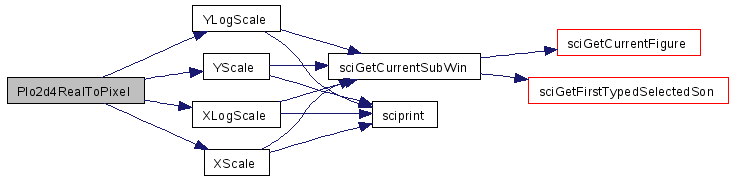
| void Plo2d4RealToPixel | ( | integer * | n1, | |
| integer * | n2, | |||
| double * | x, | |||
| double * | y, | |||
| integer * | xm, | |||
| integer * | ym, | |||
| char * | xf | |||
| ) |
Definition at line 2168 of file Plo2dEch.c.
References i, j, XLogScale(), XScale(), YLogScale(), and YScale().
Referenced by drawPolylineEntity().
02169 {
02170   integer i,j;
02172   if ((int)strlen(xf) >= 3 && xf[2]=='l')
02173   {
02174     for ( i=0 ; i < (*n2) ; i++)
02175       for (j=0 ; j< (*n1) ; j++)
02176         ym[2*i+2*(*n2)*j]= YLogScale(y[i+(*n2)*j]);
02177     for ( i=0 ; i < (*n2)-1 ; i++)
02178       for (j=0 ; j< (*n1) ; j++)
02179         ym[2*i+1+2*(*n2)*j]=      ym[2*i+2+2*(*n2)*j];
02180   }
02181   else
02182   {
02183     for ( i=0 ; i < (*n2) ; i++)
02184       for (j=0 ; j< (*n1) ; j++)
02185         ym[2*i+2*(*n2)*j]= YScale(y[i+(*n2)*j]);
02186     for ( i=0 ; i < (*n2)-1 ; i++)
02187       for (j=0 ; j< (*n1) ; j++)
02188         ym[2*i+1+2*(*n2)*j]=      ym[2*i+2+2*(*n2)*j];
02189
02190   }
02191
02193   switch (xf[0])
02194   {
02195   case 'e' :
02197     if ((int)strlen(xf) >= 2 && xf[1]=='l')
02198     {
02199       for (j=0 ; j< (*n1) ; j++)
02200         for ( i=0 ; i < (*n2) ; i++)
02201           xm[2*i+2*(*n2)*j]= XLogScale(i+1.0);
02202       for (j=0 ; j< (*n1) ; j++)
02203         for ( i=0 ; i < (*n2)-1 ; i++)
02204           xm[2*i+1+2*(*n2)*j]=     xm[2*i+2+2*(*n2)*j];
02205     }
02206     else
02207     {
02208       for (j=0 ; j< (*n1) ; j++)
02209         for ( i=0 ; i < (*n2) ; i++)
02210           xm[2*i+2*(*n2)*j]= XScale((i+1.0));
02211       for (j=0 ; j< (*n1) ; j++)
02212         for ( i=0 ; i < (*n2)-1 ; i++)
02213           xm[2*i+1+2*(*n2)*j]=     xm[2*i+2+2*(*n2)*j];
02214     }
02215     break ;
02216   case 'o' :
02217     if ((int)strlen(xf) >= 2 && xf[1]=='l')
02218     {
02219       for (j=0 ; j< (*n1) ; j++)
02220         for ( i=0 ; i < (*n2) ; i++)
02221           xm[2*i+2*(*n2)*j]= XLogScale(x[i]);
02222       for (j=0 ; j< (*n1) ; j++)
02223         for ( i=0 ; i < (*n2)-1 ; i++)
02224           xm[2*i+1+2*(*n2)*j]=     xm[2*i+2+2*(*n2)*j];
02225     }
02226     else
02227
02228     {
02229       for (j=0 ; j< (*n1) ; j++)
02230         for ( i=0 ; i < (*n2) ; i++)
02231           xm[2*i+2*(*n2)*j]= XScale(x[i]);
02232       for (j=0 ; j< (*n1) ; j++)
02233         for ( i=0 ; i < (*n2)-1 ; i++)
02234           xm[2*i+1+2*(*n2)*j]=     xm[2*i+2+2*(*n2)*j];
02235
02236     }
02237     break;
02238   case 'g' :
02239   default:
02240     if ((int)strlen(xf) >= 2 && xf[1]=='l')
02241     {
02242       for (j=0 ; j< (*n1) ; j++)
02243         for ( i=0 ; i < (*n2) ; i++)
02244           xm[2*i+2*(*n2)*j]= XLogScale(x[i+(*n2)*j]);
02245       for (j=0 ; j< (*n1) ; j++)
02246         for ( i=0 ; i < (*n2)-1 ; i++)
02247           xm[2*i+1+2*(*n2)*j]=     xm[2*i+2+2*(*n2)*j];
02248
02249     }
02250     else
02251     {
02252       for (j=0 ; j< (*n1) ; j++)
02253         for ( i=0 ; i < (*n2) ; i++)
02254           xm[2*i+2*(*n2)*j]= XScale(x[i+(*n2)*j]);
02255       for (j=0 ; j< (*n1) ; j++)
02256         for ( i=0 ; i < (*n2)-1 ; i++)
02257           xm[2*i+1+2*(*n2)*j]=  xm[2*i+2+2*(*n2)*j];
02258
02259     }
02260     break;
02261   }
02262 }
Here is the call graph for this function:
Here is the caller graph for this function:

meme chose mais pour transformer des rectangles
double to integer (pixel) direction
Definition at line 949 of file Plo2dEch.c.
References Cscale, i, inint, wcscalelist::logflag, wcscalelist::Wscx1, wcscalelist::Wscy1, XLogScale(), XScale(), YLogScale(), and YScale().
Referenced by drawrectangle_1(), drawrectangles_1(), and sciIsClicked().
00950 {
00951   integer i;
00952   if (strcmp("f2i",dir)==0)
00953     {
00955       for ( i=0 ; i < (*n) ; i= i+4)
00956         {
00957           if ( Cscale.logflag[0] == 'n' )
00958             {
00959               x1[i]=  XScale(x[i]);
00960               x1[i+2]=inint( Cscale.Wscx1*( x[i+2]));
00961             }
00962           else
00963             {
00964               x1[i]= XLogScale(x[i]);
00965               x1[i+2]=inint( Cscale.Wscx1*(log10((x[i]+x[i+2])/x[i])));
00966             }
00967           if ( Cscale.logflag[1] == 'n' )
00968             {
00969               x1[i+1]= YScale(x[i+1]);
00970               x1[i+3]=inint( Cscale.Wscy1*( x[i+3]));
00971             }
00972           else
00973             {
00974               x1[i+1]= YLogScale(x[i+1]);
00975               x1[i+3]=inint( Cscale.Wscy1*(log10(x[i+1]/(x[i+1]-x[i+3]))));
00976             }
00977         }
00978     }
00979   else if (strcmp("i2f",dir)==0)
00980     {
00981       for ( i=0 ; i < (*n) ; i=i+4)
00982         {
00983           if ( Cscale.logflag[0] == 'n' )
00984             {
00985               x[i]= XPi2R(x1[i] );
00986               x[i+2]=x1[i+2]/Cscale.Wscx1;
00987             }
00988           else
00989             {
00990               x[i]=exp10( XPi2R(x1[i]));
00991               x[i+2]=exp10(XPi2R( x1[i]+x1[i+2] ));
00992               x[i+2] -= x[i];
00993             }
00994           if ( Cscale.logflag[1] == 'n' )
00995             {
00996               x[i+1]= YPi2R( x1[i+1]);
00997               x[i+3]=x1[i+3]/Cscale.Wscy1;
00998             }
00999           else
01000             {
01001               x[i+1]=exp10( YPi2R( x1[i+1]));
01002               x[i+3]=exp10( YPi2R( x1[i+3]+x1[i+1]));
01003               x[i+2] -= x[i+1];
01004             }
01005         }
01006     }
01007   else
01008     sciprint(" Wrong dir %s argument in echelle2d\r\n",dir);
01009 }
Here is the call graph for this function:

Here is the caller graph for this function:

| void rectangleDouble2Pixel | ( | sciPointObj * | parentSubWin, | |
| double | ulPoint[3], | |||
| double | userSize[2], | |||
| int | edgesX[4], | |||
| int | edgesY[4] | |||
| ) |
Give the position of the 4 corners of a rectangle in pixels given the position of its upper left point in user coordiantes and its size. It works in every axes mode (2D/3D, log, reverse).
| parentSubWin | Subwindow in which the rectangle is drawn. | |
| ulPoint | Coordinates of the upper left point of the rectangle in user coord. | |
| userSize | Width and height of the rectangle in user coord. | |
| edgesX | X coordinates of the resulting positions. | |
| edgesY | Y coordinates of the resulting positions. |
Definition at line 1889 of file Plo2dEch.c.
References sciSubWindow::axes, HDouble2Pixel, sciSubWindow::is3d, pSUBWIN_FEATURE, AXES::reverse, ReverseDataFor3D(), trans3d(), WDouble2Pixel, XDouble2Pixel, and YDouble2Pixel.
Referenced by drawRectangleEntity().
01894 {
01895   sciSubWindow * ppSubWin = pSUBWIN_FEATURE( parentSubWin  ) ;
01896
01897   if ( ppSubWin->is3d )
01898   {
01899     double rectx[4],recty[4],rectz[4];
01900     int n = 4 ;
01901     rectx[0] = rectx[3] = ulPoint[0] ;
01902     rectx[1] = rectx[2] = ulPoint[0] + userSize[0] ;
01903     recty[0] = recty[1] = ulPoint[1] ;
01904     recty[2] = recty[3] = ulPoint[1] - userSize[1];
01905     rectz[0] = rectz[1] = rectz[2]= rectz[3] = ulPoint[2] ;
01906
01907     ReverseDataFor3D( parentSubWin, rectx, recty, rectz, n);
01908
01909     trans3d( parentSubWin,n,edgesX,edgesY,rectx,recty,rectz) ;
01910   }
01911   else
01912   {
01913     /* 2D mode */
01914     /* position of the upper left point of the rectangle with reverse axes. */
01915     double realPoint[2] ;
01916     int ulPointPix[2] ;
01917     int sizePix[2] ;
01918
01919     if ( ppSubWin->axes.reverse[0] )
01920     {
01921       realPoint[0] = ulPoint[0] + userSize[0] ;
01922     }
01923     else
01924     {
01925       realPoint[0] = ulPoint[0] ;
01926     }
01927
01928     if ( ppSubWin->axes.reverse[1] )
01929     {
01930       realPoint[1] = ulPoint[1] - userSize[1] ;
01931     }
01932     else
01933     {
01934       realPoint[1] = ulPoint[1] ;
01935     }
01936
01937     ulPointPix[0] = XDouble2Pixel( realPoint[0] ) ;
01938     ulPointPix[1] = YDouble2Pixel( realPoint[1] ) ;
01939
01940     /* Nouvelles fonctions de changement d'echelle pour les longueurs --> voir PloEch.h */
01941     sizePix[0] = WDouble2Pixel( ulPoint[0], userSize[0] ) ;
01942     /* for y we take the length from the bottom left corner */
01943     sizePix[1] = HDouble2Pixel( ulPoint[1] - userSize[1], userSize[1] ) ;
01944
01945     edgesX[0] = ulPointPix[0] ;
01946     edgesX[1] = ulPointPix[0] + sizePix[0]  ;
01947     edgesX[2] = ulPointPix[0] + sizePix[0]  ;
01948     edgesX[3] = ulPointPix[0] ;
01949
01950     edgesY[0] = ulPointPix[1] ;
01951     edgesY[1] = ulPointPix[1] ;
01952     edgesY[2] = ulPointPix[1] + sizePix[1]  ;
01953     edgesY[3] = ulPointPix[1] + sizePix[1]  ;
01954
01955   }
01956 }
Here is the call graph for this function:

Here is the caller graph for this function:

| void scizoom | ( | double | bbox[4], | |
| sciPointObj * | pobj | |||
| ) |
Definition at line 1794 of file Plo2dEch.c.
References C2F, graduate(), lmax(), lmin(), max, min, pSUBWIN_FEATURE, sciGetZooming(), and sciSetZooming().
Referenced by set_zoom_box_property().
01795 {
01796   sciPointObj *psousfen;
01797   double fmin,fmax,lmin,lmax;
01798   integer min,max,puiss,deux=2,dix=10;
01799   psousfen= pobj; /* ??? */
01800
01801   if ( !( sciGetZooming(pobj) ) )
01802   {
01803     sciSetZooming(psousfen, 1);
01804   }
01806   fmin=  bbox[0];
01807   fmax=  bbox[2];
01808   if( pSUBWIN_FEATURE (psousfen)->logflags[0] == 'n' )
01809   {
01810     C2F(graduate)(&fmin, &fmax,&lmin,&lmax,&deux,&dix,&min,&max,&puiss) ;
01811     pSUBWIN_FEATURE(psousfen)->axes.xlim[2]=puiss;
01812     pSUBWIN_FEATURE (psousfen)->ZRect[0]=lmin;
01813     pSUBWIN_FEATURE (psousfen)->ZRect[2]=lmax;
01814   }
01815   else
01816   {
01817     pSUBWIN_FEATURE(psousfen)->axes.xlim[2]=0;
01818     pSUBWIN_FEATURE (psousfen)->ZRect[0]=fmin;
01819     pSUBWIN_FEATURE (psousfen)->ZRect[2]=fmax;
01820   }
01821
01822   fmin= bbox[1];
01823   fmax= bbox[3];
01824   if ( pSUBWIN_FEATURE (psousfen)->logflags[1] == 'n' )
01825   {
01826     C2F(graduate)(&fmin, &fmax,&lmin,&lmax,&deux,&dix,&min,&max,&puiss) ;
01827     pSUBWIN_FEATURE(psousfen)->axes.ylim[2]=puiss;
01828     pSUBWIN_FEATURE (psousfen)->ZRect[1]=lmin;
01829     pSUBWIN_FEATURE (psousfen)->ZRect[3]=lmax;
01830   }
01831   else
01832   {
01833     pSUBWIN_FEATURE(psousfen)->axes.ylim[2]=0;
01834     pSUBWIN_FEATURE (psousfen)->ZRect[1]=fmin;
01835     pSUBWIN_FEATURE (psousfen)->ZRect[3]=fmax;
01836   }
01837
01838   /* default values when zooming in 3d */
01839   /* and scizoom takes only xmin ymin xmax ymax AND not zmin zmax (for now at least) */
01840   /* F.Leray 29.09.05 */
01841   pSUBWIN_FEATURE (psousfen)->ZRect[4] = pSUBWIN_FEATURE (psousfen)->SRect[4];
01842   pSUBWIN_FEATURE (psousfen)->ZRect[5] = pSUBWIN_FEATURE (psousfen)->SRect[5];
01843
01844 }
Here is the call graph for this function:

Here is the caller graph for this function:

| void set_scale | ( | char | flag[6], | |
| double | subwin[4], | |||
| double | frame_values[4], | |||
| integer | aaint[4], | |||
| char | logflag[3], | |||
| double | axis_values[4] | |||
| ) |
Definition at line 632 of file Plo2dEch.c.
References C2F, Cscale, dr(), i, L, PD0, PI0, wcscalelist::subwin_rect, and wcscalelist::wdim.
Referenced by DrawAxes(), drawSubWinEntity(), Nsetscale2d(), sci_draw(), sciInitSelectedSubWin(), sciIsClicked(), set_axes_bounds_property(), SetEch3d1(), setscale2d(), updateScale3d(), and updateSubWinScale().
00644 {
00645   char c;
00646   char wdim_changed= 'f',subwin_changed='f';
00647   char frame_values_changed='f',aaint_changed='f';
00648   char logflag_changed='f';
00649   char axis_changed = 'f';
00650   integer  verbose=0,narg,wdim[2];
00651   int i;
00652   if ( flag[0] == 't'  )
00653     {
00654       C2F(dr)("xget","wdim",&verbose,wdim,&narg, PI0, PI0,PI0,PD0,PD0,PD0,PD0,0L,0L);
00655       if ( Cscale.wdim[0] != wdim[0] || Cscale.wdim[1] != wdim[1])
00656         {
00657           Cscale.wdim[0] = wdim[0]; Cscale.wdim[1] = wdim[1];
00658           wdim_changed='t';
00659         }
00660     }
00661   if ( flag[1] == 't' )
00662     {
00663       for (i=0; i < 4 ; i++ )
00664         if ( subwin[i] != Cscale.subwin_rect[i]) { subwin_changed='t' ; break;}
00665     }
00666   if ( flag[2] == 't' )
00667     {
00668       for (i=0; i < 4 ; i++ )
00669         if ( frame_values[i] != Cscale.frect[i]) { frame_values_changed='t' ; break;}
00670       /* if no scales were present and the values given are the same as the
00671        * default frect values we must register that we are setting a scale
00672        */
00673       if ( Cscale.flag == 0) frame_values_changed='t' ;
00674     }
00675   if ( flag[3] == 't' )
00676     {
00677       for (i=0; i < 4 ; i++ )
00678         if ( aaint[i] != Cscale.Waaint1[i]) { aaint_changed='t' ; break;}
00679     }
00680   if ( flag[4] == 't' )
00681     {
00682       for (i=0; i < 2 ; i++ )
00683         if ( logflag[i] != Cscale.logflag[i]) { logflag_changed='t' ; break;}
00684     }
00685   if ( flag[5] == 't' )
00686     {
00687       for (i=0; i < 4 ; i++ )
00688         if ( axis_values[i] != Cscale.axis[i]) { axis_changed='t' ; break;}
00689     }
00690   if ( axis_changed == 't')
00691     {
00692       for (i=0; i < 4 ; i++ ) Cscale.axis[i] = axis_values[i];
00693     }
00694
00695   if ( subwin_changed == 't' )
00696     {
00697       for (i=0; i < 4 ; i++ ) Cscale.subwin_rect[i] = subwin[i];
00698     }
00699   if ( frame_values_changed == 't' )
00700     {
00701       for (i=0; i < 4 ; i++) Cscale.frect[i]=frame_values[i];
00702       /* the scale is no more a default scale */
00703       Cscale.flag = 1;
00704     }
00705   if ( wdim_changed == 't' || subwin_changed == 't' || frame_values_changed == 't'
00706        ||  axis_changed == 't' )
00707     {
00708       /* Upgrading constants for 2D transformation */
00709       double scx,scy,xoff,yoff,val;
00710
00711       sciPointObj *pobj = sciGetCurrentSubWin();
00712       sciSubWindow * ppsubwin = pSUBWIN_FEATURE (pobj);
00713
00714       scx =  ((double) Cscale.wdim[0]*Cscale.subwin_rect[2]-Cscale.wdim[0]*Cscale.subwin_rect[2]
00715               *(Cscale.axis[0]+Cscale.axis[1]));
00716       scy =  ((double) Cscale.wdim[1]*Cscale.subwin_rect[3]-Cscale.wdim[1]*Cscale.subwin_rect[3]
00717               *(Cscale.axis[2]+Cscale.axis[3]));
00718       xoff= ((double) Cscale.wdim[0]*Cscale.subwin_rect[2])*(Cscale.axis[0]);
00719       yoff= ((double) Cscale.wdim[1]*Cscale.subwin_rect[3])*(Cscale.axis[2]);
00720
00721       Cscale.Wxofset1= xoff+Cscale.subwin_rect[0]*((double)Cscale.wdim[0]);
00722       Cscale.Wyofset1= yoff+Cscale.subwin_rect[1]*((double)Cscale.wdim[1]);
00723       Cscale.Wscx1   = scx;
00724       Cscale.Wscy1   = scy;
00725
00726       val = Abs(Cscale.frect[0]- Cscale.frect[2]);
00727       Cscale.Wscx1 = (val <=SMDOUBLE) ? Cscale.Wscx1/SMDOUBLE : Cscale.Wscx1/val;
00728       val = Abs(Cscale.frect[1]- Cscale.frect[3]);
00729       Cscale.Wscy1 = (val <=SMDOUBLE) ? Cscale.Wscy1/SMDOUBLE : Cscale.Wscy1/val;
00730
00731       /*          F.Leray 12.10.04 : MODIF named scale_modification*/
00732       if(ppsubwin->axes.reverse[0]==TRUE && ppsubwin->is3d == FALSE)
00733       {
00734         Cscale.WIRect1[0] = XScale( Cscale.frect[2]);
00735         Cscale.WIRect1[2] = Abs(XScale( Cscale.frect[2]) -  XScale( Cscale.frect[0]));
00736       }
00737       else
00738       {
00739         Cscale.WIRect1[0] = XScale( Cscale.frect[0]);
00740         Cscale.WIRect1[2] = Abs(XScale( Cscale.frect[2]) -  XScale( Cscale.frect[0]));
00741       }
00742
00743       if(ppsubwin->axes.reverse[1]==TRUE && ppsubwin->is3d == FALSE)
00744       {
00745         Cscale.WIRect1[1] = YScale( Cscale.frect[1]);
00746         Cscale.WIRect1[3] = Abs(YScale( Cscale.frect[3]) -  YScale( Cscale.frect[1]));
00747       }
00748       else
00749       {
00750         Cscale.WIRect1[1] = YScale( Cscale.frect[3]);
00751         Cscale.WIRect1[3] = Abs(YScale( Cscale.frect[3]) -  YScale( Cscale.frect[1]));
00752       }
00753     }
00754   if (  aaint_changed== 't' )
00755     {
00756       for (i=0; i < 4 ; i++) Cscale.Waaint1[i]=aaint[i];
00757     }
00758   if ( logflag_changed== 't' )
00759     {
00760       Cscale.logflag[0]=logflag[0];      Cscale.logflag[1]=logflag[1];
00761     }
00762   if (  aaint_changed== 't' || frame_values_changed == 't')
00763     {
00764       Cscale.xtics[0] = Cscale.frect[0];
00765       Cscale.xtics[1] = Cscale.frect[2];
00766       Cscale.ytics[0] = Cscale.frect[1];
00767       Cscale.ytics[1] = Cscale.frect[3];
00768       Cscale.xtics[2] = 0.0;
00769       Cscale.ytics[2] = 0.0;
00770       Cscale.xtics[3] = Cscale.Waaint1[1];
00771       Cscale.ytics[3] = Cscale.Waaint1[3];
00772     }
00773
00775   if ( (c=GetDriver()) == 'X' ||  c == 'R' || c == 'I' || c == 'G' || c == 'W' )
00776     {
00777       set_window_scale(curwin(),&Cscale);
00778     }
00779 }
Here is the call graph for this function:

Here is the caller graph for this function:

| void set_window_scale_with_default | ( | int | i | ) |
Definition at line 110 of file Plo2dEch.c.
References Defscale, and set_window_scale().
Referenced by CleanPlots().
00110 { set_window_scale(i,&Defscale);}
Here is the call graph for this function:

Here is the caller graph for this function:

| void ShowScales | ( | void | ) |
Definition at line 380 of file Plo2dEch.c.
References Cscale, wcscalelist::flag, sciprint(), show_scales(), wcscalelist::subwin_rect, and The_List.
Referenced by sci_xsetech().
00381 {
00382   sciprint("-----------scales-------------\r\n");
00383   show_scales(The_List);
00384   sciprint("----------current scale-------\r\n");
00385   sciprint("\tsubwin=[%5.2f,%5.2f,%5.2f,%5.2f], flag=%d\r\n",
00386            Cscale.subwin_rect[0],Cscale.subwin_rect[1],Cscale.subwin_rect[2],Cscale.subwin_rect[3],
00387            Cscale.flag);
00388   sciprint("-----------end----------------\r\n");
00389 }
Here is the call graph for this function:

Here is the caller graph for this function:

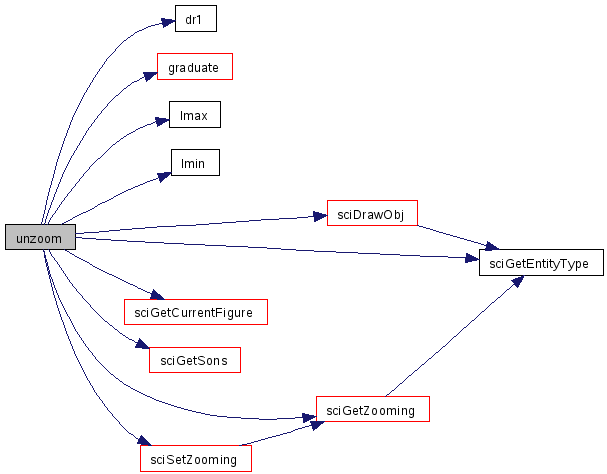
| void unzoom | ( | void | ) |
Definition at line 1372 of file Plo2dEch.c.
References C2F, dr1(), graduate(), L, lmax(), lmin(), max, min, NULL, PD0, PI0, tagSons::pnext, tagSons::pointobj, pSUBWIN_FEATURE, SCI_SUBWIN, sciDrawObj(), sciGetCurrentFigure(), sciGetEntityType(), sciGetSons(), sciGetZooming(), and sciSetZooming().
Referenced by sci_unzoom(), scig_unzoom(), set_zoom_box_property(), and set_zoom_state_property().
01373 {
01374   integer ww,verbose=0,narg;
01376   double fmin,fmax,lmin,lmax;
01377   integer min,max,puiss,deux=2,dix=10;
01378   sciPointObj *psousfen;
01379   sciSons *psonstmp;
01380
01381
01382   C2F(dr1)("xclear","v",PI0,PI0,PI0,PI0,PI0,PI0,PD0,PD0,PD0,PD0,0L,0L);
01383   C2F(dr1)("xget","window",&verbose,&ww,&narg,PI0,PI0,PI0,PD0,PD0,PD0,PD0,0L,0L);
01384   /***** 02/10/2002 ****/
01385   psonstmp = sciGetSons (sciGetCurrentFigure());
01386   while (psonstmp != (sciSons *) NULL)
01387   {
01388     if(sciGetEntityType (psonstmp->pointobj) == SCI_SUBWIN)
01389     {
01390       psousfen= (sciPointObj *)psonstmp->pointobj;
01391       if (sciGetZooming(psousfen))
01392       {
01393         sciSetZooming(psousfen, 0);
01394         /*   pSUBWIN_FEATURE (psousfen)->ZRect[0]   = pSUBWIN_FEATURE (psousfen)->ZRect_kp[0]; */
01395         /*                    pSUBWIN_FEATURE (psousfen)->ZRect[1]   = pSUBWIN_FEATURE (psousfen)->ZRect_kp[1]; */
01396         /*                    pSUBWIN_FEATURE (psousfen)->ZRect[2]   = pSUBWIN_FEATURE (psousfen)->ZRect_kp[2]; */
01397         /*                    pSUBWIN_FEATURE (psousfen)->ZRect[3]   = pSUBWIN_FEATURE (psousfen)->ZRect_kp[3]; */
01398
01399         pSUBWIN_FEATURE (psousfen)->ZRect[0]   = pSUBWIN_FEATURE (psousfen)->SRect[0];
01400         pSUBWIN_FEATURE (psousfen)->ZRect[1]   = pSUBWIN_FEATURE (psousfen)->SRect[1];
01401         pSUBWIN_FEATURE (psousfen)->ZRect[2]   = pSUBWIN_FEATURE (psousfen)->SRect[2];
01402         pSUBWIN_FEATURE (psousfen)->ZRect[3]   = pSUBWIN_FEATURE (psousfen)->SRect[3];
01403
01404         /*}  SS: moved below because if sciGetZooming(psousfen)==0
01405         ZRect is undefined -> code may enter in infinite recursion loop to compute graduation
01406         and there is no use to regraduate */
01407
01409         fmin= pSUBWIN_FEATURE (psousfen)->ZRect[0];
01410         fmax= pSUBWIN_FEATURE (psousfen)->ZRect[2];
01411         C2F(graduate)(&fmin, &fmax,&lmin,&lmax,&deux,&dix,&min,&max,&puiss) ;
01412         pSUBWIN_FEATURE(psousfen)->axes.xlim[2]=puiss;
01413
01414         fmin= pSUBWIN_FEATURE (psousfen)->ZRect[1];
01415         fmax= pSUBWIN_FEATURE (psousfen)->ZRect[3];
01416         C2F(graduate)(&fmin, &fmax,&lmin,&lmax,&deux,&dix,&min,&max,&puiss) ;
01417         pSUBWIN_FEATURE(psousfen)->axes.ylim[2]=puiss;
01418         /*****/
01419       }
01420     }
01421     psonstmp = psonstmp->pnext;
01422   }
01423
01424   sciDrawObj(sciGetCurrentFigure());
01425 }
Here is the call graph for this function:
Here is the caller graph for this function:

| void unzoom_one_axes | ( | sciPointObj * | psousfen | ) |
Definition at line 1427 of file Plo2dEch.c.
References C2F, graduate(), lmax(), lmin(), max, min, pSUBWIN_FEATURE, SCI_SUBWIN, sciDrawObj(), sciGetCurrentFigure(), sciGetEntityType(), sciGetZooming(), and sciSetZooming().
Referenced by sci_unzoom().
01428 {
01429   double fmin,fmax,lmin,lmax;
01430   integer min,max,puiss,deux=2,dix=10;
01431
01432   if (sciGetEntityType (psousfen) == SCI_SUBWIN) {
01433     if (sciGetZooming(psousfen))        {
01434       sciSetZooming(psousfen, 0);
01435       /*   pSUBWIN_FEATURE (psousfen)->ZRect[0]   = pSUBWIN_FEATURE (psousfen)->ZRect_kp[0]; */
01436       /*          pSUBWIN_FEATURE (psousfen)->ZRect[1]   = pSUBWIN_FEATURE (psousfen)->ZRect_kp[1]; */
01437       /*          pSUBWIN_FEATURE (psousfen)->ZRect[2]   = pSUBWIN_FEATURE (psousfen)->ZRect_kp[2]; */
01438       /*          pSUBWIN_FEATURE (psousfen)->ZRect[3]   = pSUBWIN_FEATURE (psousfen)->ZRect_kp[3]; */
01439
01440       pSUBWIN_FEATURE (psousfen)->ZRect[0]   = pSUBWIN_FEATURE (psousfen)->SRect[0];
01441       pSUBWIN_FEATURE (psousfen)->ZRect[1]   = pSUBWIN_FEATURE (psousfen)->SRect[1];
01442       pSUBWIN_FEATURE (psousfen)->ZRect[2]   = pSUBWIN_FEATURE (psousfen)->SRect[2];
01443       pSUBWIN_FEATURE (psousfen)->ZRect[3]   = pSUBWIN_FEATURE (psousfen)->SRect[3];
01444
01445     }
01446
01448     fmin= pSUBWIN_FEATURE (psousfen)->ZRect[0];
01449     fmax= pSUBWIN_FEATURE (psousfen)->ZRect[2];
01450     C2F(graduate)(&fmin, &fmax,&lmin,&lmax,&deux,&dix,&min,&max,&puiss) ;
01451     pSUBWIN_FEATURE(psousfen)->axes.xlim[2]=puiss;
01452
01453     fmin= pSUBWIN_FEATURE (psousfen)->ZRect[1];
01454     fmax= pSUBWIN_FEATURE (psousfen)->ZRect[3];
01455     C2F(graduate)(&fmin, &fmax,&lmin,&lmax,&deux,&dix,&min,&max,&puiss) ;
01456     pSUBWIN_FEATURE(psousfen)->axes.ylim[2]=puiss;
01457
01458     sciDrawObj(sciGetCurrentFigure());
01459   }
01460 }
Here is the call graph for this function:

Here is the caller graph for this function:

| double XDPi2R | ( | double | x | ) |
Definition at line 1650 of file Plo2dEch.c.
References sciSubWindow::axes, Cscale, FALSE, wcscalelist::frect, sciSubWindow::is3d, pSUBWIN_FEATURE, AXES::reverse, sciGetCurrentSubWin(), sciprint(), TRUE, wcscalelist::Wscx1, and wcscalelist::Wxofset1.
01651 {
01652   /*F.Leray 12.10.04 : MODIF named scale_modification*/
01653   sciPointObj *pobj = sciGetCurrentSubWin();
01654   sciSubWindow * ppsubwin = pSUBWIN_FEATURE (pobj);
01655
01656   if(ppsubwin->axes.reverse[0]==TRUE && ppsubwin->is3d == FALSE)
01657     return Cscale.frect[2] - (1.0/Cscale.Wscx1)*((x) - Cscale.Wxofset1);
01658   else
01659     return Cscale.frect[0] + (1.0/Cscale.Wscx1)*((x) - Cscale.Wxofset1);
01660
01661
01662   sciprint("Error in XScale\n");
01663   return -9000;
01664 }
Here is the call graph for this function:

| int XLogScale | ( | double | x | ) |
Definition at line 1553 of file Plo2dEch.c.
References sciSubWindow::axes, Cscale, FALSE, wcscalelist::frect, inint, sciSubWindow::is3d, pSUBWIN_FEATURE, AXES::reverse, sciGetCurrentSubWin(), sciprint(), TRUE, wcscalelist::Wscx1, and wcscalelist::Wxofset1.
Referenced by Plo2d2RealToPixel(), Plo2d3RealToPixel(), Plo2d4RealToPixel(), rect2d(), and xechelle2d().
01554 {
01555   /*F.Leray 12.10.04 : MODIF named scale_modification*/
01556
01557   sciPointObj *pobj = sciGetCurrentSubWin();
01558   sciSubWindow * ppsubwin = pSUBWIN_FEATURE (pobj);
01559
01560   if(ppsubwin->axes.reverse[0]==TRUE && ppsubwin->is3d == FALSE)
01561     return inint( Cscale.Wscx1*(Cscale.frect[2] - log10(x)) + Cscale.Wxofset1);
01562   else
01563     return inint( Cscale.Wscx1*(log10(x) -Cscale.frect[0]) + Cscale.Wxofset1);
01564
01565
01566   sciprint("Error in XLogScale\n");
01567   return -9000;
01568 }
Here is the call graph for this function:

Here is the caller graph for this function:

| double XPi2R | ( | int | x | ) |
Definition at line 1616 of file Plo2dEch.c.
References sciSubWindow::axes, Cscale, FALSE, wcscalelist::frect, sciSubWindow::is3d, pSUBWIN_FEATURE, AXES::reverse, sciGetCurrentSubWin(), sciprint(), TRUE, wcscalelist::Wscx1, and wcscalelist::Wxofset1.
Referenced by drawSegsEntity(), ellipse2d(), and xechelle2d().
01617 {
01618   /*F.Leray 12.10.04 : MODIF named scale_modification*/
01619
01620   sciPointObj *pobj = sciGetCurrentSubWin();
01621   sciSubWindow * ppsubwin = pSUBWIN_FEATURE (pobj);
01622
01623   if(ppsubwin->axes.reverse[0]==TRUE && ppsubwin->is3d == FALSE)
01624     return Cscale.frect[2] - (1.0/Cscale.Wscx1)*((x) - Cscale.Wxofset1);
01625   else
01626     return Cscale.frect[0] + (1.0/Cscale.Wscx1)*((x) - Cscale.Wxofset1);
01627
01628
01629   sciprint("Error in XScale\n");
01630   return -9000;
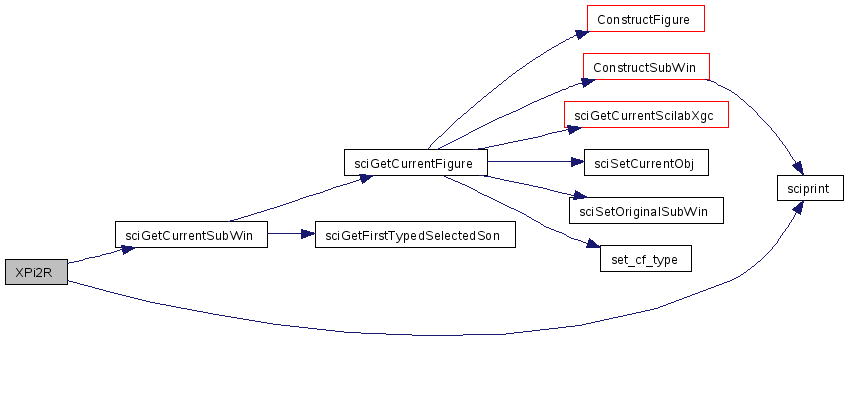
01631 }
Here is the call graph for this function:
Here is the caller graph for this function:

| int XScale | ( | double | x | ) |
Definition at line 1523 of file Plo2dEch.c.
References sciSubWindow::axes, Cscale, FALSE, FLOAT_2_INT, wcscalelist::frect, sciSubWindow::is3d, pSUBWIN_FEATURE, AXES::reverse, sciGetCurrentSubWin(), sciprint(), TRUE, wcscalelist::Wscx1, and wcscalelist::Wxofset1.
Referenced by axis2d(), axis_3ddraw(), box3d(), checkXAxes2dTics(), checkYAxes2dTics(), Convex_Box(), DrawAxis(), drawFecEntity(), drawGrayplotEntity(), drawSegsEntity(), DrawXGrid(), DrawXSubTics(), DrawXTics(), DrawYGrid(), DrawYSubTics(), DrawYTics(), ellipse2d(), Plo2d2RealToPixel(), Plo2d3RealToPixel(), Plo2d4RealToPixel(), rect2d(), Sci_Axis(), sciChamp2DRealToPixel(), XDrawAxisLine(), xechelle2d(), and YDrawAxisLine().
01524 {
01525   /*F.Leray 12.10.04 : MODIF named scale_modification*/
01526
01527   sciPointObj *pobj = sciGetCurrentSubWin();
01528   sciSubWindow * ppsubwin = pSUBWIN_FEATURE (pobj);
01529
01530   if(ppsubwin->axes.reverse[0]==TRUE && ppsubwin->is3d == FALSE)
01531   {
01532
01533     /* 2147483647 == 2^31 - 1 == INT32MAX */
01534     /*return inint( Max( Min(Cscale.Wscx1*(Cscale.frect[2] - (x)) + Cscale.Wxofset1, INT_MAX ), INT_MIN ) ) ;*/
01535     double dRes = Cscale.Wscx1 * (Cscale.frect[2] - (x)) + Cscale.Wxofset1 ;
01536     return FLOAT_2_INT( dRes ) ;
01537   }
01538   else
01539   {
01540     /*return inint( Max( Min(Cscale.Wscx1*((x) -Cscale.frect[0]) + Cscale.Wxofset1, INT_MAX ), INT_MIN ) );*/
01541     double dRes = Cscale.Wscx1 * ((x) -Cscale.frect[0]) + Cscale.Wxofset1 ;
01542     return FLOAT_2_INT( dRes ) ;
01543   }
01544
01545
01546   sciprint("Error in XScale\n");
01547   return -9000;
01548 }
Here is the call graph for this function:

Here is the caller graph for this function:

| double YDPi2R | ( | double | y | ) |
Definition at line 1667 of file Plo2dEch.c.
References sciSubWindow::axes, Cscale, FALSE, wcscalelist::frect, sciSubWindow::is3d, pSUBWIN_FEATURE, AXES::reverse, sciGetCurrentSubWin(), sciprint(), TRUE, wcscalelist::Wscy1, and wcscalelist::Wyofset1.
01668 {
01669   /*F.Leray 12.10.04 : MODIF named scale_modification*/
01670   sciPointObj *pobj = sciGetCurrentSubWin();
01671   sciSubWindow * ppsubwin = pSUBWIN_FEATURE (pobj);
01672
01673   if(ppsubwin->axes.reverse[1]==TRUE && ppsubwin->is3d == FALSE)
01674     return Cscale.frect[1] + (1.0/Cscale.Wscy1)*((y) - Cscale.Wyofset1);
01675   else
01676     return Cscale.frect[3] - (1.0/Cscale.Wscy1)*((y) - Cscale.Wyofset1);
01677
01678
01679
01680   sciprint("Error in YScale\n");
01681   return -9000;
01682 }
Here is the call graph for this function:

| int YLogScale | ( | double | y | ) |
Definition at line 1597 of file Plo2dEch.c.
References sciSubWindow::axes, Cscale, FALSE, wcscalelist::frect, inint, sciSubWindow::is3d, pSUBWIN_FEATURE, AXES::reverse, sciGetCurrentSubWin(), sciprint(), TRUE, wcscalelist::Wscy1, and wcscalelist::Wyofset1.
Referenced by Plo2d2RealToPixel(), Plo2d3RealToPixel(), Plo2d4RealToPixel(), rect2d(), and yechelle2d().
01598 {
01599   /*F.Leray 12.10.04 : MODIF named scale_modification*/
01600   sciPointObj *pobj = sciGetCurrentSubWin();
01601   sciSubWindow * ppsubwin = pSUBWIN_FEATURE (pobj);
01602
01603   if(ppsubwin->axes.reverse[1]==TRUE && ppsubwin->is3d == FALSE)
01604     return inint( Cscale.Wscy1*(log10(y)-Cscale.frect[1]) + Cscale.Wyofset1);
01605   else
01606     return inint( Cscale.Wscy1*(-log10(y)+Cscale.frect[3]) + Cscale.Wyofset1);
01607
01608
01609
01610   sciprint("Error in YLogScale\n");
01611   return -9000;
01612 }
Here is the call graph for this function:

Here is the caller graph for this function:

| double YPi2R | ( | int | y | ) |
Definition at line 1634 of file Plo2dEch.c.
References sciSubWindow::axes, Cscale, FALSE, wcscalelist::frect, sciSubWindow::is3d, pSUBWIN_FEATURE, AXES::reverse, sciGetCurrentSubWin(), sciprint(), TRUE, wcscalelist::Wscy1, and wcscalelist::Wyofset1.
Referenced by drawSegsEntity(), ellipse2d(), and yechelle2d().
01635 {
01636   /*F.Leray 12.10.04 : MODIF named scale_modification*/
01637   sciPointObj *pobj = sciGetCurrentSubWin();
01638   sciSubWindow * ppsubwin = pSUBWIN_FEATURE (pobj);
01639
01640   if(ppsubwin->axes.reverse[1]==TRUE && ppsubwin->is3d == FALSE)
01641     return Cscale.frect[1] + (1.0/Cscale.Wscy1)*((y) - Cscale.Wyofset1);
01642   else
01643     return Cscale.frect[3] - (1.0/Cscale.Wscy1)*((y) - Cscale.Wyofset1);
01644
01645
01646   sciprint("Error in YScale\n");
01647   return -9000;
01648 }
Here is the call graph for this function:

Here is the caller graph for this function:

| int YScale | ( | double | y | ) |
Definition at line 1573 of file Plo2dEch.c.
References sciSubWindow::axes, Cscale, FLOAT_2_INT, wcscalelist::frect, sciSubWindow::is3d, pSUBWIN_FEATURE, AXES::reverse, sciGetCurrentSubWin(), sciprint(), wcscalelist::Wscy1, and wcscalelist::Wyofset1.
Referenced by axis2d(), axis_3ddraw(), box3d(), checkXAxes2dTics(), checkYAxes2dTics(), Convex_Box(), DrawAxis(), drawFecEntity(), drawGrayplotEntity(), drawSegsEntity(), DrawXGrid(), DrawXSubTics(), DrawXTics(), DrawYGrid(), DrawYSubTics(), DrawYTics(), ellipse2d(), Plo2d2RealToPixel(), Plo2d3RealToPixel(), Plo2d4RealToPixel(), rect2d(), Sci_Axis(), sciChamp2DRealToPixel(), XDrawAxisLine(), YDrawAxisLine(), and yechelle2d().
01574 {
01575   /*F.Leray 12.10.04 : MODIF named scale_modification*/
01576
01577   sciPointObj *pobj = sciGetCurrentSubWin();
01578   sciSubWindow * ppsubwin = pSUBWIN_FEATURE (pobj);
01579
01580   if( ppsubwin->axes.reverse[1] && !ppsubwin->is3d )
01581   {
01582     double dRes = Cscale.Wscy1 * ( y - Cscale.frect[1] ) + Cscale.Wyofset1 ;
01583     return FLOAT_2_INT( dRes ) ;
01584   }
01585   else
01586   {
01587     double dRes = Cscale.Wscy1 * ( -y + Cscale.frect[3] ) + Cscale.Wyofset1 ;
01588     return FLOAT_2_INT( dRes ) ;
01589   }
01590
01591
01592   sciprint("Error in YScale\n");
01593   return -9000;
01594 }
Here is the call graph for this function:

Here is the caller graph for this function:

| int zoom | ( | void | ) |
Definition at line 1360 of file Plo2dEch.c.
References zoom_box(), and zoom_get_rectangle().
Referenced by sci_zoom_rect(), and scig_2dzoom().
01361 {
01362   double bbox[4];
01363   int x_pixel[2], y_pixel[2];
01364
01365   if ( zoom_get_rectangle(bbox,x_pixel,y_pixel) == 1 ) { return 1 ; }
01366
01367   zoom_box(bbox,x_pixel,y_pixel);
01368   return 0;
01369 }
Here is the call graph for this function:

Here is the caller graph for this function:

Definition at line 1154 of file Plo2dEch.c.
References sciSubWindow::axes, box3d(), C2F, Cscale, FALSE, sciSubWindow::FRect, FreeVertices(), getVertexIndex(), GetVerticesAt(), graduate(), i, InvAxis(), lmax(), lmin(), max, Max, min, Min, NULL, tagSons::pnext, tagSons::pointobj, pSUBWIN_FEATURE, AXES::reverse, SCI_SUBWIN, sciDrawObj(), sciGetCurrentFigure(), sciGetCurrentSubWin(), sciGetEntityType(), sciGetLastSons(), sciGetSons(), sciGetZooming(), sciIsAreaZoom(), sciSetSelectedSubWin(), sciSetZooming(), SetMinMaxVertices(), setVertexIndex(), setZoom3dStatus(), sciSubWindow::SRect, TRUE, wcscalelist::WIRect1, XDouble2Pixel, XPixel2Double, YDouble2Pixel, YPixel2Double, and z.
Referenced by sci_zoom_rect(), and zoom().
01155 {
01156   integer min,max,puiss,deux=2,dix=10,box[4],box1[4],section[4];
01157
01158   double fmin,fmax,lmin,lmax;
01159   sciPointObj *psousfen,*tmpsousfen;
01160   sciPointObj * pfigure = NULL;
01161   sciSons *psonstmp;
01162   sciSubWindow * ppsubwin = NULL; /* debug */
01163
01164   box[0]= Min(XDouble2Pixel(bbox[0]),XDouble2Pixel(bbox[2]));
01165   box[2]= Max(XDouble2Pixel(bbox[0]),XDouble2Pixel(bbox[2]));
01166   box[1]= Min(YDouble2Pixel(bbox[1]),YDouble2Pixel(bbox[3]));
01167   box[3]= Max(YDouble2Pixel(bbox[1]),YDouble2Pixel(bbox[3]));
01168
01169   pfigure = sciGetCurrentFigure();
01170   tmpsousfen= sciGetCurrentSubWin();
01171   psonstmp = sciGetSons (sciGetCurrentFigure());
01172   while (psonstmp != (sciSons *) NULL)
01173   {
01174     if(sciGetEntityType (psonstmp->pointobj) == SCI_SUBWIN)
01175     {
01176       psousfen= (sciPointObj *)psonstmp->pointobj;
01177       if ( pSUBWIN_FEATURE (psousfen)->is3d == TRUE) {
01178         double xmin, ymin;
01179         double xmax, ymax;
01180         double zmin, zmax;
01181         sciSons *psonstmp2 = (sciSons *) NULL;
01182         double epsilon = 1e-16;
01183
01184         int box3d[4];
01185         int section3d[4];
01186
01187         sciSetSelectedSubWin(psousfen);
01188         ppsubwin = pSUBWIN_FEATURE (psousfen);
01189
01190         box3d[0] = x_pixel[0];
01191         box3d[2] = x_pixel[1];
01192         box3d[1] = y_pixel[0];
01193         box3d[3] = y_pixel[1];
01194
01195         box1[0]= Cscale.WIRect1[0];
01196         box1[2]= Cscale.WIRect1[2]+Cscale.WIRect1[0];
01197         box1[1]= Cscale.WIRect1[1];
01198         box1[3]= Cscale.WIRect1[3]+Cscale.WIRect1[1];
01199
01200         if (sciIsAreaZoom(box3d,box1,section3d))
01201         {
01202           int tmp[4],i;
01203
01204           for(i=0;i<4;i++) tmp[i] = section3d[i];
01205
01206           section3d[0] = Min(tmp[0],tmp[2]);
01207           section3d[2] = Max(tmp[0],tmp[2]);
01208           section3d[1] = Min(tmp[1],tmp[3]);
01209           section3d[3] = Max(tmp[1],tmp[3]);
01210
01211           /* determine how many vertices we will have to draw */
01212           /* this is used for 3d zoom (to know size of the global vector) */
01213           setVertexIndex( 0 ) ;
01214
01215           /* this flag is used inside trans3d called many times by sciDrawObj */
01216           setZoom3dStatus( TRUE );
01217
01218           psonstmp2 = sciGetLastSons (psousfen);
01219
01220           sciDrawObj(psousfen); /* see GlobalFlag_Zoom3dOn impact flag in sciDrawObj & trans3d functions */
01221
01222           setZoom3dStatus( FALSE );
01223
01224           SetMinMaxVertices(pSUBWIN_FEATURE(psousfen)->vertices_list, &xmin, &ymin, &zmin, &xmax, &ymax, &zmax);
01225
01226
01227           for( i = 0 ; i < getVertexIndex() ; i++ )
01228           {
01229             int xp,yp;
01230             double x,y,z;
01231
01232             if(GetVerticesAt(pSUBWIN_FEATURE(psousfen)->vertices_list, &xp, &yp, &x, &y, &z)==-1)
01233               break; /* all the vertices have been scanned inside the current psubwin */
01234
01235             if(xp >= section3d[0] && xp <= section3d[2] && yp >= section3d[1] && yp <= section3d[3])
01236             {
01237               /*                          printf("ICI => xp = %d \t yp = %d et x = %lf \t y = %lf \t z = %lf\n",xp,yp,x,y,z); */
01238               if(x < xmin) xmin=x; if(x > xmax) xmax=x;
01239               if(y < ymin) ymin=y; if(y > ymax) ymax=y;
01240               if(z < zmin) zmin=z; if(z > zmax) zmax=z;
01241             }
01242           }
01243
01244           if(ppsubwin->axes.reverse[0] == TRUE) {
01245             double tmp2;
01246             tmp2 = InvAxis(ppsubwin->FRect[0],ppsubwin->FRect[2],xmin);
01247             xmin = InvAxis(ppsubwin->FRect[0],ppsubwin->FRect[2],xmax);
01248             xmax = tmp2;
01249           }
01250
01251           if(ppsubwin->axes.reverse[1] == TRUE) {
01252             double tmp2;
01253             tmp2 = InvAxis(ppsubwin->FRect[1],ppsubwin->FRect[3],ymin);
01254             ymin = InvAxis(ppsubwin->FRect[1],ppsubwin->FRect[3],ymax);
01255             ymax = tmp2;
01256           }
01257
01258           if(ppsubwin->axes.reverse[2] == TRUE) {
01259             double tmp2;
01260             tmp2 = InvAxis(ppsubwin->FRect[4],ppsubwin->FRect[5],zmin);
01261             zmin = InvAxis(ppsubwin->FRect[4],ppsubwin->FRect[5],zmax);
01262             zmax = tmp2;
01263           }
01264
01265           FreeVertices(psousfen);
01266
01267           /* case where no vertex has been selected : */
01268           /* no zoom is performed */
01269           if(xmin > xmax || ymin > ymax || zmin > zmax)
01270           {
01271             xmin = ppsubwin->SRect[0];
01272             xmax = ppsubwin->SRect[1];
01273
01274             ymin = ppsubwin->SRect[2];
01275             ymax = ppsubwin->SRect[3];
01276
01277             zmin = ppsubwin->SRect[4];
01278             zmax = ppsubwin->SRect[5];
01279           }
01280
01281           if (!(sciGetZooming(psousfen)))
01282             sciSetZooming(psousfen, 1);
01283
01284
01285           /* case where a 3d rotated plot2d is zoomed */
01286           if(fabs(zmin) < epsilon && fabs(zmax) < epsilon){
01287             zmin = pSUBWIN_FEATURE (psousfen)->SRect[4];
01288             zmax = pSUBWIN_FEATURE (psousfen)->SRect[5];
01289           }
01290
01291           pSUBWIN_FEATURE (psousfen)->ZRect[0] = xmin;
01292           pSUBWIN_FEATURE (psousfen)->ZRect[2] = xmax;
01293
01294           pSUBWIN_FEATURE (psousfen)->ZRect[1] = ymin;
01295           pSUBWIN_FEATURE (psousfen)->ZRect[3] = ymax;
01296
01297           pSUBWIN_FEATURE (psousfen)->ZRect[4] = zmin;
01298           pSUBWIN_FEATURE (psousfen)->ZRect[5] = zmax;
01299
01300         }
01301       }
01302       sciSetSelectedSubWin(psousfen);
01303       ppsubwin = pSUBWIN_FEATURE (psousfen);
01304
01305       if ( pSUBWIN_FEATURE (psousfen)->is3d == FALSE) {
01306
01307         box1[0]= Cscale.WIRect1[0];
01308         box1[2]= Cscale.WIRect1[2]+Cscale.WIRect1[0];
01309         box1[1]= Cscale.WIRect1[1];
01310         box1[3]= Cscale.WIRect1[3]+Cscale.WIRect1[1];
01311
01312         if (sciIsAreaZoom(box,box1,section))
01313         {
01314           bbox[0]= Min(XPixel2Double(section[0]),XPixel2Double(section[2]));
01315           bbox[2]= Max(XPixel2Double(section[0]),XPixel2Double(section[2]));
01316           bbox[1]= Min(YPixel2Double(section[1]),YPixel2Double(section[3]));
01317           bbox[3]= Max(YPixel2Double(section[1]),YPixel2Double(section[3]));
01318
01319           if (!(sciGetZooming(psousfen)))
01320             sciSetZooming(psousfen, 1);
01321
01323           fmin=  bbox[0];
01324           fmax=  bbox[2];
01325           if(pSUBWIN_FEATURE (psousfen)->logflags[0] == 'n') {
01326             C2F(graduate)(&fmin, &fmax,&lmin,&lmax,&deux,&dix,&min,&max,&puiss) ;
01327             pSUBWIN_FEATURE(psousfen)->axes.xlim[2]=puiss;
01328             pSUBWIN_FEATURE (psousfen)->ZRect[0]=lmin;
01329             pSUBWIN_FEATURE (psousfen)->ZRect[2]=lmax;}
01330           else {
01331             pSUBWIN_FEATURE(psousfen)->axes.xlim[2]=0;
01332             pSUBWIN_FEATURE (psousfen)->ZRect[0]=fmin;
01333             pSUBWIN_FEATURE (psousfen)->ZRect[2]=fmax;
01334           }
01335
01336
01337           fmin= bbox[1];
01338           fmax= bbox[3];
01339           if(pSUBWIN_FEATURE (psousfen)->logflags[1] == 'n') {
01340             C2F(graduate)(&fmin, &fmax,&lmin,&lmax,&deux,&dix,&min,&max,&puiss) ;
01341             pSUBWIN_FEATURE(psousfen)->axes.ylim[2]=puiss;
01342             pSUBWIN_FEATURE (psousfen)->ZRect[1]=lmin;
01343             pSUBWIN_FEATURE (psousfen)->ZRect[3]=lmax;}
01344           else {
01345             pSUBWIN_FEATURE(psousfen)->axes.ylim[2]=0;
01346             pSUBWIN_FEATURE (psousfen)->ZRect[1]=fmin;
01347             pSUBWIN_FEATURE (psousfen)->ZRect[3]=fmax;}
01348         }
01349       }
01350     }
01351     psonstmp = psonstmp->pnext;
01352   }
01353   sciSetSelectedSubWin(tmpsousfen);
01354   sciDrawObj(sciGetCurrentFigure());
01355
01356   return 0;
01357 }
Here is the call graph for this function:

Here is the caller graph for this function:

Definition at line 56 of file Plo2dEch.c.
Referenced by Axes3dStrings2(), axesplot(), axis2d(), axis_draw(), axis_draw2(), box3d(), CheckClickedSubwin(), checkXAxes2dTics(), checkYAxes2dTics(), computeArrowColor(), computeRealArrowSize(), Cscale2default(), DrawAxesBackground(), drawPolylineEntity(), DrawXSubTics(), DrawXTics(), DrawYSubTics(), DrawYTics(), echelle2dl(), ellipse2d(), frame_clip_on(), get_frame_in_pixel(), get_margin_in_pixel(), get_scale_win(), getscale2d(), I3dRotation(), InitAxesModel(), labels2D_draw(), Legends(), Nsetscale2d(), rect2d(), Sci_Axis(), sci_drawaxis(), sci_xchange(), SciAxisNew(), sciChamp2DRealToPixel(), sciUpdateScaleAngles(), set_scale(), SetEch3d1(), ShowScales(), updateScale3d(), XDPi2R(), xechelle2d(), XLogScale(), XPi2R(), XScale(), YDPi2R(), yechelle2d(), YLogScale(), YPi2R(), YScale(), Zoom3d_XPi2R(), Zoom3d_YPi2R(), and zoom_box().
 1.5.1
1.5.1