
#include "defs.h"#include "output.h"#include "names.h"Include dependency graph for expr.c:
Go to the source code of this file.
| #define ICONEQ | ( | z, | |||
| c | ) | (ISICON(z) && z->constblock.Const.ci==c) |
| static void adjust_arginfo | ( | Namep | np | ) | [static] |
Definition at line 1029 of file expr.c.
References Extsym::arginfo, Entrypoint::arglist, args, Entrypoint::entnextp, entries, Entrypoint::entryname, and Argtypes::nargs.
Referenced by mkfunct().
01034 {
01035         struct Entrypoint *ep;
01036         chainp args;
01037         Argtypes *at;
01038
01039         for(ep = entries; ep; ep = ep->entnextp)
01040                 for(args = ep->arglist; args; args = args->nextp)
01041                         if (np == (Namep)args->datap
01042                         && (at = ep->entryname->arginfo))
01043                                 --at->nargs;
01044         }
Here is the caller graph for this function:

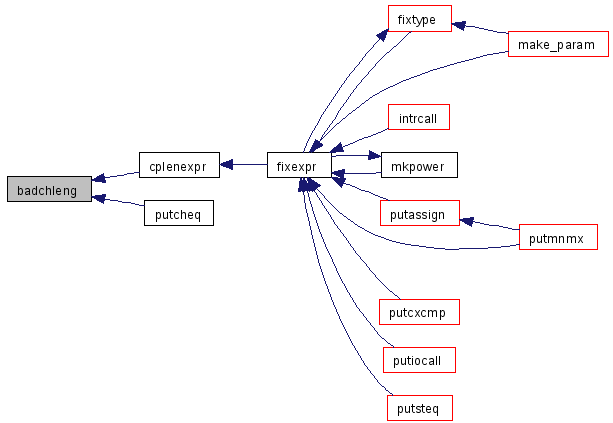
Definition at line 666 of file expr.c.
References err, errstr(), p, TADDR, and UNAM_NAME.
Referenced by cplenexpr(), and putcheq().
00668 {
00669         if (!p->headblock.vleng) {
00670                 if (p->headblock.tag == TADDR
00671                 && p->addrblock.uname_tag == UNAM_NAME)
00672                         errstr("bad use of character*(*) variable %.60s",
00673                                 p->addrblock.user.name->fvarname);
00674                 else
00675                         err("Bad use of character*(*)");
00676                 return 1;
00677                 }
00678         return 0;
00679         }
Here is the call graph for this function:

Here is the caller graph for this function:
Definition at line 2456 of file expr.c.
References badop(), err, ERR, error, is_unary_op, ISCOMPLEX, ISINT, ISLOGICAL, ISNUMERIC, maxtype(), OPABS, OPADDR, OPAND, OPARROW, OPASSIGN, OPASSIGNI, OPBITAND, OPBITANDEQ, OPBITCLR, OPBITNOT, OPBITOR, OPBITOREQ, OPBITSET, OPBITTEST, OPBITXOR, OPBITXOREQ, OPCALL, OPCCALL, OPCHARCAST, OPCOLON, OPCOMMA, OPCOMMA_ARG, OPCONCAT, OPCONV, OPDABS, OPDMAX, OPDMIN, OPDOT, OPEQ, OPEQV, OPGE, OPGT, OPIDENTITY, OPLE, OPLSHIFT, OPLSHIFTEQ, OPLT, OPMAX, OPMAX2, OPMIN, OPMIN2, OPMINUS, OPMINUSEQ, OPMOD, OPMODEQ, OPNE, OPNEG, OPNEG1, OPNEQV, OPNOT, OPOR, OPPLUS, OPPLUSEQ, OPPOWER, OPQBITCLR, OPQBITSET, OPQUEST, OPRSHIFT, OPRSHIFTEQ, OPSLASH, OPSLASHEQ, OPSTAR, OPSTAREQ, OPWHATSIN, TYADDR, TYCHAR, TYERROR, TYLOGICAL, TYLONG, TYQUAD, and TYUNKNOWN.
Referenced by fixexpr(), mkexpr(), and setdata().
02458 {
02459         char *errs;
02460
02461         if(lt==TYERROR || rt==TYERROR)
02462                 goto error1;
02463
02464         if(lt==TYUNKNOWN)
02465                 return(TYUNKNOWN);
02466         if(rt==TYUNKNOWN)
02467
02468 /* If not unary operation, return UNKNOWN */
02469
02470                 if(!is_unary_op (op) && op != OPCALL && op != OPCCALL)
02471                         return(TYUNKNOWN);
02472
02473         switch(op)
02474         {
02475         case OPPLUS:
02476         case OPMINUS:
02477         case OPSTAR:
02478         case OPSLASH:
02479         case OPPOWER:
02480         case OPMOD:
02481                 if( ISNUMERIC(lt) && ISNUMERIC(rt) )
02482                         return( maxtype(lt, rt) );
02483                 ERR("nonarithmetic operand of arithmetic operator")
02484
02485         case OPNEG:
02486         case OPNEG1:
02487                 if( ISNUMERIC(lt) )
02488                         return(lt);
02489                 ERR("nonarithmetic operand of negation")
02490
02491         case OPNOT:
02492                 if(ISLOGICAL(lt))
02493                         return(lt);
02494                 ERR("NOT of nonlogical")
02495
02496         case OPAND:
02497         case OPOR:
02498         case OPEQV:
02499         case OPNEQV:
02500                 if(ISLOGICAL(lt) && ISLOGICAL(rt))
02501                         return( maxtype(lt, rt) );
02502                 ERR("nonlogical operand of logical operator")
02503
02504         case OPLT:
02505         case OPGT:
02506         case OPLE:
02507         case OPGE:
02508         case OPEQ:
02509         case OPNE:
02510                 if(lt==TYCHAR || rt==TYCHAR || ISLOGICAL(lt) || ISLOGICAL(rt))
02511                 {
02512                         if(lt != rt){
02513                                 if (htype
02514                                         && (lt == TYCHAR && ISNUMERIC(rt)
02515                                          || rt == TYCHAR && ISNUMERIC(lt)))
02516                                                 return TYLOGICAL;
02517                                 ERR("illegal comparison")
02518                                 }
02519                 }
02520
02521                 else if( ISCOMPLEX(lt) || ISCOMPLEX(rt) )
02522                 {
02523                         if(op!=OPEQ && op!=OPNE)
02524                                 ERR("order comparison of complex data")
02525                 }
02526
02527                 else if( ! ISNUMERIC(lt) || ! ISNUMERIC(rt) )
02528                         ERR("comparison of nonarithmetic data")
02529         case OPBITTEST:
02530                 return(TYLOGICAL);
02531
02532         case OPCONCAT:
02533                 if(lt==TYCHAR && rt==TYCHAR)
02534                         return(TYCHAR);
02535                 ERR("concatenation of nonchar data")
02536
02537         case OPCALL:
02538         case OPCCALL:
02539         case OPIDENTITY:
02540                 return(lt);
02541
02542         case OPADDR:
02543         case OPCHARCAST:
02544                 return(TYADDR);
02545
02546         case OPCONV:
02547                 if(rt == 0)
02548                         return(0);
02549                 if(lt==TYCHAR && ISINT(rt) )
02550                         return(TYCHAR);
02551                 if (ISLOGICAL(lt) && ISLOGICAL(rt)
02552                 ||  ISINT(lt) && rt == TYCHAR)
02553                         return lt;
02554         case OPASSIGN:
02555         case OPASSIGNI:
02556         case OPMINUSEQ:
02557         case OPPLUSEQ:
02558         case OPSTAREQ:
02559         case OPSLASHEQ:
02560         case OPMODEQ:
02561         case OPLSHIFTEQ:
02562         case OPRSHIFTEQ:
02563         case OPBITANDEQ:
02564         case OPBITXOREQ:
02565         case OPBITOREQ:
02566                 if (ISLOGICAL(lt) && ISLOGICAL(rt) && op == OPASSIGN)
02567                         return lt;
02568                 if(lt==TYCHAR || rt==TYCHAR || ISLOGICAL(lt) || ISLOGICAL(rt))
02569                         if((op!=OPASSIGN && op != OPPLUSEQ && op != OPMINUSEQ)
02570                             || (lt!=rt))
02571                         {
02572                                 ERR("impossible conversion")
02573                         }
02574                 return(lt);
02575
02576         case OPMIN:
02577         case OPMAX:
02578         case OPDMIN:
02579         case OPDMAX:
02580         case OPMIN2:
02581         case OPMAX2:
02582         case OPBITOR:
02583         case OPBITAND:
02584         case OPBITXOR:
02585         case OPBITNOT:
02586         case OPLSHIFT:
02587         case OPRSHIFT:
02588         case OPWHATSIN:
02589         case OPABS:
02590         case OPDABS:
02591                 return(lt);
02592
02593         case OPBITCLR:
02594         case OPBITSET:
02595 #ifdef TYQUAD0
02596         case OPQBITCLR:
02597         case OPQBITSET:
02598 #endif
02599                 if (lt < TYLONG)
02600                         lt = TYLONG;
02601                 return(lt);
02602 #ifndef NO_LONG_LONG
02603         case OPQBITCLR:
02604         case OPQBITSET:
02605                 return TYQUAD;
02606 #endif
02607
02608         case OPCOMMA:
02609         case OPCOMMA_ARG:
02610         case OPQUEST:
02611         case OPCOLON:           /* Only checks the rightmost type because
02612                                    of C language definition (rightmost
02613                                    comma-expr is the value of the expr) */
02614                 return(rt);
02615
02616         case OPDOT:
02617         case OPARROW:
02618             return (lt);
02619         default:
02620                 badop("cktype", op);
02621         }
02622 error:
02623         err(errs);
02624 error1:
02625         return(TYERROR);
02626 }
Here is the call graph for this function:

Here is the caller graph for this function:

Definition at line 3236 of file expr.c.
References a, b, Constant::cd, Constant::cds, Constant::ci, Constblock::Const, Constant::cq, Fatal(), intovfl(), ISCOMPLEX, ISINT, MSKCOMPLEX, MSKREAL, ONEOF, OPDMAX, OPDMIN, OPEQ, OPGE, OPGT, OPLE, OPLT, OPMAX2, OPMIN2, OPMINUS, OPMOD, OPNE, OPPLUS, OPSLASH, OPSTAR, TYCOMPLEX, TYDCOMPLEX, TYDREAL, TYINT1, TYLOGICAL, TYLONG, TYQUAD, TYREAL, TYSHORT, Constblock::vstg, and zdiv().
Referenced by conspower(), and fold().
03238 {
03239         union Constant *ap = &app->Const,
03240                                 *bp = &bpp->Const,
03241                                 *cp = &cpp->Const;
03242         ftnint k;
03243         double ad[2], bd[2], temp;
03244         ftnint a, b;
03245 #ifndef NO_LONG_LONG
03246         Llong aL, bL;
03247 #endif
03248
03249         cpp->vstg = 0;
03250
03251         if (ONEOF(type, MSKREAL|MSKCOMPLEX)) {
03252                 ad[0] = app->vstg ? atof(ap->cds[0]) : ap->cd[0];
03253                 bd[0] = bpp->vstg ? atof(bp->cds[0]) : bp->cd[0];
03254                 if (ISCOMPLEX(type)) {
03255                         ad[1] = app->vstg ? atof(ap->cds[1]) : ap->cd[1];
03256                         bd[1] = bpp->vstg ? atof(bp->cds[1]) : bp->cd[1];
03257                         }
03258                 }
03259         switch(opcode)
03260         {
03261         case OPPLUS:
03262                 switch(type)
03263                 {
03264                 case TYINT1:
03265                 case TYSHORT:
03266                 case TYLONG:
03267 #ifdef TYQUAD0
03268                 case TYQUAD:
03269 #endif
03270                         cp->ci = ap->ci + bp->ci;
03271                         if (ap->ci != cp->ci - bp->ci)
03272                                 intovfl();
03273                         break;
03274 #ifndef NO_LONG_LONG
03275                 case TYQUAD:
03276                         cp->cq = ap->cq + bp->cq;
03277                         if (ap->cq != cp->cq - bp->cq)
03278                                 intovfl();
03279                         break;
03280 #endif
03281                 case TYCOMPLEX:
03282                 case TYDCOMPLEX:
03283                         cp->cd[1] = ad[1] + bd[1];
03284                 case TYREAL:
03285                 case TYDREAL:
03286                         cp->cd[0] = ad[0] + bd[0];
03287                         break;
03288                 }
03289                 break;
03290
03291         case OPMINUS:
03292                 switch(type)
03293                 {
03294                 case TYINT1:
03295                 case TYSHORT:
03296                 case TYLONG:
03297 #ifdef TYQUAD0
03298                 case TYQUAD:
03299 #endif
03300                         cp->ci = ap->ci - bp->ci;
03301                         if (ap->ci != bp->ci + cp->ci)
03302                                 intovfl();
03303                         break;
03304 #ifndef NO_LONG_LONG
03305                 case TYQUAD:
03306                         cp->cq = ap->cq - bp->cq;
03307                         if (ap->cq != bp->cq + cp->cq)
03308                                 intovfl();
03309                         break;
03310 #endif
03311                 case TYCOMPLEX:
03312                 case TYDCOMPLEX:
03313                         cp->cd[1] = ad[1] - bd[1];
03314                 case TYREAL:
03315                 case TYDREAL:
03316                         cp->cd[0] = ad[0] - bd[0];
03317                         break;
03318                 }
03319                 break;
03320
03321         case OPSTAR:
03322                 switch(type)
03323                 {
03324                 case TYINT1:
03325                 case TYSHORT:
03326                 case TYLONG:
03327 #ifdef TYQUAD0
03328                 case TYQUAD:
03329 #endif
03330                         cp->ci = (a = ap->ci) * (b = bp->ci);
03331                         if (a && cp->ci / a != b)
03332                                 intovfl();
03333                         break;
03334 #ifndef NO_LONG_LONG
03335                 case TYQUAD:
03336                         cp->cq = (aL = ap->cq) * (bL = bp->cq);
03337                         if (aL && cp->cq / aL != bL)
03338                                 intovfl();
03339                         break;
03340 #endif
03341                 case TYREAL:
03342                 case TYDREAL:
03343                         cp->cd[0] = ad[0] * bd[0];
03344                         break;
03345                 case TYCOMPLEX:
03346                 case TYDCOMPLEX:
03347                         temp = ad[0] * bd[0]  -  ad[1] * bd[1] ;
03348                         cp->cd[1] = ad[0] * bd[1]  +  ad[1] * bd[0] ;
03349                         cp->cd[0] = temp;
03350                         break;
03351                 }
03352                 break;
03353         case OPSLASH:
03354                 switch(type)
03355                 {
03356                 case TYINT1:
03357                 case TYSHORT:
03358                 case TYLONG:
03359 #ifdef TYQUAD0
03360                 case TYQUAD:
03361 #endif
03362                         cp->ci = ap->ci / bp->ci;
03363                         break;
03364 #ifndef NO_LONG_LONG
03365                 case TYQUAD:
03366                         cp->cq = ap->cq / bp->cq;
03367                         break;
03368 #endif
03369                 case TYREAL:
03370                 case TYDREAL:
03371                         cp->cd[0] = ad[0] / bd[0];
03372                         break;
03373                 case TYCOMPLEX:
03374                 case TYDCOMPLEX:
03375                         zdiv((dcomplex*)cp, (dcomplex*)ad, (dcomplex*)bd);
03376                         break;
03377                 }
03378                 break;
03379
03380         case OPMOD:
03381                 if( ISINT(type) )
03382                 {
03383 #ifndef NO_LONG_LONG
03384                         if (type == TYQUAD)
03385                                 cp->cq = ap->cq % bp->cq;
03386                         else
03387 #endif
03388                                 cp->ci = ap->ci % bp->ci;
03389                         break;
03390                 }
03391                 else
03392                         Fatal("inline mod of noninteger");
03393
03394         case OPMIN2:
03395         case OPDMIN:
03396                 switch(type)
03397                 {
03398                 case TYINT1:
03399                 case TYSHORT:
03400                 case TYLONG:
03401 #ifdef TYQUAD0
03402                 case TYQUAD:
03403 #endif
03404                         cp->ci = ap->ci <= bp->ci ? ap->ci : bp->ci;
03405                         break;
03406 #ifndef NO_LONG_LONG
03407                 case TYQUAD:
03408                         cp->cq = ap->cq <= bp->cq ? ap->cq : bp->cq;
03409                         break;
03410 #endif
03411                 case TYREAL:
03412                 case TYDREAL:
03413                         cp->cd[0] = ad[0] <= bd[0] ? ad[0] : bd[0];
03414                         break;
03415                 default:
03416                         Fatal("inline min of exected type");
03417                 }
03418                 break;
03419
03420         case OPMAX2:
03421         case OPDMAX:
03422                 switch(type)
03423                 {
03424                 case TYINT1:
03425                 case TYSHORT:
03426                 case TYLONG:
03427 #ifdef TYQUAD0
03428                 case TYQUAD:
03429 #endif
03430                         cp->ci = ap->ci >= bp->ci ? ap->ci : bp->ci;
03431                         break;
03432 #ifndef NO_LONG_LONG
03433                 case TYQUAD:
03434                         cp->cq = ap->cq >= bp->cq ? ap->cq : bp->cq;
03435                         break;
03436 #endif
03437                 case TYREAL:
03438                 case TYDREAL:
03439                         cp->cd[0] = ad[0] >= bd[0] ? ad[0] : bd[0];
03440                         break;
03441                 default:
03442                         Fatal("inline max of exected type");
03443                 }
03444                 break;
03445
03446         default:          /* relational ops */
03447                 switch(type)
03448                 {
03449                 case TYINT1:
03450                 case TYSHORT:
03451                 case TYLONG:
03452 #ifdef TYQUAD0
03453                 case TYQUAD:
03454 #endif
03455                         if(ap->ci < bp->ci)
03456                                 k = -1;
03457                         else if(ap->ci == bp->ci)
03458                                 k = 0;
03459                         else    k = 1;
03460                         break;
03461 #ifndef NO_LONG_LONG
03462                 case TYQUAD:
03463                         if(ap->cq < bp->cq)
03464                                 k = -1;
03465                         else if(ap->cq == bp->cq)
03466                                 k = 0;
03467                         else    k = 1;
03468                         break;
03469 #endif
03470                 case TYREAL:
03471                 case TYDREAL:
03472                         if(ad[0] < bd[0])
03473                                 k = -1;
03474                         else if(ad[0] == bd[0])
03475                                 k = 0;
03476                         else    k = 1;
03477                         break;
03478                 case TYCOMPLEX:
03479                 case TYDCOMPLEX:
03480                         if(ad[0] == bd[0] &&
03481                             ad[1] == bd[1] )
03482                                 k = 0;
03483                         else    k = 1;
03484                         break;
03485                 case TYLOGICAL:
03486                         k = ap->ci - bp->ci;
03487                 }
03488
03489                 switch(opcode)
03490                 {
03491                 case OPEQ:
03492                         cp->ci = (k == 0);
03493                         break;
03494                 case OPNE:
03495                         cp->ci = (k != 0);
03496                         break;
03497                 case OPGT:
03498                         cp->ci = (k == 1);
03499                         break;
03500                 case OPLT:
03501                         cp->ci = (k == -1);
03502                         break;
03503                 case OPGE:
03504                         cp->ci = (k >= 0);
03505                         break;
03506                 case OPLE:
03507                         cp->ci = (k <= 0);
03508                         break;
03509                 }
03510                 break;
03511         }
03512 }
Here is the call graph for this function:

Here is the caller graph for this function:

Definition at line 2955 of file expr.c.
References Constant::blanks, Constant::ccp1, Constant::cd, cds(), Constant::ci, ckalloc(), CNULL, Constblock::Const, Constant::cq, ISCOMPLEX, ISINT, ISREAL, lc, memcpy(), MSKCOMPLEX, MSKREAL, ONEOF, TYCHAR, TYCOMPLEX, TYDCOMPLEX, TYDREAL, TYINT1, TYLOGICAL, TYLOGICAL1, TYLOGICAL2, TYLONG, TYQUAD, TYREAL, TYSHORT, Constblock::vstg, and Constblock::vtype.
Referenced by fold(), mkconv(), and setdata().
02957 {
02958         int rt = rc->vtype;
02959         union Constant *lv = &lc->Const, *rv = &rc->Const;
02960
02961         lc->vtype = lt;
02962         if (ONEOF(lt, MSKREAL|MSKCOMPLEX) && ONEOF(rt, MSKREAL|MSKCOMPLEX)) {
02963                 memcpy((char *)lv, (char *)rv, sizeof(union Constant));
02964                 lc->vstg = rc->vstg;
02965                 if (ISCOMPLEX(lt) && ISREAL(rt)) {
02966                         if (rc->vstg)
02967                                 lv->cds[1] = cds("0",CNULL);
02968                         else
02969                                 lv->cd[1] = 0.;
02970                         }
02971                 return;
02972                 }
02973         lc->vstg = 0;
02974
02975         switch(lt)
02976         {
02977
02978 /* Casting to character means just copying the first sizeof (character)
02979    bytes into a new 1 character string.  This is weird. */
02980
02981         case TYCHAR:
02982                 *(lv->ccp = (char *) ckalloc(1)) = (char)rv->ci;
02983                 lv->ccp1.blanks = 0;
02984                 break;
02985
02986         case TYINT1:
02987         case TYSHORT:
02988         case TYLONG:
02989 #ifdef TYQUAD0
02990         case TYQUAD:
02991 #endif
02992                 if(rt == TYCHAR)
02993                         lv->ci = rv->ccp[0];
02994                 else if( ISINT(rt) ) {
02995 #ifndef NO_LONG_LONG
02996                         if (rt == TYQUAD)
02997                                 lv->ci = (ftnint)(rv->cq);
02998                         else
02999 #endif
03000                         lv->ci = rv->ci;
03001                         }
03002                 else    lv->ci = (ftnint)(rc->vstg
03003                                         ? atof(rv->cds[0]) : rv->cd[0]);
03004
03005                 break;
03006 #ifndef NO_LONG_LONG
03007         case TYQUAD:
03008                 if(rt == TYCHAR)
03009                         lv->cq = rv->ccp[0];
03010                 else if( ISINT(rt) ) {
03011                         if (rt == TYQUAD)
03012                                 lv->cq = rv->cq;
03013                         else
03014                                 lv->cq = rv->ci;
03015                         }
03016                 else    lv->cq = (ftnint)(rc->vstg
03017                                         ? atof(rv->cds[0]) : rv->cd[0]);
03018
03019                 break;
03020 #endif
03021
03022         case TYCOMPLEX:
03023         case TYDCOMPLEX:
03024                 lv->cd[1] = 0.;
03025
03026         case TYREAL:
03027         case TYDREAL:
03028 #ifndef NO_LONG_LONG
03029                 if (rt == TYQUAD)
03030                         lv->cd[0] = (double)(rv->cq);
03031                 else
03032 #endif
03033                 lv->cd[0] = rv->ci;
03034                 break;
03035
03036         case TYLOGICAL:
03037         case TYLOGICAL1:
03038         case TYLOGICAL2:
03039                 lv->ci = rv->ci;
03040                 break;
03041         }
03042 }
Here is the call graph for this function:

Here is the caller graph for this function:

| void consnegop | ( | Constp | p | ) |
Definition at line 3053 of file expr.c.
References badtype(), intovfl(), ISCOMPLEX, L, p, TYCOMPLEX, TYDCOMPLEX, TYDREAL, TYINT1, TYLONG, TYQUAD, TYREAL, and TYSHORT.
Referenced by fold(), mkexpr(), and yyparse().
03055 {
03056         char *s;
03057         ftnint L;
03058 #ifndef NO_LONG_LONG
03059         Llong LL;
03060 #endif
03061
03062         if (p->vstg) {
03063                 /* 20010820: comment out "*s == '0' ? s :" to preserve */
03064                 /* the sign of zero */
03065                 if (ISCOMPLEX(p->vtype)) {
03066                         s = p->Const.cds[1];
03067                         p->Const.cds[1] = *s == '-' ? s+1
03068                                         : /* *s == '0' ? s : */ s-1;
03069                         }
03070                 s = p->Const.cds[0];
03071                 p->Const.cds[0] = *s == '-' ? s+1
03072                                 : /* *s == '0' ? s : */ s-1;
03073                 return;
03074                 }
03075         switch(p->vtype)
03076         {
03077         case TYINT1:
03078         case TYSHORT:
03079         case TYLONG:
03080 #ifdef TYQUAD0
03081         case TYQUAD:
03082 #endif
03083                 p->Const.ci = -(L = p->Const.ci);
03084                 if (L != -p->Const.ci)
03085                         intovfl();
03086                 break;
03087 #ifndef NO_LONG_LONG
03088         case TYQUAD:
03089                 p->Const.cq = -(LL = p->Const.cq);
03090                 if (LL != -p->Const.cq)
03091                         intovfl();
03092                 break;
03093 #endif
03094         case TYCOMPLEX:
03095         case TYDCOMPLEX:
03096                 p->Const.cd[1] = - p->Const.cd[1];
03097                 /* fall through and do the real parts */
03098         case TYREAL:
03099         case TYDREAL:
03100                 p->Const.cd[0] = - p->Const.cd[0];
03101                 break;
03102         default:
03103                 badtype("consnegop", p->vtype);
03104         }
03105 }
Here is the call graph for this function:

Here is the caller graph for this function:

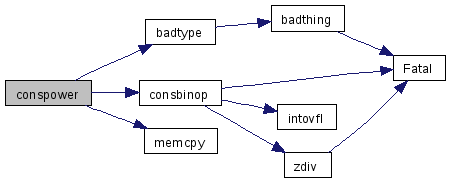
Definition at line 3118 of file expr.c.
References badtype(), Constant::cd, Constant::cds, Constant::ci, consbinop(), Constblock::Const, Constant::cq, err, ISCOMPLEX, ISINT, memcpy(), OPSLASH, OPSTAR, p, TYCOMPLEX, TYDCOMPLEX, TYDREAL, TYINT1, TYLONG, TYQUAD, TYREAL, TYSHORT, Constblock::vstg, and Constblock::vtype.
Referenced by fold().
03120 {
03121         union Constant *powp = &p->Const;
03122         int type;
03123         struct Constblock x, x0;
03124
03125         if (n == 1) {
03126                 memcpy((char *)powp, (char *)&ap->Const, sizeof(ap->Const));
03127                 return;
03128                 }
03129
03130         switch(type = ap->vtype)        /* pow = 1 */
03131         {
03132         case TYINT1:
03133         case TYSHORT:
03134         case TYLONG:
03135 #ifdef TYQUAD0
03136         case TYQUAD:
03137 #endif
03138                 powp->ci = 1;
03139                 break;
03140 #ifndef NO_LONG_LONG
03141         case TYQUAD:
03142                 powp->cq = 1;
03143                 break;
03144 #endif
03145         case TYCOMPLEX:
03146         case TYDCOMPLEX:
03147                 powp->cd[1] = 0;
03148         case TYREAL:
03149         case TYDREAL:
03150                 powp->cd[0] = 1;
03151                 break;
03152         default:
03153                 badtype("conspower", type);
03154         }
03155
03156         if(n == 0)
03157                 return;
03158         switch(type)    /* x0 = ap */
03159         {
03160         case TYINT1:
03161         case TYSHORT:
03162         case TYLONG:
03163 #ifdef TYQUAD0
03164         case TYQUAD:
03165 #endif
03166                 x0.Const.ci = ap->Const.ci;
03167                 break;
03168 #ifndef NO_LONG_LONG
03169         case TYQUAD:
03170                 x0.Const.cq = ap->Const.cq;
03171                 break;
03172 #endif
03173         case TYCOMPLEX:
03174         case TYDCOMPLEX:
03175                 x0.Const.cd[1] =
03176                         ap->vstg ? atof(ap->Const.cds[1]) : ap->Const.cd[1];
03177         case TYREAL:
03178         case TYDREAL:
03179                 x0.Const.cd[0] =
03180                         ap->vstg ? atof(ap->Const.cds[0]) : ap->Const.cd[0];
03181                 break;
03182         }
03183         x0.vtype = type;
03184         x0.vstg = 0;
03185         if(n < 0)
03186         {
03187                 n = -n;
03188                 if( ISINT(type) )
03189                 {
03190                         switch(ap->Const.ci) {
03191                                 case 0:
03192                                         err("0 ** negative number");
03193                                         return;
03194                                 case 1:
03195                                 case -1:
03196                                         goto mult;
03197                                 }
03198                         err("integer ** negative number");
03199                         return;
03200                 }
03201                 else if (!x0.Const.cd[0]
03202                                 && (!ISCOMPLEX(type) || !x0.Const.cd[1])) {
03203                         err("0.0 ** negative number");
03204                         return;
03205                         }
03206                 consbinop(OPSLASH, type, &x, p, &x0);
03207         }
03208         else
03209  mult:          consbinop(OPSTAR, type, &x, p, &x0);
03210
03211         for( ; ; )
03212         {
03213                 if(n & 01)
03214                         consbinop(OPSTAR, type, p, p, &x);
03215                 if(n >>= 1)
03216                         consbinop(OPSTAR, type, &x, &x, &x);
03217                 else
03218                         break;
03219         }
03220 }
Here is the call graph for this function:
Here is the caller graph for this function:

Definition at line 3523 of file expr.c.
References badtype(), Fatal(), ISCONST, p, TYCOMPLEX, TYDCOMPLEX, TYDREAL, TYINT1, TYLONG, TYQUAD, TYREAL, and TYSHORT.
Referenced by exdo().
03525 {
03526         char *s;
03527
03528         if( ! ISCONST(p) )
03529                 Fatal( "sgn(nonconstant)" );
03530
03531         switch(p->headblock.vtype)
03532         {
03533         case TYINT1:
03534         case TYSHORT:
03535         case TYLONG:
03536 #ifdef TYQUAD0
03537         case TYQUAD:
03538 #endif
03539                 if(p->constblock.Const.ci > 0) return(1);
03540                 if(p->constblock.Const.ci < 0) return(-1);
03541                 return(0);
03542 #ifndef NO_LONG_LONG
03543         case TYQUAD:
03544                 if(p->constblock.Const.cq > 0) return(1);
03545                 if(p->constblock.Const.cq < 0) return(-1);
03546                 return(0);
03547 #endif
03548
03549         case TYREAL:
03550         case TYDREAL:
03551                 if (p->constblock.vstg) {
03552                         s = p->constblock.Const.cds[0];
03553                         if (*s == '-')
03554                                 return -1;
03555                         if (*s == '0')
03556                                 return 0;
03557                         return 1;
03558                         }
03559                 if(p->constblock.Const.cd[0] > 0) return(1);
03560                 if(p->constblock.Const.cd[0] < 0) return(-1);
03561                 return(0);
03562
03563
03564 /* The sign of a complex number is 0 iff the number is 0 + 0i, else it's 1 */
03565
03566         case TYCOMPLEX:
03567         case TYDCOMPLEX:
03568                 if (p->constblock.vstg)
03569                         return *p->constblock.Const.cds[0] != '0'
03570                             && *p->constblock.Const.cds[1] != '0';
03571                 return(p->constblock.Const.cd[0]!=0 || p->constblock.Const.cd[1]!=0);
03572
03573         default:
03574                 badtype( "conssgn", p->constblock.vtype);
03575         }
03576         /* NOT REACHED */ return 0;
03577 }
Here is the call graph for this function:

Here is the caller graph for this function:

Definition at line 425 of file expr.c.
References Expression::addrblock, Primblock::argsp, badtag(), CHNULL, Constant::ci, Constblock::Const, Expression::constblock, copyn(), cpblock(), Expression::exprblock, Primblock::fcharp, frexpr(), Addrblock::istemp, Primblock::lcharp, Exprblock::leftp, Expression::listblock, Listblock::listp, Addrblock::memoffset, mkchain(), Chain::nextp, NO, NULL, p, pp, Expression::primblock, Exprblock::rightp, TADDR, Errorblock::tag, TCONST, TERROR, TEXPR, TLIST, TNAME, TPRIM, TYCHAR, Addrblock::vleng, Constblock::vleng, and Constblock::vtype.
Referenced by add_extern_to_list(), cast_args(), copy_data(), cplenexpr(), declare_new_addr(), dofclose(), dofinquire(), dofmove(), dofopen(), doiolist(), endio(), exarif(), exdo(), imagpart(), Inline(), intdouble(), iosetc(), iosetip(), iosetlc(), krput(), mkaddr(), mkfunct(), mklhs(), mkplace(), mkprim(), mkscalar(), mktmp(), nextdata(), p1_const(), p1_subr_ret(), prolog(), putcall(), putcat(), putch1(), putconst(), putct1(), putcx1(), putiocall(), putmnmx(), putop(), putpower(), putsteq(), realpart(), ref_defs(), retval(), startrw(), stfcall(), subcheck(), suboffset(), subskept(), and yyparse().
00427 {
00428         tagptr e;
00429         int tag;
00430         chainp ep, pp;
00431
00432 /* This table depends on the ordering of the T macros, e.g. TNAME */
00433
00434         static int blksize[ ] =
00435         {
00436                 0,
00437                 sizeof(struct Nameblock),
00438                 sizeof(struct Constblock),
00439                 sizeof(struct Exprblock),
00440                 sizeof(struct Addrblock),
00441                 sizeof(struct Primblock),
00442                 sizeof(struct Listblock),
00443                 sizeof(struct Impldoblock),
00444                 sizeof(struct Errorblock)
00445         };
00446
00447         if(p == NULL)
00448                 return(NULL);
00449
00450 /* TNAMEs are special, and don't get copied.  Each name in the current
00451    symbol table has a unique TNAME structure. */
00452
00453         if( (tag = p->tag) == TNAME)
00454                 return(p);
00455
00456         e = cpblock(blksize[p->tag], (char *)p);
00457
00458         switch(tag)
00459         {
00460         case TCONST:
00461                 if(e->constblock.vtype == TYCHAR)
00462                 {
00463                         e->constblock.Const.ccp =
00464                             copyn((int)e->constblock.vleng->constblock.Const.ci+1,
00465                                 e->constblock.Const.ccp);
00466                         e->constblock.vleng =
00467                             (expptr) cpexpr(e->constblock.vleng);
00468                 }
00469         case TERROR:
00470                 break;
00471
00472         case TEXPR:
00473                 e->exprblock.leftp =  (expptr) cpexpr(p->exprblock.leftp);
00474                 e->exprblock.rightp = (expptr) cpexpr(p->exprblock.rightp);
00475                 break;
00476
00477         case TLIST:
00478                 if(pp = p->listblock.listp)
00479                 {
00480                         ep = e->listblock.listp =
00481                             mkchain((char *)cpexpr((tagptr)pp->datap), CHNULL);
00482                         for(pp = pp->nextp ; pp ; pp = pp->nextp)
00483                                 ep = ep->nextp =
00484                                     mkchain((char *)cpexpr((tagptr)pp->datap),
00485                                                 CHNULL);
00486                 }
00487                 break;
00488
00489         case TADDR:
00490                 e->addrblock.vleng = (expptr)  cpexpr(e->addrblock.vleng);
00491                 e->addrblock.memoffset = (expptr)cpexpr(e->addrblock.memoffset);
00492                 e->addrblock.istemp = NO;
00493                 break;
00494
00495         case TPRIM:
00496                 e->primblock.argsp = (struct Listblock *)
00497                     cpexpr((expptr)e->primblock.argsp);
00498                 e->primblock.fcharp = (expptr) cpexpr(e->primblock.fcharp);
00499                 e->primblock.lcharp = (expptr) cpexpr(e->primblock.lcharp);
00500                 break;
00501
00502         default:
00503                 badtag("cpexpr", tag);
00504         }
00505
00506         return(e);
00507 }
Here is the call graph for this function:

Here is the caller graph for this function:

Definition at line 687 of file expr.c.
References badchleng(), Constant::ci, Constblock::Const, Expression::constblock, cpexpr(), ICON, ISCONST, p, and TYCHAR.
Referenced by fixexpr().
00689 {
00690         expptr rv;
00691
00692         if (badchleng(p))
00693                 return ICON(1);
00694         rv = cpexpr(p->headblock.vleng);
00695         if (ISCONST(p) && p->constblock.vtype == TYCHAR)
00696                 rv->constblock.Const.ci += p->constblock.Const.ccp1.blanks;
00697         return rv;
00698         }
Here is the call graph for this function:

Here is the caller graph for this function:

| void deregister | ( | Namep | np | ) |
| expptr errnode | ( | Void | ) |
Definition at line 931 of file expr.c.
References Primblock::argsp, CLPROC, Primblock::fcharp, fixtype(), Primblock::lcharp, Listblock::listp, memversion(), mkaddr(), mkscalar(), Primblock::namep, NULL, p, Expression::primblock, PTHISPROC, putconst(), sserr(), t, Expression::tag, TCONST, TPRIM, TYCHAR, Nameblock::vclass, Nameblock::vdim, Nameblock::vdovar, Nameblock::vprocclass, and Nameblock::vtype.
Referenced by intrcall(), and mkfunct().
00934 {
00935         chainp p;
00936         tagptr q, t;
00937         int qtag, nargs;
00938
00939         nargs = 0;
00940         if(p0)
00941                 for(p = p0->listp ; p ; p = p->nextp)
00942                 {
00943                         ++nargs;
00944                         q = (tagptr)p->datap;
00945                         qtag = q->tag;
00946                         if(qtag == TCONST)
00947                         {
00948
00949 /* Call putconst() to store values in a constant table.  Since even
00950    constants must be passed by reference, this can optimize on the storage
00951    required */
00952
00953                                 p->datap = doput ? (char *)putconst((Constp)q)
00954                                                  : (char *)q;
00955                                 continue;
00956                         }
00957
00958 /* Take a function name and turn it into an Addr.  This only happens when
00959    nothing else has figured out the function beforehand */
00960
00961                         if (qtag == TPRIM && q->primblock.argsp == 0) {
00962                             if (q->primblock.namep->vclass==CLPROC
00963                              && q->primblock.namep->vprocclass != PTHISPROC) {
00964                                 p->datap = (char *)mkaddr(q->primblock.namep);
00965                                 continue;
00966                                 }
00967
00968                             if (q->primblock.namep->vdim != NULL) {
00969                                 p->datap = (char *)mkscalar(q->primblock.namep);
00970                                 if ((q->primblock.fcharp||q->primblock.lcharp)
00971                                  && (q->primblock.namep->vtype != TYCHAR
00972                                   || q->primblock.namep->vdim))
00973                                         sserr(q->primblock.namep);
00974                                 continue;
00975                                 }
00976
00977                             if (q->primblock.namep->vdovar
00978                              && (t = (tagptr) memversion(q->primblock.namep))) {
00979                                 p->datap = (char *)fixtype(t);
00980                                 continue;
00981                                 }
00982                             }
00983                         p->datap = (char *)fixtype(q);
00984                 }
00985         return(nargs);
00986 }
Here is the call graph for this function:

Here is the caller graph for this function:

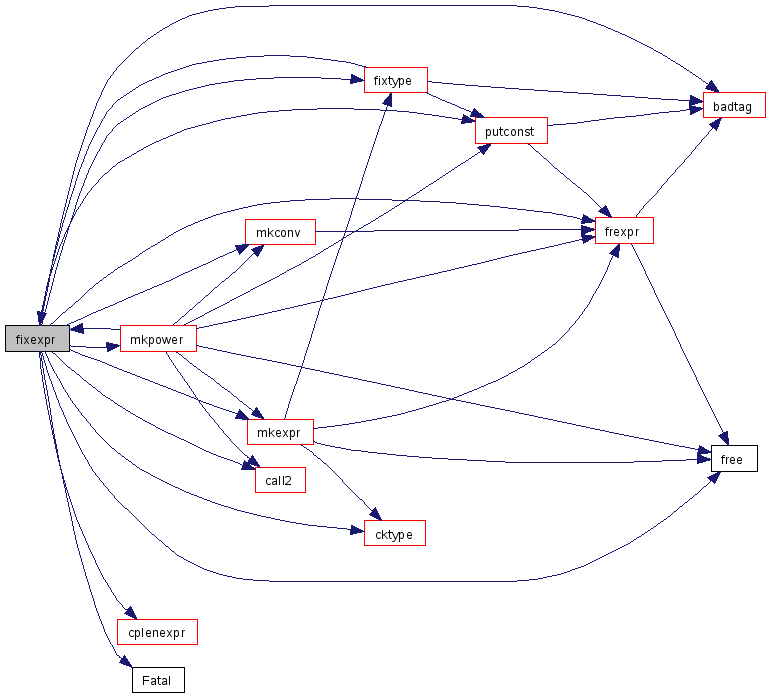
Definition at line 710 of file expr.c.
References badtag(), call2(), cktype(), Expression::constblock, cplenexpr(), err, errnode, Fatal(), fixtype(), free(), frexpr(), halign, Expression::headblock, ISCOMPLEX, ISCONST, ISERROR, ISLOGICAL, ISREAL, lp, mkconv(), mkexpr(), mkpower(), MSKADDR, MSKINT, NULL, ONEOF, OPABS, OPADDR, OPASSIGN, OPCOLON, OPCOMMA, OPCONCAT, OPCONV, OPDABS, OPDMAX, OPDMIN, OPEQ, OPGE, OPGT, OPLE, OPLT, OPMAX, OPMAX2, OPMIN, OPMIN2, OPMINUS, OPMOD, OPNE, OPPLUS, OPPLUSEQ, OPPOWER, OPQUEST, OPSLASH, OPSTAR, OPSTAREQ, p, putconst(), TADDR, Constblock::tag, TEXPR, TYCHAR, TYCOMPLEX, TYDREAL, TYERROR, typesize, TYREAL, Headblock::vtype, and Constblock::vtype.
Referenced by fixtype(), intrcall(), make_param(), mkpower(), putassign(), putcxcmp(), putiocall(), putmnmx(), and putsteq().
00712 {
00713         expptr lp, rp, q;
00714         char *hsave;
00715         int opcode, ltype, rtype, ptype, mtype;
00716
00717         if( ISERROR(p) || p->typefixed )
00718                 return( (expptr) p );
00719         else if(p->tag != TEXPR)
00720                 badtag("fixexpr", p->tag);
00721         opcode = p->opcode;
00722
00723 /* First set the types of the left and right subexpressions */
00724
00725         lp = p->leftp;
00726         if (!ISCONST(lp) || lp->constblock.vtype != TYCHAR)
00727                 lp = p->leftp = fixtype(lp);
00728         ltype = lp->headblock.vtype;
00729
00730         if(opcode==OPASSIGN && lp->tag!=TADDR)
00731         {
00732                 err("left side of assignment must be variable");
00733  eret:
00734                 frexpr((expptr)p);
00735                 return( errnode() );
00736         }
00737
00738         if(rp = p->rightp)
00739         {
00740                 if (!ISCONST(rp) || rp->constblock.vtype != TYCHAR)
00741                         rp = p->rightp = fixtype(rp);
00742                 rtype = rp->headblock.vtype;
00743         }
00744         else
00745                 rtype = 0;
00746
00747         if(ltype==TYERROR || rtype==TYERROR)
00748                 goto eret;
00749
00750 /* Now work on the whole expression */
00751
00752         /* force folding if possible */
00753
00754         if( ISCONST(lp) && (rp==NULL || ISCONST(rp)) )
00755         {
00756                 q = opcode == OPCONV && lp->constblock.vtype == p->vtype
00757                         ? lp : mkexpr(opcode, lp, rp);
00758
00759 /* mkexpr is expected to reduce constant expressions */
00760
00761                 if( ISCONST(q) ) {
00762                         p->leftp = p->rightp = 0;
00763                         frexpr((expptr)p);
00764                         return(q);
00765                         }
00766                 free( (charptr) q );    /* constants did not fold */
00767         }
00768
00769         if( (ptype = cktype(opcode, ltype, rtype)) == TYERROR)
00770                 goto eret;
00771
00772         if (ltype == TYCHAR && ISCONST(lp)) {
00773                 if (opcode == OPCONV) {
00774                         hsave = halign;
00775                         halign = 0;
00776                         lp = (expptr)putconst((Constp)lp);
00777                         halign = hsave;
00778                         }
00779                 else
00780                         lp = (expptr)putconst((Constp)lp);
00781                 p->leftp = lp;
00782                 }
00783         if (rtype == TYCHAR && ISCONST(rp))
00784                 p->rightp = rp = (expptr)putconst((Constp)rp);
00785
00786         switch(opcode)
00787         {
00788         case OPCONCAT:
00789                 if(p->vleng == NULL)
00790                         p->vleng = mkexpr(OPPLUS, cplenexpr(lp),
00791                                         cplenexpr(rp) );
00792                 break;
00793
00794         case OPASSIGN:
00795                 if (rtype == TYREAL || ISLOGICAL(ptype)
00796                  || rtype == TYDREAL && ltype == TYREAL && !ISCONST(rp))
00797                         break;
00798         case OPPLUSEQ:
00799         case OPSTAREQ:
00800                 if(ltype == rtype)
00801                         break;
00802                 if( ! ISCONST(rp) && ISREAL(ltype) && ISREAL(rtype) )
00803                         break;
00804                 if( ISCOMPLEX(ltype) || ISCOMPLEX(rtype) )
00805                         break;
00806                 if( ONEOF(ltype, MSKADDR|MSKINT) && ONEOF(rtype, MSKADDR|MSKINT)
00807                     && typesize[ltype]>=typesize[rtype] )
00808                             break;
00809
00810 /* Cast the right hand side to match the type of the expression */
00811
00812                 p->rightp = fixtype( mkconv(ptype, rp) );
00813                 break;
00814
00815         case OPSLASH:
00816                 if( ISCOMPLEX(rtype) )
00817                 {
00818                         p = (Exprp) call2(ptype,
00819
00820 /* Handle double precision complex variables */
00821
00822                             (char*)(ptype == TYCOMPLEX ? "c_div" : "z_div"),
00823                             mkconv(ptype, lp), mkconv(ptype, rp) );
00824                         break;
00825                 }
00826         case OPPLUS:
00827         case OPMINUS:
00828         case OPSTAR:
00829         case OPMOD:
00830                 if(ptype==TYDREAL && ( (ltype==TYREAL && ! ISCONST(lp) ) ||
00831                     (rtype==TYREAL && ! ISCONST(rp) ) ))
00832                         break;
00833                 if( ISCOMPLEX(ptype) )
00834                         break;
00835
00836 /* Cast both sides of the expression to match the type of the whole
00837    expression.  */
00838
00839                 if(ltype != ptype && (ltype < TYINT1 || ptype > TYDREAL))
00840                         p->leftp = fixtype(mkconv(ptype,lp));
00841                 if(rtype != ptype && (rtype < TYINT1 || ptype > TYDREAL))
00842                         p->rightp = fixtype(mkconv(ptype,rp));
00843                 break;
00844
00845         case OPPOWER:
00846                 rp = mkpower((expptr)p);
00847                 if (rp->tag == TEXPR)
00848                         rp->exprblock.typefixed = 1;
00849                 return rp;
00850
00851         case OPLT:
00852         case OPLE:
00853         case OPGT:
00854         case OPGE:
00855         case OPEQ:
00856         case OPNE:
00857                 if(ltype == rtype)
00858                         break;
00859                 if (htype) {
00860                         if (ltype == TYCHAR) {
00861                                 p->leftp = fixtype(mkconv(rtype,lp));
00862                                 break;
00863                                 }
00864                         if (rtype == TYCHAR) {
00865                                 p->rightp = fixtype(mkconv(ltype,rp));
00866                                 break;
00867                                 }
00868                         }
00869                 mtype = cktype(OPMINUS, ltype, rtype);
00870                 if(mtype==TYDREAL && (ltype==TYREAL || rtype==TYREAL))
00871                         break;
00872                 if( ISCOMPLEX(mtype) )
00873                         break;
00874                 if(ltype != mtype)
00875                         p->leftp = fixtype(mkconv(mtype,lp));
00876                 if(rtype != mtype)
00877                         p->rightp = fixtype(mkconv(mtype,rp));
00878                 break;
00879
00880         case OPCONV:
00881                 ptype = cktype(OPCONV, p->vtype, ltype);
00882                 if(lp->tag==TEXPR && lp->exprblock.opcode==OPCOMMA
00883                  && !ISCOMPLEX(ptype))
00884                 {
00885                         lp->exprblock.rightp =
00886                             fixtype( mkconv(ptype, lp->exprblock.rightp) );
00887                         free( (charptr) p );
00888                         p = (Exprp) lp;
00889                 }
00890                 break;
00891
00892         case OPADDR:
00893                 if(lp->tag==TEXPR && lp->exprblock.opcode==OPADDR)
00894                         Fatal("addr of addr");
00895                 break;
00896
00897         case OPCOMMA:
00898         case OPQUEST:
00899         case OPCOLON:
00900                 break;
00901
00902         case OPMIN:
00903         case OPMAX:
00904         case OPMIN2:
00905         case OPMAX2:
00906         case OPDMIN:
00907         case OPDMAX:
00908         case OPABS:
00909         case OPDABS:
00910                 ptype = p->vtype;
00911                 break;
00912
00913         default:
00914                 break;
00915         }
00916
00917         p->vtype = ptype;
00918         p->typefixed = 1;
00919         return((expptr) p);
00920 }
Here is the call graph for this function:
Here is the caller graph for this function:

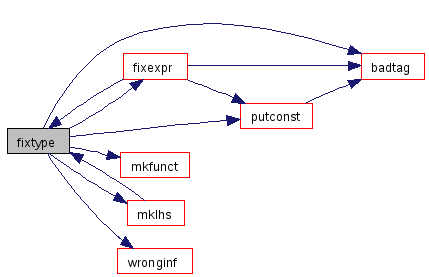
Definition at line 601 of file expr.c.
References badtag(), CLVAR, err, errnode, fixexpr(), keepsubs, mkfunct(), mklhs(), MSKADDR, MSKINT, MSKLOGICAL, MSKREAL, ONEOF, p, putconst(), TADDR, TCONST, TERROR, TEXPR, TLIST, TPRIM, TYSUBR, and wronginf().
Referenced by dim_finish(), doiolist(), exar2(), exarif(), excall(), exdo(), exequals(), exreturn(), fixargs(), fixexpr(), ioclause(), iosetc(), make_param(), mkexpr(), mklhs(), nextdata(), prolog(), putaddr(), putexpr(), putif(), putio(), putwhile(), retval(), startrw(), stfcall(), suboffset(), subskept(), and yyparse().
00603 {
00604
00605         if(p == 0)
00606                 return(0);
00607
00608         switch(p->tag)
00609         {
00610         case TCONST:
00611                 if(ONEOF(p->constblock.vtype,MSKINT|MSKLOGICAL|MSKADDR|
00612                     MSKREAL) )
00613                         return( (expptr) p);
00614
00615                 return( (expptr) putconst((Constp)p) );
00616
00617         case TADDR:
00618                 p->addrblock.memoffset = fixtype(p->addrblock.memoffset);
00619                 return( (expptr) p);
00620
00621         case TERROR:
00622                 return( (expptr) p);
00623
00624         default:
00625                 badtag("fixtype", p->tag);
00626
00627 /* This case means that   fixexpr   can't call   fixtype   with any expr,
00628    only a subexpr of its parameter. */
00629
00630         case TEXPR:
00631                 if (((Exprp)p)->typefixed)
00632                         return (expptr)p;
00633                 return( fixexpr((Exprp)p) );
00634
00635         case TLIST:
00636                 return( (expptr) p );
00637
00638         case TPRIM:
00639                 if(p->primblock.argsp && p->primblock.namep->vclass!=CLVAR)
00640                 {
00641                         if(p->primblock.namep->vtype == TYSUBR)
00642                         {
00643                                 err("function invocation of subroutine");
00644                                 return( errnode() );
00645                         }
00646                         else {
00647                                 if (p->primblock.namep->vinftype)
00648                                         wronginf(p->primblock.namep);
00649                                 return( mkfunct(p) );
00650                                 }
00651                 }
00652
00653 /* The lack of args makes   p   a function name, substring reference
00654    or variable name. */
00655
00656                 else    return mklhs((struct Primblock *) p, keepsubs);
00657         }
00658 }
Here is the call graph for this function:
Here is the caller graph for this function:

Definition at line 2659 of file expr.c.
References ALLOC, badop(), Constant::blanks, Constant::ccp1, Constant::ci, ckalloc(), cmpstr(), consbinop(), consconv(), consnegop(), conspower(), Constblock::Const, Expression::constblock, Expression::exprblock, free(), frexpr(), Expression::headblock, i, ICON, int, intovfl(), ISINT, L, Exprblock::leftp, lp, lr, LRget(), maxtype(), OPABS, OPADDR, OPAND, OPBITAND, OPBITCLR, OPBITNOT, OPBITOR, OPBITSET, OPBITTEST, OPBITXOR, Exprblock::opcode, OPCOLON, OPCOMMA, OPCOMMA_ARG, OPCONCAT, OPCONV, OPDABS, OPEQV, OPLSHIFT, OPNEG, OPNEG1, OPNEQV, OPNOT, OPOR, OPPOWER, OPQUEST, OPRSHIFT, OPSLASH, p, Exprblock::rightp, TCONST, TYCHAR, TYCOMPLEX, TYDCOMPLEX, TYDREAL, tyint, TYINT1, TYLONG, TYQUAD, TYREAL, TYSHORT, Constblock::vleng, Exprblock::vleng, Headblock::vtype, Exprblock::vtype, and zeroconst().
Referenced by mkexpr(), and putop().
02661 {
02662         Constp p;
02663         expptr lp, rp;
02664         int etype, mtype, ltype, rtype, opcode;
02665         ftnint i, bl, ll, lr;
02666         char *q, *s;
02667         struct Constblock lcon, rcon;
02668         ftnint L;
02669         double d;
02670 #ifndef NO_LONG_LONG
02671         Llong LL, LR;
02672 #endif
02673
02674         opcode = e->exprblock.opcode;
02675         etype = e->exprblock.vtype;
02676
02677         lp = e->exprblock.leftp;
02678         ltype = lp->headblock.vtype;
02679         rp = e->exprblock.rightp;
02680
02681         if(rp == 0)
02682                 switch(opcode)
02683                 {
02684                 case OPNOT:
02685 #ifndef NO_LONG_LONG
02686                         if (ltype == TYQUAD)
02687                          lp->constblock.Const.cq = ! lp->constblock.Const.cq;
02688                         else
02689 #endif
02690                          lp->constblock.Const.ci = ! lp->constblock.Const.ci;
02691  retlp:
02692                         e->exprblock.leftp = 0;
02693                         frexpr(e);
02694                         return(lp);
02695
02696                 case OPBITNOT:
02697 #ifndef NO_LONG_LONG
02698                         if (ltype == TYQUAD)
02699                          lp->constblock.Const.cq = ~ lp->constblock.Const.cq;
02700                         else
02701 #endif
02702                         lp->constblock.Const.ci = ~ lp->constblock.Const.ci;
02703                         goto retlp;
02704
02705                 case OPNEG:
02706                 case OPNEG1:
02707                         consnegop((Constp)lp);
02708                         goto retlp;
02709
02710                 case OPCONV:
02711                 case OPADDR:
02712                         return(e);
02713
02714                 case OPABS:
02715                 case OPDABS:
02716                         switch(ltype) {
02717                             case TYINT1:
02718                             case TYSHORT:
02719                             case TYLONG:
02720                                 if ((L = lp->constblock.Const.ci) < 0) {
02721                                         lp->constblock.Const.ci = -L;
02722                                         if (L != -lp->constblock.Const.ci)
02723                                                 intovfl();
02724                                         }
02725                                 goto retlp;
02726 #ifndef NO_LONG_LONG
02727                             case TYQUAD:
02728                                 if ((LL = lp->constblock.Const.cq) < 0) {
02729                                         lp->constblock.Const.cq = -LL;
02730                                         if (LL != -lp->constblock.Const.cq)
02731                                                 intovfl();
02732                                         }
02733                                 goto retlp;
02734 #endif
02735                             case TYREAL:
02736                             case TYDREAL:
02737                                 if (lp->constblock.vstg) {
02738                                     s = lp->constblock.Const.cds[0];
02739                                     if (*s == '-')
02740                                         lp->constblock.Const.cds[0] = s + 1;
02741                                     goto retlp;
02742                                 }
02743                                 if ((d = lp->constblock.Const.cd[0]) < 0.)
02744                                         lp->constblock.Const.cd[0] = -d;
02745                             case TYCOMPLEX:
02746                             case TYDCOMPLEX:
02747                                 return e;       /* lazy way out */
02748                             }
02749                 default:
02750                         badop("fold", opcode);
02751                 }
02752
02753         rtype = rp->headblock.vtype;
02754
02755         p = ALLOC(Constblock);
02756         p->tag = TCONST;
02757         p->vtype = etype;
02758         p->vleng = e->exprblock.vleng;
02759
02760         switch(opcode)
02761         {
02762         case OPCOMMA:
02763         case OPCOMMA_ARG:
02764         case OPQUEST:
02765         case OPCOLON:
02766                 goto ereturn;
02767
02768         case OPAND:
02769                 p->Const.ci = lp->constblock.Const.ci &&
02770                     rp->constblock.Const.ci;
02771                 break;
02772
02773         case OPOR:
02774                 p->Const.ci = lp->constblock.Const.ci ||
02775                     rp->constblock.Const.ci;
02776                 break;
02777
02778         case OPEQV:
02779                 p->Const.ci = lp->constblock.Const.ci ==
02780                     rp->constblock.Const.ci;
02781                 break;
02782
02783         case OPNEQV:
02784                 p->Const.ci = lp->constblock.Const.ci !=
02785                     rp->constblock.Const.ci;
02786                 break;
02787
02788         case OPBITAND:
02789 #ifndef NO_LONG_LONG
02790                 if (etype == TYQUAD) {
02791                         LRget(&LL, &LR, lp, rp);
02792                         p->Const.cq = LL & LR;
02793                         }
02794                 else
02795 #endif
02796                 p->Const.ci = lp->constblock.Const.ci &
02797                     rp->constblock.Const.ci;
02798                 break;
02799
02800         case OPBITOR:
02801 #ifndef NO_LONG_LONG
02802                 if (etype == TYQUAD) {
02803                         LRget(&LL, &LR, lp, rp);
02804                         p->Const.cq = LL | LR;
02805                         }
02806                 else
02807 #endif
02808                 p->Const.ci = lp->constblock.Const.ci |
02809                     rp->constblock.Const.ci;
02810                 break;
02811
02812         case OPBITXOR:
02813 #ifndef NO_LONG_LONG
02814                 if (etype == TYQUAD) {
02815                         LRget(&LL, &LR, lp, rp);
02816                         p->Const.cq = LL ^ LR;
02817                         }
02818                 else
02819 #endif
02820                 p->Const.ci = lp->constblock.Const.ci ^
02821                     rp->constblock.Const.ci;
02822                 break;
02823
02824         case OPLSHIFT:
02825 #ifndef NO_LONG_LONG
02826                 if (etype == TYQUAD) {
02827                         LRget(&LL, &LR, lp, rp);
02828                         p->Const.cq = LL << (int)LR;
02829                         if (p->Const.cq >> (int)LR != LL)
02830                                 intovfl();
02831                         break;
02832                         }
02833 #endif
02834                 p->Const.ci = lp->constblock.Const.ci <<
02835                     rp->constblock.Const.ci;
02836                 if ((((unsigned long)p->Const.ci) >> rp->constblock.Const.ci)
02837                                 != lp->constblock.Const.ci)
02838                         intovfl();
02839                 break;
02840
02841         case OPRSHIFT:
02842 #ifndef NO_LONG_LONG
02843                 if (etype == TYQUAD) {
02844                         LRget(&LL, &LR, lp, rp);
02845                         p->Const.cq = LL >> (int)LR;
02846                         }
02847                 else
02848 #endif
02849                 p->Const.ci = (unsigned long)lp->constblock.Const.ci >>
02850                     rp->constblock.Const.ci;
02851                 break;
02852
02853         case OPBITTEST:
02854 #ifndef NO_LONG_LONG
02855                 if (ltype == TYQUAD)
02856                         p->Const.ci = (lp->constblock.Const.cq &
02857                                 1LL << rp->constblock.Const.ci) != 0;
02858                 else
02859 #endif
02860                 p->Const.ci = (lp->constblock.Const.ci &
02861                                 1L << rp->constblock.Const.ci) != 0;
02862                 break;
02863
02864         case OPBITCLR:
02865 #ifndef NO_LONG_LONG
02866                 if (etype == TYQUAD) {
02867                         LRget(&LL, &LR, lp, rp);
02868                         p->Const.cq = LL & ~(1LL << (int)LR);
02869                         }
02870                 else
02871 #endif
02872                 p->Const.ci = lp->constblock.Const.ci &
02873                                 ~(1L << rp->constblock.Const.ci);
02874                 break;
02875
02876         case OPBITSET:
02877 #ifndef NO_LONG_LONG
02878                 if (etype == TYQUAD) {
02879                         LRget(&LL, &LR, lp, rp);
02880                         p->Const.cq = LL | (1LL << (int)LR);
02881                         }
02882                 else
02883 #endif
02884                 p->Const.ci = lp->constblock.Const.ci |
02885                                 1L << rp->constblock.Const.ci;
02886                 break;
02887
02888         case OPCONCAT:
02889                 ll = lp->constblock.vleng->constblock.Const.ci;
02890                 lr = rp->constblock.vleng->constblock.Const.ci;
02891                 bl = lp->constblock.Const.ccp1.blanks;
02892                 p->Const.ccp = q = (char *) ckalloc(ll+lr+bl);
02893                 p->Const.ccp1.blanks = rp->constblock.Const.ccp1.blanks;
02894                 p->vleng = ICON(ll+lr+bl);
02895                 s = lp->constblock.Const.ccp;
02896                 for(i = 0 ; i < ll ; ++i)
02897                         *q++ = *s++;
02898                 for(i = 0 ; i < bl ; i++)
02899                         *q++ = ' ';
02900                 s = rp->constblock.Const.ccp;
02901                 for(i = 0; i < lr; ++i)
02902                         *q++ = *s++;
02903                 break;
02904
02905
02906         case OPPOWER:
02907                 if( !ISINT(rtype)
02908                  || rp->constblock.Const.ci < 0 && zeroconst(lp))
02909                         goto ereturn;
02910                 conspower(p, (Constp)lp, rp->constblock.Const.ci);
02911                 break;
02912
02913         case OPSLASH:
02914                 if (zeroconst(rp))
02915                         goto ereturn;
02916                 /* no break */
02917
02918         default:
02919                 if(ltype == TYCHAR)
02920                 {
02921                         lcon.Const.ci = cmpstr(lp->constblock.Const.ccp,
02922                             rp->constblock.Const.ccp,
02923                             lp->constblock.vleng->constblock.Const.ci,
02924                             rp->constblock.vleng->constblock.Const.ci);
02925                         rcon.Const.ci = 0;
02926                         mtype = tyint;
02927                 }
02928                 else    {
02929                         mtype = maxtype(ltype, rtype);
02930                         consconv(mtype, &lcon, &lp->constblock);
02931                         consconv(mtype, &rcon, &rp->constblock);
02932                 }
02933                 consbinop(opcode, mtype, p, &lcon, &rcon);
02934                 break;
02935         }
02936
02937         frexpr(e);
02938         return( (expptr) p );
02939  ereturn:
02940         free((char *)p);
02941         return e;
02942 }
Here is the call graph for this function:

Here is the caller graph for this function:

| void frexpr | ( | tagptr | p | ) |
Definition at line 516 of file expr.c.
References badtag(), Chain::datap, frchain(), free(), ISCHAR, Chain::nextp, NULL, p, TADDR, TCONST, TERROR, TEXPR, TLIST, TNAME, TPRIM, and TYERROR.
Referenced by cpexpr(), dataval(), doequiv(), doiolist(), enddo(), endio(), endioctl(), exarif(), excall(), exdo(), exequals(), expr_out(), exstop(), fixexpr(), fold(), foldminmax(), frdata(), freetemps(), frexchain(), hashclear(), inferdcl(), Inline(), ioset(), list_decls(), make_param(), mkconv(), mkcxcon(), mkexpr(), mkfunct(), mklhs(), mkpower(), mkprim(), mkscalar(), nextdata(), procinit(), putaddr(), putch1(), putcheq(), putconst(), putct1(), putcx1(), putcxeq(), putmnmx(), putop(), putpower(), putx(), settype(), startrw(), subcheck(), wr_globals(), and wr_nv_ident_help().
00518 {
00519         chainp q;
00520
00521         if(p == NULL)
00522                 return;
00523
00524         switch(p->tag)
00525         {
00526         case TCONST:
00527                 if( ISCHAR(p) )
00528                 {
00529                         free( (charptr) (p->constblock.Const.ccp) );
00530                         frexpr(p->constblock.vleng);
00531                 }
00532                 break;
00533
00534         case TADDR:
00535                 if (p->addrblock.vtype > TYERROR)       /* i/o block */
00536                         break;
00537                 frexpr(p->addrblock.vleng);
00538                 frexpr(p->addrblock.memoffset);
00539                 break;
00540
00541         case TERROR:
00542                 break;
00543
00544 /* TNAME blocks don't get free'd - probably because they're pointed to in
00545    the hash table. 14-Jun-88 -- mwm */
00546
00547         case TNAME:
00548                 return;
00549
00550         case TPRIM:
00551                 frexpr((expptr)p->primblock.argsp);
00552                 frexpr(p->primblock.fcharp);
00553                 frexpr(p->primblock.lcharp);
00554                 break;
00555
00556         case TEXPR:
00557                 frexpr(p->exprblock.leftp);
00558                 if(p->exprblock.rightp)
00559                         frexpr(p->exprblock.rightp);
00560                 break;
00561
00562         case TLIST:
00563                 for(q = p->listblock.listp ; q ; q = q->nextp)
00564                         frexpr((tagptr)q->datap);
00565                 frchain( &(p->listblock.listp) );
00566                 break;
00567
00568         default:
00569                 badtag("frexpr", p->tag);
00570         }
00571
00572         free( (charptr) p );
00573 }
Here is the call graph for this function:

Here is the caller graph for this function:

| void impldcl | ( | Namep | p | ) |
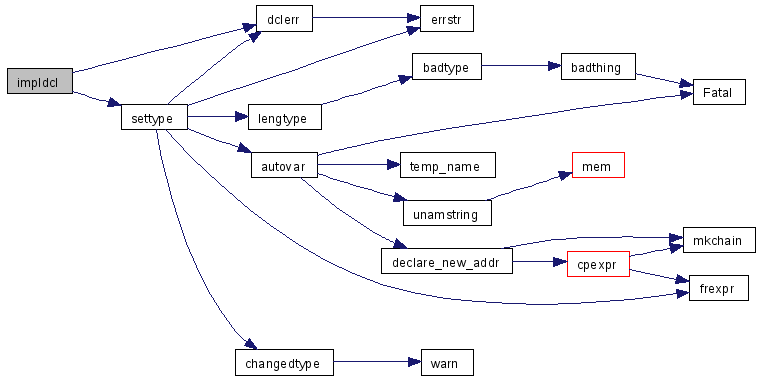
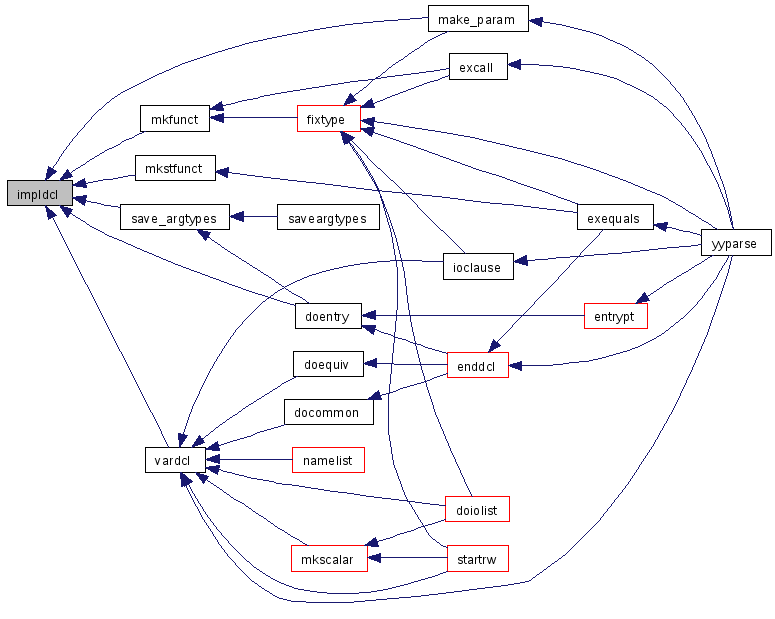
Definition at line 1979 of file expr.c.
References CLPROC, dclerr(), implleng, impltype, letter, p, PINTRINSIC, settype(), and TYUNKNOWN.
Referenced by doentry(), make_param(), mkfunct(), mkstfunct(), save_argtypes(), and vardcl().
01981 {
01982         int k;
01983         int type;
01984         ftnint leng;
01985
01986         if(p->vdcldone || (p->vclass==CLPROC && p->vprocclass==PINTRINSIC) )
01987                 return;
01988         if(p->vtype == TYUNKNOWN)
01989         {
01990                 k = letter(p->fvarname[0]);
01991                 type = impltype[ k ];
01992                 leng = implleng[ k ];
01993                 if(type == TYUNKNOWN)
01994                 {
01995                         if(p->vclass == CLPROC)
01996                                 return;
01997                         dclerr("attempt to use undefined variable", p);
01998                         type = dflttype[k];
01999                         leng = 0;
02000                 }
02001                 settype(p, type, leng);
02002                 p->vimpltype = 1;
02003         }
02004 }
Here is the call graph for this function:
Here is the caller graph for this function:
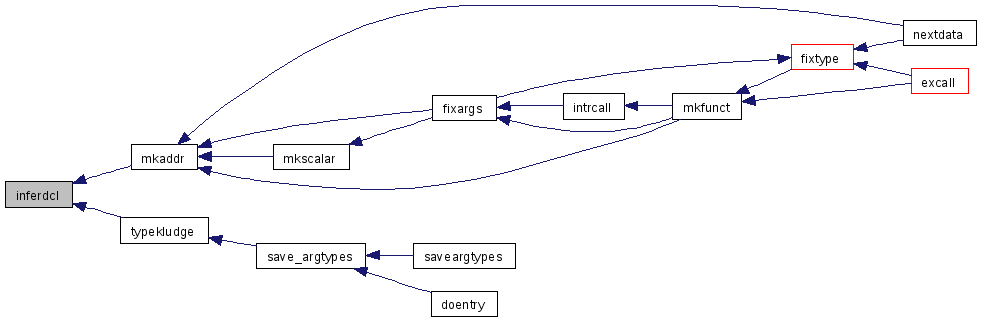
Definition at line 2012 of file expr.c.
References frexpr(), Nameblock::fvarname, impltype, letter, Nameblock::vimpltype, Nameblock::vinfproc, Nameblock::vinftype, Nameblock::vleng, and Nameblock::vtype.
Referenced by mkaddr(), and typekludge().
02014 {
02015         int k = impltype[letter(np->fvarname[0])];
02016         if (k != type) {
02017                 np->vinftype = 1;
02018                 np->vtype = type;
02019                 frexpr(np->vleng);
02020                 np->vleng = 0;
02021                 }
02022         np->vimpltype = 0;
02023         np->vinfproc = 1;
02024         }
Here is the call graph for this function:

Here is the caller graph for this function:
Definition at line 1555 of file expr.c.
References i, nregvar, regnamep, and regnum.
Referenced by memversion().
01557 {
01558         int i;
01559
01560         for(i = 0 ; i < nregvar ; ++i)
01561                 if(regnamep[i] == np)
01562                         return( regnum[i] );
01563         return(-1);
01564 }
Here is the caller graph for this function:

| static void intovfl | ( | Void | ) | [static] |
Definition at line 2629 of file expr.c.
References err.
Referenced by consbinop(), consnegop(), and fold().
02630 { err("overflow simplifying integer constants."); }
Here is the caller graph for this function:

Definition at line 2637 of file expr.c.
References Constant::ci, Constblock::Const, Expression::constblock, Constant::cq, Expression::headblock, lp, TYQUAD, and Headblock::vtype.
Referenced by fold().
02639 {
02640         if (lp->headblock.vtype == TYQUAD)
02641                 *Lp = lp->constblock.Const.cq;
02642         else
02643                 *Lp = lp->constblock.Const.ci;
02644         if (rp->headblock.vtype == TYQUAD)
02645                 *Rp = rp->constblock.Const.cq;
02646         else
02647                 *Rp = rp->constblock.Const.ci;
02648         }
Here is the caller graph for this function:

Definition at line 1533 of file expr.c.
References inregister(), mkplace(), NO, NULL, s, Nameblock::vdovar, and YES.
Referenced by doiolist(), enddo(), and fixargs().
01535 {
01536         Addrp s;
01537
01538         if(np->vdovar==NO || (inregister(np)<0) )
01539                 return(NULL);
01540         np->vdovar = NO;
01541         s = mkplace(np);
01542         np->vdovar = YES;
01543         return(s);
01544 }
Here is the call graph for this function:

Here is the caller graph for this function:

Definition at line 104 of file expr.c.
References mkconst(), p, and TYADDR.
Referenced by startrw().
00106 {
00107         Constp p;
00108
00109         p = mkconst(TYADDR);
00110         p->Const.ci = l;
00111         return( (expptr) p );
00112 }
Here is the call graph for this function:

Here is the caller graph for this function:

Definition at line 1726 of file expr.c.
References addunder(), ALLOC, badstg(), CLPROC, cpexpr(), errstr(), Extsym::exproto, Extsym::extstg, extsymtab, Extsym::extype, ICON, inferdcl(), infertypes, intraddr(), ISICON, mkext(), p, PEXTERNAL, PTHISPROC, putconst(), STGARG, STGAUTO, STGBSS, STGCOMMON, STGEQUIV, STGEXT, STGINIT, STGINTR, STGLENG, STGSTFUNCT, STGUNKNOWN, t, TADDR, TYUNKNOWN, UNAM_NAME, and xretslot.
Referenced by fixargs(), mkfunct(), mkscalar(), and nextdata().
01728 {
01729         Extsym *extp;
01730         Addrp t;
01731         int k;
01732
01733         switch( p->vstg)
01734         {
01735         case STGAUTO:
01736                 if(p->vclass == CLPROC && p->vprocclass == PTHISPROC)
01737                         return (Addrp) cpexpr((expptr)xretslot[p->vtype]);
01738                 goto other;
01739
01740         case STGUNKNOWN:
01741                 if(p->vclass != CLPROC)
01742                         break;  /* Error */
01743                 extp = mkext(p->fvarname, addunder(p->cvarname));
01744                 extp->extstg = STGEXT;
01745                 p->vstg = STGEXT;
01746                 p->vardesc.varno = extp - extsymtab;
01747                 p->vprocclass = PEXTERNAL;
01748                 if ((extp->exproto || infertypes)
01749                 && (p->vtype == TYUNKNOWN || p->vimpltype)
01750                 && (k = extp->extype))
01751                         inferdcl(p, k);
01752
01753
01754         case STGCOMMON:
01755         case STGEXT:
01756         case STGBSS:
01757         case STGINIT:
01758         case STGEQUIV:
01759         case STGARG:
01760         case STGLENG:
01761  other:
01762                 t = ALLOC(Addrblock);
01763                 t->tag = TADDR;
01764
01765                 t->vclass = p->vclass;
01766                 t->vtype = p->vtype;
01767                 t->vstg = p->vstg;
01768                 t->memno = p->vardesc.varno;
01769                 t->memoffset = ICON(p->voffset);
01770                 if (p->vdim)
01771                     t->isarray = 1;
01772                 if(p->vleng)
01773                 {
01774                         t->vleng = (expptr) cpexpr(p->vleng);
01775                         if( ISICON(t->vleng) )
01776                                 t->varleng = t->vleng->constblock.Const.ci;
01777                 }
01778
01779 /* Keep the original name around for the C code generation */
01780
01781                 t -> uname_tag = UNAM_NAME;
01782                 t -> user.name = p;
01783                 return(t);
01784
01785         case STGINTR:
01786
01787                 return ( intraddr (p));
01788
01789         case STGSTFUNCT:
01790
01791                 errstr("invalid use of statement function %.64s.", p->fvarname);
01792                 return putconst((Constp)ICON(0));
01793         }
01794         badstg("mkaddr", p->vstg);
01795         /* NOT REACHED */ return 0;
01796 }
Here is the call graph for this function:

Here is the caller graph for this function:

Definition at line 1811 of file expr.c.
References ALLOC, CLVAR, p, STGARG, STGLENG, TADDR, and TYLENG.
Referenced by doentry().
01813 {
01814         Addrp p;
01815
01816         p = ALLOC(Addrblock);
01817         p->tag = TADDR;
01818         p->vtype = type;
01819         p->vclass = CLVAR;
01820
01821 /* TYLENG is the type of the field holding the length of a character string */
01822
01823         p->vstg = (type==TYLENG ? STGLENG : STGARG);
01824         p->memno = argno;
01825         return(p);
01826 }
Here is the caller graph for this function:

Definition at line 149 of file expr.c.
References allow_i8c, err, ff, hextoi, len, m, mkconst(), p, TYLONG, TYQUAD, x, y, and z.
Referenced by yyparse().
00151 {
00152         Constp p;
00153         unsigned long m, ovfl, x, y, z;
00154         int L32, len;
00155         char buff[100], *s0 = s;
00156 #ifndef NO_LONG_LONG
00157         ULlong u;
00158 #endif
00159         static char *kind[3] = { "Binary", "Hex", "Octal" };
00160
00161         p = mkconst(TYLONG);
00162         /* Song and dance to convert to TYQUAD only if ftnint is too small. */
00163         m = x = y = ovfl = 0;
00164         /* Older C compilers may not know about */
00165         /* UL suffixes on hex constants... */
00166         while(--leng >= 0)
00167                 if(*s != ' ') {
00168                         if (!m) {
00169                                 z = x;
00170                                 x = ((x << shift) | hextoi(*s++)) & ff;
00171                                 if (!((x >> shift) - z))
00172                                         continue;
00173                                 m = (ff << (L32 = 32 - shift)) & ff;
00174                                 --s;
00175                                 x = z;
00176                                 }
00177                         ovfl |= y & m;
00178                         y = y << shift | (x >> L32);
00179                         x = ((x << shift) | hextoi(*s++)) & ff;
00180                         }
00181         /* Don't change the type to short for short constants, as
00182          * that is dangerous -- there is no syntax for long constants
00183          * with small values.
00184          */
00185         p->Const.ci = (ftnint)x;
00186 #ifndef NO_LONG_LONG
00187         if (m) {
00188                 if (allow_i8c) {
00189                         u = y;
00190                         p->Const.ucq = (u << 32) | x;
00191                         p->vtype = TYQUAD;
00192                         }
00193                 else
00194                         ovfl = 1;
00195                 }
00196 #else
00197         ovfl |= m;
00198 #endif
00199         if (ovfl) {
00200                 if (--shift == 3)
00201                         shift = 1;
00202                 if ((len = (int)leng) > 60)
00203                         sprintf(buff, "%s constant '%.60s' truncated.",
00204                                 kind[shift], s0);
00205                 else
00206                         sprintf(buff, "%s constant '%.*s' truncated.",
00207                                 kind[shift], len, s0);
00208                 err(buff);
00209                 }
00210         return( (expptr) p );
00211 }
Here is the call graph for this function:

Here is the caller graph for this function:

Definition at line 46 of file expr.c.
References ALLOC, p, and TCONST.
Referenced by make_param(), mkaddcon(), mkbitcon(), mkconv(), mkcxcon(), mkintcon(), mkintqcon(), mklogcon(), mkrealcon(), and mkstrcon().
00048 {
00049         Constp p;
00050
00051         p = ALLOC(Constblock);
00052         p->tag = TCONST;
00053         p->vtype = t;
00054         return(p);
00055 }
Here is the caller graph for this function:

Definition at line 326 of file expr.c.
References badtype(), consconv(), Expression::constblock, frexpr(), halign, ICON, ISCONST, ISINT, ISREAL, mkconst(), opconv(), p, pt, TADDR, TYADDR, TYCHAR, TYERROR, TYQUAD, TYUNKNOWN, UNAM_CONST, Constblock::vleng, Constblock::vstg, and warn().
Referenced by cast_args(), exdo(), exreturn(), fixexpr(), foldminmax(), Inline(), intrcall(), make_param(), mkpower(), putio(), putmnmx(), putop(), putx(), retval(), stfcall(), subcheck(), and suboffset().
00328 {
00329         expptr q;
00330         int pt, charwarn = 1;
00331
00332         if (t >= 100) {
00333                 t -= 100;
00334                 charwarn = 0;
00335                 }
00336         if(t==TYUNKNOWN || t==TYERROR)
00337                 badtype("mkconv", t);
00338         pt = p->headblock.vtype;
00339
00340 /* Casting to the same type is a no-op */
00341
00342         if(t == pt)
00343                 return(p);
00344
00345 /* If we're casting a constant which is not in the literal table ... */
00346
00347         else if( ISCONST(p) && pt!=TYADDR && pt != TYCHAR
00348                 || p->tag == TADDR && p->addrblock.uname_tag == UNAM_CONST)
00349         {
00350 #ifndef NO_LONG_LONG
00351                 if (t != TYQUAD && pt != TYQUAD)        /*20010820*/
00352 #endif
00353                 if (ISINT(t) && ISINT(pt) || ISREAL(t) && ISREAL(pt)) {
00354                         /* avoid trouble with -i2 */
00355                         p->headblock.vtype = t;
00356                         return p;
00357                         }
00358                 q = (expptr) mkconst(t);
00359                 consconv(t, &q->constblock, &p->constblock );
00360                 if (p->tag == TADDR)
00361                         q->constblock.vstg = p->addrblock.user.kludge.vstg1;
00362                 frexpr(p);
00363         }
00364         else {
00365                 if (pt == TYCHAR && t != TYADDR && charwarn
00366                                 && (!halign || p->tag != TADDR
00367                                 || p->addrblock.uname_tag != UNAM_CONST))
00368                         warn(
00369                  "ichar([first char. of] char. string) assumed for conversion to numeric");
00370                 q = opconv(p, t);
00371                 }
00372
00373         if(t == TYCHAR)
00374                 q->constblock.vleng = ICON(1);
00375         return(q);
00376 }
Here is the call graph for this function:
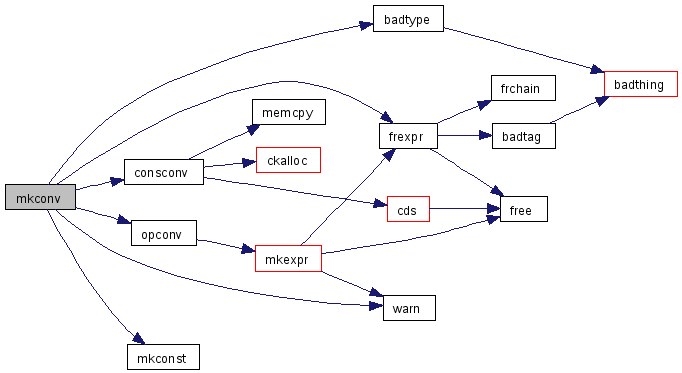
Here is the caller graph for this function:

Definition at line 253 of file expr.c.
References Constant::cd, Constant::cds, Constant::ci, Constblock::Const, Expression::constblock, dtos(), err, errnode, frexpr(), Expression::headblock, ISCONST, ISINT, ISNUMERIC, mkconst(), p, string_num(), tycomplex, TYDCOMPLEX, TYDREAL, Constblock::vstg, and Headblock::vtype.
Referenced by intrcall(), and yyparse().
00255 {
00256         int rtype, itype;
00257         Constp p;
00258
00259         rtype = realp->headblock.vtype;
00260         itype = imagp->headblock.vtype;
00261
00262         if( ISCONST(realp) && ISNUMERIC(rtype) && ISCONST(imagp) && ISNUMERIC(itype) )
00263         {
00264                 p = mkconst( (rtype==TYDREAL||itype==TYDREAL)
00265                                 ? TYDCOMPLEX : tycomplex);
00266                 if (realp->constblock.vstg || imagp->constblock.vstg) {
00267                         p->vstg = 1;
00268                         p->Const.cds[0] = ISINT(rtype)
00269                                 ? string_num("", realp->constblock.Const.ci)
00270                                 : realp->constblock.vstg
00271                                         ? realp->constblock.Const.cds[0]
00272                                         : dtos(realp->constblock.Const.cd[0]);
00273                         p->Const.cds[1] = ISINT(itype)
00274                                 ? string_num("", imagp->constblock.Const.ci)
00275                                 : imagp->constblock.vstg
00276                                         ? imagp->constblock.Const.cds[0]
00277                                         : dtos(imagp->constblock.Const.cd[0]);
00278                         }
00279                 else {
00280                         p->Const.cd[0] = ISINT(rtype)
00281                                 ? realp->constblock.Const.ci
00282                                 : realp->constblock.Const.cd[0];
00283                         p->Const.cd[1] = ISINT(itype)
00284                                 ? imagp->constblock.Const.ci
00285                                 : imagp->constblock.Const.cd[0];
00286                         }
00287         }
00288         else
00289         {
00290                 err("invalid complex constant");
00291                 p = (Constp)errnode();
00292         }
00293
00294         frexpr(realp);
00295         frexpr(imagp);
00296         return( (expptr) p );
00297 }
Here is the call graph for this function:

Here is the caller graph for this function:

Definition at line 2094 of file expr.c.
References ALLOC, Primblock::argsp, badop(), Constant::ci, cktype(), COMMUTE, consnegop(), Constblock::Const, Expression::constblock, ENULL, errnode, error, Expression::exprblock, fixtype(), fold(), free(), frexpr(), Expression::headblock, ICON, ICONEQ, INEXEC, is_negatable(), ISCONST, ISICON, ISINT, ISPLUSOP, L, Exprblock::leftp, lineno, lp, Primblock::namep, NULL, OPABS, OPADDR, OPAND, OPARROW, OPASSIGN, OPASSIGNI, OPBITAND, OPBITANDEQ, OPBITCLR, OPBITNOT, OPBITOR, OPBITOREQ, OPBITSET, OPBITTEST, OPBITXOR, OPBITXOREQ, OPCALL, OPCCALL, OPCHARCAST, Exprblock::opcode, OPCOLON, OPCOMMA, OPCOMMA_ARG, OPCONCAT, OPCONV, OPDABS, OPDMAX, OPDMIN, OPDOT, OPEQ, OPEQV, OPGE, OPGT, OPIDENTITY, OPLE, OPLSHIFT, OPLSHIFTEQ, OPLT, OPMAX, OPMAX2, OPMIN, OPMIN2, OPMINUS, OPMINUSEQ, OPMOD, OPMODEQ, OPNE, OPNEG, OPNEG1, OPNEQV, OPNOT, OPOR, OPPLUS, OPPLUSEQ, OPPOWER, OPQBITCLR, OPQBITSET, OPQUEST, OPRSHIFT, OPRSHIFTEQ, OPSLASH, OPSLASHEQ, OPSTAR, OPSTAREQ, OPWHATSIN, paren_used(), parstate, Expression::primblock, Exprblock::rightp, Exprblock::tag, Constblock::tag, Expression::tag, TCONST, TEXPR, TPRIM, TYERROR, TYUNKNOWN, Exprblock::vtype, Headblock::vtype, warn(), and zeroconst().
Referenced by addrfix(), addrof(), callk(), cktype1(), endio(), exar2(), exarif(), exassign(), exdo(), fixexpr(), Inline(), intrcall(), ioset(), ioseta(), make_int_expr(), mkfunct(), mklhs(), mkpower(), mkscalar(), nextdata(), opconv(), opconv_fudge(), out_addr(), prolog(), putassign(), putch1(), putchcmp(), putcheq(), putct1(), putcx1(), putcxcmp(), putcxeq(), puteq(), putio(), putiocall(), putmnmx(), putop(), putpower(), putsteq(), ref_defs(), stfcall(), subcheck(), suboffset(), subskept(), and yyparse().
02096 { 02097 expptr e, e1; 02098 int etype; 02099 int ltype, rtype; 02100 int ltag, rtag; 02101 long L; 02102 static long divlineno; 02103 02104 if (parstate < INEXEC) { 02105 02106 /* Song and dance to get statement functions right */ 02107 /* while catching incorrect type combinations in the */ 02108 /* first executable statement. */ 02109 02110 ltype = lp->headblock.vtype; 02111 ltag = lp->tag; 02112 if(rp && opcode!=OPCALL && opcode!=OPCCALL) 02113 { 02114 rtype = rp->headblock.vtype; 02115 rtag = rp->tag; 02116 } 02117 else rtype = 0; 02118 02119 etype = cktype(opcode, ltype, rtype); 02120 if(etype == TYERROR) 02121 goto error; 02122 goto no_fold; 02123 } 02124 02125 ltype = lp->headblock.vtype; 02126 if (ltype == TYUNKNOWN) { 02127 lp = fixtype(lp); 02128 ltype = lp->headblock.vtype; 02129 } 02130 ltag = lp->tag; 02131 if(rp && opcode!=OPCALL && opcode!=OPCCALL) 02132 { 02133 rtype = rp->headblock.vtype; 02134 if (rtype == TYUNKNOWN) { 02135 rp = fixtype(rp); 02136 rtype = rp->headblock.vtype; 02137 } 02138 rtag = rp->tag; 02139 } 02140 else rtype = 0; 02141 02142 etype = cktype(opcode, ltype, rtype); 02143 if(etype == TYERROR) 02144 goto error; 02145 02146 switch(opcode) 02147 { 02148 /* check for multiplication by 0 and 1 and addition to 0 */ 02149 02150 case OPSTAR: 02151 if( ISCONST(lp) ) 02152 COMMUTE 02153 02154 if( ISICON(rp) ) 02155 { 02156 if(rp->constblock.Const.ci == 0) 02157 goto retright; 02158 goto mulop; 02159 } 02160 break; 02161 02162 case OPSLASH: 02163 case OPMOD: 02164 if( zeroconst(rp) && lineno != divlineno ) { 02165 warn("attempted division by zero"); 02166 divlineno = lineno; 02167 } 02168 if(opcode == OPMOD) 02169 break; 02170 02171 /* Handle multiplying or dividing by 1, -1 */ 02172 02173 mulop: 02174 if( ISICON(rp) ) 02175 { 02176 if(rp->constblock.Const.ci == 1) 02177 goto retleft; 02178 02179 if(rp->constblock.Const.ci == -1) 02180 { 02181 frexpr(rp); 02182 return( mkexpr(OPNEG, lp, ENULL) ); 02183 } 02184 } 02185 02186 /* Group all constants together. In particular, 02187 02188 (x * CONST1) * CONST2 ==> x * (CONST1 * CONST2) 02189 (x * CONST1) / CONST2 ==> x * (CONST1 / CONST2) 02190 */ 02191 02192 if (!ISINT(etype) || lp->tag != TEXPR || !lp->exprblock.rightp 02193 || !ISICON(lp->exprblock.rightp)) 02194 break; 02195 02196 if (lp->exprblock.opcode == OPLSHIFT) { 02197 L = 1 << lp->exprblock.rightp->constblock.Const.ci; 02198 if (opcode == OPSTAR || ISICON(rp) && 02199 !(L % rp->constblock.Const.ci)) { 02200 lp->exprblock.opcode = OPSTAR; 02201 lp->exprblock.rightp->constblock.Const.ci = L; 02202 } 02203 } 02204 02205 if (lp->exprblock.opcode == OPSTAR) { 02206 if(opcode == OPSTAR) 02207 e = mkexpr(OPSTAR, lp->exprblock.rightp, rp); 02208 else if(ISICON(rp) && 02209 (lp->exprblock.rightp->constblock.Const.ci % 02210 rp->constblock.Const.ci) == 0) 02211 e = mkexpr(OPSLASH, lp->exprblock.rightp, rp); 02212 else break; 02213 02214 e1 = lp->exprblock.leftp; 02215 free( (charptr) lp ); 02216 return( mkexpr(OPSTAR, e1, e) ); 02217 } 02218 break; 02219 02220 02221 case OPPLUS: 02222 if( ISCONST(lp) ) 02223 COMMUTE 02224 goto addop; 02225 02226 case OPMINUS: 02227 if( ICONEQ(lp, 0) ) 02228 { 02229 frexpr(lp); 02230 return( mkexpr(OPNEG, rp, ENULL) ); 02231 } 02232 02233 if( ISCONST(rp) && is_negatable((Constp)rp)) 02234 { 02235 opcode = OPPLUS; 02236 consnegop((Constp)rp); 02237 } 02238 02239 /* Group constants in an addition expression (also subtraction, since the 02240 subtracted value was negated above). In particular, 02241 02242 (x + CONST1) + CONST2 ==> x + (CONST1 + CONST2) 02243 */ 02244 02245 addop: 02246 if( ISICON(rp) ) 02247 { 02248 if(rp->constblock.Const.ci == 0) 02249 goto retleft; 02250 if( ISPLUSOP(lp) && ISICON(lp->exprblock.rightp) ) 02251 { 02252 e = mkexpr(OPPLUS, lp->exprblock.rightp, rp); 02253 e1 = lp->exprblock.leftp; 02254 free( (charptr) lp ); 02255 return( mkexpr(OPPLUS, e1, e) ); 02256 } 02257 } 02258 if (opcode == OPMINUS && (ISINT(etype) || doing_vleng)) { 02259 /* check for (i [+const]) - (i [+const]) */ 02260 if (lp->tag == TPRIM) 02261 e = lp; 02262 else if (lp->tag == TEXPR && lp->exprblock.opcode == OPPLUS 02263 && lp->exprblock.rightp->tag == TCONST) { 02264 e = lp->exprblock.leftp; 02265 if (e->tag != TPRIM) 02266 break; 02267 } 02268 else 02269 break; 02270 if (e->primblock.argsp) 02271 break; 02272 if (rp->tag == TPRIM) 02273 e1 = rp; 02274 else if (rp->tag == TEXPR && rp->exprblock.opcode == OPPLUS 02275 && rp->exprblock.rightp->tag == TCONST) { 02276 e1 = rp->exprblock.leftp; 02277 if (e1->tag != TPRIM) 02278 break; 02279 } 02280 else 02281 break; 02282 if (e->primblock.namep != e1->primblock.namep 02283 || e1->primblock.argsp) 02284 break; 02285 L = e == lp ? 0 : lp->exprblock.rightp->constblock.Const.ci; 02286 if (e1 != rp) 02287 L -= rp->exprblock.rightp->constblock.Const.ci; 02288 frexpr(lp); 02289 frexpr(rp); 02290 return ICON(L); 02291 } 02292 02293 break; 02294 02295 02296 case OPPOWER: 02297 break; 02298 02299 /* Eliminate outermost double negations */ 02300 02301 case OPNEG: 02302 case OPNEG1: 02303 if(ltag==TEXPR && lp->exprblock.opcode==OPNEG) 02304 { 02305 e = lp->exprblock.leftp; 02306 free( (charptr) lp ); 02307 return(e); 02308 } 02309 break; 02310 02311 /* Eliminate outermost double NOTs */ 02312 02313 case OPNOT: 02314 if(ltag==TEXPR && lp->exprblock.opcode==OPNOT) 02315 { 02316 e = lp->exprblock.leftp; 02317 free( (charptr) lp ); 02318 return(e); 02319 } 02320 break; 02321 02322 case OPCALL: 02323 case OPCCALL: 02324 etype = ltype; 02325 if(rp!=NULL && rp->listblock.listp==NULL) 02326 { 02327 free( (charptr) rp ); 02328 rp = NULL; 02329 } 02330 break; 02331 02332 case OPAND: 02333 case OPOR: 02334 if( ISCONST(lp) ) 02335 COMMUTE 02336 02337 if( ISCONST(rp) ) 02338 { 02339 if(rp->constblock.Const.ci == 0) 02340 if(opcode == OPOR) 02341 goto retleft; 02342 else 02343 goto retright; 02344 else if(opcode == OPOR) 02345 goto retright; 02346 else 02347 goto retleft; 02348 } 02349 case OPEQV: 02350 case OPNEQV: 02351 02352 case OPBITAND: 02353 case OPBITOR: 02354 case OPBITXOR: 02355 case OPBITNOT: 02356 case OPLSHIFT: 02357 case OPRSHIFT: 02358 case OPBITTEST: 02359 case OPBITCLR: 02360 case OPBITSET: 02361 #ifdef TYQUAD 02362 case OPQBITCLR: 02363 case OPQBITSET: 02364 #endif 02365 02366 case OPLT: 02367 case OPGT: 02368 case OPLE: 02369 case OPGE: 02370 case OPEQ: 02371 case OPNE: 02372 02373 case OPCONCAT: 02374 break; 02375 case OPMIN: 02376 case OPMAX: 02377 case OPMIN2: 02378 case OPMAX2: 02379 case OPDMIN: 02380 case OPDMAX: 02381 02382 case OPASSIGN: 02383 case OPASSIGNI: 02384 case OPPLUSEQ: 02385 case OPSTAREQ: 02386 case OPMINUSEQ: 02387 case OPSLASHEQ: 02388 case OPMODEQ: 02389 case OPLSHIFTEQ: 02390 case OPRSHIFTEQ: 02391 case OPBITANDEQ: 02392 case OPBITXOREQ: 02393 case OPBITOREQ: 02394 02395 case OPCONV: 02396 case OPADDR: 02397 case OPWHATSIN: 02398 02399 case OPCOMMA: 02400 case OPCOMMA_ARG: 02401 case OPQUEST: 02402 case OPCOLON: 02403 case OPDOT: 02404 case OPARROW: 02405 case OPIDENTITY: 02406 case OPCHARCAST: 02407 case OPABS: 02408 case OPDABS: 02409 break; 02410 02411 default: 02412 badop("mkexpr", opcode); 02413 } 02414 02415 no_fold: 02416 e = (expptr) ALLOC(Exprblock); 02417 e->exprblock.tag = TEXPR; 02418 e->exprblock.opcode = opcode; 02419 e->exprblock.vtype = etype; 02420 e->exprblock.leftp = lp; 02421 e->exprblock.rightp = rp; 02422 if(ltag==TCONST && (rp==0 || rtag==TCONST) ) 02423 e = fold(e); 02424 return(e); 02425 02426 retleft: 02427 frexpr(rp); 02428 if (lp->tag == TPRIM) 02429 paren_used(&lp->primblock); 02430 return(lp); 02431 02432 retright: 02433 frexpr(lp); 02434 if (rp->tag == TPRIM) 02435 paren_used(&rp->primblock); 02436 return(rp); 02437 02438 error: 02439 frexpr(lp); 02440 if(rp && opcode!=OPCALL && opcode!=OPCCALL) 02441 frexpr(rp); 02442 return( errnode() ); 02443 }
Here is the call graph for this function:

Here is the caller graph for this function:
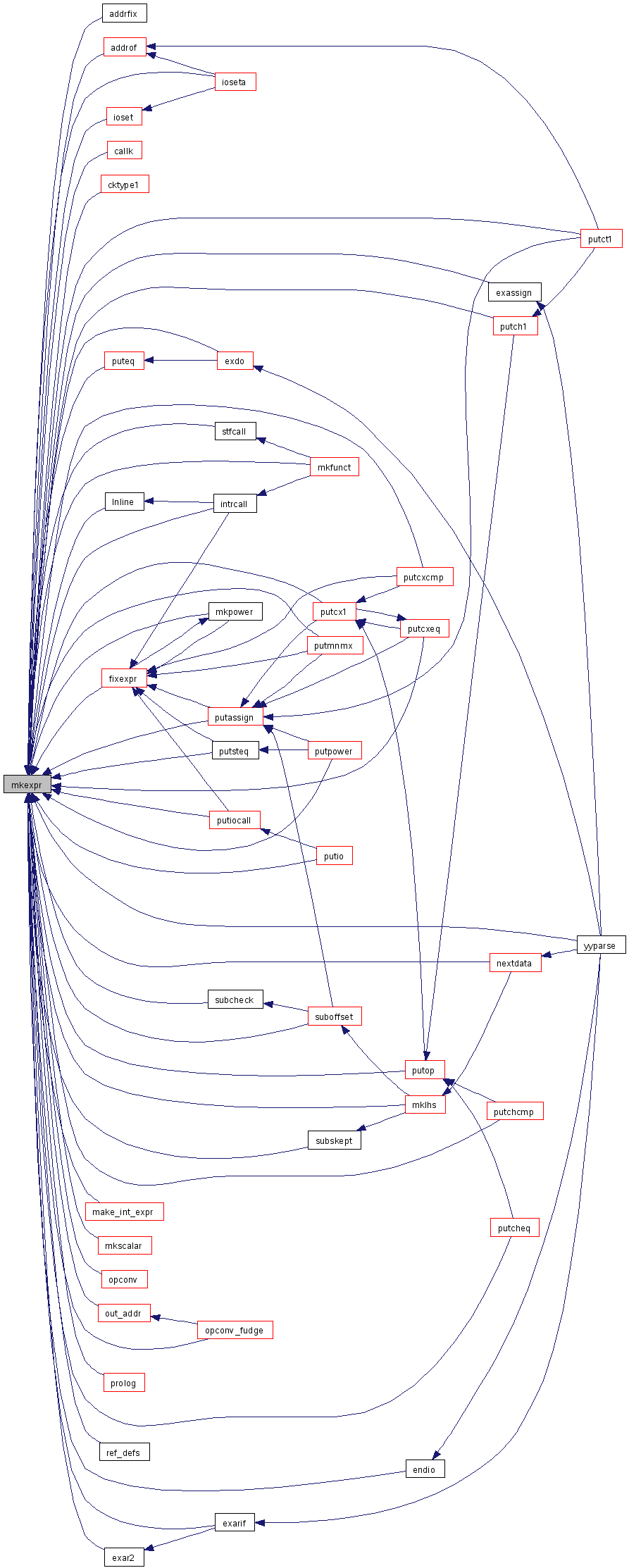
Definition at line 1052 of file expr.c.
References addunder(), adjust_arginfo(), builtin(), Extsym::cextname, CLPROC, CLUNKNOWN, cpexpr(), Nameblock::cvarname, dclerr(), dcomplex_seen, Entrypoint::enamep, Entrypoint::entnextp, entries, Entrypoint::entryname, err, errnode, error, errstr(), Expression::exprblock, Extsym::extseen, Extsym::extstg, extsymtab, Fatal(), fatali(), fatalstr(), fixargs(), free(), frexpr(), Nameblock::fvarname, impldcl(), intrcall(), intrfunct(), letter, mkaddr(), mkchain(), mkexpr(), mkext(), new_procs, NULL, OPCALL, p, PEXTERNAL, PINTRINSIC, PSTFUNCT, PTHISPROC, stfcall(), STGARG, STGCOMMON, STGEXT, STGINTR, STGUNKNOWN, TPRIM, TYCHAR, TYSUBR, TYUNKNOWN, Nameblock::vardesc, Nameblock::varno, Nameblock::vcalled, Nameblock::vclass, Nameblock::vimpltype, Exprblock::vleng, Nameblock::vleng, Nameblock::vprocclass, Nameblock::vstg, Exprblock::vtype, Nameblock::vtype, warn(), and zflag.
Referenced by excall(), and fixtype().
01054 {
01055         struct Primblock *p = (struct Primblock *)p0;
01056         struct Entrypoint *ep;
01057         Addrp ap;
01058         Extsym *extp;
01059         Namep np;
01060         expptr q;
01061         extern chainp new_procs;
01062         int k, nargs;
01063         int vclass;
01064
01065         if(p->tag != TPRIM)
01066                 return( errnode() );
01067
01068         np = p->namep;
01069         vclass = np->vclass;
01070
01071
01072         if(vclass == CLUNKNOWN)
01073         {
01074                 np->vclass = vclass = CLPROC;
01075                 if(np->vstg == STGUNKNOWN)
01076                 {
01077                         if(np->vtype!=TYSUBR && (k = intrfunct(np->fvarname))
01078                                 && (zflag || !(*(struct Intrpacked *)&k).f4
01079                                         || dcomplex_seen))
01080                         {
01081                                 np->vstg = STGINTR;
01082                                 np->vardesc.varno = k;
01083                                 np->vprocclass = PINTRINSIC;
01084                         }
01085                         else
01086                         {
01087                                 extp = mkext(np->fvarname,
01088                                         addunder(np->cvarname));
01089                                 extp->extstg = STGEXT;
01090                                 np->vstg = STGEXT;
01091                                 np->vardesc.varno = extp - extsymtab;
01092                                 np->vprocclass = PEXTERNAL;
01093                         }
01094                 }
01095                 else if(np->vstg==STGARG)
01096                 {
01097                     if(np->vtype == TYCHAR) {
01098                         adjust_arginfo(np);
01099                         if (np->vpassed) {
01100                                 char wbuf[160], *who;
01101                                 who = np->fvarname;
01102                                 sprintf(wbuf, "%s%s%s\n\t%s%s%s",
01103                                         "Character-valued dummy procedure ",
01104                                         who, " not declared EXTERNAL.",
01105                         "Code may be wrong for previous function calls having ",
01106                                         who, " as a parameter.");
01107                                 warn(wbuf);
01108                                 }
01109                         }
01110                     np->vprocclass = PEXTERNAL;
01111                 }
01112         }
01113
01114         if(vclass != CLPROC) {
01115                 if (np->vstg == STGCOMMON)
01116                         fatalstr(
01117                          "Cannot invoke common variable %.50s as a function.",
01118                                 np->fvarname);
01119                 errstr("%.80s cannot be called.", np->fvarname);
01120                 goto error;
01121                 }
01122
01123 /* F77 doesn't allow subscripting of function calls */
01124
01125         if(p->fcharp || p->lcharp)
01126         {
01127                 err("no substring of function call");
01128                 goto error;
01129         }
01130         impldcl(np);
01131         np->vimpltype = 0;      /* invoking as function ==> inferred type */
01132         np->vcalled = 1;
01133         nargs = fixargs( np->vprocclass!=PINTRINSIC,  p->argsp);
01134
01135         switch(np->vprocclass)
01136         {
01137         case PEXTERNAL:
01138                 if(np->vtype == TYUNKNOWN)
01139                 {
01140                         dclerr("attempt to use untyped function", np);
01141                         np->vtype = dflttype[letter(np->fvarname[0])];
01142                 }
01143                 ap = mkaddr(np);
01144                 if (!extsymtab[np->vardesc.varno].extseen) {
01145                         new_procs = mkchain((char *)np, new_procs);
01146                         extsymtab[np->vardesc.varno].extseen = 1;
01147                         }
01148 call:
01149                 q = mkexpr(OPCALL, (expptr)ap, (expptr)p->argsp);
01150                 q->exprblock.vtype = np->vtype;
01151                 if(np->vleng)
01152                         q->exprblock.vleng = (expptr) cpexpr(np->vleng);
01153                 break;
01154
01155         case PINTRINSIC:
01156                 q = intrcall(np, p->argsp, nargs);
01157                 break;
01158
01159         case PSTFUNCT:
01160                 q = stfcall(np, p->argsp);
01161                 break;
01162
01163         case PTHISPROC:
01164                 warn("recursive call");
01165
01166 /* entries   is the list of multiple entry points */
01167
01168                 for(ep = entries ; ep ; ep = ep->entnextp)
01169                         if(ep->enamep == np)
01170                                 break;
01171                 if(ep == NULL)
01172                         Fatal("mkfunct: impossible recursion");
01173
01174                 ap = builtin(np->vtype, ep->entryname->cextname, -2);
01175                 /* the negative last arg prevents adding */
01176                 /* this name to the list of used builtins */
01177                 goto call;
01178
01179         default:
01180                 fatali("mkfunct: impossible vprocclass %d",
01181                     (int) (np->vprocclass) );
01182         }
01183         free( (charptr) p );
01184         return(q);
01185
01186 error:
01187         frexpr((expptr)p);
01188         return( errnode() );
01189 }
Here is the call graph for this function:

Here is the caller graph for this function:

Definition at line 84 of file expr.c.
References mkconst(), p, and tyint.
Referenced by exassign(), intrcall(), mkintqcon(), nextdata(), out_addr(), and putcx1().
00086 {
00087         Constp p;
00088
00089         p = mkconst(tyint);
00090         p->Const.ci = l;
00091         return( (expptr) p );
00092 }
Here is the call graph for this function:

Here is the caller graph for this function:

Definition at line 1430 of file expr.c.
References Constant::ci, Constblock::Const, Expression::constblock, cpexpr(), fixtype(), free(), frexpr(), ICON, ISCONST, mkexpr(), mkplace(), Dimblock::ndim, NULL, OPMINUS, OPPLUS, p, s, sserr(), STGREG, suboffset(), subskept(), substrerr(), TADDR, TPRIM, TYCHAR, Nameblock::vdim, Nameblock::vleng, and Nameblock::vtype.
Referenced by exequals(), fixtype(), and nextdata().
01432 {
01433         Addrp s;
01434         Namep np;
01435
01436         if(p->tag != TPRIM)
01437                 return( (expptr) p );
01438         np = p->namep;
01439
01440         replaced = 0;
01441         s = mkplace(np);
01442         if(s->tag!=TADDR || s->vstg==STGREG)
01443         {
01444                 free( (charptr) p );
01445                 return( (expptr) s );
01446         }
01447         s->parenused = p->parenused;
01448
01449         /* compute the address modified by subscripts */
01450
01451         if (!replaced)
01452                 s->memoffset = (subkeep && np->vdim && p->argsp
01453                                 && (np->vdim->ndim > 1 || np->vtype == TYCHAR
01454                                 && (!ISCONST(np->vleng)
01455                                   || np->vleng->constblock.Const.ci != 1)))
01456                                 ? subskept(p,s)
01457                                 : mkexpr(OPPLUS, s->memoffset, suboffset(p) );
01458         frexpr((expptr)p->argsp);
01459         p->argsp = NULL;
01460
01461         /* now do substring part */
01462
01463         if(p->fcharp || p->lcharp)
01464         {
01465                 if(np->vtype != TYCHAR)
01466                         sserr(np);
01467                 else    {
01468                         if(p->lcharp == NULL)
01469                                 p->lcharp = (expptr)(
01470                                         /* s->vleng == 0 only with errors */
01471                                         s->vleng ? cpexpr(s->vleng) : ICON(1));
01472                         else if (ISCONST(p->lcharp)
01473                                  && ISCONST(np->vleng)
01474                                  && p->lcharp->constblock.Const.ci
01475                                         > np->vleng->constblock.Const.ci)
01476                                                 substrerr(np);
01477                         if(p->fcharp) {
01478                                 doing_vleng = 1;
01479                                 s->vleng = fixtype(mkexpr(OPMINUS,
01480                                                 p->lcharp,
01481                                         mkexpr(OPMINUS, p->fcharp, ICON(1) )));
01482                                 doing_vleng = 0;
01483                                 }
01484                         else    {
01485                                 frexpr(s->vleng);
01486                                 s->vleng = p->lcharp;
01487                                 }
01488                         if (s->memoffset
01489                          && ISCONST(s->memoffset)
01490                          && s->memoffset->constblock.Const.ci < 0)
01491                                 substrerr(np);
01492                 }
01493         }
01494
01495         s->vleng = fixtype( s->vleng );
01496         s->memoffset = fixtype( s->memoffset );
01497         free( (charptr) p );
01498         return( (expptr) s );
01499 }
Here is the call graph for this function:

Here is the caller graph for this function:

Definition at line 1330 of file expr.c.
References cpexpr(), rpllist, Rplblock::rplnextp, Rplblock::rplnp, Rplblock::rpltag, Rplblock::rplvp, and TNAME.
Referenced by enddo(), exasgoto(), exassign(), exdo(), memversion(), and mklhs().
01332 {
01333         Addrp s;
01334         struct Rplblock *rp;
01335         int regn;
01336
01337         /* is name on the replace list? */
01338
01339         for(rp = rpllist ; rp ; rp = rp->rplnextp)
01340         {
01341                 if(np == rp->rplnp)
01342                 {
01343                         replaced = 1;
01344                         if(rp->rpltag == TNAME)
01345                         {
01346                                 np = (Namep) (rp->rplvp);
01347                                 break;
01348                         }
01349                         else    return( (Addrp) cpexpr(rp->rplvp) );
01350                 }
01351         }
01352
01353         /* is variable a DO index in a register ? */
01354
01355         if(np->vdovar && ( (regn = inregister(np)) >= 0) )
01356                 if(np->vtype == TYERROR)
01357                         return((Addrp) errnode() );
01358                 else
01359                 {
01360                         s = ALLOC(Addrblock);
01361                         s->tag = TADDR;
01362                         s->vstg = STGREG;
01363                         s->vtype = TYIREG;
01364                         s->memno = regn;
01365                         s->memoffset = ICON(0);
01366                         s -> uname_tag = UNAM_NAME;
01367                         s -> user.name = np;
01368                         return(s);
01369                 }
01370
01371         if (np->vclass == CLPROC && np->vprocclass != PTHISPROC)
01372                 errstr("external %.60s used as a variable", np->fvarname);
01373         vardcl(np);
01374         return(mkaddr(np));
01375 }
Here is the call graph for this function:

Here is the caller graph for this function:

Definition at line 3591 of file expr.c.
References Expression::addrblock, call2(), callk_kludge, Constant::ci, Constblock::Const, Expression::constblock, err, errnode, fixexpr(), free(), frexpr(), Expression::headblock, ICON, ISCONST, ISICON, ISINT, ISREAL, lp, M, maxtype(), mkconv(), mkexpr(), MSKINT, MSKREAL, ONEOF, OPSLASH, p, Addrblock::parenused, putconst(), TADDR, Expression::tag, TYCOMPLEX, TYDCOMPLEX, TYDREAL, tyint, TYINT1, TYLONG, TYQUAD, TYSHORT, and Headblock::vtype.
Referenced by fixexpr().
03593 {
03594         expptr q, lp, rp;
03595         int ltype, rtype, mtype, tyi;
03596
03597         lp = p->exprblock.leftp;
03598         rp = p->exprblock.rightp;
03599         ltype = lp->headblock.vtype;
03600         rtype = rp->headblock.vtype;
03601
03602         if (lp->tag == TADDR)
03603                 lp->addrblock.parenused = 0;
03604
03605         if (rp->tag == TADDR)
03606                 rp->addrblock.parenused = 0;
03607
03608         if(ISICON(rp))
03609         {
03610                 if(rp->constblock.Const.ci == 0)
03611                 {
03612                         frexpr(p);
03613                         if( ISINT(ltype) )
03614                                 return( ICON(1) );
03615                         else if (ISREAL (ltype))
03616                                 return mkconv (ltype, ICON (1));
03617                         else
03618                                 return( (expptr) putconst((Constp)
03619                                         mkconv(ltype, ICON(1))) );
03620                 }
03621                 if(rp->constblock.Const.ci < 0)
03622                 {
03623                         if( ISINT(ltype) )
03624                         {
03625                                 frexpr(p);
03626                                 err("integer**negative");
03627                                 return( errnode() );
03628                         }
03629                         rp->constblock.Const.ci = - rp->constblock.Const.ci;
03630                         p->exprblock.leftp = lp
03631                                 = fixexpr((Exprp)mkexpr(OPSLASH, ICON(1), lp));
03632                 }
03633                 if(rp->constblock.Const.ci == 1)
03634                 {
03635                         frexpr(rp);
03636                         free( (charptr) p );
03637                         return(lp);
03638                 }
03639
03640                 if( ONEOF(ltype, MSKINT|MSKREAL) ) {
03641                         p->exprblock.vtype = ltype;
03642                         return(p);
03643                 }
03644         }
03645         if( ISINT(rtype) )
03646         {
03647                 if(ltype==TYSHORT && rtype==TYSHORT && (!ISCONST(lp) || tyint==TYSHORT) )
03648                         q = call2(TYSHORT, "pow_hh", lp, rp);
03649                 else    {
03650                         if(ONEOF(ltype,M(TYINT1)|M(TYSHORT)))
03651                         {
03652                                 ltype = TYLONG;
03653                                 lp = mkconv(TYLONG,lp);
03654                         }
03655 #ifdef TYQUAD
03656                         if (ltype == TYQUAD)
03657                                 rp = mkconv(TYQUAD,rp);
03658                         else
03659 #endif
03660                         rp = mkconv(TYLONG,rp);
03661                         if (ISCONST(rp)) {
03662                                 tyi = tyint;
03663                                 tyint = TYLONG;
03664                                 rp = (expptr)putconst((Constp)rp);
03665                                 tyint = tyi;
03666                                 }
03667                         q = call2(ltype, powint[ltype-TYLONG], lp, rp);
03668                 }
03669         }
03670         else if( ISREAL( (mtype = maxtype(ltype,rtype)) )) {
03671                 extern int callk_kludge;
03672                 callk_kludge = TYDREAL;
03673                 q = call2(mtype, "pow_dd", mkconv(TYDREAL,lp), mkconv(TYDREAL,rp));
03674                 callk_kludge = 0;
03675                 }
03676         else    {
03677                 q  = call2(TYDCOMPLEX, "pow_zz",
03678                     mkconv(TYDCOMPLEX,lp), mkconv(TYDCOMPLEX,rp));
03679                 if(mtype == TYCOMPLEX)
03680                         q = mkconv(TYCOMPLEX, q);
03681         }
03682         free( (charptr) p );
03683         return(q);
03684 }
Here is the call graph for this function:

Here is the caller graph for this function:

Definition at line 1844 of file expr.c.
References ALLOC, args, CLPARAM, cpexpr(), Chain::datap, errnode, errstr(), frchain(), frexpr(), Chain::nextp, p, and TPRIM.
Referenced by excall(), and yyparse().
01846 {
01847         typedef union {
01848                 struct Paramblock paramblock;
01849                 struct Nameblock nameblock;
01850                 struct Headblock headblock;
01851                 } *Primu;
01852         Primu v = (Primu)v0;
01853         struct Primblock *p;
01854
01855         if(v->headblock.vclass == CLPARAM)
01856         {
01857
01858 /* v   is to be a Paramblock */
01859
01860                 if(args || substr)
01861                 {
01862                         errstr("no qualifiers on parameter name %s",
01863                             v->paramblock.fvarname);
01864                         frexpr((expptr)args);
01865                         if(substr)
01866                         {
01867                                 frexpr((tagptr)substr->datap);
01868                                 frexpr((tagptr)substr->nextp->datap);
01869                                 frchain(&substr);
01870                         }
01871                         frexpr((expptr)v);
01872                         return( errnode() );
01873                 }
01874                 return( (expptr) cpexpr(v->paramblock.paramval) );
01875         }
01876
01877         p = ALLOC(Primblock);
01878         p->tag = TPRIM;
01879         p->vtype = v->nameblock.vtype;
01880
01881 /* v   is to be a Nameblock */
01882
01883         p->namep = (Namep) v;
01884         p->argsp = args;
01885         if(substr)
01886         {
01887                 p->fcharp = (expptr) substr->datap;
01888                 p->lcharp = (expptr) substr->nextp->datap;
01889                 frchain(&substr);
01890         }
01891         return( (expptr) p);
01892 }
Here is the call graph for this function:

Here is the caller graph for this function:

Definition at line 125 of file expr.c.
References cds(), CNULL, mkconst(), and p.
Referenced by imagpart(), intrcall(), putcx1(), realpart(), and yyparse().
00127 {
00128         Constp p;
00129
00130         p = mkconst(t);
00131         p->Const.cds[0] = cds(d,CNULL);
00132         p->vstg = 1;
00133         return( (expptr) p );
00134 }
Here is the call graph for this function:

Here is the caller graph for this function:
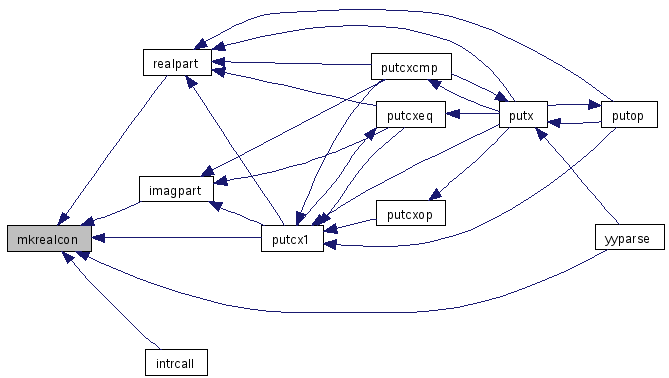
Definition at line 998 of file expr.c.
References Dimblock::baseoffset, checksubs, cpexpr(), frexpr(), ICON, Addrblock::memoffset, mkaddr(), mkexpr(), OPSTAR, STGARG, TYCHAR, typesize, vardcl(), Nameblock::vdim, Nameblock::vleng, Nameblock::vstg, and Nameblock::vtype.
Referenced by doiolist(), fixargs(), and startrw().
01000 {
01001         Addrp ap;
01002
01003         vardcl(np);
01004         ap = mkaddr(np);
01005
01006         /* The prolog causes array arguments to point to the
01007          * (0,...,0) element, unless subscript checking is on.
01008          */
01009         if( !checksubs && np->vstg==STGARG)
01010         {
01011                 struct Dimblock *dp;
01012                 dp = np->vdim;
01013                 frexpr(ap->memoffset);
01014                 ap->memoffset = mkexpr(OPSTAR,
01015                     (np->vtype==TYCHAR ?
01016                     cpexpr(np->vleng) :
01017                     (tagptr)ICON(typesize[np->vtype]) ),
01018                     cpexpr(dp->baseoffset) );
01019         }
01020         return(ap);
01021 }
Here is the call graph for this function:

Here is the caller graph for this function:

Definition at line 226 of file expr.c.
References ckalloc(), ICON, mkconst(), p, and TYCHAR.
Referenced by exstop(), subcheck(), and yyparse().
00228 {
00229         Constp p;
00230         char *s;
00231
00232         p = mkconst(TYCHAR);
00233         p->vleng = ICON(l);
00234         p->Const.ccp = s = (char *) ckalloc(l+1);
00235         p->Const.ccp1.blanks = 0;
00236         while(--l >= 0)
00237                 *s++ = *v++;
00238         *s = '\0';
00239         return( (expptr) p );
00240 }
Here is the call graph for this function:

Here is the caller graph for this function:

Definition at line 389 of file expr.c.
References ENULL, err, Expression::headblock, mkexpr(), OPCONV, p, TYSUBR, and Headblock::vtype.
Referenced by mkconv().
00391 {
00392         expptr q;
00393
00394         if (t == TYSUBR)
00395                 err("illegal use of subroutine name");
00396         q = mkexpr(OPCONV, p, ENULL);
00397         q->headblock.vtype = t;
00398         return(q);
00399 }
Here is the call graph for this function:

Here is the caller graph for this function:

| void paren_used | ( | struct Primblock * | p | ) |
Definition at line 2069 of file expr.c.
References Nameblock::fvarname, p, Nameblock::vdim, and warn1().
Referenced by mkexpr(), and yyparse().
02071 {
02072         Namep np;
02073
02074         p->parenused = 1;
02075         if (!p->argsp && (np = p->namep) && np->vdim)
02076                 warn1("inappropriate operation on unsubscripted array %.50s",
02077                         np->fvarname);
02078         }
Here is the call graph for this function:

Here is the caller graph for this function:

| void sserr | ( | Namep | np | ) |
Definition at line 3732 of file expr.c.
References errstr(), Nameblock::fvarname, TYCHAR, and Nameblock::vtype.
Referenced by fixargs(), mklhs(), and yyparse().
03734 {
03735         errstr(np->vtype == TYCHAR
03736                 ? "substring of character array %.70s"
03737                 : "substring of noncharacter %.73s", np->fvarname);
03738         }
Here is the call graph for this function:

Here is the caller graph for this function:
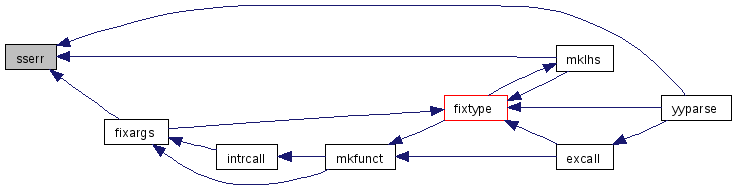
Definition at line 1199 of file expr.c.
References ALLOC, Nameblock::arginfo, Constant::ci, Constblock::Const, Expression::constblock, cpexpr(), Chain::datap, dclerr(), done, err, errstr(), Expression::exprblock, fixtype(), free(), Nameblock::fvarname, Expression::headblock, ICON, letter, mkconv(), mkexpr(), mktmp(), Chain::nextp, NULL, OPASSIGN, putexpr(), rhs, rpllist, Rplblock::rplnextp, Rplblock::rplnp, Rplblock::rpltag, Rplblock::rplvp, Rplblock::rplxp, TADDR, Expression::tag, TCONST, TERROR, TYCHAR, type, TYUNKNOWN, Nameblock::varxptr, Exprblock::vleng, Nameblock::vleng, Nameblock::vstfdesc, Headblock::vtype, and Nameblock::vtype.
Referenced by mkfunct().
01201 {
01202         chainp actuals;
01203         int nargs;
01204         chainp oactp, formals;
01205         int type;
01206         expptr Ln, Lq, q, q1, rhs, ap;
01207         Namep tnp;
01208         struct Rplblock *rp;
01209         struct Rplblock *tlist;
01210
01211         if (np->arginfo) {
01212                 errstr("statement function %.66s calls itself.",
01213                         np->fvarname);
01214                 return ICON(0);
01215                 }
01216         np->arginfo = (Argtypes *)np;   /* arbitrary nonzero value */
01217         if(actlist)
01218         {
01219                 actuals = actlist->listp;
01220                 free( (charptr) actlist);
01221         }
01222         else
01223                 actuals = NULL;
01224         oactp = actuals;
01225
01226         nargs = 0;
01227         tlist = NULL;
01228         if( (type = np->vtype) == TYUNKNOWN)
01229         {
01230                 dclerr("attempt to use untyped statement function", np);
01231                 type = np->vtype = dflttype[letter(np->fvarname[0])];
01232         }
01233         formals = (chainp) np->varxptr.vstfdesc->datap;
01234         rhs = (expptr) (np->varxptr.vstfdesc->nextp);
01235
01236         /* copy actual arguments into temporaries */
01237         while(actuals!=NULL && formals!=NULL)
01238         {
01239                 if (!(tnp = (Namep) formals->datap)) {
01240                         /* buggy statement function declaration */
01241                         q = ICON(1);
01242                         goto done;
01243                         }
01244                 rp = ALLOC(Rplblock);
01245                 rp->rplnp = tnp;
01246                 ap = fixtype((tagptr)actuals->datap);
01247                 if(tnp->vtype==ap->headblock.vtype && tnp->vtype!=TYCHAR
01248                     && (ap->tag==TCONST || ap->tag==TADDR) )
01249                 {
01250
01251 /* If actuals are constants or variable names, no temporaries are required */
01252                         rp->rplvp = (expptr) ap;
01253                         rp->rplxp = NULL;
01254                         rp->rpltag = ap->tag;
01255                 }
01256                 else    {
01257                         rp->rplvp = (expptr) mktmp(tnp->vtype, tnp->vleng);
01258                         rp -> rplxp = NULL;
01259                         putexpr ( mkexpr(OPASSIGN, cpexpr(rp->rplvp), ap));
01260                         if((rp->rpltag = rp->rplvp->tag) == TERROR)
01261                                 err("disagreement of argument types in statement function call");
01262                 }
01263                 rp->rplnextp = tlist;
01264                 tlist = rp;
01265                 actuals = actuals->nextp;
01266                 formals = formals->nextp;
01267                 ++nargs;
01268         }
01269
01270         if(actuals!=NULL || formals!=NULL)
01271                 err("statement function definition and argument list differ");
01272
01273         /*
01274    now push down names involved in formal argument list, then
01275    evaluate rhs of statement function definition in this environment
01276 */
01277
01278         if(tlist)       /* put tlist in front of the rpllist */
01279         {
01280                 for(rp = tlist; rp->rplnextp; rp = rp->rplnextp)
01281                         ;
01282                 rp->rplnextp = rpllist;
01283                 rpllist = tlist;
01284         }
01285
01286 /* So when the expression finally gets evaled, that evaluator must read
01287    from the globl   rpllist   14-jun-88 mwm */
01288
01289         q = (expptr) mkconv(type, fixtype(cpexpr(rhs)) );
01290
01291         /* get length right of character-valued statement functions... */
01292         if (type == TYCHAR
01293          && (Ln = np->vleng)
01294          && q->tag != TERROR
01295          && (Lq = q->exprblock.vleng)
01296          && (Lq->tag != TCONST
01297                 || Ln->constblock.Const.ci != Lq->constblock.Const.ci)) {
01298                 q1 = (expptr) mktmp(type, Ln);
01299                 putexpr ( mkexpr(OPASSIGN, cpexpr(q1), q));
01300                 q = q1;
01301                 }
01302
01303         /* now generate the tree ( t1=a1, (t2=a2,... , f))))) */
01304         while(--nargs >= 0)
01305         {
01306                 if(rpllist->rplxp)
01307                         q = mkexpr(OPCOMMA, rpllist->rplxp, q);
01308                 rp = rpllist->rplnextp;
01309                 frexpr(rpllist->rplvp);
01310                 free((char *)rpllist);
01311                 rpllist = rp;
01312         }
01313  done:
01314         frchain( &oactp );
01315         np->arginfo = 0;
01316         return(q);
01317 }
Here is the call graph for this function:

Here is the caller graph for this function:

Definition at line 1655 of file expr.c.
References call4(), Constant::ci, Constblock::Const, Expression::constblock, cpexpr(), ENULL, errstr(), Expression::exprblock, frexpr(), Nameblock::fvarname, ICON, ISICON, lineno, mkconv(), mkexpr(), mkstrcon(), mktmp(), Dimblock::nelt, NULL, OPAND, OPASSIGN, OPCCALL, Exprblock::opcode, OPCOLON, OPLE, OPLT, OPQUEST, p, procname, STGREG, t, TADDR, TYLONG, Nameblock::vdim, and Nameblock::vlastdim.
Referenced by suboffset().
01657 {
01658         struct Dimblock *dimp;
01659         expptr t, checkvar, checkcond, badcall;
01660
01661         dimp = np->vdim;
01662         if(dimp->nelt == NULL)
01663                 return(p);      /* don't check arrays with * bounds */
01664         np->vlastdim = 0;
01665         if( ISICON(p) )
01666         {
01667
01668 /* check for negative (constant) offset */
01669
01670                 if(p->constblock.Const.ci < 0)
01671                         goto badsub;
01672                 if( ISICON(dimp->nelt) )
01673
01674 /* see if constant offset exceeds the array declaration */
01675
01676                         if(p->constblock.Const.ci < dimp->nelt->constblock.Const.ci)
01677                                 return(p);
01678                         else
01679                                 goto badsub;
01680         }
01681
01682 /* We know that the subscript offset   p   or   dimp -> nelt   is not a constant.
01683    Now find a register to use for run-time bounds checking */
01684
01685         if(p->tag==TADDR && p->addrblock.vstg==STGREG)
01686         {
01687                 checkvar = (expptr) cpexpr(p);
01688                 t = p;
01689         }
01690         else    {
01691                 checkvar = (expptr) mktmp(TYLONG, ENULL);
01692                 t = mkexpr(OPASSIGN, cpexpr(checkvar), p);
01693         }
01694         checkcond = mkexpr(OPLT, t, cpexpr(dimp->nelt) );
01695         if( ! ISICON(p) )
01696                 checkcond = mkexpr(OPAND, checkcond,
01697                     mkexpr(OPLE, ICON(0), cpexpr(checkvar)) );
01698
01699 /* Construct the actual test */
01700
01701         badcall = call4(p->headblock.vtype, "s_rnge",
01702             mkstrcon(strlen(np->fvarname), np->fvarname),
01703             mkconv(TYLONG,  cpexpr(checkvar)),
01704             mkstrcon(strlen(procname), procname),
01705             ICON(lineno) );
01706         badcall->exprblock.opcode = OPCCALL;
01707         p = mkexpr(OPQUEST, checkcond,
01708             mkexpr(OPCOLON, checkvar, badcall));
01709
01710         return(p);
01711
01712 badsub:
01713         frexpr(p);
01714         errstr("subscript on variable %s out of range", np->fvarname);
01715         return ( ICON(0) );
01716 }
Here is the call graph for this function:

Here is the caller graph for this function:

Definition at line 1576 of file expr.c.
References Primblock::argsp, Dimblock::baseoffset, checksubs, cpexpr(), Chain::datap, Dimblock::dims, Dimblock::dimsize, ENULL, erri(), errstr(), fixtype(), Nameblock::fvarname, ICON, ISCONST, ISINT, maxdim, MAXDIM, mkconv(), mkexpr(), mktmp(), n, Dimblock::ndim, Chain::nextp, NOEXT, NULL, OPMINUS, OPPLUS, OPSTAR, p, Expression::primblock, prod(), putassign(), putout(), si, size, STGARG, subcheck(), Expression::tag, TPRIM, TYCHAR, TYLONG, typesize, Nameblock::vdim, Nameblock::vleng, Nameblock::vstg, and Nameblock::vtype.
Referenced by doequiv(), and mklhs().
01578 {
01579         int n;
01580         expptr si, size;
01581         chainp cp;
01582         expptr e, e1, offp, prod;
01583         struct Dimblock *dimp;
01584         expptr sub[MAXDIM+1];
01585         Namep np;
01586
01587         np = p->namep;
01588         offp = ICON(0);
01589         n = 0;
01590         if(p->argsp)
01591                 for(cp = p->argsp->listp ; cp ; cp = cp->nextp)
01592                 {
01593                         si = fixtype(cpexpr((tagptr)cp->datap));
01594                         if (!ISINT(si->headblock.vtype)) {
01595                                 NOEXT("non-integer subscript");
01596                                 si = mkconv(TYLONG, si);
01597                                 }
01598                         sub[n++] = si;
01599                         if(n > maxdim)
01600                         {
01601                                 erri("more than %d subscripts", maxdim);
01602                                 break;
01603                         }
01604                 }
01605
01606         dimp = np->vdim;
01607         if(n>0 && dimp==NULL)
01608                 errstr("subscripts on scalar variable %.68s", np->fvarname);
01609         else if(dimp && dimp->ndim!=n)
01610                 errstr("wrong number of subscripts on %.68s", np->fvarname);
01611         else if(n > 0)
01612         {
01613                 prod = sub[--n];
01614                 while( --n >= 0)
01615                         prod = mkexpr(OPPLUS, sub[n],
01616                             mkexpr(OPSTAR, prod, cpexpr(dimp->dims[n].dimsize)) );
01617                 if(checksubs || np->vstg!=STGARG)
01618                         prod = mkexpr(OPMINUS, prod, cpexpr(dimp->baseoffset));
01619
01620 /* Add in the run-time bounds check */
01621
01622                 if(checksubs)
01623                         prod = subcheck(np, prod);
01624                 size = np->vtype == TYCHAR ?
01625                     (expptr) cpexpr(np->vleng) : ICON(typesize[np->vtype]);
01626                 prod = mkexpr(OPSTAR, prod, size);
01627                 offp = mkexpr(OPPLUS, offp, prod);
01628         }
01629
01630 /* Check for substring indicator */
01631
01632         if(p->fcharp && np->vtype==TYCHAR) {
01633                 e = p->fcharp;
01634                 e1 = mkexpr(OPMINUS, cpexpr(e), ICON(1));
01635                 if (!ISCONST(e) && (e->tag != TPRIM || e->primblock.argsp)) {
01636                         e = (expptr)mktmp(TYLONG, ENULL);
01637                         putout(putassign(cpexpr(e), e1));
01638                         p->fcharp = mkexpr(OPPLUS, cpexpr(e), ICON(1));
01639                         e1 = e;
01640                         }
01641                 offp = mkexpr(OPPLUS, offp, e1);
01642                 }
01643         return(offp);
01644 }
Here is the call graph for this function:

Here is the caller graph for this function:

Definition at line 1383 of file expr.c.
References a, cpexpr(), Chain::datap, erri(), fixtype(), ICON, Listblock::listp, mkchain(), mkexpr(), Chain::nextp, OPMINUS, p, putx(), TYCHAR, UNAM_NAME, and UNAM_REF.
Referenced by mklhs().
01385 {
01386         expptr ep;
01387         struct Listblock *Lb;
01388         chainp cp;
01389
01390         if (a->uname_tag != UNAM_NAME)
01391                 erri("subskept: uname_tag %d", a->uname_tag);
01392         a->user.name->vrefused = 1;
01393         a->user.name->visused = 1;
01394         a->uname_tag = UNAM_REF;
01395         Lb = (struct Listblock *)cpexpr((tagptr)p->argsp);
01396         for(cp = Lb->listp; cp; cp = cp->nextp)
01397                 cp->datap = (char *)putx(fixtype((tagptr)cp->datap));
01398         if (a->vtype == TYCHAR) {
01399                 ep = p->fcharp  ? mkexpr(OPMINUS, cpexpr(p->fcharp), ICON(1))
01400                                 : ICON(0);
01401                 Lb->listp = mkchain((char *)ep, Lb->listp);
01402                 }
01403         return (expptr)Lb;
01404         }
Here is the call graph for this function:

Here is the caller graph for this function:

| static void substrerr | ( | Namep | np | ) | [static] |
Definition at line 1410 of file expr.c.
References Argdcl, checksubs, errstr(), f(), Nameblock::fvarname, void(), and warn1().
Referenced by mklhs().
01412 {
01413         void (*f) Argdcl((const char*, const char*));
01414         f = checksubs ? errstr : warn1;
01415         (*f)("substring of %.65s is out of bounds.", np->fvarname);
01416         }
Here is the call graph for this function:

Here is the caller graph for this function:

| void vardcl | ( | Namep | v | ) |
Definition at line 1905 of file expr.c.
References CLNAMELIST, CLPROC, CLUNKNOWN, CLVAR, dclerr(), doing_stmtfcn, impldcl(), implstg, ISCONST, lastvarno, letter, PTHISPROC, STGAUTO, STGBSS, STGUNKNOWN, t, TYUNKNOWN, v, and YES.
Referenced by docommon(), doequiv(), doiolist(), ioclause(), mkscalar(), namelist(), startrw(), and yyparse().
01907 {
01908         struct Dimblock *t;
01909         expptr neltp;
01910         extern int doing_stmtfcn;
01911
01912         if(v->vclass == CLUNKNOWN) {
01913                 v->vclass = CLVAR;
01914                 if (v->vinftype) {
01915                         v->vtype = TYUNKNOWN;
01916                         if (v->vdcldone) {
01917                                 v->vdcldone = 0;
01918                                 impldcl(v);
01919                                 }
01920                         }
01921                 }
01922         if(v->vdcldone)
01923                 return;
01924         if(v->vclass == CLNAMELIST)
01925                 return;
01926
01927         if(v->vtype == TYUNKNOWN)
01928                 impldcl(v);
01929         else if(v->vclass!=CLVAR && v->vprocclass!=PTHISPROC)
01930         {
01931                 dclerr("used as variable", v);
01932                 return;
01933         }
01934         if(v->vstg==STGUNKNOWN) {
01935                 if (doing_stmtfcn) {
01936                         /* neither declare this variable if its only use */
01937                         /* is in defining a stmt function, nor complain  */
01938                         /* that it is never used */
01939                         v->vimpldovar = 1;
01940                         return;
01941                         }
01942                 v->vstg = implstg[ letter(v->fvarname[0]) ];
01943                 v->vimplstg = 1;
01944                 }
01945
01946 /* Compute the actual storage location, i.e. offsets from base addresses,
01947    possibly the stack pointer */
01948
01949         switch(v->vstg)
01950         {
01951         case STGBSS:
01952                 v->vardesc.varno = ++lastvarno;
01953                 break;
01954         case STGAUTO:
01955                 if(v->vclass==CLPROC && v->vprocclass==PTHISPROC)
01956                         break;
01957                 if(t = v->vdim)
01958                         if( (neltp = t->nelt) && ISCONST(neltp) ) ;
01959                         else
01960                                 dclerr("adjustable automatic array", v);
01961                 break;
01962
01963         default:
01964                 break;
01965         }
01966         v->vdcldone = YES;
01967 }
Here is the call graph for this function:
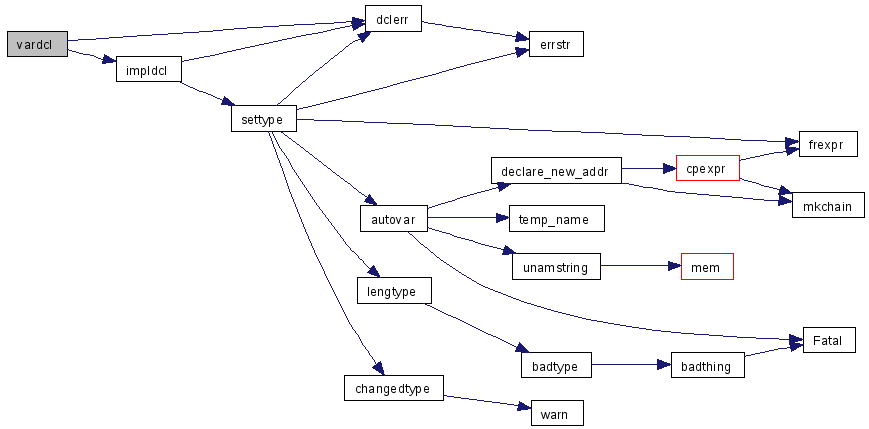
Here is the caller graph for this function:

| void wronginf | ( | Namep | np | ) |
Definition at line 580 of file expr.c.
References Nameblock::fvarname, ICON, implleng, impltype, letter, TYCHAR, Nameblock::vinftype, Nameblock::vleng, Nameblock::vtype, and warn1().
Referenced by fixtype().
00582 {
00583         int c;
00584         ftnint k;
00585         warn1("fixing wrong type inferred for %.65s", np->fvarname);
00586         np->vinftype = 0;
00587         c = letter(np->fvarname[0]);
00588         if ((np->vtype = impltype[c]) == TYCHAR
00589         && (k = implleng[c]))
00590                 np->vleng = ICON(k);
00591         }
Here is the call graph for this function:

Here is the caller graph for this function:

Definition at line 3698 of file expr.c.
References a, b, dcomplex::dimag, dcomplex::dreal, and Fatal().
Referenced by consbinop().
03700 {
03701         double ratio, den;
03702         double abr, abi;
03703
03704         if( (abr = b->dreal) < 0.)
03705                 abr = - abr;
03706         if( (abi = b->dimag) < 0.)
03707                 abi = - abi;
03708         if( abr <= abi )
03709         {
03710                 if(abi == 0)
03711                         Fatal("complex division by zero");
03712                 ratio = b->dreal / b->dimag ;
03713                 den = b->dimag * (1 + ratio*ratio);
03714                 c->dreal = (a->dreal*ratio + a->dimag) / den;
03715                 c->dimag = (a->dimag*ratio - a->dreal) / den;
03716         }
03717
03718         else
03719         {
03720                 ratio = b->dimag / b->dreal ;
03721                 den = b->dreal * (1 + ratio*ratio);
03722                 c->dreal = (a->dreal + a->dimag*ratio) / den;
03723                 c->dimag = (a->dimag - a->dreal*ratio) / den;
03724         }
03725 }
Here is the call graph for this function:

Here is the caller graph for this function:

Definition at line 2031 of file expr.c.
References Constant::cd, Constant::cds, Constant::ci, Constblock::Const, Constant::cq, Constblock::tag, TCONST, TYCOMPLEX, TYDCOMPLEX, TYDREAL, TYINT1, TYLONG, TYQUAD, TYREAL, TYSHORT, Constblock::vstg, and Constblock::vtype.
Referenced by fold(), and mkexpr().
02033 {
02034         Constp c = (Constp) e;
02035         if (c->tag == TCONST)
02036                 switch(c->vtype) {
02037                 case TYINT1:
02038                 case TYSHORT:
02039                 case TYLONG:
02040 #ifdef TYQUAD0
02041                 case TYQUAD:
02042 #endif
02043                         return c->Const.ci == 0;
02044 #ifndef NO_LONG_LONG
02045                 case TYQUAD:
02046                         return c->Const.cq == 0;
02047 #endif
02048
02049                 case TYREAL:
02050                 case TYDREAL:
02051                         if (c->vstg == 1)
02052                                 return !strcmp(c->Const.cds[0],"0.");
02053                         return c->Const.cd[0] == 0.;
02054
02055                 case TYCOMPLEX:
02056                 case TYDCOMPLEX:
02057                         if (c->vstg == 1)
02058                                 return !strcmp(c->Const.cds[0],"0.")
02059                                     && !strcmp(c->Const.cds[1],"0.");
02060                         return c->Const.cd[0] == 0. && c->Const.cd[1] == 0.;
02061                 }
02062         return 0;
02063         }
Here is the caller graph for this function:

| char dflttype[26] |
int doing_vleng [static] |
| char* powint[] |
 1.5.1
1.5.1


