
#include "defs.h"#include "names.h"Include dependency graph for intr.c:
Go to the source code of this file.
Data Structures | |
| struct | Intrbits |
| struct | Intrblock |
| struct | Specblock |
Functions | |
| void | r8fix (Void) |
| static expptr | foldminmax (int ismin, struct Listblock *argsp) |
| expptr | intrcall (Namep np, struct Listblock *argsp, int nargs) |
| int | intrfunct (char *s) |
| Addrp | intraddr (Namep np) |
| void | cast_args (int maxtype, chainp args) |
| expptr | Inline (int fno, int type, struct Chain *args) |
Variables | |
| union { | |
| int ijunk | |
| Intrpacked bits | |
| } | packed |
| LOCAL struct Intrblock | intrtab [] |
| LOCAL struct Specblock | spectab [] |
| char * | callbyvalue [] |
Definition at line 1020 of file intr.c.
References args, cpexpr(), ENULL, mkconv(), mktmp(), puteq(), and TCONST.
Referenced by intrcall().
01022 {
01023     for (; args; args = args -> nextp) {
01024         expptr e = (expptr) args->datap;
01025         if (e -> headblock.vtype != maxtype)
01026             if (e -> tag == TCONST)
01027                 args->datap = (char *) mkconv(maxtype, e);
01028             else {
01029                 Addrp temp = mktmp(maxtype, ENULL);
01030
01031                 puteq(cpexpr((expptr)temp), e);
01032                 args->datap = (char *)temp;
01033             } /* else */
01034     } /* for */
01035 } /* cast_args */
Here is the call graph for this function:

Here is the caller graph for this function:

Definition at line 502 of file intr.c.
References ci, Const, Chain::datap, frexpr(), h, ISINT, ISREAL, Listblock::listp, mkconv(), Chain::nextp, TYQUAD, and Listblock::vtype.
Referenced by intrcall(), and putmnmx().
00504 {
00505 #ifndef NO_LONG_LONG
00506         Llong cq, cq1;
00507 #endif
00508         Constp h;
00509         double cd, cd1;
00510         ftnint ci;
00511         int mtype;
00512         struct Chain *cp, *cpx;
00513
00514         mtype = argsp->vtype;
00515         cp = cpx = argsp->listp;
00516         h = &((expptr)cp->datap)->constblock;
00517 #ifndef NO_LONG_LONG
00518         if (mtype == TYQUAD) {
00519                 cq = h->vtype == TYQUAD ? h->Const.cq : h->Const.ci;
00520                 while(cp = cp->nextp) {
00521                         h = &((expptr)cp->datap)->constblock;
00522                         cq1 = h->vtype == TYQUAD ? h->Const.cq : h->Const.ci;
00523                         if (ismin) {
00524                                 if (cq > cq1) {
00525                                         cq = cq1;
00526                                         cpx = cp;
00527                                         }
00528                                 }
00529                         else {
00530                                 if (cq < cq1) {
00531                                         cq = cq1;
00532                                         cpx = cp;
00533                                         }
00534                                 }
00535                         }
00536                 }
00537         else
00538 #endif
00539         if (ISINT(mtype)) {
00540                 ci = h->Const.ci;
00541                 if (ismin)
00542                         while(cp = cp->nextp) {
00543                                 h = &((expptr)cp->datap)->constblock;
00544                                 if (ci > h->Const.ci) {
00545                                         ci = h->Const.ci;
00546                                         cpx = cp;
00547                                         }
00548                                 }
00549                 else
00550                         while(cp = cp->nextp) {
00551                                 h = &((expptr)cp->datap)->constblock;
00552                                 if (ci < h->Const.ci) {
00553                                         ci = h->Const.ci;
00554                                         cpx = cp;
00555                                         }
00556                                 }
00557                 }
00558         else {
00559                 if (ISREAL(h->vtype))
00560                         cd = h->vstg ? atof(h->Const.cds[0]) : h->Const.cd[0];
00561 #ifndef NO_LONG_LONG
00562                 else if (h->vtype == TYQUAD)
00563                         cd = (double)(h->Const.cq);
00564 #endif
00565                 else
00566                         cd = h->Const.ci;
00567                 while(cp = cp->nextp) {
00568                         h = &((expptr)cp->datap)->constblock;
00569                         if (ISREAL(h->vtype))
00570                                 cd1 = h->vstg   ? atof(h->Const.cds[0])
00571                                                 : h->Const.cd[0];
00572 #ifndef NO_LONG_LONG
00573                         else if (h->vtype == TYQUAD)
00574                                 cd1 = (double)(h->Const.cq);
00575 #endif
00576                         else
00577                                 cd1 = h->Const.ci;
00578                         if (ismin) {
00579                                 if (cd > cd1) {
00580                                         cd = cd1;
00581                                         cpx = cp;
00582                                         }
00583                                 }
00584                         else {
00585                                 if (cd < cd1) {
00586                                         cd = cd1;
00587                                         cpx = cp;
00588                                         }
00589                                 }
00590                         }
00591                 }
00592         h = &((expptr)cpx->datap)->constblock;
00593         cpx->datap = 0;
00594         frexpr((tagptr)argsp);
00595         if (h->vtype != mtype)
00596                 return mkconv(mtype, (expptr)h);
00597         return (expptr)h;
00598         }
Here is the call graph for this function:

Here is the caller graph for this function:

Definition at line 1046 of file intr.c.
References addressable(), args, cpexpr(), ENULL, forcedouble, frexpr(), mkconv(), mkexpr(), mktmp(), NULL, OPABS, OPASSIGN, OPCOMMA, OPDABS, OPMOD, OPSTAR, t, t1, TYDREAL, tyioint, and TYREAL.
Referenced by intrcall().
01048 {
01049         register expptr q, t, t1;
01050
01051         switch(fno)
01052         {
01053         case 8: /* real abs */
01054         case 9: /* short int abs */
01055         case 10:        /* long int abs */
01056         case 11:        /* double precision abs */
01057                 if( addressable(q = (expptr) args->datap) )
01058                 {
01059                         t = q;
01060                         q = NULL;
01061                 }
01062                 else
01063                         t = (expptr) mktmp(type,ENULL);
01064                 t1 = mkexpr(type == TYREAL && forcedouble ? OPDABS : OPABS,
01065                         cpexpr(t), ENULL);
01066                 if(q)
01067                         t1 = mkexpr(OPCOMMA, mkexpr(OPASSIGN, cpexpr(t),q), t1);
01068                 frexpr(t);
01069                 return(t1);
01070
01071         case 26:        /* dprod */
01072                 q = mkexpr(OPSTAR, mkconv(TYDREAL,(expptr)args->datap),
01073                         (expptr)args->nextp->datap);
01074                 return(q);
01075
01076         case 27:        /* len of character string */
01077                 q = (expptr) cpexpr(((tagptr)args->datap)->headblock.vleng);
01078                 frexpr((expptr)args->datap);
01079                 return mkconv(tyioint, q);
01080
01081         case 14:        /* half-integer mod */
01082         case 15:        /* mod */
01083                 return mkexpr(OPMOD, (expptr) args->datap,
01084                                 (expptr) args->nextp->datap);
01085         }
01086         return(NULL);
01087 }
Here is the call graph for this function:

Here is the caller graph for this function:

Definition at line 970 of file intr.c.
References builtin(), CLPROC, errnode, errstr(), fatali(), fatalstr(), Nameblock::fvarname, INTRBGEN, INTRBOOL, INTRCNST, INTRCONV, INTRGEN, INTRMAX, INTRMIN, INTRSPEC, packed, PINTRINSIC, sp(), spectab, tyint, TYLOGICAL, TYLONG, TYSHORT, Nameblock::vardesc, Nameblock::varno, Nameblock::vclass, and Nameblock::vprocclass.
Referenced by mkaddr().
00972 {
00973         Addrp q;
00974         register struct Specblock *sp;
00975         int f3field;
00976
00977         if(np->vclass!=CLPROC || np->vprocclass!=PINTRINSIC)
00978                 fatalstr("intraddr: %s is not intrinsic", np->fvarname);
00979         packed.ijunk = np->vardesc.varno;
00980         f3field = packed.bits.f3;
00981
00982         switch(packed.bits.f1)
00983         {
00984         case INTRGEN:
00985                 /* imag, log, and log10 arent specific functions */
00986                 if(f3field==31 || f3field==43 || f3field==47)
00987                         goto bad;
00988
00989         case INTRSPEC:
00990                 sp = spectab + f3field;
00991                 if (tyint == TYLONG
00992                 && (sp->rtype == TYSHORT || sp->rtype == TYLOGICAL))
00993                         ++sp;
00994                 q = builtin(sp->rtype, sp->spxname,
00995                         sp->othername ? 1 : 0);
00996                 return(q);
00997
00998         case INTRCONV:
00999         case INTRMIN:
01000         case INTRMAX:
01001         case INTRBOOL:
01002         case INTRCNST:
01003         case INTRBGEN:
01004 bad:
01005                 errstr("cannot pass %s as actual", np->fvarname);
01006                 return((Addrp)errnode());
01007         }
01008         fatali("intraddr: impossible f1=%d\n", (int) packed.bits.f1);
01009         /* NOT REACHED */ return 0;
01010 }
Here is the call graph for this function:

Here is the caller graph for this function:

Definition at line 608 of file intr.c.
References Expression::addrblock, badtype(), builtin(), callbyvalue, cast_args(), Constant::ci, Constblock::Const, Expression::constblock, Chain::datap, ENULL, err66(), Expression::exprblock, Fatal(), fatali(), fixargs(), fixexpr(), foldminmax(), frchain(), free(), Nameblock::fvarname, Expression::headblock, i, ICON, Inline(), INTRBGEN, INTRBOOL, INTRCNST, INTRCONV, INTRGEN, INTRMAX, INTRMIN, INTRSPEC, ISCOMPLEX, ISCONST, Listblock::listp, M, maxtype(), mkchain(), mkconv(), mkcxcon(), mkexpr(), mkintcon(), mkrealcon(), MSKINT, MSKLOGICAL, MSKREAL, Chain::nextp, NO, no66flag, ONEOF, op, OPBITBITS, OPBITNOT, OPBITSH, OPBITTEST, OPCALL, OPCCALL, OPCONV, OPLSHIFT, OPMAX, OPMIN, OPRSHIFT, packed, Addrblock::parenused, s, sp(), spectab, TADDR, Expression::tag, TYDCOMPLEX, TYDREAL, tyint, tylog, TYLOGICAL, TYLONG, TYQUAD, TYREAL, TYSHORT, TYUNKNOWN, Nameblock::vardesc, Nameblock::varno, Listblock::vtype, Exprblock::vtype, Headblock::vtype, warn1(), and YES.
Referenced by mkfunct().
00610 { 00611 int i, rettype; 00612 ftnint k; 00613 Addrp ap; 00614 register struct Specblock *sp; 00615 register struct Chain *cp; 00616 expptr q, ep; 00617 int constargs, mtype, op; 00618 int f1field, f2field, f3field; 00619 char *s; 00620 static char bit_bits[] = "?bit_bits", 00621 bit_shift[] = "?bit_shift", 00622 bit_cshift[] = "?bit_cshift"; 00623 static char *bitop[3] = { bit_bits, bit_shift, bit_cshift }; 00624 static int t_pref[2] = { 'l', 'q' }; 00625 00626 packed.ijunk = np->vardesc.varno; 00627 f1field = packed.bits.f1; 00628 f2field = packed.bits.f2; 00629 f3field = packed.bits.f3; 00630 if(nargs == 0) 00631 goto badnargs; 00632 00633 mtype = 0; 00634 constargs = 1; 00635 for(cp = argsp->listp ; cp ; cp = cp->nextp) 00636 { 00637 ep = (expptr)cp->datap; 00638 if (!ISCONST(ep)) 00639 constargs = 0; 00640 else if( ep->headblock.vtype==TYSHORT ) 00641 cp->datap = (char *) mkconv(tyint, ep); 00642 mtype = maxtype(mtype, ep->headblock.vtype); 00643 } 00644 00645 switch(f1field) 00646 { 00647 case INTRBGEN: 00648 op = f3field; 00649 if( ! ONEOF(mtype, MSKINT) ) 00650 goto badtype; 00651 if (op < OPBITBITS) { 00652 if(nargs != 2) 00653 goto badnargs; 00654 if (op != OPBITTEST) { 00655 #ifdef TYQUAD 00656 if (mtype == TYQUAD) 00657 op += 2; 00658 #endif 00659 goto intrbool2; 00660 } 00661 q = mkexpr(op, (expptr)argsp->listp->datap, 00662 (expptr)argsp->listp->nextp->datap); 00663 q->exprblock.vtype = TYLOGICAL; 00664 goto intrbool2a; 00665 } 00666 if (nargs != 2 && (nargs != 3 || op == OPBITSH)) 00667 goto badnargs; 00668 cp = argsp->listp; 00669 ep = (expptr)cp->datap; 00670 if (ep->headblock.vtype < TYLONG) 00671 cp->datap = (char *)mkconv(TYLONG, ep); 00672 while(cp->nextp) { 00673 cp = cp->nextp; 00674 ep = (expptr)cp->datap; 00675 if (ep->headblock.vtype != TYLONG) 00676 cp->datap = (char *)mkconv(TYLONG, ep); 00677 } 00678 if (op == OPBITSH) { 00679 ep = (expptr)argsp->listp->nextp->datap; 00680 if (ISCONST(ep)) { 00681 if ((k = ep->constblock.Const.ci) < 0) { 00682 q = (expptr)argsp->listp->datap; 00683 if (ISCONST(q)) { 00684 ep->constblock.Const.ci = -k; 00685 op = OPRSHIFT; 00686 goto intrbool2; 00687 } 00688 } 00689 else { 00690 op = OPLSHIFT; 00691 goto intrbool2; 00692 } 00693 } 00694 } 00695 else if (nargs == 2) { 00696 if (op == OPBITBITS) 00697 goto badnargs; 00698 cp->nextp = mkchain((char*)ICON(-1), 0); 00699 } 00700 ep = (expptr)argsp->listp->datap; 00701 i = ep->headblock.vtype; 00702 s = bitop[op - OPBITBITS]; 00703 *s = t_pref[i - TYLONG]; 00704 ap = builtin(i, s, 1); 00705 return fixexpr((Exprp) 00706 mkexpr(OPCCALL, (expptr)ap, (expptr)argsp) ); 00707 00708 case INTRBOOL: 00709 op = f3field; 00710 if( ! ONEOF(mtype, MSKINT|MSKLOGICAL) ) 00711 goto badtype; 00712 if(op == OPBITNOT) 00713 { 00714 if(nargs != 1) 00715 goto badnargs; 00716 q = mkexpr(OPBITNOT, (expptr)argsp->listp->datap, ENULL); 00717 } 00718 else 00719 { 00720 if(nargs != 2) 00721 goto badnargs; 00722 intrbool2: 00723 q = mkexpr(op, (expptr)argsp->listp->datap, 00724 (expptr)argsp->listp->nextp->datap); 00725 } 00726 intrbool2a: 00727 frchain( &(argsp->listp) ); 00728 free( (charptr) argsp); 00729 return(q); 00730 00731 case INTRCONV: 00732 rettype = f2field; 00733 switch(rettype) { 00734 case TYLONG: 00735 rettype = tyint; 00736 break; 00737 case TYLOGICAL: 00738 rettype = tylog; 00739 } 00740 if( ISCOMPLEX(rettype) && nargs==2) 00741 { 00742 expptr qr, qi; 00743 qr = (expptr) argsp->listp->datap; 00744 qi = (expptr) argsp->listp->nextp->datap; 00745 if (qr->headblock.vtype == TYDREAL 00746 || qi->headblock.vtype == TYDREAL) 00747 rettype = TYDCOMPLEX; 00748 if(ISCONST(qr) && ISCONST(qi)) 00749 q = mkcxcon(qr,qi); 00750 else q = mkexpr(OPCONV,mkconv(rettype-2,qr), 00751 mkconv(rettype-2,qi)); 00752 } 00753 else if(nargs == 1) { 00754 if (f3field && ((Exprp)argsp->listp->datap)->vtype 00755 == TYDCOMPLEX) 00756 rettype = TYDREAL; 00757 q = mkconv(rettype+100, (expptr)argsp->listp->datap); 00758 if (q->tag == TADDR) 00759 q->addrblock.parenused = 1; 00760 } 00761 else goto badnargs; 00762 00763 q->headblock.vtype = rettype; 00764 frchain(&(argsp->listp)); 00765 free( (charptr) argsp); 00766 return(q); 00767 00768 00769 #if 0 00770 case INTRCNST: 00771 00772 /* Machine-dependent f77 stuff that f2c omits: 00773 00774 intcon contains 00775 radix for short int 00776 radix for long int 00777 radix for single precision 00778 radix for double precision 00779 precision for short int 00780 precision for long int 00781 precision for single precision 00782 precision for double precision 00783 emin for single precision 00784 emin for double precision 00785 emax for single precision 00786 emax for double prcision 00787 largest short int 00788 largest long int 00789 00790 realcon contains 00791 tiny for single precision 00792 tiny for double precision 00793 huge for single precision 00794 huge for double precision 00795 mrsp (epsilon) for single precision 00796 mrsp (epsilon) for double precision 00797 */ 00798 { register struct Incstblock *cstp; 00799 extern ftnint intcon[14]; 00800 extern double realcon[6]; 00801 00802 cstp = consttab + f3field; 00803 for(i=0 ; i<f2field ; ++i) 00804 if(cstp->atype == mtype) 00805 goto foundconst; 00806 else 00807 ++cstp; 00808 goto badtype; 00809 00810 foundconst: 00811 switch(cstp->rtype) 00812 { 00813 case TYLONG: 00814 return(mkintcon(intcon[cstp->constno])); 00815 00816 case TYREAL: 00817 case TYDREAL: 00818 return(mkrealcon(cstp->rtype, 00819 realcon[cstp->constno]) ); 00820 00821 default: 00822 Fatal("impossible intrinsic constant"); 00823 } 00824 } 00825 #endif 00826 00827 case INTRGEN: 00828 sp = spectab + f3field; 00829 if(no66flag) 00830 if(sp->atype == mtype) 00831 goto specfunct; 00832 else err66("generic function"); 00833 00834 for(i=0; i<f2field ; ++i) 00835 if(sp->atype == mtype) 00836 goto specfunct; 00837 else 00838 ++sp; 00839 warn1 ("bad argument type to intrinsic %s", np->fvarname); 00840 00841 /* Made this a warning rather than an error so things like "log (5) ==> 00842 log (5.0)" can be accommodated. When none of these cases matches, the 00843 argument is cast up to the first type in the spectab list; this first 00844 type is assumed to be the "smallest" type, e.g. REAL before DREAL 00845 before COMPLEX, before DCOMPLEX */ 00846 00847 sp = spectab + f3field; 00848 mtype = sp -> atype; 00849 goto specfunct; 00850 00851 case INTRSPEC: 00852 sp = spectab + f3field; 00853 specfunct: 00854 if(tyint==TYLONG && ONEOF(sp->rtype,M(TYSHORT)|M(TYLOGICAL)) 00855 && (sp+1)->atype==sp->atype) 00856 ++sp; 00857 00858 if(nargs != sp->nargs) 00859 goto badnargs; 00860 if(mtype != sp->atype) 00861 goto badtype; 00862 00863 /* NOTE!! I moved fixargs (YES) into the ELSE branch so that constants in 00864 the inline expression wouldn't get put into the constant table */ 00865 00866 fixargs (NO, argsp); 00867 cast_args (mtype, argsp -> listp); 00868 00869 if(q = Inline((int)(sp-spectab), mtype, argsp->listp)) 00870 { 00871 frchain( &(argsp->listp) ); 00872 free( (charptr) argsp); 00873 } else { 00874 00875 if(sp->othername) { 00876 /* C library routines that return double... */ 00877 /* sp->rtype might be TYREAL */ 00878 ap = builtin(sp->rtype, 00879 callbyvalue[sp->othername], 1); 00880 q = fixexpr((Exprp) 00881 mkexpr(OPCCALL, (expptr)ap, (expptr)argsp) ); 00882 } else { 00883 fixargs(YES, argsp); 00884 ap = builtin(sp->rtype, sp->spxname, 0); 00885 q = fixexpr((Exprp) 00886 mkexpr(OPCALL, (expptr)ap, (expptr)argsp) ); 00887 } /* else */ 00888 } /* else */ 00889 return(q); 00890 00891 case INTRMIN: 00892 case INTRMAX: 00893 if(nargs < 2) 00894 goto badnargs; 00895 if( ! ONEOF(mtype, MSKINT|MSKREAL) ) 00896 goto badtype; 00897 argsp->vtype = mtype; 00898 if (constargs) 00899 q = foldminmax(f1field==INTRMIN, argsp); 00900 else 00901 q = mkexpr(f1field==INTRMIN ? OPMIN : OPMAX, 00902 (expptr)argsp, ENULL); 00903 00904 q->headblock.vtype = mtype; 00905 rettype = f2field; 00906 if(rettype == TYLONG) 00907 rettype = tyint; 00908 else if(rettype == TYUNKNOWN) 00909 rettype = mtype; 00910 return( mkconv(rettype, q) ); 00911 00912 default: 00913 fatali("intrcall: bad intrgroup %d", f1field); 00914 } 00915 badnargs: 00916 errstr("bad number of arguments to intrinsic %s", np->fvarname); 00917 goto bad; 00918 00919 badtype: 00920 errstr("bad argument type to intrinsic %s", np->fvarname); 00921 00922 bad: 00923 return( errnode() ); 00924 }
Here is the call graph for this function:

Here is the caller graph for this function:

| int intrfunct | ( | char * | s | ) |
Definition at line 933 of file intr.c.
References errext(), i, intr_omit, INTREND, intrtab, noextflag, p, and packed.
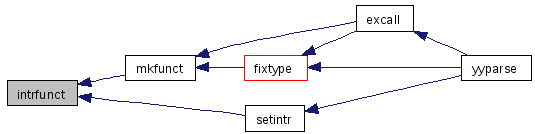
Referenced by mkfunct(), and setintr().
00935 {
00936         register struct Intrblock *p;
00937         int i;
00938         extern int intr_omit;
00939
00940         for(p = intrtab; p->intrval.intrgroup!=INTREND ; ++p)
00941         {
00942                 if( !strcmp(s, p->intrfname) )
00943                 {
00944                         if (i = p->intrval.extflag) {
00945                                 if (i & intr_omit)
00946                                         return 0;
00947                                 if (noextflag)
00948                                         errext(s);
00949                                 }
00950                         packed.bits.f1 = p->intrval.intrgroup;
00951                         packed.bits.f2 = p->intrval.intrstuff;
00952                         packed.bits.f3 = p->intrval.intrno;
00953                         packed.bits.f4 = p->intrval.dblcmplx;
00954                         return(packed.ijunk);
00955                 }
00956         }
00957
00958         return(0);
00959 }
Here is the call graph for this function:

Here is the caller graph for this function:
| void r8fix | ( | Void | ) |
Definition at line 428 of file intr.c.
References I, INTRGEN, intrtab, S, TYCOMPLEX, TYDCOMPLEX, TYDREAL, and TYREAL.
Referenced by set_externs().
00429 {
00430         register struct Intrblock *I;
00431         register struct Specblock *S;
00432
00433         for(I = intrtab; I->intrfname[0]; I++)
00434                 if (I->intrval.intrgroup != INTRGEN)
00435                     switch(I->intrval.intrstuff) {
00436                         case TYREAL:
00437                                 I->intrval.intrstuff = TYDREAL;
00438                                 I->intrval.intrno = I->intrval.dblintrno;
00439                                 break;
00440                         case TYCOMPLEX:
00441                                 I->intrval.intrstuff = TYDCOMPLEX;
00442                                 I->intrval.intrno = I->intrval.dblintrno;
00443                                 I->intrval.dblcmplx = 1;
00444                         }
00445
00446         for(S = spectab; S->atype; S++)
00447             switch(S->atype) {
00448                 case TYCOMPLEX:
00449                         S->atype = TYDCOMPLEX;
00450                         if (S->rtype == TYREAL)
00451                                 S->rtype = TYDREAL;
00452                         else if (S->rtype == TYCOMPLEX)
00453                                 S->rtype = TYDCOMPLEX;
00454                         switch(S->spxname[0]) {
00455                                 case 'r':
00456                                         S->spxname[0] = 'd';
00457                                         break;
00458                                 case 'c':
00459                                         S->spxname[0] = 'z';
00460                                         break;
00461                                 default:
00462                                         Fatal("r8fix bug");
00463                                 }
00464                         break;
00465                 case TYREAL:
00466                         S->atype = TYDREAL;
00467                         switch(S->rtype) {
00468                             case TYREAL:
00469                                 S->rtype = TYDREAL;
00470                                 if (S->spxname[0] != 'r')
00471                                         Fatal("r8fix bug");
00472                                 S->spxname[0] = 'd';
00473                             case TYDREAL:       /* d_prod */
00474                                 break;
00475
00476                             case TYSHORT:
00477                                 if (!strcmp(S->spxname, "hr_expn"))
00478                                         S->spxname[1] = 'd';
00479                                 else if (!strcmp(S->spxname, "h_nint"))
00480                                         strcpy(S->spxname, "h_dnnt");
00481                                 else Fatal("r8fix bug");
00482                                 break;
00483
00484                             case TYLONG:
00485                                 if (!strcmp(S->spxname, "ir_expn"))
00486                                         S->spxname[1] = 'd';
00487                                 else if (!strcmp(S->spxname, "i_nint"))
00488                                         strcpy(S->spxname, "i_dnnt");
00489                                 else Fatal("r8fix bug");
00490                                 break;
00491
00492                             default:
00493                                 Fatal("r8fix bug");
00494                             }
00495                 }
00496         }
Here is the caller graph for this function:

| struct Intrpacked bits |
| char* callbyvalue[] |
Initial value:
        {0,
        "sqrt",
        "exp",
        "log",
        "sin",
        "cos",
        "tan",
        "asin",
        "acos",
        "atan",
        "atan2",
        "sinh",
        "cosh",
        "tanh"
        }
Definition at line 410 of file intr.c.
Referenced by intrcall().
Referenced by intrfunct(), and r8fix().
| union { ... } packed |
Referenced by intraddr(), intrcall(), and intrfunct().
Referenced by intraddr(), and intrcall().
 1.5.1
1.5.1