
#include "defs.h"#include "names.h"#include "pccdefs.h"#include "p1defs.h"Include dependency graph for put.c:
Go to the source code of this file.
Defines | |
| #define | LIT_CHAR 1 |
| #define | LIT_FLOAT 2 |
| #define | LIT_INT 3 |
| #define | LIT_INTQ 4 |
Functions | |
| void | putexpr (expptr p) |
| expptr | putassign (expptr lp, expptr rp) |
| void | puteq (expptr lp, expptr rp) |
| expptr | putsteq (Addrp a, Addrp b) |
| Addrp | mkfield (register Addrp res, char *f, int ty) |
| Addrp | realpart (register Addrp p) |
| expptr | imagpart (register Addrp p) |
| int | ncat (register expptr p) |
| ftnint | lencat (register expptr p) |
| Addrp | putconst (register Constp p) |
Variables | |
| int | ops2 [] |
| #define LIT_CHAR 1 |
| #define LIT_FLOAT 2 |
| #define LIT_INT 3 |
| #define LIT_INTQ 4 |
Definition at line 190 of file put.c.
References cds(), CNULL, cpexpr(), dtos(), ISCOMPLEX, ISINT, mkfield(), mkrealcon(), p, TADDR, TYCOMPLEX, TYDREAL, TYREAL, and UNAM_CONST.
Referenced by putcx1(), putcxcmp(), and putcxeq().
00192 {
00193         register Addrp q;
00194
00195         if( ISCOMPLEX(p->vtype) )
00196         {
00197                 if (p->tag == TADDR && p->uname_tag == UNAM_CONST)
00198                         return mkrealcon (p -> vtype + TYREAL - TYCOMPLEX,
00199                                 p->user.kludge.vstg1 ? p->user.Const.cds[1]
00200                                 : cds(dtos(p->user.Const.cd[1]),CNULL));
00201                 q = (Addrp) cpexpr((expptr) p);
00202                 q = mkfield (q, "i", p -> vtype + TYREAL - TYCOMPLEX);
00203                 return( (expptr) q );
00204         }
00205         else
00206
00207 /* Cast an integer type onto a Double Real type */
00208
00209                 return( mkrealcon( ISINT(p->vtype) ? TYDREAL : p->vtype , "0"));
00210 }
Here is the call graph for this function:

Here is the caller graph for this function:

Definition at line 242 of file put.c.
References err, ISICON, NULL, OPCONCAT, TADDR, and TEXPR.
Referenced by doiolist(), and putch1().
00244 {
00245         if(p->tag==TEXPR && p->exprblock.opcode==OPCONCAT)
00246                 return( lencat(p->exprblock.leftp) + lencat(p->exprblock.rightp) );
00247         else if( p->headblock.vleng!=NULL && ISICON(p->headblock.vleng) )
00248                 return(p->headblock.vleng->constblock.Const.ci);
00249         else if(p->tag==TADDR && p->addrblock.varleng!=0)
00250                 return(p->addrblock.varleng);
00251         else
00252         {
00253                 err("impossible element in concatenation");
00254                 return(0);
00255         }
00256 }
Here is the caller graph for this function:

Definition at line 149 of file put.c.
Referenced by imagpart(), and realpart().
Here is the caller graph for this function:

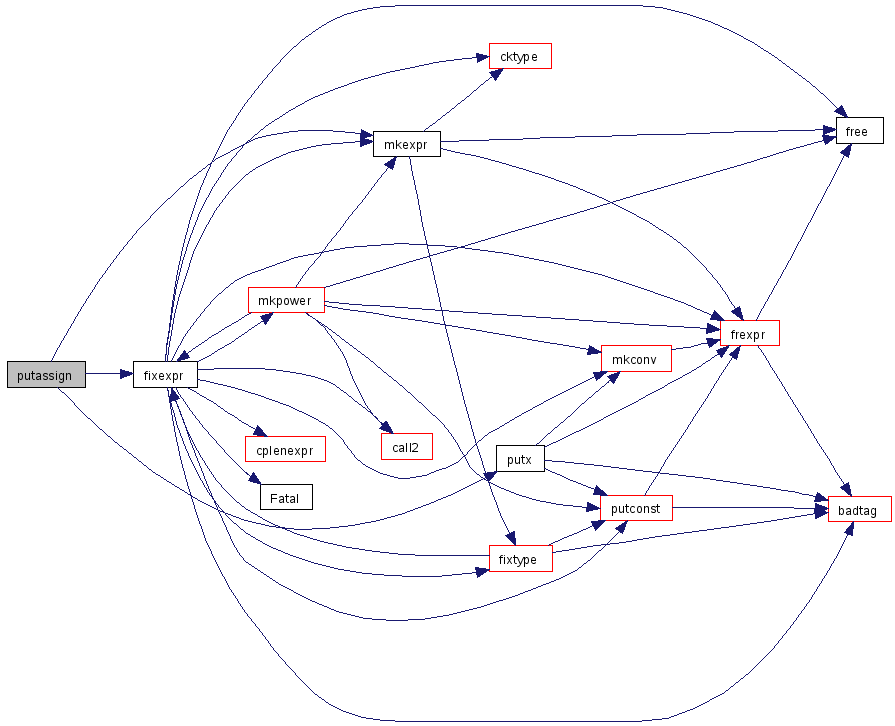
Definition at line 100 of file put.c.
References fixexpr(), lp, mkexpr(), OPASSIGN, and putx().
Referenced by intdouble(), krput(), putct1(), putcx1(), putcxeq(), putmnmx(), putpower(), and suboffset().
Here is the call graph for this function:
Here is the caller graph for this function:

Definition at line 272 of file put.c.
References ALLOC, BAD_MEMNO, badtag(), Constant::ccp0, Constant::ccp1, Literal::cds, cds(), Const, Addrblock::Const, cpexpr(), dtos(), frexpr(), halign, ICON, int, Addrblock::kludge, len, LIT_CHAR, LIT_FLOAT, LIT_INT, LIT_INTQ, Literal::litdval, Literal::litival2, Literal::litnum, litpool, Literal::littype, Literal::litval, memcmp(), Addrblock::memno, Addrblock::memoffset, newlabel(), nliterals, STGCONST, TADDR, Addrblock::tag, TCONST, TYADDR, TYCHAR, TYCOMPLEX, TYDCOMPLEX, TYDREAL, tyint, TYINT1, TYLOGICAL, TYLOGICAL1, TYLOGICAL2, TYLONG, type, TYQUAD, TYREAL, TYSHORT, UNAM_CONST, Addrblock::user, Addrblock::vleng, Addrblock::vstg, and Addrblock::vtype.
Referenced by doiolist(), fixargs(), fixexpr(), fixtype(), mkaddr(), mkpower(), putcall(), putcat(), putch1(), putcx1(), putio(), putop(), and putx().
00274 {
00275         register Addrp q;
00276         struct Literal *litp, *lastlit;
00277         int k, len, type;
00278         int litflavor;
00279         double cd[2];
00280         ftnint nblanks;
00281         char *strp;
00282         char cdsbuf0[64], cdsbuf1[64], *ds[2];
00283
00284         if (p->tag != TCONST)
00285                 badtag("putconst", p->tag);
00286
00287         q = ALLOC(Addrblock);
00288         q->tag = TADDR;
00289         type = p->vtype;
00290         q->vtype = ( type==TYADDR ? tyint : type );
00291         q->vleng = (expptr) cpexpr(p->vleng);
00292         q->vstg = STGCONST;
00293
00294 /* Create the new label for the constant.  This is wasteful of labels
00295    because when the constant value already exists in the literal pool,
00296    this label gets thrown away and is never reclaimed.  It might be
00297    cleaner to move this down past the first   switch()   statement below */
00298
00299         q->memno = newlabel();
00300         q->memoffset = ICON(0);
00301         q -> uname_tag = UNAM_CONST;
00302
00303 /* Copy the constant info into the Addrblock; do this by copying the
00304    largest storage elts */
00305
00306         q -> user.Const = p -> Const;
00307         q->user.kludge.vstg1 = p->vstg; /* distinguish string from binary fp */
00308
00309         /* check for value in literal pool, and update pool if necessary */
00310
00311         k = 1;
00312         switch(type)
00313         {
00314         case TYCHAR:
00315                 if (halign) {
00316                         strp = p->Const.ccp;
00317                         nblanks = p->Const.ccp1.blanks;
00318                         len = (int)p->vleng->constblock.Const.ci;
00319                         litflavor = LIT_CHAR;
00320                         goto loop;
00321                         }
00322                 else
00323                         q->memno = BAD_MEMNO;
00324                 break;
00325         case TYCOMPLEX:
00326         case TYDCOMPLEX:
00327                 k = 2;
00328                 if (p->vstg)
00329                         cd[1] = atof(ds[1] = p->Const.cds[1]);
00330                 else
00331                         ds[1] = cds(dtos(cd[1] = p->Const.cd[1]), cdsbuf1);
00332         case TYREAL:
00333         case TYDREAL:
00334                 litflavor = LIT_FLOAT;
00335                 if (p->vstg)
00336                         cd[0] = atof(ds[0] = p->Const.cds[0]);
00337                 else
00338                         ds[0] = cds(dtos(cd[0] = p->Const.cd[0]), cdsbuf0);
00339                 goto loop;
00340
00341 #ifndef NO_LONG_LONG
00342         case TYQUAD:
00343                 litflavor = LIT_INTQ;
00344                 goto loop;
00345 #endif
00346
00347         case TYLOGICAL1:
00348         case TYLOGICAL2:
00349         case TYLOGICAL:
00350         case TYLONG:
00351         case TYSHORT:
00352         case TYINT1:
00353 #ifdef TYQUAD0
00354         case TYQUAD:
00355 #endif
00356                 litflavor = LIT_INT;
00357
00358 /* Scan the literal pool for this constant value.  If this same constant
00359    has been assigned before, use the same label.  Note that this routine
00360    does NOT consider two differently-typed constants with the same bit
00361    pattern to be the same constant */
00362
00363  loop:
00364                 lastlit = litpool + nliterals;
00365                 for(litp = litpool ; litp<lastlit ; ++litp)
00366
00367 /* Remove this type checking to ensure that all bit patterns are reused */
00368
00369                         if(type == litp->littype) switch(litflavor)
00370                         {
00371                         case LIT_CHAR:
00372                                 if (len == (int)litp->litval.litival2[0]
00373                                 && nblanks == litp->litval.litival2[1]
00374                                 && !memcmp(strp, litp->cds[0], len)) {
00375                                         q->memno = litp->litnum;
00376                                         frexpr((expptr)p);
00377                                         q->user.Const.ccp1.ccp0 = litp->cds[0];
00378                                         return(q);
00379                                         }
00380                                 break;
00381                         case LIT_FLOAT:
00382                                 if(cd[0] == litp->litval.litdval[0]
00383                                 && !strcmp(ds[0], litp->cds[0])
00384                                 && (k == 1 ||
00385                                     cd[1] == litp->litval.litdval[1]
00386                                     && !strcmp(ds[1], litp->cds[1]))) {
00387 ret:
00388                                         q->memno = litp->litnum;
00389                                         frexpr((expptr)p);
00390                                         return(q);
00391                                         }
00392                                 break;
00393
00394                         case LIT_INT:
00395                                 if(p->Const.ci == litp->litval.litival)
00396                                         goto ret;
00397                                 break;
00398 #ifndef NO_LONG_LONG
00399                         case LIT_INTQ:
00400                                 if(p->Const.cq == litp->litval.litqval)
00401                                         goto ret;
00402                                 break;
00403 #endif
00404                         }
00405
00406 /* If there's room in the literal pool, add this new value to the pool */
00407
00408                 if(nliterals < maxliterals)
00409                 {
00410                         ++nliterals;
00411
00412                         /* litp   now points to the next free elt */
00413
00414                         litp->littype = type;
00415                         litp->litnum = q->memno;
00416                         switch(litflavor)
00417                         {
00418                         case LIT_CHAR:
00419                                 litp->litval.litival2[0] = len;
00420                                 litp->litval.litival2[1] = nblanks;
00421                                 q->user.Const.ccp = litp->cds[0] = (char*)
00422                                         memcpy(gmem(len,0), strp, len);
00423                                 break;
00424
00425                         case LIT_FLOAT:
00426                                 litp->litval.litdval[0] = cd[0];
00427                                 litp->cds[0] = copys(ds[0]);
00428                                 if (k == 2) {
00429                                         litp->litval.litdval[1] = cd[1];
00430                                         litp->cds[1] = copys(ds[1]);
00431                                         }
00432                                 break;
00433
00434                         case LIT_INT:
00435                                 litp->litval.litival = p->Const.ci;
00436                                 break;
00437 #ifndef NO_LONG_LONG
00438                         case LIT_INTQ:
00439                                 litp->litval.litqval = p->Const.cq;
00440                                 break;
00441 #endif
00442                         } /* switch (litflavor) */
00443                 }
00444                 else
00445                         many("literal constants", 'L', maxliterals);
00446
00447                 break;
00448         case TYADDR:
00449             break;
00450         default:
00451                 badtype ("putconst", p -> vtype);
00452                 break;
00453         } /* switch */
00454
00455         if (type != TYCHAR || halign)
00456             frexpr((expptr)p);
00457         return( q );
00458 }
Here is the call graph for this function:

Here is the caller graph for this function:

Definition at line 115 of file put.c.
References lp, mkexpr(), OPASSIGN, and putexpr().
Referenced by cast_args(), doiolist(), enddo(), exdo(), and exequals().
Here is the call graph for this function:

Here is the caller graph for this function:

| void putexpr | ( | expptr | p | ) |
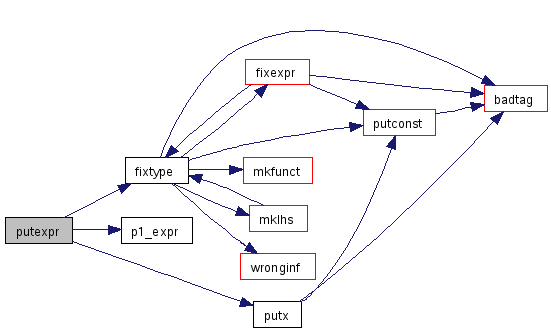
Definition at line 81 of file put.c.
References fixtype(), p, p1_expr(), and putx().
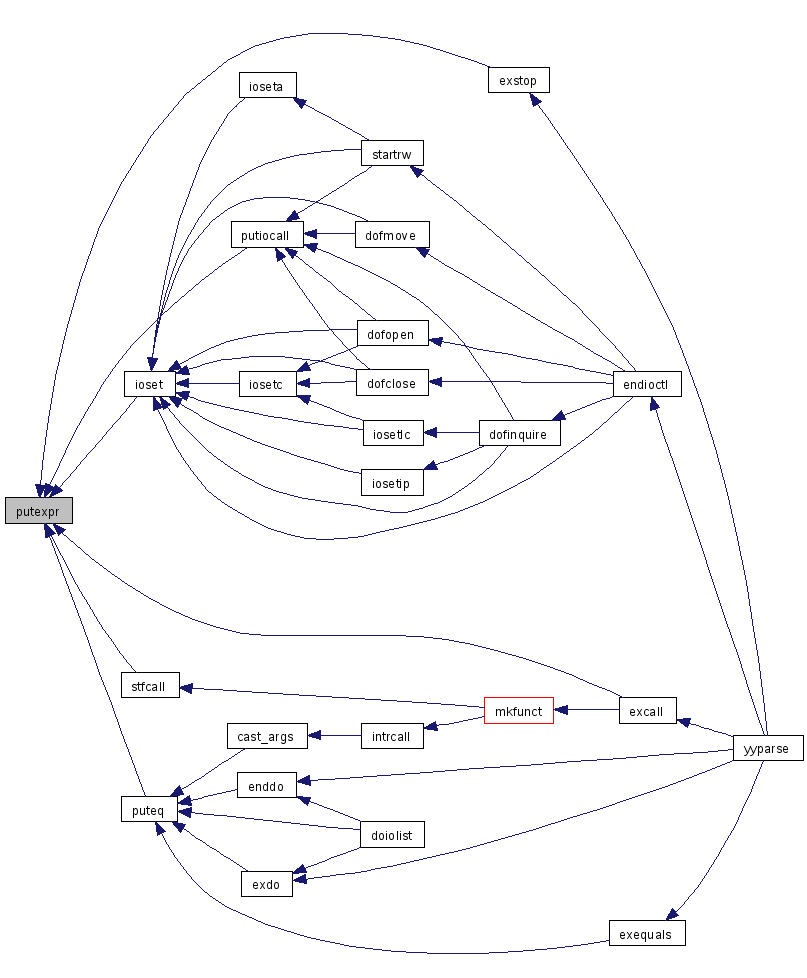
Referenced by excall(), exstop(), ioset(), puteq(), putiocall(), and stfcall().
00083 {
00084 /* Write the expression to the p1 file */
00085
00086         p = (expptr) putx (fixtype (p));
00087         p1_expr (p);
00088 }
Here is the call graph for this function:
Here is the caller graph for this function:
Definition at line 132 of file put.c.
References a, b, cpexpr(), fixexpr(), mkexpr(), OPSTAREQ, and putx().
Referenced by putpower().
00134 {
00135         return putx( fixexpr((Exprp)
00136                 mkexpr(OPSTAREQ, cpexpr((expptr)a), cpexpr((expptr)b))));
00137 }
Here is the call graph for this function:

Here is the caller graph for this function:

Definition at line 163 of file put.c.
References cds(), CNULL, cpexpr(), dtos(), ISCOMPLEX, mkfield(), mkrealcon(), p, TADDR, TYCOMPLEX, TYREAL, and UNAM_CONST.
Referenced by putcx1(), putcxcmp(), putcxeq(), putop(), and putx().
00165 {
00166         register Addrp q;
00167
00168         if (p->tag == TADDR
00169          && p->uname_tag == UNAM_CONST
00170          && ISCOMPLEX (p->vtype))
00171                 return (Addrp)mkrealcon (p -> vtype + TYREAL - TYCOMPLEX,
00172                         p->user.kludge.vstg1 ? p->user.Const.cds[0]
00173                                 : cds(dtos(p->user.Const.cd[0]),CNULL));
00174
00175         q = (Addrp) cpexpr((expptr) p);
00176         if( ISCOMPLEX(p->vtype) )
00177                 q = mkfield (q, "r", p -> vtype + TYREAL - TYCOMPLEX);
00178
00179         return(q);
00180 }
Here is the call graph for this function:

Here is the caller graph for this function:

Initial value:
{
        P2BAD, P2PLUS, P2MINUS, P2STAR, P2SLASH, P2BAD, P2NEG,
        P2OROR, P2ANDAND, P2EQ, P2NE, P2NOT,
        P2BAD,
        P2LT, P2EQ, P2GT, P2LE, P2NE, P2GE,
        P2CALL, P2CALL, P2ASSIGN, P2PLUSEQ, P2STAREQ, P2CONV, P2LSHIFT, P2MOD,
        P2COMOP, P2QUEST, P2COLON,
        1, P2BAD, P2BAD, P2BAD, P2BAD,
        P2BITOR, P2BITAND, P2BITXOR, P2BITNOT, P2RSHIFT,
        P2BAD, P2BAD, P2BAD, P2BAD, P2BAD, P2BAD, P2BAD, P2BAD, P2BAD,
        P2BAD, P2BAD, P2BAD, P2BAD,
        1,1,1,1,1,
        1,1,1,1,
        1,1,1,1,1
}
 1.5.1
1.5.1