
#include "defs.h"#include "iob.h"Include dependency graph for mem.c:
Go to the source code of this file.
Data Structures | |
| struct | memblock |
Defines | |
| #define | MEMBSIZE 32000 |
| #define | GMEMBSIZE 16000 |
Typedefs | |
| typedef memblock | memblock |
Functions | |
| char * | gmem (int n, int round) |
| void | mem_init (Void) |
| char * | mem (int n, int round) |
| char * | tostring (register char *s, int n) |
| char * | cpstring (register char *s) |
| void | new_iob_data (register io_setup *ios, char *name) |
| char * | string_num (char *pfx, long n) |
| void | def_start (FILE *outfile, char *s1, char *s2, char *post) |
| void | other_undefs (FILE *outfile) |
Variables | |
| static memblock * | mem0 |
| memblock * | curmemblock |
| memblock * | firstmemblock |
| char * | mem_first |
| char * | mem_next |
| char * | mem_last |
| char * | mem0_last |
| static defines * | define_list |
| #define MEMBSIZE 32000 |
| char* cpstring | ( | register char * | s | ) |
Definition at line 177 of file mem.c.
References mem().
Referenced by data_value(), ioseta(), new_iob_data(), and wr_equiv_init().
Here is the call graph for this function:

Here is the caller graph for this function:

| void def_start | ( | FILE * | outfile, | |
| char * | s1, | |||
| char * | s2, | |||
| char * | post | |||
| ) |
Definition at line 233 of file mem.c.
References define_list, defines::defname, in_define, mem(), n1, defines::next, and nice_printf().
Referenced by ref_defs(), wr_common_decls(), wr_one_init(), and write_char_init().
00235 {
00236         defines *d;
00237         int n, n1;
00238         extern int in_define;
00239
00240         n = n1 = strlen(s1);
00241         if (s2)
00242                 n += strlen(s2);
00243         d = (defines *)mem(sizeof(defines)+n, 1);
00244         d->next = define_list;
00245         define_list = d;
00246         strcpy(d->defname, s1);
00247         if (s2)
00248                 strcpy(d->defname + n1, s2);
00249         in_define = 1;
00250         nice_printf(outfile, "#define %s", d->defname);
00251         if (post)
00252                 nice_printf(outfile, " %s", post);
00253         }
Here is the call graph for this function:

Here is the caller graph for this function:

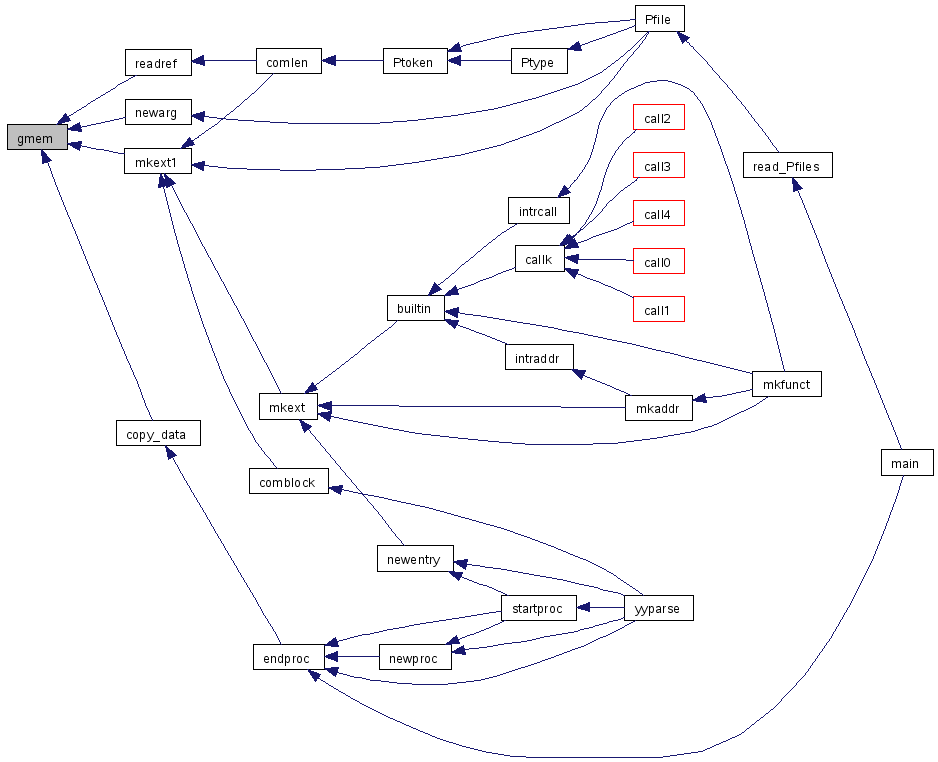
Definition at line 40 of file mem.c.
References Alloc(), GMEMBSIZE, last, and mem::next.
Referenced by copy_data(), mkext1(), newarg(), and readref().
00042 {
00043         static char *last, *next;
00044         char *rv;
00045         if (round)
00046 #ifdef CRAY
00047                 if ((long)next & 0xe000000000000000)
00048                         next = (char *)(((long)next & 0x1fffffffffffffff) + 1);
00049 #else
00050 #ifdef MSDOS
00051                 if ((int)next & 1)
00052                         next++;
00053 #else
00054                 next = (char *)(((long)next + sizeof(char *)-1)
00055                                 & ~((long)sizeof(char *)-1));
00056 #endif
00057 #endif
00058         rv = next;
00059         if ((next += n) > last) {
00060                 rv = Alloc(n + GMEMBSIZE);
00061
00062                 next = rv + n;
00063                 last = next + GMEMBSIZE;
00064                 }
00065         return rv;
00066         }
Here is the call graph for this function:

Here is the caller graph for this function:
Definition at line 97 of file mem.c.
References Alloc(), b, curmemblock, MEMBSIZE, memblock::next, and s.
Referenced by cds(), cpstring(), def_start(), do_p1_charp(), dtos(), fmtname(), ioseta(), mkname(), new_iob_data(), p1getf(), putif(), putwhile(), setfmt(), string_num(), tostring(), and unamstring().
00099 {
00100         memblock *b;
00101         register char *rv, *s;
00102
00103         if (round)
00104 #ifdef CRAY
00105                 if ((long)mem_next & 0xe000000000000000)
00106                         mem_next = (char *)(((long)mem_next & 0x1fffffffffffffff) + 1);
00107 #else
00108 #ifdef MSDOS
00109                 if ((int)mem_next & 1)
00110                         mem_next++;
00111 #else
00112                 mem_next = (char *)(((long)mem_next + sizeof(char *)-1)
00113                                 & ~((long)sizeof(char *)-1));
00114 #endif
00115 #endif
00116         rv = mem_next;
00117         s = rv + n;
00118         if (s >= mem_last) {
00119                 if (n > MEMBSIZE)  {
00120                         fprintf(stderr, "mem(%d) failure!\n", n);
00121                         exit(1);
00122                         }
00123                 if (!(b = curmemblock->next)) {
00124                         b = (memblock *)Alloc(sizeof(memblock));
00125                         curmemblock->next = b;
00126                         b->next = 0;
00127                         }
00128                 curmemblock = b;
00129                 rv = b->buf;
00130                 mem_last = rv + sizeof(b->buf);
00131                 s = rv + n;
00132                 }
00133         mem_next = s;
00134         return rv;
00135         }
Here is the call graph for this function:

Here is the caller graph for this function:

| void mem_init | ( | Void | ) |
Definition at line 80 of file mem.c.
References Alloc(), memblock::buf, curmemblock, firstmemblock, mem0, MEMBSIZE, and memblock::next.
Referenced by fileinit().
00081 {
00082         curmemblock = firstmemblock = mem0
00083                 = (memblock *)Alloc(sizeof(memblock));
00084         mem_first = mem0->buf;
00085         mem_next  = mem0->buf;
00086         mem_last  = mem0->buf + MEMBSIZE;
00087         mem0_last = mem0->buf + MEMBSIZE;
00088         mem0->next = 0;
00089         }
Here is the call graph for this function:

Here is the caller graph for this function:

| void new_iob_data | ( | register io_setup * | ios, | |
| char * | name | |||
| ) |
Definition at line 189 of file mem.c.
References cpstring(), iob_data::fields, iob_list, mem(), iob_data::name, iob_data::next, and iob_data::type.
Referenced by startrw().
00191 {
00192         register iob_data *iod;
00193         register char **s, **se;
00194
00195         iod = (iob_data *)
00196                 mem(sizeof(iob_data) + ios->nelt*sizeof(char *), 1);
00197         iod->next = iob_list;
00198         iob_list = iod;
00199         iod->type = ios->fields[0];
00200         iod->name = cpstring(name);
00201         s = iod->fields;
00202         se = s + ios->nelt;
00203         while(s < se)
00204                 *s++ = "0";
00205         *s = 0;
00206         }
Here is the call graph for this function:

Here is the caller graph for this function:

| void other_undefs | ( | FILE * | outfile | ) |
Definition at line 260 of file mem.c.
References define_list, defines::defname, defines::next, and nice_printf().
Referenced by start_formatting().
00262 {
00263         defines *d;
00264         if (d = define_list) {
00265                 define_list = 0;
00266                 nice_printf(outfile, "\n");
00267                 do
00268                         nice_printf(outfile, "#undef %s\n", d->defname);
00269                         while(d = d->next);
00270                 nice_printf(outfile, "\n");
00271                 }
00272         }
Here is the call graph for this function:

Here is the caller graph for this function:

| char* string_num | ( | char * | pfx, | |
| long | n | |||
| ) |
Definition at line 214 of file mem.c.
Referenced by ioset(), and mkcxcon().
00216 {
00217         char buf[32];
00218         sprintf(buf, "%s%ld", pfx, n);
00219         /* can't trust return type of sprintf -- BSD gets it wrong */
00220         return strcpy(mem(strlen(buf)+1,0), buf);
00221         }
Here is the call graph for this function:

Here is the caller graph for this function:

| char* tostring | ( | register char * | s, | |
| int | n | |||
| ) |
Definition at line 143 of file mem.c.
References mem(), s1, str_fmt, and t.
Referenced by ioseta().
00145 {
00146         register char *s1, *se, **sf;
00147         char *rv, *s0;
00148         register int k = n + 2, t;
00149
00150         sf = str_fmt;
00151         sf['%'] = "%";
00152         s0 = s;
00153         se = s + n;
00154         for(; s < se; s++) {
00155                 t = *(unsigned char *)s;
00156                 s1 = sf[t];
00157                 while(*++s1)
00158                         k++;
00159                 }
00160         sf['%'] = "%%";
00161         rv = s1 = mem(k,0);
00162         *s1++ = '"';
00163         for(s = s0; s < se; s++) {
00164                 t = *(unsigned char *)s;
00165                 sprintf(s1, sf[t], t);
00166                 s1 += strlen(s1);
00167                 }
00168         *s1 = 0;
00169         return rv;
00170         }
Here is the call graph for this function:
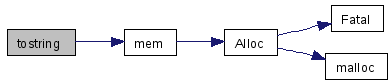
Here is the caller graph for this function:

defines* define_list [static] |
 1.5.1
1.5.1