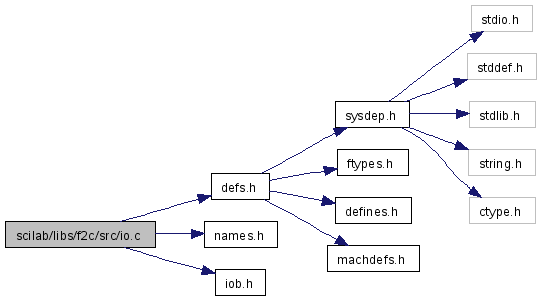
#include "defs.h"#include "names.h"#include "iob.h"Include dependency graph for io.c:
Go to the source code of this file.
Data Structures | |
| struct | Ioclist |
Defines | |
| #define | TYIOINT TYLONG |
| #define | SZIOINT SZLONG |
| #define | UNFORMATTED 0 |
| #define | FORMATTED 1 |
| #define | LISTDIRECTED 2 |
| #define | NAMEDIRECTED 3 |
| #define | V(z) ioc[z].iocval |
| #define | IOALL 07777 |
| #define | NIOS (sizeof(ioc)/sizeof(struct Ioclist) - 1) |
| #define | IOSERR 3 |
| #define | IOSEND 4 |
| #define | IOSIOSTAT 5 |
| #define | IOSREC 6 |
| #define | IOSRECL 7 |
| #define | IOSFILE 8 |
| #define | IOSSTATUS 9 |
| #define | IOSACCESS 10 |
| #define | IOSFORM 11 |
| #define | IOSBLANK 12 |
| #define | IOSEXISTS 13 |
| #define | IOSOPENED 14 |
| #define | IOSNUMBER 15 |
| #define | IOSNAMED 16 |
| #define | IOSNAME 17 |
| #define | IOSSEQUENTIAL 18 |
| #define | IOSDIRECT 19 |
| #define | IOSFORMATTED 20 |
| #define | IOSUNFORMATTED 21 |
| #define | IOSNEXTREC 22 |
| #define | IOSNML 23 |
| #define | IOSTP V(IOSIOSTAT) |
| #define | SZFLAG SZIOINT |
| #define | XERR 0 |
| #define | XUNIT SZFLAG |
| #define | XEND SZFLAG + SZIOINT |
| #define | XFMT 2*SZFLAG + SZIOINT |
| #define | XREC 2*SZFLAG + SZIOINT + SZADDR |
| #define | XIUNIT SZFLAG |
| #define | XIEND SZFLAG + SZADDR |
| #define | XIFMT 2*SZFLAG + SZADDR |
| #define | XIRLEN 2*SZFLAG + 2*SZADDR |
| #define | XIRNUM 2*SZFLAG + 2*SZADDR + SZIOINT |
| #define | XIREC 2*SZFLAG + 2*SZADDR + 2*SZIOINT |
| #define | XFNAME SZFLAG + SZIOINT |
| #define | XFNAMELEN SZFLAG + SZIOINT + SZADDR |
| #define | XSTATUS SZFLAG + 2*SZIOINT + SZADDR |
| #define | XACCESS SZFLAG + 2*SZIOINT + 2*SZADDR |
| #define | XFORMATTED SZFLAG + 2*SZIOINT + 3*SZADDR |
| #define | XRECLEN SZFLAG + 2*SZIOINT + 4*SZADDR |
| #define | XBLANK SZFLAG + 3*SZIOINT + 4*SZADDR |
| #define | XCLSTATUS SZFLAG + SZIOINT |
| #define | XFILE SZFLAG + SZIOINT |
| #define | XFILELEN SZFLAG + SZIOINT + SZADDR |
| #define | XEXISTS SZFLAG + 2*SZIOINT + SZADDR |
| #define | XOPEN SZFLAG + 2*SZIOINT + 2*SZADDR |
| #define | XNUMBER SZFLAG + 2*SZIOINT + 3*SZADDR |
| #define | XNAMED SZFLAG + 2*SZIOINT + 4*SZADDR |
| #define | XNAME SZFLAG + 2*SZIOINT + 5*SZADDR |
| #define | XNAMELEN SZFLAG + 2*SZIOINT + 6*SZADDR |
| #define | XQACCESS SZFLAG + 3*SZIOINT + 6*SZADDR |
| #define | XQACCLEN SZFLAG + 3*SZIOINT + 7*SZADDR |
| #define | XSEQ SZFLAG + 4*SZIOINT + 7*SZADDR |
| #define | XSEQLEN SZFLAG + 4*SZIOINT + 8*SZADDR |
| #define | XDIRECT SZFLAG + 5*SZIOINT + 8*SZADDR |
| #define | XDIRLEN SZFLAG + 5*SZIOINT + 9*SZADDR |
| #define | XFORM SZFLAG + 6*SZIOINT + 9*SZADDR |
| #define | XFORMLEN SZFLAG + 6*SZIOINT + 10*SZADDR |
| #define | XFMTED SZFLAG + 7*SZIOINT + 10*SZADDR |
| #define | XFMTEDLEN SZFLAG + 7*SZIOINT + 11*SZADDR |
| #define | XUNFMT SZFLAG + 8*SZIOINT + 11*SZADDR |
| #define | XUNFMTLEN SZFLAG + 8*SZIOINT + 12*SZADDR |
| #define | XQRECL SZFLAG + 9*SZIOINT + 12*SZADDR |
| #define | XNEXTREC SZFLAG + 9*SZIOINT + 13*SZADDR |
| #define | XQBLANK SZFLAG + 9*SZIOINT + 14*SZADDR |
| #define | XQBLANKLEN SZFLAG + 9*SZIOINT + 15*SZADDR |
| #define | zork(n, t) n, sizeof(n)/sizeof(char *) - 1, t |
Functions | |
| static void dofclose | Argdcl ((void)) |
| static void dofmove | Argdcl ((char *)) |
| static void doiolist | Argdcl ((chainp)) |
| static void ioset | Argdcl ((int, int, expptr)) |
| static void ioseta | Argdcl ((int, Addrp)) |
| static void iosetc | Argdcl ((int, expptr)) |
| static void iosetip | Argdcl ((int, int)) |
| static void iosetlc | Argdcl ((int, int, int)) |
| static void putio | Argdcl ((expptr, expptr)) |
| static void putiocall | Argdcl ((expptr)) |
| int | fmtstmt (register struct Labelblock *lp) |
| void | setfmt (struct Labelblock *lp) |
| void | startioctl () |
| static long | newiolabel (Void) |
| void | endioctl (Void) |
| int | iocname (Void) |
| void | ioclause (register int n, register expptr p) |
| void | doio (chainp list) |
| LOCAL void | doiolist (chainp p0) |
| LOCAL void | putio (expptr nelt, register expptr addr) |
| void | endio (Void) |
| LOCAL void | putiocall (register expptr q) |
| void | fmtname (Namep np, register Addrp q) |
| LOCAL Addrp | asg_addr (union Expression *p) |
| void | startrw (Void) |
| LOCAL void | dofopen (Void) |
| LOCAL void | dofclose (Void) |
| LOCAL void | dofinquire (Void) |
| LOCAL void | dofmove (char *subname) |
| LOCAL void | ioset (int type, int offset, register expptr p) |
| LOCAL void | iosetc (int offset, register expptr p) |
| LOCAL void | ioseta (int offset, register Addrp p) |
| LOCAL void | iosetip (int i, int offset) |
| LOCAL void | iosetlc (int i, int offp, int offl) |
Variables | |
| int | byterev |
| int | inqmask |
| iob_data * | iob_list |
| Addrp | io_structs [9] |
| LOCAL char | ioroutine [12] |
| LOCAL long | ioendlab |
| LOCAL long | ioerrlab |
| LOCAL int | endbit |
| LOCAL int | errbit |
| LOCAL long | jumplab |
| LOCAL long | skiplab |
| LOCAL int | ioformatted |
| LOCAL int | statstruct = NO |
| LOCAL struct Labelblock * | skiplabel |
| Addrp | ioblkp |
| LOCAL struct Ioclist | ioc [] |
| LOCAL char * | cilist_names [] |
| LOCAL char * | icilist_names [] |
| LOCAL char * | olist_names [] |
| LOCAL char * | cllist_names [] |
| LOCAL char * | alist_names [] |
| LOCAL char * | inlist_names [] |
| LOCAL char ** | io_fields |
| LOCAL io_setup | io_stuff [] |
| int | iocalladdr = TYADDR |
| int | typeconv [TYERROR+1] |
| static int | ioset_assign = OPASSIGN |
| #define FORMATTED 1 |
| #define IOSACCESS 10 |
| #define IOSBLANK 12 |
| #define IOSDIRECT 19 |
| #define IOSEND 4 |
| #define IOSERR 3 |
| #define IOSEXISTS 13 |
| #define IOSFILE 8 |
| #define IOSFORM 11 |
| #define IOSFORMATTED 20 |
| #define IOSIOSTAT 5 |
| #define IOSNAME 17 |
| #define IOSNAMED 16 |
| #define IOSNEXTREC 22 |
| #define IOSNML 23 |
| #define IOSNUMBER 15 |
| #define IOSOPENED 14 |
| #define IOSRECL 7 |
| #define IOSSEQUENTIAL 18 |
| #define IOSSTATUS 9 |
| #define IOSTP V(IOSIOSTAT) |
| #define IOSUNFORMATTED 21 |
| #define LISTDIRECTED 2 |
| #define NAMEDIRECTED 3 |
| #define TYIOINT TYLONG |
Definition at line 29 of file io.c.
Referenced by dofclose(), dofinquire(), dofmove(), dofopen(), endioctl(), ioset(), iosetlc(), and startrw().
| #define UNFORMATTED 0 |
Definition at line 72 of file io.c.
Referenced by C2F(), dofclose(), dofinquire(), dofmove(), dofopen(), endioctl(), intsplin3d(), iosetip(), iosetlc(), startioctl(), and startrw().
| #define XACCESS SZFLAG + 2*SZIOINT + 2*SZADDR |
| #define XBLANK SZFLAG + 3*SZIOINT + 4*SZADDR |
| #define XCLSTATUS SZFLAG + SZIOINT |
| #define XDIRECT SZFLAG + 5*SZIOINT + 8*SZADDR |
| #define XDIRLEN SZFLAG + 5*SZIOINT + 9*SZADDR |
| #define XERR 0 |
| #define XEXISTS SZFLAG + 2*SZIOINT + SZADDR |
| #define XFILE SZFLAG + SZIOINT |
| #define XFILELEN SZFLAG + SZIOINT + SZADDR |
| #define XFMTED SZFLAG + 7*SZIOINT + 10*SZADDR |
| #define XFMTEDLEN SZFLAG + 7*SZIOINT + 11*SZADDR |
| #define XFNAMELEN SZFLAG + SZIOINT + SZADDR |
| #define XFORM SZFLAG + 6*SZIOINT + 9*SZADDR |
| #define XFORMATTED SZFLAG + 2*SZIOINT + 3*SZADDR |
| #define XFORMLEN SZFLAG + 6*SZIOINT + 10*SZADDR |
| #define XIRNUM 2*SZFLAG + 2*SZADDR + SZIOINT |
| #define XNAME SZFLAG + 2*SZIOINT + 5*SZADDR |
| #define XNAMED SZFLAG + 2*SZIOINT + 4*SZADDR |
| #define XNAMELEN SZFLAG + 2*SZIOINT + 6*SZADDR |
| #define XNEXTREC SZFLAG + 9*SZIOINT + 13*SZADDR |
| #define XNUMBER SZFLAG + 2*SZIOINT + 3*SZADDR |
| #define XOPEN SZFLAG + 2*SZIOINT + 2*SZADDR |
| #define XQACCESS SZFLAG + 3*SZIOINT + 6*SZADDR |
| #define XQACCLEN SZFLAG + 3*SZIOINT + 7*SZADDR |
| #define XQBLANK SZFLAG + 9*SZIOINT + 14*SZADDR |
| #define XQBLANKLEN SZFLAG + 9*SZIOINT + 15*SZADDR |
| #define XQRECL SZFLAG + 9*SZIOINT + 12*SZADDR |
| #define XREC 2*SZFLAG + SZIOINT + SZADDR |
| #define XRECLEN SZFLAG + 2*SZIOINT + 4*SZADDR |
| #define XSEQ SZFLAG + 4*SZIOINT + 7*SZADDR |
| #define XSEQLEN SZFLAG + 4*SZIOINT + 8*SZADDR |
| #define XSTATUS SZFLAG + 2*SZIOINT + SZADDR |
| #define XUNFMT SZFLAG + 8*SZIOINT + 11*SZADDR |
| #define XUNFMTLEN SZFLAG + 8*SZIOINT + 12*SZADDR |
| #define XUNIT SZFLAG |
Definition at line 146 of file io.c.
Referenced by dofclose(), dofinquire(), dofmove(), dofopen(), and startrw().
| static void putiocall Argdcl | ( | (expptr) | ) | [static] |
| static void doiolist Argdcl | ( | (chainp) | ) | [static] |
| static void dofmove Argdcl | ( | (char *) | ) | [static] |
| static void dofclose Argdcl | ( | (void) | ) | [static] |
| LOCAL Addrp asg_addr | ( | union Expression * | p | ) |
Definition at line 919 of file io.c.
References ALLOC, badtag(), fmtname(), ICON, Addrblock::isarray, Addrblock::memoffset, Addrblock::ntempelt, p, STGAUTO, TADDR, Addrblock::tag, TPRIM, TYCHAR, Addrblock::vstg, and Addrblock::vtype.
Referenced by startrw().
00921 {
00922         register Addrp q;
00923
00924         if (p->tag != TPRIM)
00925                 badtag("asg_addr", p->tag);
00926         q = ALLOC(Addrblock);
00927         q->tag = TADDR;
00928         q->vtype = TYCHAR;
00929         q->vstg = STGAUTO;
00930         q->ntempelt = 1;
00931         q->isarray = 0;
00932         q->memoffset = ICON(0);
00933         fmtname(p->primblock.namep, q);
00934         return q;
00935         }
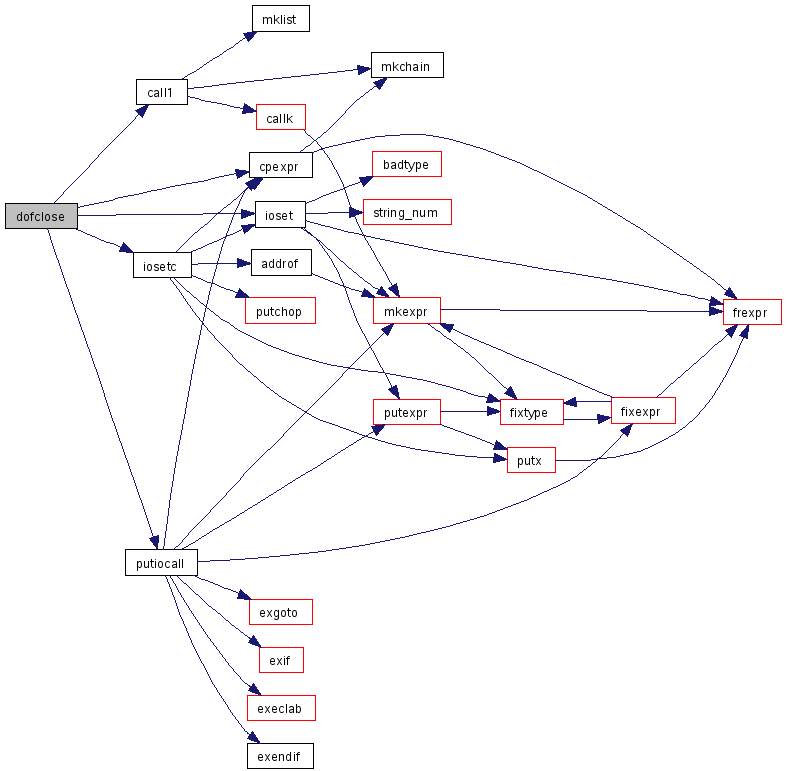
Here is the call graph for this function:

Here is the caller graph for this function:

| LOCAL void dofclose | ( | Void | ) |
Definition at line 1221 of file io.c.
References call1(), cpexpr(), err, ioblkp, ioset(), iosetc(), IOSSTATUS, IOSUNIT, ISINT, p, putiocall(), TYINT, TYIOINT, V, XCLSTATUS, and XUNIT.
Referenced by endioctl().
01222 {
01223         register expptr p;
01224
01225         if( (p = V(IOSUNIT)) && ISINT(p->headblock.vtype) )
01226         {
01227                 ioset(TYIOINT, XUNIT, cpexpr(p) );
01228                 iosetc(XCLSTATUS, V(IOSSTATUS));
01229                 putiocall( call1(TYINT, "f_clos", cpexpr((expptr)ioblkp)) );
01230         }
01231         else
01232                 err("bad unit in close statement");
01233 }
Here is the call graph for this function:
Here is the caller graph for this function:

| LOCAL void dofinquire | ( | Void | ) |
Definition at line 1237 of file io.c.
References call1(), cpexpr(), err, ioblkp, IOSACCESS, IOSBLANK, IOSDIRECT, ioset(), iosetip(), iosetlc(), IOSEXISTS, IOSFILE, IOSFORM, IOSFORMATTED, IOSNAME, IOSNAMED, IOSNEXTREC, IOSNUMBER, IOSOPENED, IOSRECL, IOSSEQUENTIAL, IOSUNFORMATTED, IOSUNIT, p, putiocall(), TYINT, TYIOINT, V, XDIRECT, XDIRLEN, XEXISTS, XFILE, XFILELEN, XFMTED, XFMTEDLEN, XFORM, XFORMLEN, XNAME, XNAMED, XNAMELEN, XNEXTREC, XNUMBER, XOPEN, XQACCESS, XQACCLEN, XQBLANK, XQBLANKLEN, XQRECL, XSEQ, XSEQLEN, XUNFMT, XUNFMTLEN, and XUNIT.
Referenced by endioctl().
01238 {
01239         register expptr p;
01240         if(p = V(IOSUNIT))
01241         {
01242                 if( V(IOSFILE) )
01243                         err("inquire by unit or by file, not both");
01244                 ioset(TYIOINT, XUNIT, cpexpr(p) );
01245         }
01246         else if( ! V(IOSFILE) )
01247                 err("must inquire by unit or by file");
01248         iosetlc(IOSFILE, XFILE, XFILELEN);
01249         iosetip(IOSEXISTS, XEXISTS);
01250         iosetip(IOSOPENED, XOPEN);
01251         iosetip(IOSNUMBER, XNUMBER);
01252         iosetip(IOSNAMED, XNAMED);
01253         iosetlc(IOSNAME, XNAME, XNAMELEN);
01254         iosetlc(IOSACCESS, XQACCESS, XQACCLEN);
01255         iosetlc(IOSSEQUENTIAL, XSEQ, XSEQLEN);
01256         iosetlc(IOSDIRECT, XDIRECT, XDIRLEN);
01257         iosetlc(IOSFORM, XFORM, XFORMLEN);
01258         iosetlc(IOSFORMATTED, XFMTED, XFMTEDLEN);
01259         iosetlc(IOSUNFORMATTED, XUNFMT, XUNFMTLEN);
01260         iosetip(IOSRECL, XQRECL);
01261         iosetip(IOSNEXTREC, XNEXTREC);
01262         iosetlc(IOSBLANK, XQBLANK, XQBLANKLEN);
01263
01264         putiocall( call1(TYINT,  "f_inqu", cpexpr((expptr)ioblkp) ));
01265 }
Here is the call graph for this function:

Here is the caller graph for this function:

| LOCAL void dofmove | ( | char * | subname | ) |
Definition at line 1274 of file io.c.
References call1(), cpexpr(), err, ioblkp, ioset(), IOSUNIT, ISINT, p, putiocall(), TYINT, TYIOINT, V, and XUNIT.
Referenced by endioctl().
01276 {
01277         register expptr p;
01278
01279         if( (p = V(IOSUNIT)) && ISINT(p->headblock.vtype) )
01280         {
01281                 ioset(TYIOINT, XUNIT, cpexpr(p) );
01282                 putiocall( call1(TYINT, subname, cpexpr((expptr)ioblkp) ));
01283         }
01284         else
01285                 err("bad unit in I/O motion statement");
01286 }
Here is the call graph for this function:

Here is the caller graph for this function:

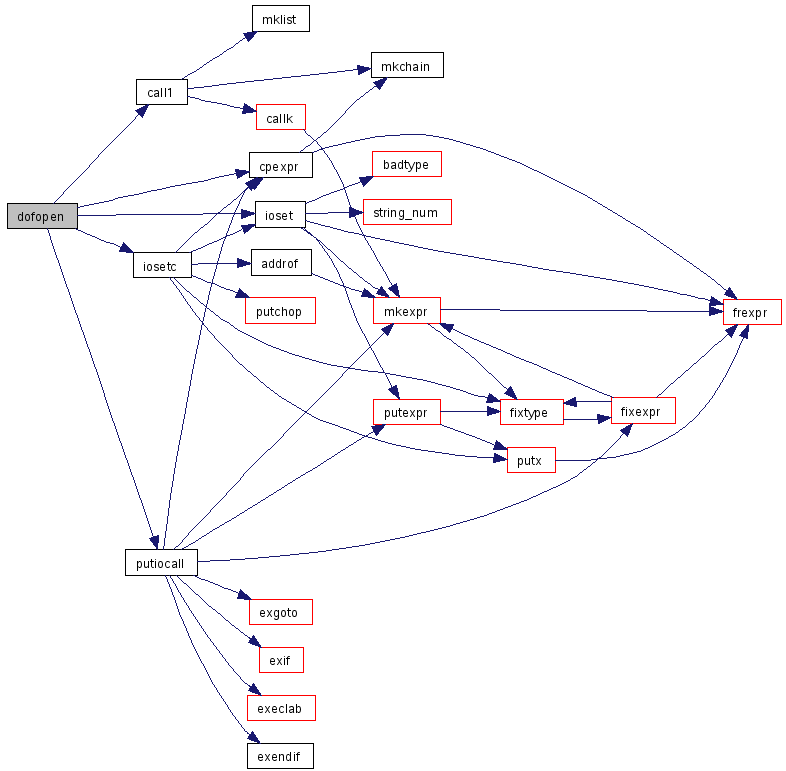
| LOCAL void dofopen | ( | Void | ) |
Definition at line 1187 of file io.c.
References call1(), cpexpr(), err, ICON, ioblkp, IOSACCESS, IOSBLANK, ioset(), iosetc(), IOSFILE, IOSFORM, IOSRECL, IOSSTATUS, IOSUNIT, ISINT, p, putiocall(), TYCHAR, TYINT, TYIOINT, V, XACCESS, XBLANK, XFNAME, XFNAMELEN, XFORMATTED, XRECLEN, XSTATUS, and XUNIT.
Referenced by endioctl().
01188 {
01189         register expptr p;
01190
01191         if( (p = V(IOSUNIT)) && ISINT(p->headblock.vtype) )
01192                 ioset(TYIOINT, XUNIT, cpexpr(p) );
01193         else
01194                 err("bad unit in open");
01195         if( (p = V(IOSFILE)) )
01196                 if(p->headblock.vtype == TYCHAR)
01197                         ioset(TYIOINT, XFNAMELEN, cpexpr(p->headblock.vleng) );
01198                 else
01199                         err("bad file in open");
01200
01201         iosetc(XFNAME, p);
01202
01203         if(p = V(IOSRECL))
01204                 if( ISINT(p->headblock.vtype) )
01205                         ioset(TYIOINT, XRECLEN, cpexpr(p) );
01206                 else
01207                         err("bad recl");
01208         else
01209                 ioset(TYIOINT, XRECLEN, ICON(0) );
01210
01211         iosetc(XSTATUS, V(IOSSTATUS));
01212         iosetc(XACCESS, V(IOSACCESS));
01213         iosetc(XFORMATTED, V(IOSFORM));
01214         iosetc(XBLANK, V(IOSBLANK));
01215
01216         putiocall( call1(TYINT, "f_open", cpexpr((expptr)ioblkp) ));
01217 }
Here is the call graph for this function:
Here is the caller graph for this function:

| void doio | ( | chainp | list | ) |
Definition at line 650 of file io.c.
References call0(), doiolist(), err, NAMEDIRECTED, putiocall(), and TYINT.
Referenced by yyparse().
00652 {
00653         if(ioformatted == NAMEDIRECTED)
00654         {
00655                 if(list)
00656                         err("no I/O list allowed in NAMELIST read/write");
00657         }
00658         else
00659         {
00660                 doiolist(list);
00661                 ioroutine[0] = 'e';
00662                 if (skiplab)
00663                         jumplab = 0;
00664                 putiocall( call0(TYINT, ioroutine) );
00665         }
00666 }
Here is the call graph for this function:

Here is the caller graph for this function:

| LOCAL void doiolist | ( | chainp | p0 | ) |
Definition at line 677 of file io.c.
References Expression::addrblock, Primblock::argsp, Expression::constblock, cpexpr(), Impldoblock::datalist, enddo(), err, exdo(), fixtype(), free(), frexpr(), halign, Expression::headblock, ICON, Impldoblock::impdospec, Expression::impldoblock, iostmt, IOWRITE, ISCHAR, ISCOMPLEX, ISCONST, lencat(), memversion(), mkscalar(), mktmp(), Primblock::namep, Dimblock::nelt, newlabel(), NULL, ohalign, p, Expression::primblock, putconst(), puteq(), putio(), TADDR, Expression::tag, TCONST, TIMPLDO, TPRIM, TYCHAR, TYERROR, UNAM_CONST, Addrblock::uname_tag, vardcl(), Nameblock::vdim, Headblock::vleng, Headblock::vtype, and Constblock::vtype.
Referenced by doio().
00679 {
00680         chainp p;
00681         register tagptr q;
00682         register expptr qe;
00683         register Namep qn;
00684         Addrp tp;
00685         int range;
00686         extern char *ohalign;
00687
00688         for (p = p0 ; p ; p = p->nextp)
00689         {
00690                 q = (tagptr)p->datap;
00691                 if(q->tag == TIMPLDO)
00692                 {
00693                         exdo(range = (int)newlabel(), (Namep)0,
00694                                 q->impldoblock.impdospec);
00695                         doiolist(q->impldoblock.datalist);
00696                         enddo(range);
00697                         free( (charptr) q);
00698                 }
00699                 else    {
00700                         if(q->tag==TPRIM && q->primblock.argsp==NULL
00701                             && q->primblock.namep->vdim!=NULL)
00702                         {
00703                                 vardcl(qn = q->primblock.namep);
00704                                 if(qn->vdim->nelt) {
00705                                         putio( fixtype(cpexpr(qn->vdim->nelt)),
00706                                             (expptr)mkscalar(qn) );
00707                                         qn->vlastdim = 0;
00708                                         }
00709                                 else
00710                                         err("attempt to i/o array of unknown size");
00711                         }
00712                         else if(q->tag==TPRIM && q->primblock.argsp==NULL &&
00713                             (qe = (expptr) memversion(q->primblock.namep)) )
00714                                 putio(ICON(1),qe);
00715                         else if (ISCONST(q) && q->constblock.vtype == TYCHAR) {
00716                                 halign = 0;
00717                                 putio(ICON(1), qe = fixtype(cpexpr(q)));
00718                                 halign = ohalign;
00719                                 }
00720                         else if(((qe = fixtype(cpexpr(q)))->tag==TADDR &&
00721                             (qe->addrblock.uname_tag != UNAM_CONST ||
00722                             !ISCOMPLEX(qe -> addrblock.vtype))) ||
00723                             (qe -> tag == TCONST && !ISCOMPLEX(qe ->
00724                             headblock.vtype))) {
00725                                 if (qe -> tag == TCONST)
00726                                         qe = (expptr) putconst((Constp)qe);
00727                                 putio(ICON(1), qe);
00728                         }
00729                         else if(qe->headblock.vtype != TYERROR)
00730                         {
00731                                 if(iostmt == IOWRITE)
00732                                 {
00733                                         expptr qvl;
00734                                         qvl = NULL;
00735                                         if( ISCHAR(qe) )
00736                                         {
00737                                                 qvl = (expptr)
00738                                                     cpexpr(qe->headblock.vleng);
00739                                                 tp = mktmp(qe->headblock.vtype,
00740                                                     ICON(lencat(qe)));
00741                                         }
00742                                         else
00743                                                 tp = mktmp(qe->headblock.vtype,
00744                                                     qe->headblock.vleng);
00745                                         puteq( cpexpr((expptr)tp), qe);
00746                                         if(qvl) /* put right length on block */
00747                                         {
00748                                                 frexpr(tp->vleng);
00749                                                 tp->vleng = qvl;
00750                                         }
00751                                         putio(ICON(1), (expptr)tp);
00752                                 }
00753                                 else
00754                                         err("non-left side in READ list");
00755                         }
00756                         frexpr(q);
00757                 }
00758         }
00759         frchain( &p0 );
00760 }
Here is the call graph for this function:

Here is the caller graph for this function:

| void endio | ( | Void | ) |
Definition at line 832 of file io.c.
References cpexpr(), execlab(), exendif(), exgoto(), exif(), frexpr(), ICON, IOREAD, iostmt, IOSTP, IOWRITE, labeltab, mkexpr(), NAMEDIRECTED, OPGT, OPLT, OPNE, p1_label(), and skiplabel.
Referenced by yyparse().
00833 {
00834         if(skiplab)
00835         {
00836                 if (ioformatted != NAMEDIRECTED)
00837                         p1_label((long)(skiplabel - labeltab));
00838                 if(ioendlab) {
00839                         exif( mkexpr(OPLT, cpexpr(IOSTP), ICON(0)));
00840                         exgoto(execlab(ioendlab));
00841                         exendif();
00842                         }
00843                 if(ioerrlab) {
00844                         exif( mkexpr(iostmt==IOREAD||iostmt==IOWRITE
00845                                         ? OPGT : OPNE,
00846                                 cpexpr(IOSTP), ICON(0)));
00847                         exgoto(execlab(ioerrlab));
00848                         exendif();
00849                         }
00850         }
00851
00852         if(IOSTP)
00853                 frexpr(IOSTP);
00854 }
Here is the call graph for this function:

Here is the caller graph for this function:

| void endioctl | ( | Void | ) |
Definition at line 425 of file io.c.
References autovar(), dofclose(), dofinquire(), dofmove(), dofopen(), ENULL, err, execlab(), fatali(), io_setup::fields, frexpr(), i, ICON, inioctl, io_structs, IOBACKSPACE, ioblkp, IOCLOSE, IOENDFILE, IOINQUIRE, IOOPEN, IOREAD, IOREWIND, IOSEND, IOSERR, ioset(), IOSIOSTAT, iostmt, IOSTP, IOWRITE, ISICON, ISINT, mktmp(), newiolabel(), NIOS, NO, NULL, p, startrw(), TADDR, TYINT, TYIOINT, io_setup::type, V, and XERR.
Referenced by yyparse().
00426 {
00427         int i;
00428         expptr p;
00429         struct io_setup *ios;
00430
00431         inioctl = NO;
00432
00433         /* set up for error recovery */
00434
00435         ioerrlab = ioendlab = skiplab = jumplab = 0;
00436
00437         if(p = V(IOSEND))
00438                 if(ISICON(p))
00439                         execlab(ioendlab = p->constblock.Const.ci);
00440                 else
00441                         err("bad end= clause");
00442
00443         if(p = V(IOSERR))
00444                 if(ISICON(p))
00445                         execlab(ioerrlab = p->constblock.Const.ci);
00446                 else
00447                         err("bad err= clause");
00448
00449         if(IOSTP)
00450                 if(IOSTP->tag!=TADDR || ! ISINT(IOSTP->addrblock.vtype) )
00451                 {
00452                         err("iostat must be an integer variable");
00453                         frexpr(IOSTP);
00454                         IOSTP = NULL;
00455                 }
00456
00457         if(iostmt == IOREAD)
00458         {
00459                 if(IOSTP)
00460                 {
00461                         if(ioerrlab && ioendlab && ioerrlab==ioendlab)
00462                                 jumplab = ioerrlab;
00463                         else
00464                                 skiplab = jumplab = newiolabel();
00465                 }
00466                 else    {
00467                         if(ioerrlab && ioendlab && ioerrlab!=ioendlab)
00468                         {
00469                                 IOSTP = (expptr) mktmp(TYINT, ENULL);
00470                                 skiplab = jumplab = newiolabel();
00471                         }
00472                         else
00473                                 jumplab = (ioerrlab ? ioerrlab : ioendlab);
00474                 }
00475         }
00476         else if(iostmt == IOWRITE)
00477         {
00478                 if(IOSTP && !ioerrlab)
00479                         skiplab = jumplab = newiolabel();
00480                 else
00481                         jumplab = ioerrlab;
00482         }
00483         else
00484                 jumplab = ioerrlab;
00485
00486         endbit = IOSTP!=NULL || ioendlab!=0;    /* for use in startrw() */
00487         errbit = IOSTP!=NULL || ioerrlab!=0;
00488         if (jumplab && !IOSTP)
00489                 IOSTP = (expptr) mktmp(TYINT, ENULL);
00490
00491         if(iostmt!=IOREAD && iostmt!=IOWRITE)
00492         {
00493                 ios = io_stuff + iostmt;
00494                 io_fields = ios->fields;
00495                 ioblkp = io_structs[iostmt];
00496                 if(ioblkp == NULL)
00497                         io_structs[iostmt] = ioblkp =
00498                                 autovar(1, ios->type, ENULL, "");
00499                 ioset(TYIOINT, XERR, ICON(errbit));
00500         }
00501
00502         switch(iostmt)
00503         {
00504         case IOOPEN:
00505                 dofopen();
00506                 break;
00507
00508         case IOCLOSE:
00509                 dofclose();
00510                 break;
00511
00512         case IOINQUIRE:
00513                 dofinquire();
00514                 break;
00515
00516         case IOBACKSPACE:
00517                 dofmove("f_back");
00518                 break;
00519
00520         case IOREWIND:
00521                 dofmove("f_rew");
00522                 break;
00523
00524         case IOENDFILE:
00525                 dofmove("f_end");
00526                 break;
00527
00528         case IOREAD:
00529         case IOWRITE:
00530                 startrw();
00531                 break;
00532
00533         default:
00534                 fatali("impossible iostmt %d", iostmt);
00535         }
00536         for(i = 1 ; i<=NIOS ; ++i)
00537                 if(i!=IOSIOSTAT && V(i)!=NULL)
00538                         frexpr(V(i));
00539 }
Here is the call graph for this function:

Here is the caller graph for this function:

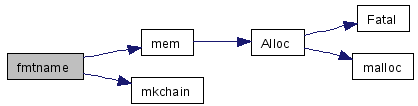
Definition at line 891 of file io.c.
References assigned_fmts, Nameblock::fvarname, IDENT_LEN, mem(), mkchain(), s, t, UNAM_CHARP, UNAM_IDENT, and Nameblock::vfmt_asg.
Referenced by asg_addr(), and exassign().
00893 {
00894         register int k;
00895         register char *s, *t;
00896         extern chainp assigned_fmts;
00897
00898         if (!np->vfmt_asg) {
00899                 np->vfmt_asg = 1;
00900                 assigned_fmts = mkchain((char *)np, assigned_fmts);
00901                 }
00902         k = strlen(s = np->fvarname);
00903         if (k < IDENT_LEN - 4) {
00904                 q->uname_tag = UNAM_IDENT;
00905                 t = q->user.ident;
00906                 }
00907         else {
00908                 q->uname_tag = UNAM_CHARP;
00909                 q->user.Charp = t = mem(k + 5,0);
00910                 }
00911         sprintf(t, "%s_fmt", s);
00912         }
Here is the call graph for this function:
Here is the caller graph for this function:

| int fmtstmt | ( | register struct Labelblock * | lp | ) |
Definition at line 294 of file io.c.
References CNULL, execerr(), int, LABFORMAT, LABUNKNOWN, newlabel(), and NULL.
Referenced by startrw(), and yyparse().
00296 {
00297         if(lp == NULL)
00298         {
00299                 execerr("unlabeled format statement" , CNULL);
00300                 return(-1);
00301         }
00302         if(lp->labtype == LABUNKNOWN)
00303         {
00304                 lp->labtype = LABFORMAT;
00305                 lp->labelno = (int)newlabel();
00306         }
00307         else if(lp->labtype != LABFORMAT)
00308         {
00309                 execerr("bad format number", CNULL);
00310                 return(-1);
00311         }
00312         return(lp->labelno);
00313 }
Here is the call graph for this function:
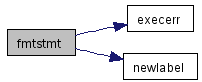
Here is the caller graph for this function:

Definition at line 578 of file io.c.
References CLUNKNOWN, err, errstr(), fixtype(), FORMATTED, ioc, Ioclist::iocname, Ioclist::iocval, IOOPEN, IOREAD, IOSBAD, IOSFILE, IOSFMT, IOSNML, IOSPOSITIONAL, IOSTDIN, IOSTDOUT, iostmt, IOSUNIT, LISTDIRECTED, nioctl, NOEXT, NULL, TPRIM, TYCHAR, and vardcl().
Referenced by yyparse().
00580 {
00581         struct Ioclist *iocp;
00582
00583         ++nioctl;
00584         if(n == IOSBAD)
00585                 return;
00586         if(n == IOSPOSITIONAL)
00587                 {
00588                 n = nioctl;
00589                 if (n == IOSFMT) {
00590                         if (iostmt == IOOPEN) {
00591                                 n = IOSFILE;
00592                                 NOEXT("file= specifier omitted from open");
00593                                 }
00594                         else if (iostmt < IOREAD)
00595                                 goto illegal;
00596                         }
00597                 else if(n > IOSFMT)
00598                         {
00599  illegal:
00600                         err("illegal positional iocontrol");
00601                         return;
00602                         }
00603                 }
00604         else if (n == IOSNML)
00605                 n = IOSFMT;
00606
00607         if(p == NULL)
00608         {
00609                 if(n == IOSUNIT)
00610                         p = (expptr) (iostmt==IOREAD ? IOSTDIN : IOSTDOUT);
00611                 else if(n != IOSFMT)
00612                 {
00613                         err("illegal * iocontrol");
00614                         return;
00615                 }
00616         }
00617         if(n == IOSFMT)
00618                 ioformatted = (p==NULL ? LISTDIRECTED : FORMATTED);
00619
00620         iocp = & ioc[n];
00621         if(iocp->iocval == NULL)
00622         {
00623                 if(n!=IOSFMT && ( n!=IOSUNIT || (p && p->headblock.vtype!=TYCHAR) ) )
00624                         p = fixtype(p);
00625                 else if (p && p->tag == TPRIM
00626                            && p->primblock.namep->vclass == CLUNKNOWN) {
00627                         /* kludge made necessary by attempt to infer types
00628                          * for untyped external parameters: given an error
00629                          * in calling sequences, an integer argument might
00630                          * tentatively be assumed TYCHAR; this would otherwise
00631                          * be corrected too late in startrw after startrw
00632                          * had decided this to be an internal file.
00633                          */
00634                         vardcl(p->primblock.namep);
00635                         p->primblock.vtype = p->primblock.namep->vtype;
00636                         }
00637                 iocp->iocval = p;
00638         }
00639         else
00640                 errstr("iocontrol %s repeated", iocp->iocname);
00641 }
Here is the call graph for this function:

Here is the caller graph for this function:

| int iocname | ( | Void | ) |
Definition at line 543 of file io.c.
References errstr(), i, ioc, iocname(), IOOPEN, IOSBAD, iostmt, M, NIOS, NOEXT, and token.
Referenced by iocname(), iosetip(), and yyparse().
00544 {
00545         register int i;
00546         int found, mask;
00547
00548         found = 0;
00549         mask = M(iostmt);
00550         for(i = 1 ; i <= NIOS ; ++i)
00551                 if(!strcmp(ioc[i].iocname, token))
00552                         if(ioc[i].iotype & mask)
00553                                 return(i);
00554                         else {
00555                                 found = i;
00556                                 break;
00557                                 }
00558         if(found) {
00559                 if (iostmt == IOOPEN && !strcmp(ioc[i].iocname, "name")) {
00560                         NOEXT("open with \"name=\" treated as \"file=\"");
00561                         for(i = 1; strcmp(ioc[i].iocname, "file"); i++);
00562                         return i;
00563                         }
00564                 errstr("invalid control %s for statement", ioc[found].iocname);
00565                 }
00566         else
00567                 errstr("unknown iocontrol %s", token);
00568         return(IOSBAD);
00569 }
Here is the call graph for this function:

Here is the caller graph for this function:

Definition at line 1297 of file io.c.
References ALLOC, badtype(), iob_data::fields, frexpr(), ICON, Addrblock::ident, iob_list, ioblkp, Addrblock::isarray, ISCONST, Addrblock::memoffset, mkexpr(), iob_data::name, Addrblock::ntempelt, putexpr(), s, STGAUTO, string_num(), SZLONG, TADDR, Addrblock::tag, TCONST, TYADDR, TYCHAR, TYIOINT, UNAM_IDENT, Addrblock::uname_tag, Addrblock::user, Addrblock::vstg, and Addrblock::vtype.
Referenced by dofclose(), dofinquire(), dofmove(), dofopen(), endioctl(), ioseta(), iosetc(), iosetip(), iosetlc(), and startrw().
01299 {
01300         offset /= SZLONG;
01301         if(statstruct && ISCONST(p)) {
01302                 register char *s;
01303                 switch(type) {
01304                         case TYADDR:    /* stmt label */
01305                                 s = "fmt_";
01306                                 break;
01307                         case TYIOINT:
01308                                 s = "";
01309                                 break;
01310                         default:
01311                                 badtype("ioset", type);
01312                         }
01313                 iob_list->fields[offset] =
01314                         string_num(s, p->constblock.Const.ci);
01315                 frexpr(p);
01316                 }
01317         else {
01318                 register Addrp q;
01319
01320                 q = ALLOC(Addrblock);
01321                 q->tag = TADDR;
01322                 q->vtype = type;
01323                 q->vstg = STGAUTO;
01324                 q->ntempelt = 1;
01325                 q->isarray = 0;
01326                 q->memoffset = ICON(0);
01327                 q->uname_tag = UNAM_IDENT;
01328                 sprintf(q->user.ident, "%s.%s",
01329                         statstruct ? iob_list->name : ioblkp->user.ident,
01330                         io_fields[offset + 1]);
01331                 if (type == TYADDR && p->tag == TCONST
01332                                    && p->constblock.vtype == TYADDR) {
01333                         /* kludge */
01334                         register Addrp p1;
01335                         p1 = ALLOC(Addrblock);
01336                         p1->tag = TADDR;
01337                         p1->vtype = type;
01338                         p1->vstg = STGAUTO;     /* wrong, but who cares? */
01339                         p1->ntempelt = 1;
01340                         p1->isarray = 0;
01341                         p1->memoffset = ICON(0);
01342                         p1->uname_tag = UNAM_IDENT;
01343                         sprintf(p1->user.ident, "fmt_%ld",
01344                                 p->constblock.Const.ci);
01345                         frexpr(p);
01346                         p = (expptr)p1;
01347                         }
01348                 if (type == TYADDR && p->headblock.vtype == TYCHAR)
01349                         q->vtype = TYCHAR;
01350                 putexpr(mkexpr(ioset_assign, (expptr)q, p));
01351                 }
01352 }
Here is the call graph for this function:

Here is the caller graph for this function:

Definition at line 1384 of file io.c.
References addrof(), badtag(), badthing(), buf, Extsym::cextname, Constant::ci, ci, Constblock::Const, Expression::constblock, cpstring(), Extsym::curno, Nameblock::cvarname, ENULL, extsymtab, iob_data::fields, ICON, iob_list, ioset(), mem(), mkexpr(), NOEXT, OPCHARCAST, s, s1, STGCOMMON, SZLONG, TADDR, Expression::tag, TCONST, tostring(), TYADDR, TYCHAR, UNAM_CONST, UNAM_NAME, usedefsforcommon, Nameblock::vardesc, Nameblock::varno, Nameblock::vcommequiv, Nameblock::visused, Nameblock::voffset, and Nameblock::vstg.
Referenced by startrw().
01386 {
01387         char *s, *s1;
01388         static char who[] = "ioseta";
01389         expptr e, mo;
01390         Namep np;
01391         ftnint ci;
01392         int k;
01393         char buf[24], buf1[24];
01394         Extsym *comm;
01395         extern int usedefsforcommon;
01396
01397         if(statstruct)
01398         {
01399                 if (!p)
01400                         return;
01401                 if (p->tag != TADDR)
01402                         badtag(who, p->tag);
01403                 offset /= SZLONG;
01404                 switch(p->uname_tag) {
01405                     case UNAM_NAME:
01406                         mo = p->memoffset;
01407                         if (mo->tag != TCONST)
01408                                 badtag("ioseta/memoffset", mo->tag);
01409                         np = p->user.name;
01410                         np->visused = 1;
01411                         ci = mo->constblock.Const.ci - np->voffset;
01412                         if (np->vstg == STGCOMMON
01413                         && !np->vcommequiv
01414                         && !usedefsforcommon) {
01415                                 comm = &extsymtab[np->vardesc.varno];
01416                                 sprintf(buf, "%d.", comm->curno);
01417                                 k = strlen(buf) + strlen(comm->cextname)
01418                                         + strlen(np->cvarname);
01419                                 if (ci) {
01420                                         sprintf(buf1, "+%ld", ci);
01421                                         k += strlen(buf1);
01422                                         }
01423                                 else
01424                                         buf1[0] = 0;
01425                                 s = mem(k + 1, 0);
01426                                 sprintf(s, "%s%s%s%s", comm->cextname, buf,
01427                                         np->cvarname, buf1);
01428                                 }
01429                         else if (ci) {
01430                                 sprintf(buf,"%ld", ci);
01431                                 s1 = p->user.name->cvarname;
01432                                 k = strlen(buf) + strlen(s1);
01433                                 sprintf(s = mem(k+2,0), "%s+%s", s1, buf);
01434                                 }
01435                         else
01436                                 s = cpstring(np->cvarname);
01437                         break;
01438                     case UNAM_CONST:
01439                         s = tostring(p->user.Const.ccp1.ccp0,
01440                                 (int)p->vleng->constblock.Const.ci);
01441                         break;
01442                     default:
01443                         badthing("uname_tag", who, p->uname_tag);
01444                     }
01445                 /* kludge for Hollerith */
01446                 if (p->vtype != TYCHAR) {
01447                         s1 = mem(strlen(s)+10,0);
01448                         sprintf(s1, "(char *)%s%s", p->isarray ? "" : "&", s);
01449                         s = s1;
01450                         }
01451                 iob_list->fields[offset] = s;
01452         }
01453         else {
01454                 if (!p)
01455                         e = ICON(0);
01456                 else if (p->vtype != TYCHAR) {
01457                         NOEXT("non-character variable as format or internal unit");
01458                         e = mkexpr(OPCHARCAST, (expptr)p, ENULL);
01459                         }
01460                 else
01461                         e = addrof((expptr)p);
01462                 ioset(TYADDR, offset, e);
01463                 }
01464 }
Here is the call graph for this function:

Here is the caller graph for this function:

Definition at line 1363 of file io.c.
References addrof(), cpexpr(), err, fixtype(), ICON, ioset(), NULL, p, putchop(), putx(), TYADDR, and TYCHAR.
Referenced by dofclose(), dofopen(), and iosetlc().
01365 {
01366         if(p == NULL)
01367                 ioset(TYADDR, offset, ICON(0) );
01368         else if(p->headblock.vtype == TYCHAR) {
01369                 p = putx(fixtype((expptr)putchop(cpexpr(p))));
01370                 ioset(TYADDR, offset, addrof(p));
01371                 }
01372         else
01373                 err("non-character control clause");
01374 }
Here is the call graph for this function:

Here is the caller graph for this function:

Definition at line 1475 of file io.c.
References addrof(), cpexpr(), errstr(), ICON, inqmask, ioc, iocname(), ioset(), ONEOF, OPASSIGN, OPASSIGNI, p, TADDR, TYADDR, and V.
Referenced by dofinquire().
01477 {
01478         register expptr p;
01479
01480         if(p = V(i))
01481                 if(p->tag==TADDR &&
01482                     ONEOF(p->addrblock.vtype, inqmask) ) {
01483                         ioset_assign = OPASSIGNI;
01484                         ioset(TYADDR, offset, addrof(cpexpr(p)) );
01485                         ioset_assign = OPASSIGN;
01486                         }
01487                 else
01488                         errstr("impossible inquire parameter %s", ioc[i].iocname);
01489         else
01490                 ioset(TYADDR, offset, ICON(0) );
01491 }
Here is the call graph for this function:

Here is the caller graph for this function:

Definition at line 1502 of file io.c.
References cpexpr(), ioset(), iosetc(), p, TYCHAR, TYIOINT, and V.
Referenced by dofinquire().
01504 {
01505         register expptr p;
01506         if( (p = V(i)) && p->headblock.vtype==TYCHAR)
01507                 ioset(TYIOINT, offl, cpexpr(p->headblock.vleng) );
01508         iosetc(offp, p);
01509 }
Here is the call graph for this function:

Here is the caller graph for this function:

| static long newiolabel | ( | Void | ) | [static] |
Definition at line 416 of file io.c.
References Labelblock::labdefined, lastiolabno, mklabel(), and skiplabel.
Referenced by endioctl().
00416                  {
00417         long rv;
00418         rv = ++lastiolabno;
00419         skiplabel = mklabel(rv);
00420         skiplabel->labdefined = 1;
00421         return rv;
00422         }
Here is the call graph for this function:

Here is the caller graph for this function:

Definition at line 777 of file io.c.
References addr, ALLOC, byterev, call2(), call3(), call4(), Addrblock::charleng, ENULL, fixtype(), FORMATTED, ICON, Addrblock::ident, Addrblock::isarray, ISCOMPLEX, ISCONST, LISTDIRECTED, M, Addrblock::memoffset, mkconv(), mkexpr(), Addrblock::ntempelt, ONEOF, OPCHARCAST, OPSTAR, putconst(), putiocall(), s, STGAUTO, TADDR, Addrblock::tag, TYADDR, TYCHAR, TYCOMPLEX, TYINT, TYINT1, tyioint, TYLENG, TYLOGICAL1, type, Typename, TYREAL, UNAM_IDENT, Addrblock::uname_tag, Addrblock::user, Addrblock::vstg, and Addrblock::vtype.
Referenced by doiolist().
00779 {
00780         int type;
00781         register expptr q;
00782         register Addrp c = 0;
00783
00784         type = addr->headblock.vtype;
00785         if(ioformatted!=LISTDIRECTED && ISCOMPLEX(type) )
00786         {
00787                 nelt = mkexpr(OPSTAR, ICON(2), nelt);
00788                 type -= (TYCOMPLEX-TYREAL);
00789         }
00790
00791         /* pass a length with every item.  for noncharacter data, fake one */
00792         if(type != TYCHAR)
00793         {
00794
00795                 if( ISCONST(addr) )
00796                         addr = (expptr) putconst((Constp)addr);
00797                 c = ALLOC(Addrblock);
00798                 c->tag = TADDR;
00799                 c->vtype = TYLENG;
00800                 c->vstg = STGAUTO;
00801                 c->ntempelt = 1;
00802                 c->isarray = 1;
00803                 c->memoffset = ICON(0);
00804                 c->uname_tag = UNAM_IDENT;
00805                 c->charleng = 1;
00806                 sprintf(c->user.ident, "(ftnlen)sizeof(%s)", Typename[type]);
00807                 addr = mkexpr(OPCHARCAST, addr, ENULL);
00808                 }
00809
00810         nelt = fixtype( mkconv(tyioint,nelt) );
00811         if(ioformatted == LISTDIRECTED) {
00812                 expptr mc = mkconv(tyioint, ICON(typeconv[type]));
00813                 q = c   ? call4(TYINT, "do_lio", mc, nelt, addr, (expptr)c)
00814                         : call3(TYINT, "do_lio", mc, nelt, addr);
00815                 }
00816         else {
00817                 char *s = (char*)(ioformatted==FORMATTED ? "do_fio"
00818                         : !byterev ? "do_uio"
00819                         : ONEOF(type, M(TYCHAR)|M(TYINT1)|M(TYLOGICAL1))
00820                         ? "do_ucio" : "do_unio");
00821                 q = c   ? call3(TYINT, s, nelt, addr, (expptr)c)
00822                         : call2(TYINT, s, nelt, addr);
00823                 }
00824         iocalladdr = TYCHAR;
00825         putiocall(q);
00826         iocalladdr = TYADDR;
00827 }
Here is the call graph for this function:

Here is the caller graph for this function:

| LOCAL void putiocall | ( | register expptr | q | ) |
Definition at line 863 of file io.c.
References cpexpr(), execlab(), exendif(), exgoto(), exif(), fixexpr(), ICON, IOSTP, mkexpr(), OPASSIGN, OPNE, putexpr(), TYINT, tyint, and tyioint.
Referenced by dofclose(), dofinquire(), dofmove(), dofopen(), doio(), putio(), and startrw().
00865 {
00866         int tyintsave;
00867
00868         tyintsave = tyint;
00869         tyint = tyioint;        /* for -I2 and -i2 */
00870
00871         if(IOSTP)
00872         {
00873                 q->headblock.vtype = TYINT;
00874                 q = fixexpr((Exprp)mkexpr(OPASSIGN, cpexpr(IOSTP), q));
00875         }
00876         putexpr(q);
00877         if(jumplab) {
00878                 exif(mkexpr(OPNE, cpexpr(IOSTP), ICON(0)));
00879                 exgoto(execlab(jumplab));
00880                 exendif();
00881                 }
00882         tyint = tyintsave;
00883 }
Here is the call graph for this function:

Here is the caller graph for this function:

| void setfmt | ( | struct Labelblock * | lp | ) |
Definition at line 321 of file io.c.
References flline(), lexline(), lp, mem(), n, s, str_fmt, t, warn(), warn1(), and warni().
Referenced by yyparse().
00323 {
00324         char *s, *s0, *sc, *se, *t;
00325         int k, n, parity;
00326
00327         s0 = s = lexline(&n);
00328         se = t = s + n;
00329
00330         /* warn of trivial errors, e.g. "  11 CONTINUE" (one too few spaces) */
00331         /* following FORMAT... */
00332
00333         if (n <= 0)
00334                 warn("No (...) after FORMAT");
00335         else if (*s != '(')
00336                 warni("%c rather than ( after FORMAT", *s);
00337         else if (se[-1] != ')') {
00338                 *se = 0;
00339                 while(--t > s && *t != ')') ;
00340                 if (t <= s)
00341                         warn("No ) at end of FORMAT statement");
00342                 else if (se - t > 30)
00343                         warn1("Extraneous text at end of FORMAT: ...%s", se-12);
00344                 else
00345                         warn1("Extraneous text at end of FORMAT: %s", t+1);
00346                 t = se;
00347                 }
00348
00349         /* fix MYQUOTES (\002's) and \\'s */
00350
00351         parity = 1;
00352         str_fmt['%'] = "%";
00353         while(s < se) {
00354                 k = *(unsigned char *)s++;
00355                 if (k == 2) {
00356                         if ((parity ^= 1) && *s == 2) {
00357                                 t -= 2;
00358                                 ++s;
00359                                 }
00360                         else
00361                                 t += 3;
00362                         }
00363                 else {
00364                         sc = str_fmt[k];
00365                         while(*++sc)
00366                                 t++;
00367                         }
00368                 }
00369         s = s0;
00370         parity = 1;
00371         if (lp) {
00372                 lp->fmtstring = t = mem((int)(t - s + 1), 0);
00373                 while(s < se) {
00374                         k = *(unsigned char *)s++;
00375                         if (k == 2) {
00376                                 if ((parity ^= 1) && *s == 2)
00377                                         s++;
00378                                 else {
00379                                         t[0] = '\\';
00380                                         t[1] = '0';
00381                                         t[2] = '0';
00382                                         t[3] = '2';
00383                                         t += 4;
00384                                         }
00385                                 }
00386                         else {
00387                                 sc = str_fmt[k];
00388                                 do *t++ = *sc++;
00389                                    while(*sc);
00390                                 }
00391                         }
00392                 *t = 0;
00393                 }
00394         str_fmt['%'] = "%%";
00395         flline();
00396 }
Here is the call graph for this function:

Here is the caller graph for this function:

| void startioctl | ( | ) |
| void startrw | ( | Void | ) |
Definition at line 938 of file io.c.
References ALLOC, asg_addr(), autovar(), call1(), CLNAMELIST, CLVAR, cpexpr(), ENULL, err, io_setup::fields, fixtype(), fmtstmt(), FORMATTED, frexpr(), ICON, Addrblock::ident, intfile(), io_structs, ioblkp, IOREAD, ioset(), ioseta(), IOSFMT, IOSREC, IOSTDIN, iostmt, IOSUNIT, ISCONST, ISICON, ISINT, isstatic(), lastvarno, LISTDIRECTED, lp, Addrblock::memno, Addrblock::memoffset, mkaddcon(), mklabel(), mkscalar(), MSKSTATIC, NAMEDIRECTED, new_iob_data(), nioctl, NO, NULL, ok, ONEOF, p, putiocall(), STGINIT, TADDR, Addrblock::tag, temp_name(), TPRIM, TYADDR, TYCHAR, TYINT, TYIOINT, io_setup::type, UNAM_IDENT, UNFORMATTED, Addrblock::user, V, vardcl(), Addrblock::vclass, Nameblock::vclass, Nameblock::vdim, Addrblock::vleng, Addrblock::vstg, Nameblock::vstg, Addrblock::vtype, Nameblock::vtype, XEND, XERR, XFMT, XIEND, XIFMT, XIRLEN, XIRNUM, XIUNIT, XREC, XUNIT, and YES.
Referenced by endioctl().
00939 {
00940         register expptr p;
00941         register Namep np;
00942         register Addrp unitp, fmtp, recp;
00943         register expptr nump;
00944         int iostmt1;
00945         flag intfile, sequential, ok, varfmt;
00946         struct io_setup *ios;
00947
00948         /* First look at all the parameters and determine what is to be done */
00949
00950         ok = YES;
00951         statstruct = YES;
00952
00953         intfile = NO;
00954         if(p = V(IOSUNIT))
00955         {
00956                 if( ISINT(p->headblock.vtype) ) {
00957  int_unit:
00958                         unitp = (Addrp) cpexpr(p);
00959                         }
00960                 else if(p->headblock.vtype == TYCHAR)
00961                 {
00962                         if (nioctl == 1 && iostmt == IOREAD) {
00963                                 /* kludge to recognize READ(format expr) */
00964                                 V(IOSFMT) = p;
00965                                 V(IOSUNIT) = p = (expptr) IOSTDIN;
00966                                 ioformatted = FORMATTED;
00967                                 goto int_unit;
00968                                 }
00969                         intfile = YES;
00970                         if(p->tag==TPRIM && p->primblock.argsp==NULL &&
00971                             (np = p->primblock.namep)->vdim!=NULL)
00972                         {
00973                                 vardcl(np);
00974                                 if(nump = np->vdim->nelt)
00975                                 {
00976                                         nump = fixtype(cpexpr(nump));
00977                                         if( ! ISCONST(nump) ) {
00978                                                 statstruct = NO;
00979                                                 np->vlastdim = 0;
00980                                                 }
00981                                 }
00982                                 else
00983                                 {
00984                                         err("attempt to use internal unit array of unknown size");
00985                                         ok = NO;
00986                                         nump = ICON(1);
00987                                 }
00988                                 unitp = mkscalar(np);
00989                         }
00990                         else    {
00991                                 nump = ICON(1);
00992                                 unitp = (Addrp /*pjw */) fixtype(cpexpr(p));
00993                         }
00994                         if(! isstatic((expptr)unitp) )
00995                                 statstruct = NO;
00996                 }
00997                 else {
00998                         err("unit specifier not of type integer or character");
00999                         ok = NO;
01000                         }
01001         }
01002         else
01003         {
01004                 err("bad unit specifier");
01005                 ok = NO;
01006         }
01007
01008         sequential = YES;
01009         if(p = V(IOSREC))
01010                 if( ISINT(p->headblock.vtype) )
01011                 {
01012                         recp = (Addrp) cpexpr(p);
01013                         sequential = NO;
01014                 }
01015                 else    {
01016                         err("bad REC= clause");
01017                         ok = NO;
01018                 }
01019         else
01020                 recp = NULL;
01021
01022
01023         varfmt = YES;
01024         fmtp = NULL;
01025         if(p = V(IOSFMT))
01026         {
01027                 if(p->tag==TPRIM && p->primblock.argsp==NULL)
01028                 {
01029                         np = p->primblock.namep;
01030                         if(np->vclass == CLNAMELIST)
01031                         {
01032                                 ioformatted = NAMEDIRECTED;
01033                                 fmtp = (Addrp) fixtype(p);
01034                                 V(IOSFMT) = (expptr)fmtp;
01035                                 if (skiplab)
01036                                         jumplab = 0;
01037                                 goto endfmt;
01038                         }
01039                         vardcl(np);
01040                         if(np->vdim)
01041                         {
01042                                 if( ! ONEOF(np->vstg, MSKSTATIC) )
01043                                         statstruct = NO;
01044                                 fmtp = mkscalar(np);
01045                                 goto endfmt;
01046                         }
01047                         if( ISINT(np->vtype) )  /* ASSIGNed label */
01048                         {
01049                                 statstruct = NO;
01050                                 varfmt = YES;
01051                                 fmtp = asg_addr(p);
01052                                 goto endfmt;
01053                         }
01054                 }
01055                 p = V(IOSFMT) = fixtype(p);
01056                 if(p->headblock.vtype == TYCHAR
01057                         /* Since we allow write(6,n)            */
01058                         /* we may as well allow write(6,n(2))   */
01059                 || p->tag == TADDR && ISINT(p->addrblock.vtype))
01060                 {
01061                         if( ! isstatic(p) )
01062                                 statstruct = NO;
01063                         fmtp = (Addrp) cpexpr(p);
01064                 }
01065                 else if( ISICON(p) )
01066                 {
01067                         struct Labelblock *lp;
01068                         lp = mklabel(p->constblock.Const.ci);
01069                         if (fmtstmt(lp) > 0)
01070                         {
01071                                 fmtp = (Addrp)mkaddcon(lp->stateno);
01072                                 /* lp->stateno for names fmt_nnn */
01073                                 lp->fmtlabused = 1;
01074                                 varfmt = NO;
01075                         }
01076                         else
01077                                 ioformatted = UNFORMATTED;
01078                 }
01079                 else    {
01080                         err("bad format descriptor");
01081                         ioformatted = UNFORMATTED;
01082                         ok = NO;
01083                 }
01084         }
01085         else
01086                 fmtp = NULL;
01087
01088 endfmt:
01089         if(intfile) {
01090                 if (ioformatted==UNFORMATTED) {
01091                         err("unformatted internal I/O not allowed");
01092                         ok = NO;
01093                         }
01094                 if (recp) {
01095                         err("direct internal I/O not allowed");
01096                         ok = NO;
01097                         }
01098                 }
01099         if(!sequential && ioformatted==LISTDIRECTED)
01100         {
01101                 err("direct list-directed I/O not allowed");
01102                 ok = NO;
01103         }
01104         if(!sequential && ioformatted==NAMEDIRECTED)
01105         {
01106                 err("direct namelist I/O not allowed");
01107                 ok = NO;
01108         }
01109
01110         if( ! ok ) {
01111                 statstruct = NO;
01112                 return;
01113                 }
01114
01115         /*
01116    Now put out the I/O structure, statically if all the clauses
01117    are constants, dynamically otherwise
01118 */
01119
01120         if (intfile) {
01121                 ios = io_stuff + iostmt;
01122                 iostmt1 = IOREAD;
01123                 }
01124         else {
01125                 ios = io_stuff;
01126                 iostmt1 = 0;
01127                 }
01128         io_fields = ios->fields;
01129         if(statstruct)
01130         {
01131                 ioblkp = ALLOC(Addrblock);
01132                 ioblkp->tag = TADDR;
01133                 ioblkp->vtype = ios->type;
01134                 ioblkp->vclass = CLVAR;
01135                 ioblkp->vstg = STGINIT;
01136                 ioblkp->memno = ++lastvarno;
01137                 ioblkp->memoffset = ICON(0);
01138                 ioblkp -> uname_tag = UNAM_IDENT;
01139                 new_iob_data(ios,
01140                         temp_name("io_", lastvarno, ioblkp->user.ident));                       }
01141         else if(!(ioblkp = io_structs[iostmt1]))
01142                 io_structs[iostmt1] = ioblkp =
01143                         autovar(1, ios->type, ENULL, "");
01144
01145         ioset(TYIOINT, XERR, ICON(errbit));
01146         if(iostmt == IOREAD)
01147                 ioset(TYIOINT, (intfile ? XIEND : XEND), ICON(endbit) );
01148
01149         if(intfile)
01150         {
01151                 ioset(TYIOINT, XIRNUM, nump);
01152                 ioset(TYIOINT, XIRLEN, cpexpr(unitp->vleng) );
01153                 ioseta(XIUNIT, unitp);
01154         }
01155         else
01156                 ioset(TYIOINT, XUNIT, (expptr) unitp);
01157
01158         if(recp)
01159                 ioset(TYIOINT, /* intfile ? XIREC : */ XREC, (expptr) recp);
01160
01161         if(varfmt)
01162                 ioseta( intfile ? XIFMT : XFMT , fmtp);
01163         else
01164                 ioset(TYADDR, intfile ? XIFMT : XFMT, (expptr) fmtp);
01165
01166         ioroutine[0] = 's';
01167         ioroutine[1] = '_';
01168         ioroutine[2] = iostmt==IOREAD ? 'r' : 'w';
01169         ioroutine[3] = "ds"[sequential];
01170         ioroutine[4] = "ufln"[ioformatted];
01171         ioroutine[5] = "ei"[intfile];
01172         ioroutine[6] = '\0';
01173
01174         putiocall( call1(TYINT, ioroutine, cpexpr((expptr)ioblkp) ));
01175
01176         if(statstruct)
01177         {
01178                 frexpr((expptr)ioblkp);
01179                 statstruct = NO;
01180                 ioblkp = 0;     /* unnecessary */
01181         }
01182 }
Here is the call graph for this function:

Here is the caller graph for this function:

| LOCAL char* alist_names[] |
| LOCAL char* cilist_names[] |
| LOCAL char* cllist_names[] |
| LOCAL char* icilist_names[] |
| LOCAL char* inlist_names[] |
Initial value:
 {
        "inlist",
        "inerr",
        "inunit",
        "infile",
        "infilen",
        "inex",
        "inopen",
        "innum",
        "innamed",
        "inname",
        "innamlen",
        "inacc",
        "inacclen",
        "inseq",
        "inseqlen",
        "indir",
        "indirlen",
        "infmt",
        "infmtlen",
        "inform",
        "informlen",
        "inunf",
        "inunflen",
        "inrecl",
        "innrec",
        "inblank",
        "inblanklen"
        }
| Addrp io_structs[9] |
Initial value:
 {
        zork(cilist_names, TYCILIST),
        zork(inlist_names, TYINLIST),
        zork(olist_names,  TYOLIST),
        zork(cllist_names, TYCLLIST),
        zork(alist_names,  TYALIST),
        zork(alist_names,  TYALIST),
        zork(alist_names,  TYALIST),
        zork(icilist_names,TYICILIST),
        zork(icilist_names,TYICILIST)
        }
Definition at line 51 of file io.c.
Referenced by ioset(), ioseta(), new_iob_data(), procinit(), and write_ioblocks().
Definition at line 65 of file io.c.
Referenced by dofclose(), dofinquire(), dofmove(), dofopen(), endioctl(), ioset(), and startrw().
Referenced by ioclause(), iocname(), and iosetip().
| int iocalladdr = TYADDR |
| LOCAL int ioformatted |
int ioset_assign = OPASSIGN [static] |
| LOCAL char* olist_names[] |
| LOCAL struct Labelblock* skiplabel |
| LOCAL int statstruct = NO |
 1.5.1
1.5.1