
#include <stdlib.h>#include "intersci-n.h"#include "getrhs.h"#include "crerhs.h"#include <varargs.h>Include dependency graph for intersci-n.c:
Go to the source code of this file.
Defines | |
| #define | MAXBUF 4096 |
Functions | |
| static void GenBuilder | __PARAMS ((char *file, char *files, char *libs)) |
| void | CheckCreateOrder (void) |
| int | main (int argc, char **argv) |
| void | Generate (char *file) |
| void | WriteMain (FILE *f, char *file) |
| void | WriteAddInter (char *file) |
| void | Copyright () |
| void | WriteHeader (FILE *f, char *fname0, char *fname) |
| void | WriteFunctionCode (FILE *f) |
| void | WriteInfoCode (FILE *f) |
| void | WriteArgCheck (FILE *f, int i) |
| void | WriteCrossCheck (FILE *f) |
| void | WriteEqualCheck (FILE *f) |
| void | WriteListAnalysis (FILE *f, int i, char *list_type) |
| void | WriteFortranCall (FILE *f) |
| void | WriteOutput (FILE *f) |
| void | WriteVariable (FILE *f, VARPTR var, IVAR ivar, int insidelist, int nel) |
| int | GetNumberInScilabCall (int ivar) |
| int | GetNumberInFortranCall (int ivar) |
| char * | Forname2Int (VARPTR var, int i) |
| void | GenFundef (char *file, int interf) |
| static void | GenBuilder (char *file, char *files, char *libs) |
| void | Fprintf (FILE *f, int indent2, char *format,...) |
| void | white (FILE *f, int ind) |
| void | FCprintf (FILE *f, char *format,...) |
| VARPTR | VarAlloc () |
| BASFUNPTR | BasfunAlloc () |
| FORSUBPTR | ForsubAlloc () |
Variables | |
| int | icre = 1 |
| int | indent = 0 |
| int | pass = 0 |
| char | target = 'C' |
| VARPTR | variables [MAXVAR] |
| int | nVariable |
| BASFUNPTR | basfun |
| FORSUBPTR | forsub |
| int | nFun |
| char * | funNames [MAXFUN] |
| char | str1 [4 *MAXNAM] |
| char | str2 [4 *MAXNAM] |
| char | unknown [] = "ukn" |
| char | sbuf [MAXBUF] |
| #define MAXBUF 4096 |
Definition at line 1004 of file intersci-n.c.
| static void GenBuilder __PARAMS | ( | (char *file, char *files, char *libs) | ) | [static] |
| BASFUNPTR BasfunAlloc | ( | ) |
| void CheckCreateOrder | ( | void | ) |
Definition at line 516 of file intersci-n.c.
References forsub::arg, count, CSTRINGV, EXTERNAL, forsub, i, min, name, forsub::narg, var::stack_position, and variables.
Referenced by WriteFortranCall().
00517 {
00518   int ivar,min= 10000;
00519   int i,count=0;
00520   if ( forsub->narg == 0) return ;
00521   for (i = 0; i < forsub->narg; i++)
00522     {
00523       ivar = forsub->arg[i];
00524       if (variables[ivar-1]->list_el == 0
00525           &&  variables[ivar-1]->is_sciarg == 0
00526           &&  variables[ivar-1]->for_type != EXTERNAL
00527           &&  variables[ivar-1]->for_type != CSTRINGV )
00528         {
00529           count++;
00530           if ( min != 10000 && variables[ivar-1]->stack_position !=0
00531                && variables[ivar-1]->stack_position < min)
00532             {
00533               fprintf(stderr,"Error: declaration for local variables \n");
00534               fprintf(stderr,"\t must respect the order given in the calling sequence\n");
00535               fprintf(stderr,"\t declaration for %s must be moved downward\n",
00536                       variables[ivar-1]->name);
00537               exit(1);
00538             }
00539           if (  variables[ivar-1]->stack_position !=0 )
00540             min = variables[ivar-1]->stack_position;
00541         }
00542     }
00543 }
Here is the caller graph for this function:

| void Copyright | ( | ) |
Definition at line 196 of file intersci-n.c.
Referenced by Generate(), and ISCIReadFile().
00197 {
00198   printf("\nINTERSCI Version %s (%s)\n",VERSION,DATE);
00199   printf("    Copyright (C) INRIA/ENPC All rights reserved\n\n");
00200 }
Here is the caller graph for this function:

| void FCprintf | ( | FILE * | f, | |
| char * | format, | |||
| ... | ||||
| ) |
Definition at line 1048 of file intersci-n.c.
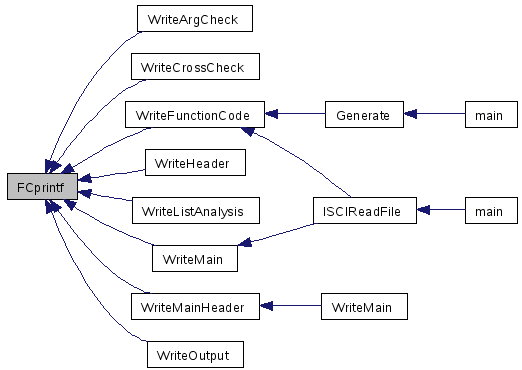
Referenced by WriteArgCheck(), WriteCrossCheck(), WriteFunctionCode(), WriteHeader(), WriteListAnalysis(), WriteMain(), WriteMainHeader(), and WriteOutput().
01049 {
01050   va_list ap;
01051 #ifdef __STDC__
01052   va_start(ap,format);
01053 #else
01054   FILE *f;
01055   char *format;
01056   va_start(ap);
01057   f = va_arg(ap, FILE *);
01058   format = va_arg(ap, char *);
01059 #endif
01060   vfprintf(f,format,ap);
01061   va_end(ap);
01062 }
Here is the caller graph for this function:
Definition at line 899 of file intersci-n.c.
References l, malloc(), p, and var.
Referenced by GetDim(), OutBMATRIX(), OutCOLUMN(), OutExtBMATRIX(), OutExtBMATRIX1(), OutExtCOLUMN(), OutExtIMATRIX(), OutExtMATRIX(), OutExtPOLYNOM(), OutExtROW(), OutExtSPARSE(), OutExtSTRING(), OutExtSTRINGMAT(), OutExtVECTOR(), OutIMATRIX(), OutLISTarg(), OutMATRIX(), OutPOLYNOM(), OutROW(), OutSPARSE(), OutSTRING(), OutSTRINGMAT(), OutVECTOR(), WriteCallRest(), WriteCrossCheck(), WriteExternalVariableOutput(), and WriteVariableOutput().
00900 {
00901   int l;
00902   char *p;
00903   if ( var->for_name[i] == (char *) 0)
00904     {
00905       printf("Error in Forname2Int for variable %s \n",var->name);
00906       printf("Maybe an internal variable has a dimension\n");
00907       printf("which can't be evaluated\n");
00908       abort();
00909       return(unknown);
00910     }
00911   if ( var->C_name[i] != (char *) 0)
00912     return var->C_name[i];
00913   if (strncmp(var->for_name[i],"stk",3) == 0) {
00914     l = strlen(var->for_name[i]);
00915     p = (char *)malloc((unsigned)(l + 6));
00916     sprintf(p,"int(%s)",var->for_name[i]);
00917     return p;
00918   }
00919   else return var->for_name[i];
00920 }
Here is the call graph for this function:

Here is the caller graph for this function:

| FORSUBPTR ForsubAlloc | ( | ) |
| void Fprintf | ( | FILE * | f, | |
| int | indent2, | |||
| char * | format, | |||
| ... | ||||
| ) |
Definition at line 1013 of file intersci-n.c.
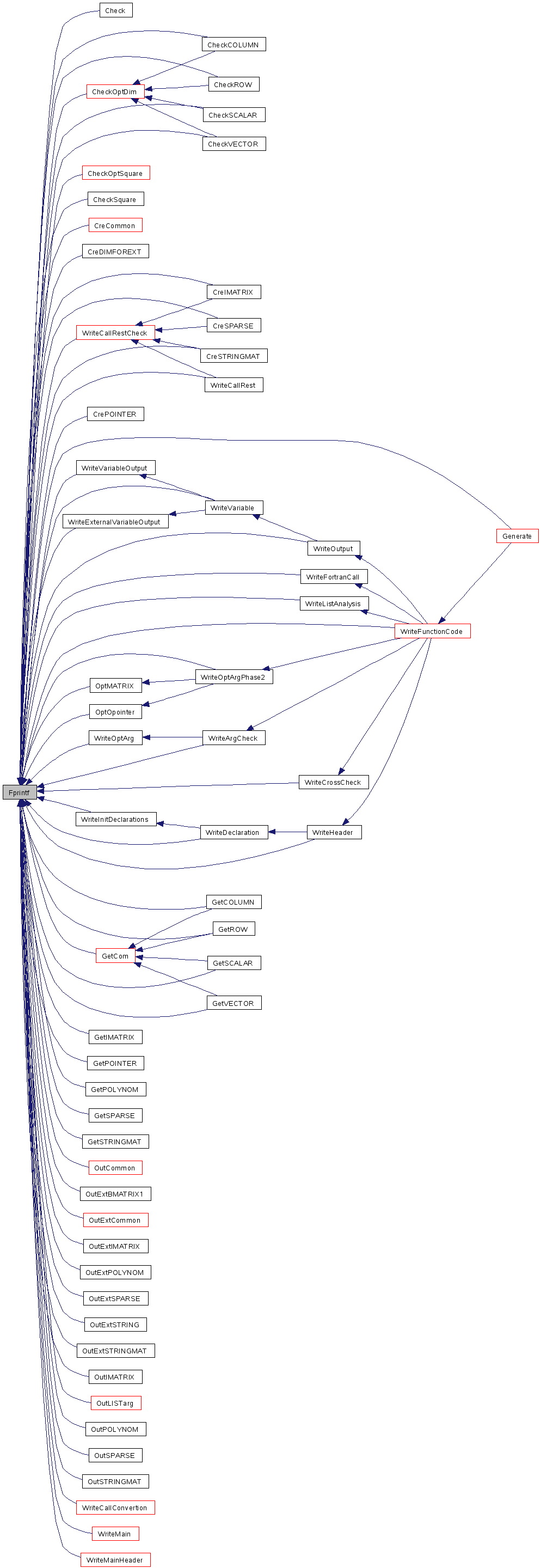
Referenced by Check(), CheckCOLUMN(), CheckOptDim(), CheckOptSquare(), CheckROW(), CheckSCALAR(), CheckSquare(), CheckVECTOR(), CreCommon(), CreDIMFOREXT(), CreIMATRIX(), CrePOINTER(), CreSPARSE(), CreSTRINGMAT(), Generate(), GetCOLUMN(), GetCom(), GetIMATRIX(), GetPOINTER(), GetPOLYNOM(), GetROW(), GetSCALAR(), GetSPARSE(), GetSTRINGMAT(), GetVECTOR(), OptMATRIX(), OptOpointer(), OutCommon(), OutExtBMATRIX1(), OutExtCommon(), OutExtIMATRIX(), OutExtPOLYNOM(), OutExtSPARSE(), OutExtSTRING(), OutExtSTRINGMAT(), OutIMATRIX(), OutLISTarg(), OutPOLYNOM(), OutSPARSE(), OutSTRINGMAT(), WriteArgCheck(), WriteCallConvertion(), WriteCallRest(), WriteCallRestCheck(), WriteCrossCheck(), WriteDeclaration(), WriteExternalVariableOutput(), WriteFortranCall(), WriteFunctionCode(), WriteHeader(), WriteInitDeclarations(), WriteListAnalysis(), WriteMain(), WriteMainHeader(), WriteOptArg(), WriteOptArgPhase2(), WriteOutput(), WriteVariable(), and WriteVariableOutput().
01014 {
01015   int i;
01016   static int count=0;
01017   va_list ap;
01018   va_start(ap,format);
01019
01020   vsprintf(sbuf,format,ap);
01021
01022   for ( i = 0 ; i < (int) strlen(sbuf); i++)
01023     {
01024       if ( count == 0)
01025         {
01026           white(f,indent2);
01027           count = indent2;
01028         }
01029       if ( count >= 100 && sbuf[i] != '\n' && (sbuf[i] == ' ' || sbuf[i]== ',' || sbuf[i] == ';' || sbuf[i] == '(' ) )
01030         {
01031           fprintf(f,"\n");
01032           white(f,indent2);count=indent2;
01033         }
01034       if ( sbuf[i] == '\n') count = -1 ;
01035       fprintf(f,"%c",sbuf[i]);
01036       count++;
01037     }
01038   va_end(ap);
01039 }
Here is the caller graph for this function:
| static void GenBuilder | ( | char * | file, | |
| char * | files, | |||
| char * | libs | |||
| ) | [static] |
Definition at line 943 of file intersci-n.c.
References first, funNames, i, MAXNAM, nFun, and NULL.
Referenced by main().
00944 {
00945   FILE *fout;
00946   char filout[MAXNAM];
00947   int i;
00948   strcpy(filout,file);
00949   strcat(filout,"_builder.sce");
00950   fout = fopen(filout,"w");
00951   fprintf(fout,"// generated with intersci \n");
00952   fprintf(fout,"ilib_name = 'lib%s'\t\t// interface library name\n",file);
00953
00954   /* files = 'file1.o file2.o ....' delimiter = ' ' */
00955   while ( files != NULL)
00956     {
00957       static int first =1;
00958       if ( first ==1 ) { fprintf(fout,"files =['%s.o';\n\t'",file);first ++;}
00959       else { fprintf(fout,"\t'");}
00960       while ( *files != 0 && *files != ' ' ) { fprintf(fout,"%c",*files); files++;}
00961       while ( *files == ' ') files++;
00962       if ( *files == 0 ) { fprintf(fout,"'];\n"); break;}
00963       else {  fprintf(fout,"'\n");} ;
00964     }
00965
00966   while ( libs != NULL)
00967     {
00968       static int first =1;
00969       if ( first ==1 ) { fprintf(fout,"libs =['");first ++;}
00970       else { fprintf(fout,"\t'");}
00971       while ( *libs != 0 && *libs != ' ' ) { fprintf(fout,"%c",*libs); libs++;}
00972       while ( *libs == ' ') libs++;
00973       if ( *libs == 0 ) { fprintf(fout,"'];\n"); break;}
00974       else {  fprintf(fout,"'\n");} ;
00975     }
00976
00977   fprintf(fout,"\ntable =[");
00978   i=0;
00979   if ( nFun == 1)
00980     fprintf(fout,"\"%s\",\"ints%s\"];\n",funNames[i],funNames[i]);
00981   else
00982     {
00983       fprintf(fout,"\"%s\",\"ints%s\";\n",funNames[i],funNames[i]);
00984       for (i = 1; i < nFun-1; i++) {
00985         fprintf(fout,"\t\"%s\",\"ints%s\";\n",funNames[i],funNames[i]);
00986       }
00987       i=nFun-1;
00988       fprintf(fout,"\t\"%s\",\"ints%s\"];\n",funNames[i],funNames[i]);
00989     }
00990   fprintf(fout,"ilib_build(ilib_name,table,files,libs);\n");
00991   printf("\nfile \"%s\" has been created\n",filout);
00992   fclose(fout);
00993 }
Here is the caller graph for this function:

| void Generate | ( | char * | file | ) |
Definition at line 86 of file intersci-n.c.
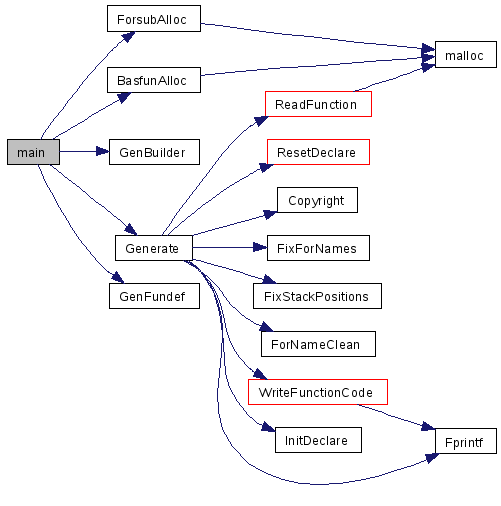
References Copyright(), fin, FixForNames(), FixStackPositions(), ForNameClean(), Fprintf(), icre, indent, InitDeclare(), MAXFUN, MAXNAM, nFun, pass, ReadFunction(), ResetDeclare(), target, and WriteFunctionCode().
Referenced by main().
00087 {
00088   int icrekp;
00089   FILE *fin, *fout, *foutv;
00090   char filout[MAXNAM];
00091   char filin[MAXNAM];
00092   sprintf(filin,"%s.desc",file);
00093   fin = fopen(filin,"r");
00094   if (fin == 0) {
00095     printf("interface file \"%s\" does not exist\n",filin);
00096     exit(1);
00097   }
00098   Copyright();
00099   strcpy(filout,file);
00100   strcat(filout,(target == 'F' ) ? ".f" : ".c" );
00101   fout = fopen(filout,"w");
00102   strcpy(filout,file);
00103   strcat(filout,".tmp");
00104   foutv = fopen(filout,"w");
00105   InitDeclare();
00106   nFun = 0;
00107   Fprintf(fout,indent,"#include \"stack-c.h\"\n");
00108   while(ReadFunction(fin)) {
00109     nFun++;
00110     if (nFun > MAXFUN) {
00111       printf("Too many SCILAB functions. The maximum is %d\n",MAXFUN);
00112       exit(1);
00113     }
00114     pass=0;
00116     FixStackPositions();
00117     icrekp=icre;
00118     FixForNames();
00119     ResetDeclare();
00121     /* first pass to collect declarations */
00122     WriteFunctionCode(foutv);
00123     /* cleaning added Fornames before pass 2 */
00124     ForNameClean();
00125     FixForNames();
00126     /* scond pass to produce code */
00127     pass=1;
00128     icre=icrekp;
00129     WriteFunctionCode(fout);
00131   }
00132   /* WriteMain(fout,file); */
00133   printf("C file \"%s.c\" has been created\n",file);
00134   /* WriteAddInter(file) ; */
00135   printf("Scilab file \"%s.sce\" has been created\n",file);
00136   fclose(fout);
00137   fclose(fin);
00138 }
Here is the call graph for this function:

Here is the caller graph for this function:

| void GenFundef | ( | char * | file, | |
| int | interf | |||
| ) |
Definition at line 922 of file intersci-n.c.
References funNames, i, int, j, MAXNAM, and nFun.
Referenced by main().
00923 {
00924   FILE *fout;
00925   char filout[MAXNAM];
00926   int i,j;
00927   if (interf != 0 )
00928     {
00929       strcpy(filout,file);
00930       strcat(filout,".fundef");
00931       fout = fopen(filout,"w");
00932       fprintf(fout,"#define IN_%s %.2d\n",file,interf);
00933       for (i = 0; i < nFun; i++) {
00934         fprintf(fout,"{\"%s\",",funNames[i]);
00935         for (j = 0; j < 25 - (int)strlen(funNames[i]); j++) fprintf(fout," ");
00936         fprintf(fout,"\t\tIN_%s,\t%d,\t3},\n",file,i+1);
00937       }
00938       printf("\nfile \"%s\" has been created\n",filout);
00939       fclose(fout);
00940     }
00941 }
Here is the caller graph for this function:

Definition at line 878 of file intersci-n.c.
References forsub::arg, forsub, j, and forsub::narg.
Referenced by WriteVariable(), and WriteVariableOutput().
00879 {
00880   int j;
00881   for (j = 0; j < forsub->narg; j++)
00882     {
00883       if (ivar == forsub->arg[j])
00884         {
00885           return( j + 1);
00886           break;
00887         }
00888     }
00889   return(0);
00890 }
Here is the caller graph for this function:

Definition at line 865 of file intersci-n.c.
References basfun, basfun::in, j, and basfun::nin.
Referenced by WriteVariable(), and WriteVariableOutput().
00866 {
00867   int j;
00868   for (j = 0; j < basfun->nin; j++)
00869     {
00870       if (ivar == basfun->in[j]) {
00871         return(j+1);
00872         break;
00873       }
00874     }
00875   return(0);
00876 }
Here is the caller graph for this function:

Definition at line 33 of file intersci-n.c.
References basfun, BasfunAlloc(), file, forsub, ForsubAlloc(), GenBuilder(), Generate(), GenFundef(), NULL, and target.
00034 {
00035   char *files,*libs;
00036   char *file;
00037   int SciLabinterface = 0 ;
00038   switch (argc)
00039     {
00040     case 2:
00041       file = argv[1];
00042       target =  'C';
00043       SciLabinterface =  0;
00044       files = NULL;
00045       libs = NULL;
00046       break;
00047     case 3:
00048       file = argv[1];
00049       target = 'C';
00050       SciLabinterface = 0;
00051       files = argv[2];
00052       libs = NULL;
00053       break;
00054     case 4:
00055       file = argv[1];
00056       target = 'C';
00057       SciLabinterface = 0;
00058       files = argv[2];
00059       libs = argv[3];
00060       break;
00061     default:
00062       printf("usage:  intersci <interface file> 'files' 'libs' \n");
00063       exit(1);
00064       break;
00065     }
00066   basfun = BasfunAlloc();
00067   if (basfun == 0) {
00068     printf("Running out of memory\n");
00069     exit(1);
00070   }
00071   forsub = ForsubAlloc();
00072   if (forsub == 0) {
00073     printf("Running out of memory\n");
00074     exit(1);
00075   }
00076   Generate(file);
00077   GenFundef(file,SciLabinterface);
00078   GenBuilder(file,files,libs);
00079   exit(0);
00080 }
Here is the call graph for this function:
| VARPTR VarAlloc | ( | ) |
Definition at line 1068 of file intersci-n.c.
References malloc().
Referenced by GetOutVar().
Here is the call graph for this function:

Here is the caller graph for this function:

| void white | ( | FILE * | f, | |
| int | ind | |||
| ) |
| void WriteAddInter | ( | char * | file | ) |
Definition at line 168 of file intersci-n.c.
References funNames, i, MAXNAM, and nFun.
Referenced by ISCIReadFile().
00169 {
00170   FILE *fout;
00171   int i;
00172   char filout[MAXNAM];
00173   strcpy(filout,file);
00174   strcat(filout,".sce");
00175   fout = fopen(filout,"w");
00176   if ( fout != (FILE*) 0)
00177     {
00178       fprintf(fout,"// Addinter for file %s\n",file);
00179       fprintf(fout,"// for hppa/sun-solaris/linux/dec\n");
00180       fprintf(fout,"//--------------------------------\n");
00181       fprintf(fout,"//Scilab functions \n");
00182       fprintf(fout,"%s_funs=[...\n",file);
00183       for (i = 0; i < nFun -1; i++)
00184         fprintf(fout,"  '%s';\n",funNames[i]);
00185       fprintf(fout,"  '%s']\n",funNames[nFun-1]);
00186       fprintf(fout,"// interface file to link: ifile='%s.o' \n",file);
00187       fprintf(fout,"// user's files to link: ufiles=['file1.o','file2.o',....] \n");
00188       fprintf(fout,"addinter([files],'%s',%s_funs);\n",file,file);
00189       fclose(fout);
00190     }
00191   else
00192     fprintf(stderr,"Can't open file %s\n",file);
00193 }
Here is the caller graph for this function:

| void WriteArgCheck | ( | FILE * | f, | |
| int | i | |||
| ) |
Definition at line 382 of file intersci-n.c.
References basfun, Fprintf(), i1, basfun::in, indent, RHSTAB, GetRhsTab::type, var, variables, and WriteOptArg().
Referenced by WriteFunctionCode().
00383 {
00384   int i1;
00385   VARPTR var = variables[basfun->in[i]-1];
00386
00387   i1 = i + 1;
00388
00389   Fprintf(f,indent,"/*  checking variable %s */\n",var->name);
00390
00391   if (var->opt_type != 0)
00392     {
00393       /* Optional Arguments */
00394       WriteOptArg(f,var);
00395     }
00396   else
00397     {
00402       if (RHSTAB[var->type].type != var->type )
00403         {
00404           fprintf(stderr,"Bug in intersci : Something wrong in RHSTAB\n");
00405         }
00406       (*(RHSTAB[var->type].fonc))(f,var,0);
00407     }
00408 }
Here is the call graph for this function:
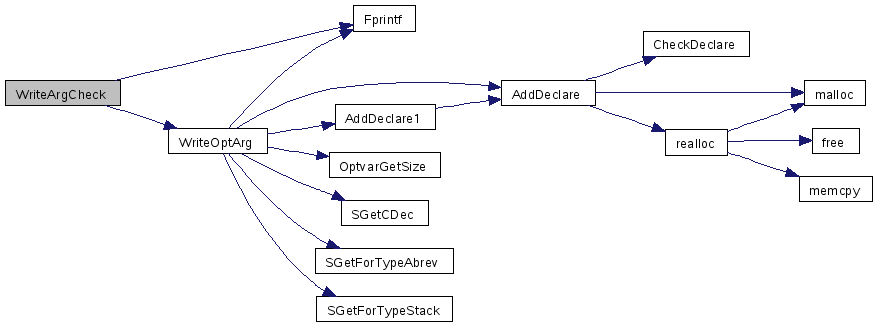
Here is the caller graph for this function:

| void WriteCrossCheck | ( | FILE * | f | ) |
Definition at line 416 of file intersci-n.c.
References DIMFOREXT, Fprintf(), i, indent, j, nVariable, var, and variables.
Referenced by WriteFunctionCode().
00417 {
00418   int i, j;
00419   VARPTR var;
00420   Fprintf(f,indent,"/* cross variable size checking */\n");
00421   for (i = 0; i < nVariable; i++)
00422     {
00423       var = variables[i];
00424       if ( var->type == DIMFOREXT )
00425         {
00426           if ( var->nfor_name > 1)
00427             {
00428               for ( j = 1 ; j < var->nfor_name ; j++)
00429                 {
00431                   /* we do not check external values since they are not known here */
00432                   if ( (var->for_name_orig[j] != var->for_name_orig[j-1])
00433                        && ( var->for_name[j-1][1] != 'e' &&  var->for_name[j][1] != 'e' ))
00434                     {
00435                       Fprintf(f,indent,"CheckDimProp(%d,%d,%s != %s);\n",
00436                               var->for_name_orig[j-1], var->for_name_orig[j],
00437                               var->for_name[j-1],   var->for_name[j]);
00438                     }
00439                 }
00440             }
00441         }
00442       else if (var->type == SCALAR)
00443         {
00445           if ( var->nfor_name > 1)
00446             {
00447               for ( j = 1 ; j < var->nfor_name ; j++)
00448                 {
00449                   int dim=2;
00450                   if ( var->for_name[j][0]=='m') dim=1;
00451                   if ( var->for_name[j][1] != 'e' )  /* do not check external variables */
00452                     {
00453                       if ( strncmp(var->for_name[0],"istk",4)==0)
00454                         Fprintf(f,indent,"CheckOneDim(%d,%d,%s,*%s);\n",
00455                                 var->for_name_orig[j], dim ,  var->for_name[j],var->for_name[0]);
00456                       else
00457                         Fprintf(f,indent,"CheckOneDim(%d,%d,%s,%s);\n",
00458                                 var->for_name_orig[j], dim ,  var->for_name[j],var->for_name[0]);
00459                     }
00460                 }
00461             }
00462         }
00463     }
00464   /*
00465      FCprintf(f,"/ *       cross formal parameter checking\n");
00466      FCprintf(f," *      not implemented yet * /\n");  */
00467 }
Here is the call graph for this function:

Here is the caller graph for this function:

| void WriteEqualCheck | ( | FILE * | f | ) |
Definition at line 472 of file intersci-n.c.
Referenced by WriteFunctionCode().
00473 {
00474   /*Fprintf(f,indent,"/ * cross equal output variable checking\n");
00475     Fprintf(f,indent,"   not implemented yet* /\n"); */
00476 }
Here is the caller graph for this function:

| void WriteFortranCall | ( | FILE * | f | ) |
Definition at line 546 of file intersci-n.c.
References AddDeclare(), forsub::arg, CheckCreateOrder(), CRERHSTAB, DEC_INT, forsub, Fprintf(), GetExistVar(), i, ind, indent, MAXCALL, name, forsub::name, forsub::narg, NULL, nVariable, target, var::type, and variables.
Referenced by WriteFunctionCode().
00547 {
00548   int i, ind;
00549   IVAR ivar, iivar;
00550   char call[MAXCALL];
00551
00552   sprintf(call,"C2F(%s)(",forsub->name);
00553
00554   CheckCreateOrder();
00555
00556   /* loop on FORTRAN arguments */
00557
00558   for (i = 0; i < forsub->narg; i++)
00559     {
00560       ivar = forsub->arg[i];
00561       ind = 0;
00562       if (variables[ivar-1]->list_el != 0)
00563         {
00564           /* FORTRAN argument is a list element */
00565           iivar = GetExistVar(variables[ivar-1]->list_name);
00566           if ( variables[iivar-1]->is_sciarg == 0)
00567             {
00568               printf("list or tlist \"%s\" must be an argument of SCILAB function\n",
00569                      variables[ivar-1]->list_name);
00570               exit(1);
00571             }
00572           strcat(call,variables[ivar-1]->for_name[0]);
00573           strcat(call,",");
00574         }
00575       else
00576         {
00577
00578           if ( variables[ivar-1]->is_sciarg == 1)
00579             {
00580                 #ifdef WIN32
00581                         _try
00582                         {
00583                                 if (target == 'C' && variables[ivar-1]->C_name[0] != NULL)
00584                                 {
00585                                         strcat(call,"&");
00586                                         strcat(call,variables[ivar-1]->C_name[0]);
00587                                 }
00588                                 else strcat(call,variables[ivar-1]->for_name[0]);
00589                                 strcat(call,",");
00590                         }
00591
00592                         _except (EXCEPTION_EXECUTE_HANDLER)
00593                         {
00594                           printf("Error EXCEPTION_EXECUTE_HANDLER %s %d\n",__FILE__,__LINE__);
00595                           exit(1);
00596                         }
00597                 #else
00598                         if (target == 'C' && variables[ivar-1]->C_name[0] != NULL)
00599                         {
00600                                 strcat(call,"&");
00601                                 strcat(call,variables[ivar-1]->C_name[0]);
00602                         }
00603                         else strcat(call,variables[ivar-1]->for_name[0]);
00604                         strcat(call,",");
00605                 #endif
00606
00607                 }
00608
00609
00610
00611           else
00612             {
00613               /* FORTRAN argument is not a SCILAB argument */
00614               /* a new variable is created on the stack for each
00615                  Fortran argument */
00616               (*(CRERHSTAB[variables[ivar-1]->type].fonc))(f,variables[ivar-1]);
00617                 #ifdef _MSC_VER
00618                   _try
00619                   {
00620               if (target == 'C' && variables[ivar-1]->C_name[0] != NULL)
00621                         {
00622                                 strcat(call,"&");
00623                                 strcat(call,variables[ivar-1]->C_name[0]);
00624                         }
00625               else strcat(call,variables[ivar-1]->for_name[0]);
00626               strcat(call,",");
00627                   }
00628                   _except (EXCEPTION_EXECUTE_HANDLER)
00629                   {
00630                           printf("Error EXCEPTION_EXECUTE_HANDLER %s %d\n",__FILE__,__LINE__);
00631                           exit(1);
00632                   }
00633                 #else
00634                   if (target == 'C' && variables[ivar-1]->C_name[0] != NULL)
00635                   {
00636                           strcat(call,"&");
00637                           strcat(call,variables[ivar-1]->C_name[0]);
00638                   }
00639                   else strcat(call,variables[ivar-1]->for_name[0]);
00640                   strcat(call,",");
00641                 #endif
00642             }
00643         }
00644     }
00645   if  (forsub->narg == 0)
00646     strcat(call,")");
00647   else
00648     call[strlen(call)-1] = ')';
00649
00650   if (target == 'C' ) strcat(call,";\n");
00651   Fprintf(f,indent,call);
00652
00653   for ( i=0 ; i < nVariable ; i++)
00654     {
00655       if ( strcmp(variables[i]->name,"err")==0)
00656         {
00657           AddDeclare(DEC_INT,"err=0");
00658           Fprintf(f,indent++,"if (err >  0) {\n");
00659           Fprintf(f,indent,"Scierror(999,\"%%s: Internal Error \\r\\n\",fname);\n");
00660           Fprintf(f,indent,"return 0;\n");
00661           Fprintf(f,--indent,"};\n");
00662           break;
00663         }
00664     }
00665 }
Here is the call graph for this function:

Here is the caller graph for this function:

| void WriteFunctionCode | ( | FILE * | f | ) |
Definition at line 214 of file intersci-n.c.
References AddDeclare(), basfun, DEC_DATA, DEC_INT, FCprintf(), forsub, Fprintf(), i, indent, LIST, basfun::maxOpt, MLIST, name, basfun::name, forsub::name, basfun::NewMaxOpt, nFun, basfun::nin, basfun::out, pass, SGetForTypeAbrev(), str1, str2, TLIST, type, variables, WriteArgCheck(), WriteCrossCheck(), WriteEqualCheck(), WriteFortranCall(), WriteHeader(), WriteListAnalysis(), WriteOptArgPhase2(), and WriteOutput().
Referenced by Generate(), and ISCIReadFile().
00215 {
00216   int i;
00217   IVAR ivar;
00218   if ( pass == 1)
00219     {
00220       printf("  generating C interface for function (%s) Scilab function\"%s\"\n",
00221              forsub->name,
00222              basfun->name);
00223     }
00224   FCprintf(f,"/******************************************\n");
00225   FCprintf(f," * SCILAB function : %s, fin = %d\n",basfun->name,nFun);
00226   FCprintf(f," ******************************************/\n");
00227
00228   WriteHeader(f,"ints",basfun->name);
00229
00230   /* optional arguments : new style */
00232   basfun->NewMaxOpt= basfun->maxOpt;
00233   if ( basfun->NewMaxOpt > 0 )
00234     {
00236       AddDeclare(DEC_INT,"nopt");
00237       AddDeclare(DEC_INT,"iopos");
00238       Fprintf(f,indent,"nopt=NumOpt();\n");
00239     }
00240
00241   /* rhs argument number checking */
00242
00243   if ( basfun->NewMaxOpt > 0 )
00244     Fprintf(f,indent,"CheckRhs(%d,%d+nopt);\n",basfun->nin - basfun->maxOpt,
00245             basfun->nin-basfun->maxOpt);
00246   else
00247     Fprintf(f,indent,"CheckRhs(%d,%d);\n",basfun->nin - basfun->maxOpt,basfun->nin);
00248
00249
00250   /* lhs argument number checking */
00251   ivar = basfun->out;
00252   if ( ivar == 0)
00253     {
00254       Fprintf(f,indent,"CheckLhs(0,1);\n");
00255     }
00256   else
00257     {
00258       if ((variables[ivar-1]->length == 0)
00259           || (variables[ivar-1]->type == LIST)
00260           || (variables[ivar-1]->type == TLIST))
00261         {
00262           Fprintf(f,indent,"CheckLhs(1,1);\n");
00263         }
00264       else
00265         {
00266           Fprintf(f,indent,"CheckLhs(1,%d);\n",variables[ivar-1]->length);
00267         }
00268     }
00269   /* SCILAB argument checking */
00270   for (i = 0; i < basfun->nin - basfun->NewMaxOpt ; i++)
00271     {
00272       switch ( variables[i]->type )
00273         {
00274         case LIST :
00275           WriteListAnalysis(f,i,"l");
00276           break;
00277         case TLIST:
00278           WriteListAnalysis(f,i,"t");
00279           break;
00280         case MLIST :
00281           WriteListAnalysis(f,i,"m");
00282           break;
00283         default:
00284           WriteArgCheck(f,i);
00285           break;
00286         }
00287     }
00288
00289   if ( basfun->NewMaxOpt != 0)
00290     {
00291       sprintf(str1,"rhs_opts opts[]={\n");
00292       for (i = basfun->nin -basfun->NewMaxOpt ; i < basfun->nin ; i++)
00293         {
00294           sprintf(str2,"\t{-1,\"%s\",\"%s\",0,0,0},\n",variables[i]->name,
00295                   SGetForTypeAbrev(variables[i]));
00296           strcat(str1,str2);
00297         }
00298       strcat(str1,"\t{-1,NULL,NULL,NULL,0,0}}");
00299       AddDeclare(DEC_DATA,str1);
00300       Fprintf(f,indent,"iopos=Rhs;\n");
00301       Fprintf(f,indent,"if ( get_optionals(fname,opts) == 0) return 0;\n");
00302       for (i = basfun->nin -basfun->NewMaxOpt ; i < basfun->nin ; i++)
00303         {
00304           WriteOptArgPhase2(f,i);
00305         }
00306     }
00307
00308   /* SCILAB cross checking */
00309   WriteCrossCheck(f);
00310
00311   /* SCILAB equal output variable checking */
00312   WriteEqualCheck(f);
00313
00314   /* FORTRAN call */
00315   WriteFortranCall(f);
00316
00317   /* FORTRAN output to SCILAB */
00318   WriteOutput(f);
00319 }
Here is the call graph for this function:

Here is the caller graph for this function:

| void WriteHeader | ( | FILE * | f, | |
| char * | fname0, | |||
| char * | fname | |||
| ) |
Definition at line 206 of file intersci-n.c.
References Fprintf(), indent, and WriteDeclaration().
Referenced by WriteFunctionCode().
00207 {
00208   Fprintf(f,indent,"\nint %s%s(fname)\n",fname0,fname);
00209   Fprintf(f,indent+3,"char *fname;\n");
00210   Fprintf(f,indent,"{\n");indent++;
00211   WriteDeclaration(f);
00212 }
Here is the call graph for this function:

Here is the caller graph for this function:

| void WriteInfoCode | ( | FILE * | f | ) |
Definition at line 322 of file intersci-n.c.
References basfun, var::el, EMPTY, GetExistOutVar(), i, var::length, LIST, name, basfun::name, basfun::nin, SEQUENCE, SGetSciType(), TLIST, type, var::type, var, and variables.
00323 {
00324   int i,iout;
00325   IVAR ivar;
00326   VARPTR var,vout;
00327
00328   iout = GetExistOutVar();
00329   vout = variables[iout -1];
00330
00331   switch (vout->type) {
00332   case LIST:
00333   case TLIST:
00334     /* loop on output variables */
00335     printf("list(");
00336     for (i = 0; i < vout->length; i++)
00337       {
00338         ivar = vout->el[i];
00339         var = variables[ivar-1];
00340         printf("%s",var->name);
00341         if ( i != vout->length -1 )
00342           printf(",");
00343         else
00344           printf(")");
00345       }
00346     break ;
00347   case SEQUENCE:
00348     /* loop on output variables */
00349     printf("[");
00350     for (i = 0; i < vout->length; i++)
00351       {
00352         ivar = vout->el[i];
00353         var = variables[ivar-1];
00354         printf("%s",var->name);
00355         if ( i != vout->length -1 )
00356           printf(",");
00357         else
00358           printf("]");
00359       }
00360     break;
00361   case EMPTY:
00362     printf("[]\n");
00363     break;
00364   }
00365
00366   printf("=%s(",basfun->name);
00367   for (i = 0; i < basfun->nin; i++)
00368     {
00369       printf("%s(%s)",variables[i]->name,SGetSciType(variables[i]->type));
00370       if ( i != basfun->nin -1 )
00371         printf(",");
00372     }
00373   printf(")\n");
00374
00375 }
Here is the call graph for this function:

| void WriteListAnalysis | ( | FILE * | f, | |
| int | i, | |||
| char * | list_type | |||
| ) |
Definition at line 482 of file intersci-n.c.
References AddDeclare1(), DEC_INT, Fprintf(), i1, indent, var::name, nVariable, RHSTAB, GetRhsTab::type, var, and variables.
Referenced by WriteFunctionCode().
00483 {
00484   int k,i1;
00485   VARPTR var;
00486   i1=i+1;
00487
00488   AddDeclare1(DEC_INT,"m%d",i1);
00489   AddDeclare1(DEC_INT,"n%d",i1);
00490   AddDeclare1(DEC_INT,"l%d",i1);
00491   Fprintf(f,indent,"GetRhsVar(%d,\"%s\",&m%d,&n%d,&l%d);\n",
00492           i1,list_type,i1,i1,i1);
00493   for (k = 0; k < nVariable ; k++)
00494     {
00495       var = variables[k];
00496       if ((var->list_el != 0) &&
00497           (strcmp(var->list_name,variables[i]->name) == 0) &&
00498           var->present)
00499         {
00500           Fprintf(f,indent,"/* list element %d %s */\n",var->list_el,var->name);
00501           if (RHSTAB[var->type].type != var->type )
00502             {
00503               fprintf(stderr,"Bug in intersci : Something wrong in RHSTAB\n");
00504             }
00505           (*(RHSTAB[var->type].fonc))(f,var,0);
00506         }
00507     }
00508 }
Here is the call graph for this function:

Here is the caller graph for this function:

| void WriteMain | ( | FILE * | f, | |
| char * | file | |||
| ) |
Definition at line 144 of file intersci-n.c.
References FCprintf(), Fprintf(), funNames, i, indent, and nFun.
Referenced by ISCIReadFile().
00145 {
00146   int i;
00147   FCprintf(f,"\n/**********************\n");
00148   FCprintf(f," *  interface function \n");
00149   FCprintf(f," ********************/\n");
00150   Fprintf(f,indent++,"static TabF Tab[]={\n");
00151   for (i = 0; i < nFun; i++) {
00152     Fprintf(f,indent,"{ ints%s, \"%s\"},\n",funNames[i],funNames[i]);
00153   }
00154   Fprintf(f,--indent,"};\n\n");
00155   Fprintf(f,indent,"int C2F(%s)()\n",file);
00156   Fprintf(f,indent++,"{\n");
00157   Fprintf(f,indent,"Rhs=Max(0,Rhs);\n");
00158   Fprintf(f,indent,"(*(Tab[Fin-1].f))(Tab[Fin-1].name);\n");
00159   Fprintf(f,indent,"return 0;\n");
00160   Fprintf(f,--indent,"};\n");
00161
00162 }
Here is the call graph for this function:

Here is the caller graph for this function:

| void WriteOutput | ( | FILE * | f | ) |
Definition at line 672 of file intersci-n.c.
References CheckOutVar(), var::el, EMPTY, Fprintf(), i, icre, indent, var::length, LIST, MLIST, SEQUENCE, SGetSciType(), var::stack_position, TLIST, var::type, var, variables, and WriteVariable().
Referenced by WriteFunctionCode().
00673 {
00674   IVAR iout,ivar;
00675   VARPTR var,vout;
00676   int i;
00677
00678   iout = CheckOutVar();
00679
00680   if ( iout == 0)
00681     {
00682       Fprintf(f,indent,"LhsVar(1)=0;\n;return 0;\n");
00683     }
00684   else
00685     {
00686       vout = variables[iout-1];
00687       switch (vout->type)
00688         {
00689         case LIST:
00690         case TLIST:
00691         case MLIST:
00692           Fprintf(f,indent,"/* Creation of output %s of length %d*/\n",
00693                   SGetSciType(vout->type),vout->length);
00694           vout->stack_position = icre;
00695           icre++;
00696           Fprintf(f,indent,"Create%s(%d,%d);\n",
00697                   SGetSciType(vout->type),
00698                   vout->stack_position,
00699                   vout->length);
00700           /* loop on output variables */
00701           for (i = 0; i < vout->length; i++)
00702             {
00703               ivar = vout->el[i];
00704               var = variables[ivar-1];
00705               Fprintf(f,indent,"/* Element %d: %s*/\n",i+1,var->name);
00706               WriteVariable(f,var,ivar,1,i+1);
00707             }
00708           Fprintf(f,indent,"LhsVar(1)= %d;\nreturn 0;",vout->stack_position);
00709           break;
00710         case SEQUENCE:
00711           /* loop on output variables */
00712           for (i = 0; i < vout->length; i++)
00713             {
00714               ivar = vout->el[i];
00715               var = variables[ivar-1];
00716               WriteVariable(f,var,ivar,0,0);
00717             }
00718           Fprintf(f,indent,"return 0;\n");
00719           break;
00720         case EMPTY:
00721           Fprintf(f,indent,"LhsVar(1)=0;\n;return 0;\n");
00722           break;
00723         }
00724     }
00725   Fprintf(f,--indent,"}\n");
00726 }
Here is the call graph for this function:

Here is the caller graph for this function:

Definition at line 735 of file intersci-n.c.
References forsub::arg, basfun, CSTRINGV, EXTERNAL, var::for_type, forsub, Fprintf(), GetNumberInFortranCall(), GetNumberInScilabCall(), icre, basfun::in, indent, j, forsub::narg, basfun::NewMaxOpt, basfun::nin, var, variables, WriteExternalVariableOutput(), and WriteVariableOutput().
Referenced by WriteOutput().
00736 {
00737   IVAR ivar2, barg, farg;
00738   VARPTR var2;
00739   int j;
00740
00741   /* get number of variable in SCILAB calling list */
00742
00743   barg = GetNumberInScilabCall(ivar);
00744
00745   /* get number of variable in FORTRAN calling list */
00746
00747   farg = GetNumberInFortranCall(ivar);
00748
00749   if (var->for_type == EXTERNAL)
00750     {
00751       /* external type */
00752       if (barg != 0)
00753         {
00754           printf("output variable with external type \"%s\" \n",var->name);
00755           printf("  cannot be an input argument of SCILAB function\n");
00756           exit(1);
00757         }
00758       if (var->equal != 0)
00759         {
00760           printf("output variable with external type \"%s\"\n", var->name);
00761           printf("  cannot have a convertion\n");
00762           exit(1);
00763         }
00764       if (farg == 0)
00765         {
00766           printf("output variable with external type \"%s\" must be\n", var->name);
00767           printf("  an argument of FORTRAN subroutine");
00768           exit(1);
00769         }
00770       WriteExternalVariableOutput(f,var,insidelist,nel);
00771     }
00772   else
00773     {
00774       if ( insidelist == 0 && var->list_el == 0 )
00775         {
00776           if ( var->opt_type != 0)
00777             {
00778               Fprintf(f,indent,"LhsVar(%d)= opts[%d].position /* %s */;\n",
00779                       var->out_position,
00780                       var->stack_position - basfun->NewMaxOpt+1,
00781                       var->name);
00782             }
00783           else
00784             {
00785
00786               if ( var->for_type == CSTRINGV)
00787                 /* variable is recreated fro output */
00788                 Fprintf(f,indent,"LhsVar(%d)= %d;\n",
00789                         var->out_position,icre);
00790               else
00791                 Fprintf(f,indent,"LhsVar(%d)= %d;\n",
00792                         var->out_position,var->stack_position);
00793             }
00794         }
00795       if (var->equal != 0)
00796         {
00797           /* SCILAB type convertion */
00798           if (barg !=0 || farg!= 0)
00799             {
00800               printf("output variable with convertion \"%s\" must not be\n",var->name);
00801               printf("  an input variable of SCILAB function or an argument\n");
00802               printf("  of FORTRAN subroutine\n");
00803               exit(1);
00804             }
00805           ivar2 = var->equal;
00806           var2 = variables[ivar2-1];
00807           /* get number of equal variable in SCILAB calling list */
00808           barg = 0;
00809           for (j = 0; j < basfun->nin; j++)
00810             {
00811               if (ivar2 == basfun->in[j])
00812                 {
00813                   barg = j + 1;
00814                   break;
00815                 }
00816             }
00817           if (barg == 0)
00818             {
00819               printf("output variable with convertion \"%s\" must be\n",
00820                      var->name);
00821               printf("  an input variable of SCILAB function\n");
00822               exit(1);
00823             }
00824           /* get number of equal variable in FORTRAN calling list */
00825           farg = 0;
00826           for (j = 0; j < forsub->narg; j++) {
00827             if (ivar2 == forsub->arg[j]) {
00828               farg = j + 1;
00829               break;
00830             }
00831           }
00832           if (farg == 0)
00833             {
00834               printf("output variable with convertion \"%s\" must be\n",
00835                      var->name);
00836               printf("  an argument FORTRAN subroutine");
00837               exit(1);
00838             }
00839           var->for_type = var2->for_type;
00840           WriteVariableOutput(f,var,1,insidelist,nel);
00841         }
00842       else
00843         {
00844           /* no SCILAB type convertion */
00845           if ( var->type == LIST || var->type == TLIST )
00846             {
00849               WriteVariableOutput(f,var,0,insidelist,nel);
00850               return;
00851             }
00852           if (farg == 0 ) {
00853             printf("variable without convertion \"%s\" must be an argument\n",
00854                    var->name);
00855             printf("  of FORTRAN subroutine\n");
00856             exit(1);
00857           }
00858
00859           WriteVariableOutput(f,var,0,insidelist,nel);
00860         }
00861     }
00862 }
Here is the call graph for this function:

Here is the caller graph for this function:

Definition at line 22 of file intersci-n.c.
Referenced by GetNumberInScilabCall(), main(), WriteArgCheck(), WriteFunctionCode(), WriteInfoCode(), and WriteVariable().
Definition at line 23 of file intersci-n.c.
Referenced by CheckCreateOrder(), GetNumberInFortranCall(), main(), WriteFortranCall(), WriteFunctionCode(), and WriteVariable().
| char* funNames[MAXFUN] |
Definition at line 25 of file intersci-n.c.
Referenced by GenBuilder(), GenFundef(), ReadFunction(), WriteAddInter(), and WriteMain().
Definition at line 15 of file intersci-n.c.
Referenced by FixStackPositions(), Generate(), OutCommon(), OutExtCommon(), OutExtIMATRIX(), OutExtSPARSE(), OutExtSTRING(), OutIMATRIX(), OutSPARSE(), OutSTRINGMAT(), ReadFunction(), WriteCallConvertion(), WriteCallRest(), WriteFunctionCode(), WriteOutput(), and WriteVariable().
Definition at line 16 of file intersci-n.c.
Definition at line 24 of file intersci-n.c.
Referenced by GenBuilder(), Generate(), GenFundef(), ISCIReadFile(), ReadFunction(), WriteAddInter(), WriteFunctionCode(), and WriteMain().
Definition at line 21 of file intersci-n.c.
Referenced by CheckOutVar(), FixForNames(), FixStackPositions(), ForNameClean(), GetExistOutVar(), GetExistVar(), GetOutVar(), GetVar(), OutLIST(), ReadFunction(), ShowVariables(), WriteCrossCheck(), WriteFortranCall(), and WriteListAnalysis().
Definition at line 17 of file intersci-n.c.
| char sbuf[MAXBUF] |
Definition at line 1005 of file intersci-n.c.
| char str1[4 *MAXNAM] |
Definition at line 26 of file intersci-n.c.
| char str2[4 *MAXNAM] |
Definition at line 27 of file intersci-n.c.
| char target = 'C' |
Definition at line 18 of file intersci-n.c.
| char unknown[] = "ukn" |
Definition at line 20 of file intersci-n.c.
Referenced by AddForName(), AddForName1(), ChangeForName(), Check(), CheckCreateOrder(), CheckOptDim(), CheckOutVar(), CreatePredefVar(), CreSPARSE(), FixForNames(), FixStackPositions(), ForNameClean(), GetDim(), GetExistOutVar(), GetExistVar(), GetOutVar(), GetVar(), OptMATRIX(), OutBMATRIX(), OutCOLUMN(), OutCommon(), OutExtBMATRIX(), OutExtBMATRIX1(), OutExtCOLUMN(), OutExtCommon(), OutExtIMATRIX(), OutExtMATRIX(), OutExtPOLYNOM(), OutExtROW(), OutExtSPARSE(), OutExtSTRING(), OutExtSTRINGMAT(), OutExtVECTOR(), OutIMATRIX(), OutLIST(), OutLISTarg(), OutMATRIX(), OutPOLYNOM(), OutROW(), OutSPARSE(), OutSTRING(), OutSTRINGMAT(), OutVECTOR(), ReadFunction(), ReadListElement(), ShowVariables(), WriteArgCheck(), WriteCallConvertion(), WriteCallRest(), WriteCallRestCheck(), WriteCrossCheck(), WriteExternalVariableOutput(), WriteFortranCall(), WriteFunctionCode(), WriteInfoCode(), WriteListAnalysis(), WriteOptArgPhase2(), WriteOutput(), WriteVariable(), and WriteVariableOutput().
 1.5.1
1.5.1




