
#include <stdio.h>#include <stdlib.h>#include <ctype.h>#include <string.h>#include <errno.h>#include <sys/stat.h>#include <sys/types.h>#include "logger.h"#include "pldstr.h"#include "bt-int.h"#include "bytedecoders.h"#include "olestream-unwrap.h"#include "ole.h"#include "MALLOC.h"Include dependency graph for ole.c:
Go to the source code of this file.
Defines | |
| #define | OLE_SECTORID_FREE -1 |
| #define | OLE_SECTORID_ENDOFCHAIN -2 |
| #define | OLE_SECTORID_SAT -3 |
| #define | OLE_SECTORID_MSAT -4 |
| #define | header_id(x) ((x) +0) |
| #define | header_clid(x) ((x) +0x08) |
| #define | header_minor_version(x) ((x) +0x18) |
| #define | header_dll_version(x) ((x) +0x1a) |
| #define | header_byte_order(x) ((x) +0x1c) |
| #define | header_sector_shift(x) ((x) +0x1e) |
| #define | header_mini_sector_shift(x) ((x) +0x20) |
| #define | header_fat_sector_count(x) ((x) +0x2c) |
| #define | header_directory_stream_start_sector(x) ((x) +0x30) |
| #define | header_mini_cutoff_size(x) ((x) +0x38) |
| #define | header_mini_fat_start(x) ((x) +0x3c) |
| #define | header_mini_fat_sector_count(x) ((x) +0x40) |
| #define | header_dif_start_sector(x) ((x) +0x44) |
| #define | header_dif_sector_count(x) ((x) +0x48) |
| #define | header_fat_sectors(x) ((x) +0x4c) |
| #define | pps_rawname(x) ((x) +0) |
| #define | pps_sizeofname(x) ((x) +0x40) |
| #define | pps_type(x) ((x) +0x42) |
| #define | pps_previouspps(x) ((x) +0x44) |
| #define | pps_nextpps(x) ((x) +0x48) |
| #define | pps_directorypps(x) ((x) +0x4c) |
| #define | pps_time1seconds(x) ((x) +0x64) |
| #define | pps_time1days(x) ((x) +0x68) |
| #define | pps_time2seconds(x) ((x) +0x6c) |
| #define | pps_time2days(x) ((x) +0x70) |
| #define | pps_propertystart(x) ((x) +0x74) |
| #define | pps_sizeofproperty(x) ((x) +0x78) |
| #define | LEN_BYTE 1 |
| #define | LEN_USHORT 2 |
| #define | LEN_ULONG 4 |
| #define | STGTY_INVALID 0 |
| #define | STGTY_STORAGE 1 |
| #define | STGTY_STREAM 2 |
| #define | STGTY_LOCKBYTES 3 |
| #define | STGTY_PROPERTY 4 |
| #define | STGTY_ROOT 5 |
| #define | DE_RED 0 |
| #define | DE_BLACK 1 |
| #define | DOLE if (OLE_DNORMAL(ole->debug)) |
| #define | VOLE if (ole->verbose) |
Functions | |
| int | OLE_version (void) |
| int | OLE_init (struct OLE_object *ole) |
| int | OLE_dir_init (struct OLE_directory_entry *dir) |
| int | OLE_set_verbose (struct OLE_object *ole, int level) |
| int | OLE_set_quiet (struct OLE_object *ole, int level) |
| int | OLE_set_debug (struct OLE_object *ole, int level) |
| int | OLE_set_save_unknown_streams (struct OLE_object *ole, int level) |
| int | OLE_sectorpos (struct OLE_object *ole, int SID) |
| int | OLE_get_block (struct OLE_object *ole, int block_index, unsigned char *block_buffer) |
| int | OLE_get_miniblock (struct OLE_object *ole, int block_index, unsigned char *block_buffer) |
| int | OLE_dbstosbs (char *raw_string, size_t byte_count, char *clean_string, int clean_string_len) |
| int | OLE_print_string (char *string, size_t char_count) |
| int | OLE_print_sector (struct OLE_object *ole, char *sector, unsigned int bytes) |
| int | OLE_is_file_OLE (struct OLE_object *ole) |
| int | OLE_get_header (struct OLE_object *ole) |
| int | OLE_convert_header (struct OLE_object *ole) |
| int | OLE_header_sanity_check (struct OLE_object *ole) |
| int | OLE_print_header (struct OLE_object *ole) |
| int | OLE_convert_directory (struct OLE_object *ole, unsigned char *buf, struct OLE_directory_entry *dir) |
| int | OLE_print_directory (struct OLE_object *ole, struct OLE_directory_entry *dir) |
| int | OLE_load_FAT (struct OLE_object *ole) |
| int | OLE_follow_chain (struct OLE_object *ole, int FAT_sector_start) |
| int | OLE_follow_minichain (struct OLE_object *ole, int miniFAT_sector_start) |
| unsigned char * | OLE_load_minichain (struct OLE_object *ole, int miniFAT_sector_start) |
| unsigned char * | OLE_load_chain (struct OLE_object *ole, int FAT_sector_start) |
| int | OLE_open_file (struct OLE_object *ole, char *fullpath) |
| int | OLE_open_directory (struct OLE_object *ole, char *directory) |
| int | OLE_set_filename_report_fn (struct OLE_object *ole, int(*ptr_to_fn)(char *)) |
| int | OLE_store_stream (struct OLE_object *ole, char *stream_name, char *directory, char *stream, size_t stream_size) |
| int | OLE_decode_file_done (struct OLE_object *ole) |
| int | OLE_terminate_and_return (struct OLE_object *ole, int result) |
| int | OLE_decode_stream (struct OLE_object *ole, struct OLE_directory_entry *adir, char *decode_path) |
| int | OLE_decode_file (struct OLE_object *ole, char *fname, char *decode_path) |
Variables | |
| unsigned char | OLE_id_v2 [] = { 0xd0, 0xcf, 0x11, 0xe0, 0xa1, 0xb1, 0x1a, 0xe1 } |
| unsigned char | OLE_id_v1 [] = { 0x0e, 0x11, 0xfc, 0x0d, 0xd0, 0xcf, 0x11, 0xe0 } |
| #define DOLE if (OLE_DNORMAL(ole->debug)) |
Definition at line 76 of file ole.c.
Referenced by OLE_convert_directory(), OLE_decode_file(), OLE_decode_stream(), OLE_follow_chain(), OLE_follow_minichain(), OLE_get_block(), OLE_load_chain(), OLE_load_FAT(), OLE_load_minichain(), and OLE_open_file().
| #define LEN_ULONG 4 |
Definition at line 62 of file ole.c.
Referenced by OLE_convert_header(), OLE_follow_chain(), OLE_follow_minichain(), OLE_load_chain(), OLE_load_FAT(), and OLE_load_minichain().
| #define OLE_SECTORID_ENDOFCHAIN -2 |
Definition at line 21 of file ole.c.
Referenced by OLE_follow_chain(), OLE_follow_minichain(), and OLE_load_minichain().
| #define OLE_SECTORID_FREE -1 |
Sector ID values (predefined)
Definition at line 20 of file ole.c.
Referenced by OLE_follow_chain(), OLE_follow_minichain(), and OLE_load_minichain().
| #define OLE_SECTORID_MSAT -4 |
Definition at line 23 of file ole.c.
Referenced by OLE_follow_chain(), OLE_follow_minichain(), and OLE_load_minichain().
| #define OLE_SECTORID_SAT -3 |
Definition at line 22 of file ole.c.
Referenced by OLE_follow_chain(), OLE_follow_minichain(), and OLE_load_minichain().
| #define STGTY_INVALID 0 |
| #define STGTY_ROOT 5 |
| #define STGTY_STORAGE 1 |
| #define STGTY_STREAM 2 |
| #define VOLE if (ole->verbose) |
Definition at line 77 of file ole.c.
Referenced by OLE_get_block(), OLE_load_chain(), and OLE_load_FAT().
| int OLE_convert_directory | ( | struct OLE_object * | ole, | |
| unsigned char * | buf, | |||
| struct OLE_directory_entry * | dir | |||
| ) |
Definition at line 776 of file ole.c.
References dir, DOLE, FL, get_1byte_value(), get_2byte_value(), get_4byte_value(), LOGGER_log(), memcpy(), memset(), OLE_DIRECTORY_ELEMENT_NAME_SIZE, and OLE_OK.
Referenced by OLE_decode_file().
00777 {
00783   memset( dir->element_name, '\0', OLE_DIRECTORY_ELEMENT_NAME_SIZE);
00784
00791   memcpy( dir->element_name, buf, OLE_DIRECTORY_ELEMENT_NAME_SIZE );
00792
00797   dir->element_name_byte_count = get_2byte_value( buf + 0x40 );
00798
00807   dir->element_type = get_1byte_value( buf +0x42 );
00808
00813   dir->element_colour = get_1byte_value( buf +0x43 );
00814
00816   dir->left_child = get_4byte_value( buf +0x44 );
00817
00819   dir->right_child = get_4byte_value( buf +0x48 );
00820
00821
00825   dir->root = get_4byte_value( buf +0x4c );
00826
00827   memcpy( dir->class, buf +0x50, 16 );
00828   dir->userflags = get_4byte_value( buf +0x60 );
00829   memcpy( dir->timestamps, buf +0x64, 16 );
00832   dir->start_sector = get_4byte_value( buf +0x74 );
00833
00835   DOLE LOGGER_log("%s:%d:OLE_directory_entry:DEBUG: stream size = 0x%x %x %x %x"
00836                   ,FL
00837                   ,*(buf +0x78)
00838                   ,*(buf +0x79)
00839                   ,*(buf +0x7A)
00840                   ,*(buf +0x7B)
00841                   );
00842   dir->stream_size = get_4byte_value( buf +0x78 );
00843
00844   return OLE_OK;
00845 }
Here is the call graph for this function:

Here is the caller graph for this function:

| int OLE_convert_header | ( | struct OLE_object * | ole | ) |
Definition at line 602 of file ole.c.
References OLE_object::file_size, get_2byte_value(), get_4byte_value(), h, OLE_object::header, OLE_object::header_block, header_byte_order, header_dif_sector_count, header_dif_start_sector, header_directory_stream_start_sector, header_dll_version, header_fat_sector_count, header_fat_sectors, header_mini_cutoff_size, header_mini_fat_sector_count, header_mini_fat_start, header_mini_sector_shift, header_minor_version, header_sector_shift, i, OLE_object::last_sector, LEN_ULONG, OLE_HEADER_FAT_SECTOR_COUNT_LIMIT, and OLE_OK.
Referenced by OLE_decode_file().
00603 {
00604   struct OLE_header *h;
00605   unsigned char *hb;
00606   unsigned char *fat_start;
00607   unsigned int i;
00608
00609   h = &(ole->header);
00610   hb = ole->header_block;
00611
00618   h->minor_version = get_2byte_value(header_minor_version(hb));
00619   h->dll_version = get_2byte_value(header_dll_version(hb));
00620   h->byte_order = get_2byte_value(header_byte_order(hb));
00621   h->sector_shift = get_2byte_value(header_sector_shift(hb));
00622   h->sector_size = 1 << h->sector_shift;
00623
00624   h->mini_sector_shift = get_2byte_value(header_mini_sector_shift(hb));
00625   h->mini_sector_size = 1 << h->mini_sector_shift;
00626
00627   h->fat_sector_count = get_4byte_value(header_fat_sector_count(hb));
00628   h->directory_stream_start_sector = get_4byte_value(header_directory_stream_start_sector(hb));
00629   h->mini_cutoff_size = get_4byte_value(header_mini_cutoff_size(hb));
00630   h->mini_fat_start = get_4byte_value(header_mini_fat_start(hb));
00631   h->mini_fat_sector_count = get_4byte_value(header_mini_fat_sector_count(hb));
00632   h->dif_start_sector = get_4byte_value(header_dif_start_sector(hb));
00633   h->dif_sector_count = get_4byte_value(header_dif_sector_count(hb));
00634
00639   ole->last_sector = ole->file_size  >> h->sector_shift;
00640
00642   fat_start = header_fat_sectors(hb);
00643   for (i = 0; i < h->fat_sector_count; i++)
00644     {
00645       if (i >= OLE_HEADER_FAT_SECTOR_COUNT_LIMIT) break;
00646       h->FAT[i] = get_4byte_value( fat_start +(LEN_ULONG *i));
00647     }
00648
00649   return OLE_OK;
00650 }
Here is the call graph for this function:

Here is the caller graph for this function:

| int OLE_dbstosbs | ( | char * | raw_string, | |
| size_t | byte_count, | |||
| char * | clean_string, | |||
| int | clean_string_len | |||
| ) |
Definition at line 445 of file ole.c.
Referenced by OLE_decode_file(), OLE_decode_stream(), and OLE_print_directory().
00446 {
00447   char *limit = raw_string +byte_count -1;
00448
00449   clean_string_len--;
00450
00451   while ((raw_string < limit)&&(byte_count >0)&&(byte_count--)&&(clean_string_len--))
00452     {
00453       int v = (char)*raw_string;
00454
00455       if (isprint(v))
00456         {
00457           *clean_string = v;
00458           clean_string++;
00459         }
00460
00461       raw_string += 2;
00462     }
00463   *clean_string = '\0';
00464
00465   return OLE_OK;
00466 }
Here is the caller graph for this function:

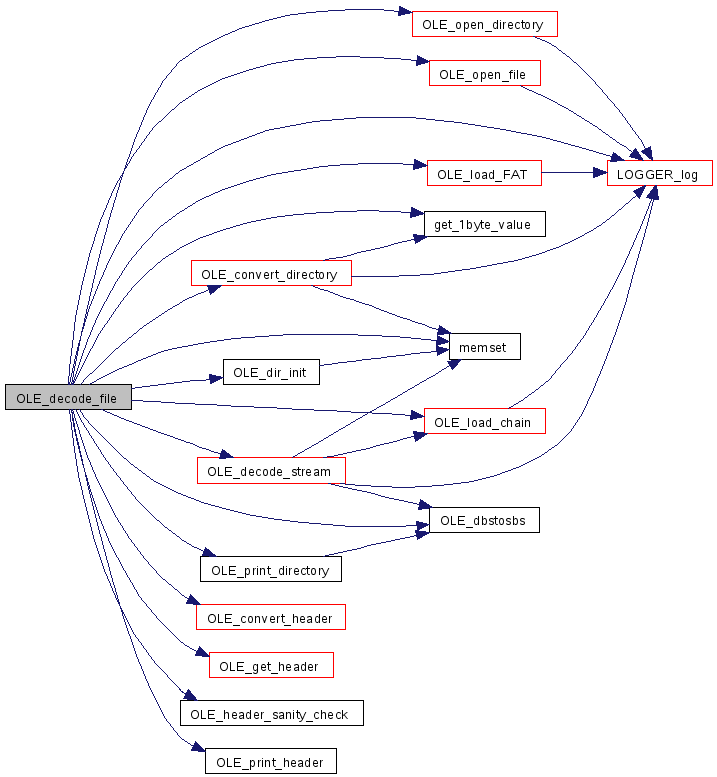
| int OLE_decode_file | ( | struct OLE_object * | ole, | |
| char * | fname, | |||
| char * | decode_path | |||
| ) |
Definition at line 1774 of file ole.c.
References OLE_header::directory_stream_start_sector, DOLE, OLE_directory_entry::element_colour, OLE_directory_entry::element_name, OLE_directory_entry::element_name_byte_count, OLE_directory_entry::element_type, FL, get_1byte_value(), OLE_object::header, i, OLE_object::last_chain_size, LOGGER_log(), memset(), OLE_header::mini_fat_start, OLE_object::miniFAT, OLE_object::ministream, NULL, OLE_convert_directory(), OLE_convert_header(), OLE_dbstosbs(), OLE_decode_stream(), OLE_dir_init(), OLE_get_header(), OLE_header_sanity_check(), OLE_load_chain(), OLE_load_FAT(), OLE_OK, OLE_open_directory(), OLE_open_file(), OLE_print_directory(), OLE_print_header(), OLEER_DECODE_NULL_FILENAME, OLEER_DECODE_NULL_OBJECT, OLEER_DECODE_NULL_PATH, OLEER_INSANE_OLE_FILE, OLEER_PROPERTIES_READ_FAIL, OLE_object::properties, result, OLE_directory_entry::start_sector, STGTY_INVALID, STGTY_ROOT, STGTY_STORAGE, and STGTY_STREAM.
Referenced by ripole().
01775 {
01776   unsigned char *current_property, *property_limit;
01777   int result = 0;
01778   int i;
01779
01780   /* Reject any bad paramters.*/
01781   if (ole == NULL) return OLEER_DECODE_NULL_OBJECT;
01782   if (fname == NULL) return OLEER_DECODE_NULL_FILENAME;
01783   if (decode_path == NULL) return OLEER_DECODE_NULL_PATH;
01784
01785   /* We need to gain access to the OLE2 data file, without*/
01786   /*            this pretty much everything is pointless.*/
01787   DOLE LOGGER_log("%s:%d:OLE_decode_file:DEBUG: opening %s", FL, fname );
01788   result = OLE_open_file( ole, fname );
01789   if (result != 0) return result;
01790
01791   /* Try create the output directory which we're using*/
01792   /*            to write the decoded files out to.*/
01793   DOLE LOGGER_log("%s:%d:OLE_decode_file:DEBUG: opening output directory %s", FL, decode_path);
01794   result = OLE_open_directory( ole, decode_path );
01795   if (result != 0) return result;
01796
01797   /* In order to successfully decode an OLE2 stream, we have to read*/
01798   /*            and understand the first 512 bytes of the file, this is the */
01799   /*            OLE2 header. */
01800   DOLE LOGGER_log("%s:%d:OLE_decode_file:DEBUG: Getting main header", FL);
01801   result = OLE_get_header( ole );
01802   if (result != 0) return result;
01803
01804   DOLE LOGGER_log("%s:%d:OLE_decode_file:DEBUG: Converting main header", FL);
01805   result = OLE_convert_header( ole );
01806   if (result != 0) return result;
01807
01808   result = OLE_header_sanity_check( ole );
01809   if (result > 0) return OLEER_INSANE_OLE_FILE;
01810
01811   DOLE OLE_print_header( ole );
01812
01813   DOLE LOGGER_log("%s:%d:OLE_decode_file:DEBUG: Loading FAT", FL);
01814   result = OLE_load_FAT( ole );
01815   if (result != 0) return result;
01816
01817   DOLE LOGGER_log("%s:%d:OLE_decode_file:DEBUG: Loading miniFAT chain", FL);
01818   ole->miniFAT = OLE_load_chain( ole, ole->header.mini_fat_start );
01819   /* commented out by Serge Steer for Scilab*/
01820   /* if (ole->miniFAT == NULL) return OLEER_MINIFAT_READ_FAIL;*/
01821
01822   DOLE LOGGER_log("%s:%d:OLE_decode_file:DEBUG: Loading Directory stream chain", FL);
01823   ole->properties = OLE_load_chain( ole, ole->header.directory_stream_start_sector );
01824   if (ole->properties == NULL) return OLEER_PROPERTIES_READ_FAIL;
01825
01826   i=0;
01827   current_property = ole->properties;
01828   property_limit = current_property +ole->last_chain_size ;
01829   /* while(1)*/
01830   while (current_property < property_limit)
01831     {
01832       struct OLE_directory_entry a_dir_object, *adir;
01833       int property_value=0;
01834
01835       adir = &a_dir_object;
01836
01837       OLE_dir_init(adir);
01838
01839       property_value = get_1byte_value(current_property);
01840       if (property_value < 1) break;
01841
01842       DOLE LOGGER_log("%s:%d:OLE_decode_file:DEBUG:--------- DIRECTORY INDEX: %d",FL,i);
01843
01844       OLE_convert_directory( ole, current_property, adir );
01845
01846       DOLE {
01847         LOGGER_log("%s:%d:OLE_decode_file:DEBUG: Printing directory details...",FL);
01848         OLE_print_directory( ole, adir);
01849         LOGGER_log("%s:%d:OLE_decode_file:DEBUG: End of directory details",FL);
01850       }
01851
01852       if (adir->element_colour > 1) break;
01853
01854       if ((adir->element_type == STGTY_INVALID)||(adir->element_type > STGTY_ROOT))
01855         {
01856           DOLE LOGGER_log("%s:%d:OLE_decode_file:DEBUG: breaking out due to element type %d",FL, adir->element_type);
01857           break;
01858
01859         } else if (adir->element_type == STGTY_ROOT){
01863           DOLE LOGGER_log("%s:%d:OLE_decode_file:DEBUG: Loading ministream/SmallBlockArray",FL);
01864           ole->ministream = OLE_load_chain( ole, adir->start_sector );
01865           /* commented out by Serge Steer for Scilab*/
01866           /*if (ole->ministream == NULL) return OLEER_MINISTREAM_READ_FAIL;*/
01867           DOLE LOGGER_log("%s:%d:OLE_decode_file:DEBUG: ministream done",FL);
01868
01869         } else if (adir->element_type == STGTY_STORAGE) {
01873           DOLE LOGGER_log("%s:%d:OLE_decode_file:DEBUG: Item is directory, start child is at index %d\n",FL,i);
01874           ole->ministream = OLE_load_chain( ole, adir->start_sector );
01875           /* commented out by Serge Steer for Scilab*/
01876           /*if (ole->ministream == NULL) return OLEER_MINISTREAM_READ_FAIL;*/
01877           DOLE LOGGER_log("%s:%d:OLE_decode_file:DEBUG: DIRECTORY ministream done",FL);
01878
01879         } else if (adir->element_type == STGTY_STREAM) {
01883           /* due to ole.c bugs we restrict here steams to decode to Workbooks (Excel) */
01884           char element_name[64];
01885           memset(element_name, '\0', 64);
01886           OLE_dbstosbs( adir->element_name, adir->element_name_byte_count, element_name, 64 );
01887
01888           if ((strcmp(element_name,"Workbook")==0)||(strcmp(element_name,"Book")==0)) {
01889             OLE_decode_stream( ole, adir, decode_path );
01890           }
01891           /*end of replacment code */
01892           /* Original code */
01893           /*  OLE_decode_stream( ole, adir, decode_path );*/
01894         } else {
01898           DOLE LOGGER_log("%s:%d:OLE_decode_file:DEBUG: Element type %d does not need to be handled",FL,adir->element_type);
01899         }
01900
01901       /* Jump to the next property record, which*/
01902       /*                is always 128 bytes ahead.*/
01903       current_property += 128;
01904       i++;
01905
01906     } /* While there are still more directory entries to read in.*/
01907
01908   DOLE LOGGER_log("%s:%d:OLE_decode_file:DEBUG: Finished",FL);
01909
01910   /*
01911     if (ole->f) fclose(ole->f);
01912     fclose(ole->f);
01913     if (ole->FAT) FREE(ole->FAT);
01914     if (ole->miniFAT) FREE(ole->miniFAT);
01915     if (ole->ministream) FREE(ole->ministream);
01916     if (ole->properties) FREE(ole->properties);
01917   */
01918
01919   return OLE_OK;
01920 }
Here is the call graph for this function:
Here is the caller graph for this function:

| int OLE_decode_file_done | ( | struct OLE_object * | ole | ) |
Definition at line 1597 of file ole.c.
References OLE_object::f, OLE_object::FAT, FREE, OLE_object::miniFAT, OLE_object::ministream, and OLE_object::properties.
Referenced by OLE_terminate_and_return(), and ripole().
01598 {
01599   if (ole->f) fclose(ole->f);
01601   if (ole->FAT) FREE(ole->FAT);
01602   if (ole->miniFAT) FREE(ole->miniFAT);
01603   if (ole->ministream) FREE(ole->ministream);
01604   if (ole->properties) FREE(ole->properties);
01605
01606   return 0;
01607 }
Here is the caller graph for this function:

| int OLE_decode_stream | ( | struct OLE_object * | ole, | |
| struct OLE_directory_entry * | adir, | |||
| char * | decode_path | |||
| ) |
Definition at line 1670 of file ole.c.
References OLE_object::debug, DOLE, OLE_directory_entry::element_name, OLE_directory_entry::element_name_byte_count, OLE_object::filename_report_fn, FL, FREE, OLE_object::header, LOGGER_log(), memset(), OLE_header::mini_cutoff_size, NULL, OLE_dbstosbs(), OLE_load_chain(), OLE_load_minichain(), OLE_store_stream(), OLEER_MINISTREAM_STREAM_READ_FAIL, OLEER_NORMALSTREAM_STREAM_READ_FAIL, OLEUNWRAP_decodestream(), OLEUNWRAP_init(), OLEUNWRAP_set_debug(), OLEUNWRAP_set_filename_report_fn(), OLEUNWRAP_set_save_unknown_streams(), OLEUNWRAP_set_verbose(), OLEUW_STREAM_NOT_DECODED, PLD_dprintf(), result, OLE_object::save_unknown_streams, OLE_directory_entry::start_sector, OLE_directory_entry::stream_size, and OLE_object::verbose.
Referenced by OLE_decode_file().
01671 {
01672   char *stream_data;
01673   struct OLEUNWRAP_object oleuw;
01674   int decode_result = OLEUW_STREAM_NOT_DECODED;
01675   char element_name[64];
01676   int result = 0;
01677
01678   memset(element_name, '\0', 64);
01679   OLE_dbstosbs( adir->element_name, adir->element_name_byte_count, element_name, 64 );
01680
01681   DOLE LOGGER_log("%s:%d:OLE_decode_stream:DEBUG: Decoding stream '%s'",FL, element_name);
01682
01683   DOLE LOGGER_log("%s:%d:OLE_decode_stream:DEBUG: Initializing stream unwrapper",FL);
01684   OLEUNWRAP_init(&oleuw);
01685   OLEUNWRAP_set_debug(&oleuw,ole->debug);
01686   OLEUNWRAP_set_verbose(&oleuw,ole->verbose);
01687   OLEUNWRAP_set_filename_report_fn(&oleuw, ole->filename_report_fn);
01688   OLEUNWRAP_set_save_unknown_streams(&oleuw, ole->save_unknown_streams);
01689   DOLE LOGGER_log("%s:%d:OLE_decode_stream:DEBUG: Unwrap engine set.",FL);
01690
01691   if (adir->stream_size >= ole->header.mini_cutoff_size)
01692     {
01696       DOLE LOGGER_log("%s:%d:OLE_decode_stream:DEBUG:  Loading normal sized chain starting at sector %d",FL, adir->start_sector);
01697       stream_data = OLE_load_chain( ole, adir->start_sector );
01698       if (stream_data == NULL)
01699         {
01700           DOLE LOGGER_log("%s:%d:OLE_decode_stream:DEBUG: Terminating from stream data being NULL  ",FL);
01701           /*OLE_decode_file_done(ole);*/
01702           return OLEER_MINISTREAM_STREAM_READ_FAIL;
01703         }
01704       DOLE LOGGER_log("%s:%d:OLE_decode_stream:DEBUG: Normal decode START. element name ='%s' stream size = '%ld'",FL, element_name, adir->stream_size);
01705       decode_result = OLEUNWRAP_decodestream( &oleuw, element_name, stream_data, adir->stream_size, decode_path );
01706       DOLE LOGGER_log("%s:%d:OLE_decode_stream:DEBUG: Normal decode done.",FL);
01707     } else {
01708
01709
01713       DOLE LOGGER_log("%s:%d:OLE_decode_stream:DEBUG: Minichain loader, starting at sector %d"
01714                       ,FL
01715                       ,adir->start_sector
01716                       );
01717       stream_data = OLE_load_minichain( ole, adir->start_sector );
01718       if (stream_data == NULL)
01719         {
01720           DOLE LOGGER_log("%s:%d:OLE_decode_stream:DEBUG: Ministream was non-existant, terminating",FL);
01721           /*OLE_decode_file_done(ole);*/
01722           return OLEER_NORMALSTREAM_STREAM_READ_FAIL;
01723         }
01724       DOLE LOGGER_log("%s:%d:OLE_decode_file:DEBUG: Mini decode START.",FL);
01725       decode_result = OLEUNWRAP_decodestream( &oleuw, element_name, stream_data, adir->stream_size, decode_path );
01726       DOLE LOGGER_log("%s:%d:OLE_decode_file:DEBUG: Mini decode done.",FL);
01727     }
01728
01729   /* Added for Scilab */
01730   if ((stream_data != NULL)&&(decode_result == OLEUW_STREAM_NOT_DECODED)&&
01731       (ole->save_unknown_streams==2)&&((strcmp(element_name,"Workbook")==0)||(strcmp(element_name,"Book")==0)))
01732     {
01733       strcpy(element_name,"Workbook");
01734       OLE_store_stream( ole, element_name, decode_path, stream_data, adir->stream_size );
01735
01736     } /* If we needed to save an unknown stream*/
01737
01738   else /* end Scilab addition */if ((stream_data != NULL)&&(decode_result == OLEUW_STREAM_NOT_DECODED)&&(ole->save_unknown_streams))
01739     {
01740       char *lfname;
01741
01742       lfname = PLD_dprintf("ole-stream.%d",adir->start_sector);
01743       if (lfname != NULL)
01744         {
01745           DOLE LOGGER_log("%s:%d:OLE_decode_stream:DEBUG: Saving stream to %s",FL,lfname);
01746           OLE_store_stream( ole, lfname, decode_path, stream_data, adir->stream_size );
01747           FREE(lfname);
01748         }
01749     } /* If we needed to save an unknown stream*/
01750
01751   /* Clean up an stream_data which we may have */
01752   /* read in from the chain-loader.*/
01753   if (stream_data) FREE(stream_data);
01754
01755   return result;
01756 }
Here is the call graph for this function:

Here is the caller graph for this function:

| int OLE_dir_init | ( | struct OLE_directory_entry * | dir | ) |
Definition at line 160 of file ole.c.
References dir, memset(), and OLE_DIRECTORY_ELEMENT_NAME_SIZE.
Referenced by OLE_decode_file().
00161 {
00162   memset(dir->element_name,'\0', OLE_DIRECTORY_ELEMENT_NAME_SIZE);
00163   dir->element_name_byte_count = 0;
00164
00165   dir->element_type = 0;
00166   dir->element_colour = 0;
00167
00168   dir->left_child = 0;
00169   dir->right_child = 0;
00170   dir->root = 0;
00171
00172   dir->class[0] = '\0';
00173   dir->userflags = 0;
00174   dir->timestamps[0] = '\0';
00175   dir->start_sector = 0;
00176   dir->stream_size = 0;
00177
00178   return 0;
00179 };
Here is the call graph for this function:

Here is the caller graph for this function:

| int OLE_follow_chain | ( | struct OLE_object * | ole, | |
| int | FAT_sector_start | |||
| ) |
Definition at line 1106 of file ole.c.
References BTI_add(), BTI_done(), BTI_init(), DOLE, OLE_object::FAT, OLE_object::FAT_limit, FL, get_4byte_value(), OLE_object::last_sector, LEN_ULONG, LOGGER_log(), n, OLE_SECTORID_ENDOFCHAIN, OLE_SECTORID_FREE, OLE_SECTORID_MSAT, and OLE_SECTORID_SAT.
Referenced by OLE_load_chain().
01107 {
01108   int current_sector = FAT_sector_start;
01109   int chain_length=0;
01110   int last_sector_of_file = ole->last_sector;
01111   int break_out = 0;
01112   struct bti_node *n;
01113
01114   BTI_init(&n);
01115
01116   if (FAT_sector_start < 0) return 0;
01117
01118   DOLE LOGGER_log("%s:%d:OLE_follow_chain:DEBUG: Starting chain follow at sector %d",FL, FAT_sector_start );
01119
01120   do {
01121     int next_sector;
01122     unsigned char *next_sector_location;
01123
01124     next_sector_location = ole->FAT +(LEN_ULONG *current_sector);
01125     if (next_sector_location > (ole->FAT_limit -4)) {
01126       DOLE LOGGER_log("%s:%d:OLE_follow_chain:DEBUG: ERROR: Next sector was outside of the limits of this file (%ld > %ld)",FL, next_sector_location, ole->FAT_limit);
01127       break;
01128     }
01129
01130     /*next_sector = get_4byte_value( ole->FAT +(LEN_ULONG *current_sector));*/
01131     next_sector = get_4byte_value( next_sector_location );
01132
01133     if (BTI_add(&n, next_sector) != 0)
01134       {
01135         DOLE LOGGER_log("%s:%d:OLE_follow_chain:DEBUG: Sector collision, terminating chain traversal",FL);
01136         chain_length=-1;
01137
01138         break;
01139       }
01140
01141     DOLE LOGGER_log("%s:%d:OLE_follow_chain:DEBUG: 0x%0X:%d)->(0x%0X:%d)\n",FL, current_sector, current_sector, next_sector, next_sector);
01142
01143     /* 20040729-10H37 Added this to prevent endless loop which sometimes occurs at sector 0*/
01144
01145     if (next_sector == current_sector) break;
01146
01147     /*          fflush(stdout);*/
01148     current_sector = next_sector;
01149     chain_length++;
01150
01152     switch (current_sector) {
01153     case OLE_SECTORID_MSAT:
01154     case OLE_SECTORID_SAT:
01155     case OLE_SECTORID_ENDOFCHAIN:
01156     case OLE_SECTORID_FREE:
01157       break_out=1;
01158       break;
01159     default:
01160       break_out=0;
01161     };
01162
01163     if (current_sector < 0) break_out = 1;
01164
01165   } while ((break_out==0)&&(current_sector < last_sector_of_file));
01166
01167   BTI_done(&n);
01168
01169   return chain_length;
01170 }
Here is the call graph for this function:

Here is the caller graph for this function:

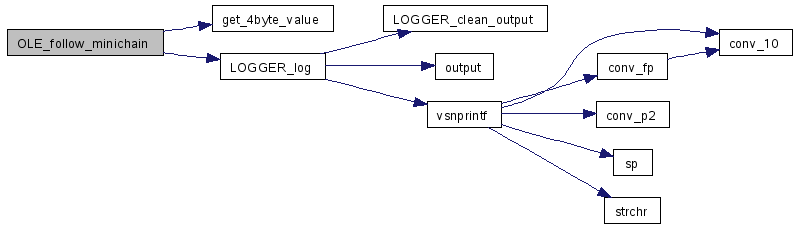
| int OLE_follow_minichain | ( | struct OLE_object * | ole, | |
| int | miniFAT_sector_start | |||
| ) |
Definition at line 1188 of file ole.c.
References DOLE, FL, get_4byte_value(), LEN_ULONG, LOGGER_log(), OLE_object::miniFAT, OLE_SECTORID_ENDOFCHAIN, OLE_SECTORID_FREE, OLE_SECTORID_MSAT, and OLE_SECTORID_SAT.
Referenced by OLE_load_minichain().
01189 {
01190   /*unsigned int current_sector = miniFAT_sector_start;*/
01191   int current_sector = miniFAT_sector_start;
01192   int chain_length=0;
01193   int break_out = 0;
01194
01195   DOLE LOGGER_log("%s:%d:OLE_follow_minichain:DEBUG: Starting at sector %d",FL, miniFAT_sector_start);
01196
01197   if (miniFAT_sector_start < 0) return 0;
01198
01199   do {
01200     /*unsigned int next_sector;*/
01201     int next_sector;
01202
01203     DOLE LOGGER_log("%s:%d:OLE_follow_minichain:DEBUG: Requesting 4-byte value at '%d'",FL, ole->miniFAT +(LEN_ULONG *current_sector));
01204     /* next text commented out because ole->miniFAT_limit is set to null ans vever change
01205        if (ole->miniFAT +(LEN_ULONG *current_sector) > ole->miniFAT_limit) {
01206        DOLE LOGGER_log("%s:%d:OLE_follow_minichain:DEBUG: Requested location is out of bounds\n",FL);
01207        return 0;
01208        }
01209     */
01210
01211     next_sector = get_4byte_value( ole->miniFAT +(LEN_ULONG *current_sector));
01212
01213     DOLE LOGGER_log("%s:%d:OLE_follow_minichain:DEBUG: Current Msector(0x%0X:%d)->next(0x%0X:%d)\n", FL, current_sector, current_sector, next_sector, next_sector);
01214
01218     if (current_sector == next_sector) break;
01219
01220     chain_length++;
01221     current_sector = next_sector;
01222
01224     switch (current_sector) {
01225     case OLE_SECTORID_MSAT:
01226     case OLE_SECTORID_SAT:
01227     case OLE_SECTORID_ENDOFCHAIN:
01228     case OLE_SECTORID_FREE:
01229       break_out=1;
01230       break;
01231     default:
01232       break_out=0;
01233     };
01234
01235     DOLE LOGGER_log("%s:%d:OLE_follow_minichain:DEBUG: current sector = %d",FL,current_sector);
01236     /* Test changed  Serge Steer Scilab */
01237     /*  } while ((break_out==0) &&(current_sector <= ole->last_sector));*/
01238   } while ((break_out==0));
01239   DOLE LOGGER_log("%s:%d:OLE_follow_minichain:DEBUG: Done.  Chainlength=%d",FL, chain_length);
01240
01241   return chain_length;
01242 }
Here is the call graph for this function:
Here is the caller graph for this function:

| int OLE_get_block | ( | struct OLE_object * | ole, | |
| int | block_index, | |||
| unsigned char * | block_buffer | |||
| ) |
Definition at line 328 of file ole.c.
References bb, DOLE, errno, OLE_object::f, FL, FREE, OLE_object::header, LOGGER_log(), MALLOC, memcpy(), NULL, offset, OLE_OK, OLE_sectorpos(), OLEER_GET_BLOCK_READ, OLEER_GET_BLOCK_SEEK, OLE_header::sector_size, SEEK_SET, strerror(), and VOLE.
Referenced by OLE_get_header(), OLE_load_chain(), and OLE_load_FAT().
00329 {
00330   if (block_buffer == NULL)
00331     {
00332       LOGGER_log("%s:%d:OLE_get_block:ERROR: Block buffer is NULL",FL);
00333       return -1;
00334     }
00335
00336   if (ole->f != NULL)
00337     {
00338       int read_count = 0;
00339       int fseek_result = 0;
00340       size_t offset = 0;
00341       unsigned char *bb = NULL;
00342
00343       bb = MALLOC(sizeof(unsigned char) *ole->header.sector_size);
00344       if (bb == NULL)
00345         {
00346           LOGGER_log("%s:%d:OLE_get_block:ERROR: Cannot allocate %d bytes for OLE block",FL, ole->header.sector_size);
00347           return -1;
00348         }
00349
00350       DOLE LOGGER_log("%s:%d:OLE_get_block:DEBUG: BlockIndex=%d, Buffer=0x%x",FL, block_index, block_buffer);
00351
00352       /*20051211-2343:PLD: offset = (block_index +1) << ole->header.sector_shift;*/
00353       offset = OLE_sectorpos(ole, block_index);
00354
00355       DOLE LOGGER_log("%s:%d:OLE_get_block:DEBUG: Read offset in file = 0x%x size to read= 0x%x",FL,offset,ole->header.sector_size);
00356
00357       fseek_result = fseek(ole->f, offset, SEEK_SET);
00358       if (fseek_result != 0)
00359         {
00360           if (bb != NULL) { FREE(bb); bb = NULL; }
00361           LOGGER_log("%s:%d:OLE_get_block:ERROR: Seek failure (block=%d:%d)",FL, block_index,offset, strerror(errno));
00362           return OLEER_GET_BLOCK_SEEK;
00363         }
00364
00365       /*read_count = fread(block_buffer, sizeof(unsigned char), ole->header.sector_size, ole->f);*/
00366       read_count = fread(bb, sizeof(unsigned char), ole->header.sector_size, ole->f);
00367       DOLE LOGGER_log("%s:%d:OLE_get_block:DEBUG: Read %d byte of data",FL,read_count);
00368       if (read_count != (int)ole->header.sector_size)
00369         {
00370           if (bb != NULL){ FREE(bb); bb = NULL; }
00371           VOLE LOGGER_log("%s:%d:Mismatch in bytes read. Requested %d, got %d\n", FL, ole->header.sector_size, read_count);
00372           return OLEER_GET_BLOCK_READ;
00373         }
00374
00375       DOLE LOGGER_log("%s:%d:OLE_get_block:DEBUG: Copying over memory read from file",FL);
00376
00377       memcpy(block_buffer, bb, ole->header.sector_size);
00378
00379       DOLE LOGGER_log("%s:%d:OLE_get_block:DEBUG: memory block copied to block_buffer",FL);
00380
00381       /* We're now done with BB, dispose of it */
00382       if (bb) { FREE(bb); bb = NULL; }
00383
00384       DOLE LOGGER_log("%s:%d:OLE_get_block:DEBUG: Disposed of temporary bb block",FL);
00385
00386     } else {
00387       LOGGER_log("%s:%d:OLE_get_block:ERROR: OLE file is closed\n",FL);
00388       return -1;
00389     }
00390
00391   DOLE LOGGER_log("%s:%d:OLE_get_block:DEBUG: Done",FL);
00392
00393   return OLE_OK;
00394 }
Here is the call graph for this function:

Here is the caller graph for this function:

| int OLE_get_header | ( | struct OLE_object * | ole | ) |
Definition at line 573 of file ole.c.
References OLE_object::header, OLE_object::header_block, OLE_get_block(), OLE_HEADER_BLOCK_SIZE, OLE_is_file_OLE(), OLE_OK, OLEER_NOT_OLE_FILE, result, and OLE_header::sector_size.
Referenced by OLE_decode_file().
00574 {
00575   int result = 0;
00576   ole->header.sector_size = OLE_HEADER_BLOCK_SIZE;
00577   result = OLE_get_block( ole, -1, ole->header_block );
00578
00579   if (OLE_is_file_OLE( ole ) == 0)
00580     {
00581       return OLEER_NOT_OLE_FILE;
00582     }
00583
00584   return OLE_OK;
00585 }
Here is the call graph for this function:

Here is the caller graph for this function:

| int OLE_get_miniblock | ( | struct OLE_object * | ole, | |
| int | block_index, | |||
| unsigned char * | block_buffer | |||
| ) |
Definition at line 414 of file ole.c.
References OLE_object::header, memcpy(), OLE_header::mini_sector_shift, OLE_header::mini_sector_size, OLE_object::ministream, offset, and OLE_OK.
Referenced by OLE_load_minichain().
00415 {
00416   /* This code may refer memory outside of the allocated one for  ole->ministream *
00417      in case of VBA Streams Serge Steer 26/01/2007*/
00418   if (ole->ministream)
00419     {
00420       int offset = block_index << ole->header.mini_sector_shift;
00421       memcpy( block_buffer, ole->ministream +offset, ole->header.mini_sector_size);
00422     }
00423
00424   return OLE_OK;
00425 }
Here is the call graph for this function:

Here is the caller graph for this function:

| int OLE_header_sanity_check | ( | struct OLE_object * | ole | ) |
Definition at line 671 of file ole.c.
References OLE_object::file_size, h, and OLE_object::header.
Referenced by OLE_decode_file().
00672 {
00673   int insanity=0;
00674   int max_sectors;
00675   struct OLE_header *h;
00676
00677   h = &(ole->header);
00678
00679   max_sectors = ole->file_size / h->sector_size;
00680
00681   if (h->sector_shift > 20) insanity++;
00682   if (h->mini_sector_shift > 10) insanity++;
00683   if (h->fat_sector_count < 0) insanity++;
00684   if (h->fat_sector_count > (unsigned int)max_sectors) insanity++;
00685   if (h->directory_stream_start_sector > (unsigned int) max_sectors) insanity++;
00686
00687   return insanity;
00688 }
Here is the caller graph for this function:

| int OLE_init | ( | struct OLE_object * | ole | ) |
Definition at line 121 of file ole.c.
References OLE_object::debug, OLE_object::f, OLE_object::FAT, OLE_object::FAT_limit, OLE_object::file_size, OLE_object::filename_report_fn, OLE_object::header, OLE_object::header_block, OLE_header::mini_sector_shift, OLE_object::miniFAT, OLE_object::miniFAT_limit, OLE_object::ministream, NULL, OLE_OK, OLE_object::properties, OLE_object::quiet, OLE_header::sector_shift, and OLE_object::verbose.
Referenced by ripole().
00122 {
00123   ole->debug = 0;
00124   ole->verbose = 0;
00125   ole->quiet = 0;
00126   ole->filename_report_fn = NULL;
00127   ole->f = NULL;
00128   ole->file_size = 0;
00129
00130   ole->FAT = NULL;
00131   ole->FAT_limit = NULL;
00132   ole->miniFAT = NULL;
00133   ole->miniFAT_limit = NULL;
00134
00135   ole->header_block[0] = '\0';
00136   ole->ministream = NULL;
00137   ole->properties = NULL;
00138
00139   ole->header.sector_shift = 0;
00140   ole->header.mini_sector_shift = 0;
00141
00142   return OLE_OK;
00143 }
Here is the caller graph for this function:

| int OLE_is_file_OLE | ( | struct OLE_object * | ole | ) |
Definition at line 548 of file ole.c.
References OLE_object::header_block, memcmp(), OLE_id_v1, and OLE_id_v2.
Referenced by OLE_get_header().
00549 {
00550
00551   if (memcmp(OLE_id_v1, ole->header_block, sizeof(OLE_id_v1))==0) return 1;
00552   if (memcmp(OLE_id_v2, ole->header_block, sizeof(OLE_id_v2))==0) return 1;
00553
00554   return 0;
00555
00556 }
Here is the call graph for this function:

Here is the caller graph for this function:

| unsigned char* OLE_load_chain | ( | struct OLE_object * | ole, | |
| int | FAT_sector_start | |||
| ) |
Definition at line 1340 of file ole.c.
References buffer, DOLE, OLE_object::error, OLE_object::FAT, FL, FREE, get_4byte_value(), OLE_object::header, OLE_object::last_chain_size, LEN_ULONG, LOGGER_log(), MALLOC, NULL, offset, OLE_follow_chain(), OLE_get_block(), OLE_OK, OLE_header::sector_shift, OLE_header::sector_size, and VOLE.
Referenced by OLE_decode_file(), and OLE_decode_stream().
01341 {
01342
01343   int chain_length = 0;
01344   int current_sector = FAT_sector_start;
01345   unsigned char *buffer = NULL;
01346   unsigned char *bp = NULL;
01347
01348
01349   ole->last_chain_size = 0;
01350
01351   if (FAT_sector_start < 0) return NULL;
01352
01353   DOLE LOGGER_log("%s:%d:OLE_load_chain:DEBUG: Loading chain, starting at sector %d",FL,FAT_sector_start);
01354
01355   chain_length = OLE_follow_chain( ole, FAT_sector_start );
01356   DOLE LOGGER_log("%s:%d:OLE_load_chain:DEBUG: %d sectors need to be loaded",FL,chain_length);
01357
01358   if (chain_length > 0)
01359     {
01360       size_t offset;
01361
01362       offset = ole->last_chain_size = chain_length << ole->header.sector_shift;
01363       bp = buffer = MALLOC( (offset) *sizeof(unsigned char));
01364       if (buffer == NULL)
01365         {
01366           LOGGER_log("%s:%d:OLE_load_chain:ERROR: Cannot allocate %d bytes for OLE chain",FL,offset);
01367           return NULL;
01368         }
01369
01370       if (buffer != NULL)
01371         {
01372           int tick = 0;
01373           unsigned char *bp_limit;
01374           bp_limit = bp +offset;
01375
01376           do {
01377             int next_sector;
01378
01379             DOLE LOGGER_log("%s:%d:OLE_load_chain:DEBUG: Loading sector[%d] %d",FL, tick, current_sector );
01380
01381             ole->error = OLE_get_block( ole, current_sector, bp );
01382             if (ole->error != OLE_OK)
01383               {
01384                 /*FREE5                                 if (bp != NULL) FREE(bp);*/
01385                 return NULL;
01386               }
01387
01388             bp += ole->header.sector_size;
01389             if (bp > bp_limit) {
01390               if (buffer != NULL) { FREE(buffer); bp = buffer = NULL; }
01391               VOLE LOGGER_log("%s:%d:OLE_load_chain:ERROR: Load-chain went over memory boundary",FL);
01392               return NULL;
01393             };
01394
01395             next_sector = get_4byte_value( ole->FAT +(LEN_ULONG *current_sector));
01396             current_sector = next_sector;
01397             tick++;
01398           } while ((current_sector >= 0)&&(current_sector <= ole->last_sector));
01399         }
01400     }
01401   DOLE LOGGER_log("%s:%d:OLE_load_chain:DEBUG: Done loading chain",FL);
01402
01403   return buffer;
01404 }
Here is the call graph for this function:

Here is the caller graph for this function:

| int OLE_load_FAT | ( | struct OLE_object * | ole | ) |
Definition at line 908 of file ole.c.
References OLE_object::debug, OLE_header::dif_sector_count, OLE_header::dif_start_sector, DOLE, OLE_object::FAT, OLE_header::FAT, OLE_object::FAT_limit, OLE_header::fat_sector_count, FL, FREE, get_4byte_value(), OLE_object::header, i, LEN_ULONG, LOGGER_log(), MALLOC, NULL, OLE_DPEDANTIC, OLE_get_block(), OLE_HEADER_FAT_SECTOR_COUNT_LIMIT, OLE_OK, OLE_print_sector(), OLEER_MEMORY_OVERFLOW, OLE_header::sector_shift, OLE_header::sector_size, and VOLE.
Referenced by OLE_decode_file().
00909 {
00910   unsigned int FAT_size;
00911
00912   FAT_size = ole->header.fat_sector_count << ole->header.sector_shift;
00913   DOLE LOGGER_log("%s:%d:OLE_load_FAT:DEBUG:Allocating for %d sectors (%d bytes) \n"
00914                   ,FL,ole->header.fat_sector_count, FAT_size);
00915
00916   ole->FAT = MALLOC( FAT_size *sizeof(unsigned char));
00917   ole->FAT_limit = ole->FAT +FAT_size;
00918   if (ole->FAT != NULL)
00919     {
00920       unsigned int i;
00921       unsigned char *fat_position = ole->FAT;
00922       unsigned int sector_count = ole->header.fat_sector_count;
00923
00924       if (sector_count > OLE_HEADER_FAT_SECTOR_COUNT_LIMIT)
00925         {
00926           sector_count = OLE_HEADER_FAT_SECTOR_COUNT_LIMIT;
00927           DOLE LOGGER_log("%s:%d:OLE_load_FAT:DEBUG: sector count greater than limit; set to %d",FL, sector_count);
00928         }
00929
00930       /* Load in all our primary-FAT sectors from the OLE file*/
00931       for (i = 0; i < sector_count; i++)
00932         {
00933           int getblock_result = 0;
00934
00935           DOLE LOGGER_log("%s:%d:OLE_load_FAT:DEBUG: Loading sector %d",FL, i);
00936           getblock_result = OLE_get_block(ole, ole->header.FAT[i], fat_position);
00937           if (getblock_result != 0)
00938             {
00939               /* if the get block fails, return the error - but keep the FAT*/
00940               /*                pointer alive - so that we can facilitate debugging*/
00941               /*                otherwise the caller is always going to get a NULL pointer*/
00942               /*                and have no idea to what extent the data was read.*/
00943
00944               /* This behavior may be changed later - but for now (beta development)*/
00945               /*                it'll be okay to leave it here - just make sure we know to*/
00946               /*                free the FAT block later.*/
00947
00948               return getblock_result;
00949             }
00950
00951           fat_position += ole->header.sector_size;
00952           if (fat_position > ole->FAT_limit)
00953             {
00954               LOGGER_log("%s:%d:OLE_load_FAT:DEBUG: FAT boundary limit exceeded %p > %p", FL, fat_position, ole->FAT_limit);
00955               return -1;
00956             }
00957         }
00958
00959       /* If our DIF count is > 0, this means we have a pretty big*/
00960       /*                file on hand (> 7Mb) and thus we now have to do some*/
00961       /*                fancy double-dereferenced sector request - enough to */
00962       /*                twist your brain if you're not alert, you have been*/
00963       /*                warned.*/
00964
00965       if (ole->header.dif_sector_count > 0)
00966         {
00967           unsigned char *fat_block;
00968           unsigned char *fat_block_end;
00969           unsigned int current_sector = ole->header.dif_start_sector;
00970
00971           DOLE LOGGER_log("%s:%d:OLE_load_FAT:DEBUG: Allocating %d bytes to fat_block\n",FL, ole->header.sector_size);
00972
00973           fat_block = MALLOC( ole->header.sector_size );
00974
00975           if (fat_block == NULL)
00976             {
00977               LOGGER_log("%s:%d:OLE_load_FAT:ERROR: Unable to allocate %d bytes\n", FL, ole->header.sector_size);
00978               return -1;
00979               /*                        exit(1);*/
00980             }
00981
00982           /* We need to know where the end of this block is - because it's*/
00983           /*            used to show us where the NEXT FAT block is going to come from*/
00984           /*            NOTE - this only occurs if we do have another block, else */
00985           /*            we'll simply have to just realise that we don't need any more*/
00986           /*            blocks and stop with this one.*/
00987
00988           fat_block_end = fat_block +ole->header.sector_size -LEN_ULONG;
00989
00990           /* We know we've got 'dif_sector_count' blocks to read, each of*/
00991           /*            these blocks hold no more than 127 sector addresses which*/
00992           /*            contain the actual FAT data we're after (this is the double*/
00993           /*            dereference bit that twists your brain )*/
00994
00995           DOLE LOGGER_log("%s:%d:OLE_load_FAT:DEBUG: Loading DIF sectors (count = %d)",FL,ole->header.dif_sector_count);
00996
00997           for (i = 0; i < ole->header.dif_sector_count; i++)
00998             {
00999               int import_sector;
01000               unsigned char *DIF = fat_block;
01001               int tick = 0;
01002               int getblock_result;
01003
01004               DOLE LOGGER_log("%s:%d:OLE_load_FAT:DEBUG: Reading DIF/XBAT index-data[%d] from sector 0x%x",FL,i,current_sector);
01005               getblock_result = OLE_get_block(ole, current_sector, fat_block);
01006               if (getblock_result != OLE_OK)
01007                 {
01008                   if (fat_block) FREE(fat_block);
01009                   return getblock_result;
01010                 }
01011
01012               if (OLE_DPEDANTIC(ole->debug)) OLE_print_sector(ole, fat_block, ole->header.sector_size);
01013
01014               /* Now, traverse this block until we hit a < 0*/
01015               /*                If we get what is a non-valid sector value*/
01016               /*                we know we've reached the end of the valid*/
01017               /*                sectors from which to read more extended FAT*/
01018               /*                data.*/
01019
01020               do {
01021                 import_sector = get_4byte_value( DIF );
01022                 DOLE LOGGER_log("%s:%d:OLE_load_FAT:DEBUG: import sector = 0x%x",FL,import_sector);
01023                 if (import_sector >= 0)
01024                   {
01025                     if (fat_position +ole->header.sector_size <= ole->FAT_limit)
01026                       {
01027                         DOLE LOGGER_log("%s:%d:OLE_load_FAT:DEBUG: Reading DIF/XBAT-data[%d] from sector 0x%x",FL,tick,import_sector);
01028                         getblock_result = OLE_get_block(ole, import_sector, fat_position);
01029                         if (getblock_result != OLE_OK)
01030                           {
01031                             LOGGER_log("%s:%d:OLE_load_FAT:ERROR: Not able to load block, import sector = 0x%x, fat position = 0x%x",FL, import_sector, fat_position);
01032                             if (fat_block) FREE(fat_block);
01033                             return getblock_result;
01034                           }
01035
01036                         fat_position += ole->header.sector_size;
01037                         DOLE LOGGER_log("%s:%d:OLE_load_FAT:DEBUG: FAT position = 0x%x (start = 0x%x, end = 0x%x)"
01038                                         ,FL
01039                                         ,fat_position
01040                                         ,fat_block
01041                                         ,ole->FAT_limit
01042                                         );
01043
01044                         /*if (fat_position +ole->header.sector_size > ole->FAT_limit)*/
01045                         if (fat_position > ole->FAT_limit)
01046                           {
01047                             DOLE LOGGER_log("%s:%d:OLE_load_FAT:ERROR: FAT memory boundary limit exceeded %p >= %p",FL,fat_position,ole->FAT_limit);
01048                             if (fat_block) FREE(fat_block);
01049                             return OLEER_MEMORY_OVERFLOW;
01050                           }
01051                         tick++;
01052                         DIF += LEN_ULONG;
01053                       }  else {
01054                         LOGGER_log("%s:%d:OLE_load_FAT:ERROR: FAT memory boundary limit exceeded %p >= %p",FL,fat_position,ole->FAT_limit);
01055                         if (fat_block) FREE(fat_block);
01056                         return OLEER_MEMORY_OVERFLOW;
01057                       }
01058                   } else {
01059                     VOLE LOGGER_log("%s:%d:OLE_load_FAT:ERROR: sector request was negative (%d)",FL, import_sector);
01060                   }
01061
01062                 DOLE LOGGER_log("%s:%d:OLE_load_FAT:DEBUG: DIF = 0x%x",FL,DIF);
01063               } while ((import_sector >= 0)&&(DIF < fat_block_end));
01064
01065               /* Get the next sector of DIF/XBAT data ...*/
01066
01067               /* If we still have more sectors full of extended FAT*/
01068               /*                sectors that we have to read, then we neet to*/
01069               /*                obtain the address of the next FAT-sector filled*/
01070               /*                sector*/
01071
01072               if ( i < ole->header.dif_sector_count -1 )
01073                 {
01074                   current_sector = get_4byte_value( fat_block_end );
01075                   DOLE LOGGER_log("%s:%d:OLE_load_FAT:DEBUG: Next DIF/XBAT index sector located at 0x%x",FL,current_sector);
01076                   if (current_sector < 0) break;
01077                 }
01078             } /* For every DIF/XBAT sector we're supposed to read*/
01079
01080           if (fat_block) FREE(fat_block);
01081         } /* If we have DIF/XBAT sectors to read into the FAT*/
01082
01083     } /* If we managed to allocate memory for our FAT table*/
01084
01085   return OLE_OK;
01086 }
Here is the call graph for this function:

Here is the caller graph for this function:

| unsigned char* OLE_load_minichain | ( | struct OLE_object * | ole, | |
| int | miniFAT_sector_start | |||
| ) |
Definition at line 1263 of file ole.c.
References buffer, DOLE, FL, get_4byte_value(), OLE_object::header, LEN_ULONG, LOGGER_log(), MALLOC, OLE_header::mini_sector_size, OLE_object::miniFAT, NULL, OLE_follow_minichain(), OLE_get_miniblock(), OLE_SECTORID_ENDOFCHAIN, OLE_SECTORID_FREE, OLE_SECTORID_MSAT, and OLE_SECTORID_SAT.
Referenced by OLE_decode_stream().
01264 {
01265
01266   int chain_length = 0;
01267   int current_sector = miniFAT_sector_start;
01268   unsigned char *buffer;
01269   unsigned char *bp;
01270   int break_out = 0;
01271
01272   DOLE LOGGER_log("%s:%d:OLE_load_minichain:DEBUG: Loading minichain starting at %d",FL, miniFAT_sector_start);
01273
01274   /* Added this sanity checking 2003 Aug 28*/
01275   if (miniFAT_sector_start < 0) return NULL;
01276
01277   chain_length = OLE_follow_minichain( ole, miniFAT_sector_start );
01278   DOLE LOGGER_log("%s:%d:OLE_load_minichain:DEBUG: Found %d mini-sectors to load (%d bytes)\n",FL, chain_length, chain_length *ole->header.mini_sector_size);
01279
01280   /* 20040911-21H59*/
01281   /* If our chain is 0 length, then there's nothing to return*/
01282   if (chain_length == 0) return NULL;
01283
01284   bp = buffer = MALLOC( chain_length *ole->header.mini_sector_size *sizeof(unsigned char));
01285   if (buffer != NULL)
01286     {
01287       do {
01288         int next_sector;
01289
01290         DOLE LOGGER_log("%s:%d:OLE_load_minichain:DEBUG: Loading sector %d",FL, current_sector);
01291         OLE_get_miniblock( ole, current_sector, bp );
01292         bp += ole->header.mini_sector_size;
01293
01294         next_sector = get_4byte_value( ole->miniFAT +(LEN_ULONG *current_sector));
01295         current_sector = next_sector;
01296         /* NEXT LINES ADDED TO BE COHERENT WITH  OLE_follow_minichain ABOVE Serge Steer Scilab */
01297         switch (current_sector) {
01298         case OLE_SECTORID_MSAT:
01299         case OLE_SECTORID_SAT:
01300         case OLE_SECTORID_ENDOFCHAIN:
01301         case OLE_SECTORID_FREE:
01302           break_out=1;
01303           break;
01304         default:
01305           break_out=0;
01306         };
01307         /* Test changed  Serge Steer Scilab */
01308         /* } while ((current_sector != OLE_SECTORID_ENDOFCHAIN)&&(current_sector >= 0)&&(current_sector <= ole->last_sector));*/
01309
01310       } while ((break_out==0));
01311
01312     } else {
01313       LOGGER_log("%s:%d:OLE_get_miniblock:ERROR: Failed to allocate enough memory for miniChain",FL);
01314     }
01315
01316   DOLE LOGGER_log("%s:%d:OLE_load_minichain:DEBUG: Done. buffer=%p",FL, buffer);
01317
01318   return buffer;
01319 }
Here is the call graph for this function:

Here is the caller graph for this function:

| int OLE_open_directory | ( | struct OLE_object * | ole, | |
| char * | directory | |||
| ) |
Definition at line 1477 of file ole.c.
References errno, FL, LOGGER_log(), NULL, OLE_OK, result, and strerror().
Referenced by OLE_decode_file().
01478 {
01479   int result=0;
01480
01481 #ifndef _MSC_VER
01482   result = mkdir( directory, S_IRWXU );
01483 #else
01484     result = CreateDirectory( directory,NULL);
01485       /* If the function succeeds, the return value is nonzero.
01486          If the function fails, the return value is zero. */
01487       if (result) result=0;
01488 #endif
01489                     if ((result != 0)&&(errno != EEXIST))
01490                       {
01491                         LOGGER_log("%s:%d:OLE_open_directory:ERROR: %s",FL,strerror(errno));
01492                       } else result = OLE_OK;
01493
01494                     return result;
01495 }
Here is the call graph for this function:

Here is the caller graph for this function:

| int OLE_open_file | ( | struct OLE_object * | ole, | |
| char * | fullpath | |||
| ) |
Definition at line 1426 of file ole.c.
References DOLE, errno, f(), OLE_object::f, OLE_object::file_size, FL, OLE_object::last_sector, LOGGER_log(), NULL, OLE_OK, OLEER_BAD_INPUT_FILE, OLEER_NOT_OLE_FILE, OLE_object::quiet, stat, and strerror().
Referenced by OLE_decode_file().
01427 {
01428   struct stat st;
01429   int stat_result;
01430   FILE *f;
01431
01432   stat_result = stat(fullpath, &st);
01433   if (stat_result != 0) {
01434     DOLE LOGGER_log("%s:%d:OLE_open_file:ERROR: Cannot locate file '%s' for opening (%s)",FL, fullpath, strerror(errno));
01435     return OLEER_BAD_INPUT_FILE;
01436   }
01437
01438   DOLE LOGGER_log("%s:%d:OLE_open_file:DEBUG: File size of %s = %ld",FL, fullpath, st.st_size);
01439   if ((stat_result == 0) && (st.st_size < 512)) return OLEER_NOT_OLE_FILE;
01440
01441   ole->file_size = st.st_size;
01442
01443   f = fopen(fullpath,"rb");
01444   if (f == NULL)
01445     {
01446       ole->f = NULL;
01447       if (ole->quiet == 0)
01448         {
01449           LOGGER_log("%s:%d:OLE_open_file:ERROR:Cannot open %s for reading (%s)\n",FL,fullpath, strerror(errno));
01450         }
01451       return -1;
01452     } else {
01453       ole->f = f;
01454       ole->file_size = st.st_size;
01455       ole->last_sector = -1;
01456     }
01457   return OLE_OK;
01458 }
Here is the call graph for this function:

Here is the caller graph for this function:

| int OLE_print_directory | ( | struct OLE_object * | ole, | |
| struct OLE_directory_entry * | dir | |||
| ) |
Definition at line 863 of file ole.c.
References dir, OLE_dbstosbs(), and OLE_OK.
Referenced by OLE_decode_file().
00864 {
00865   char element[64];
00866   OLE_dbstosbs( dir->element_name, dir->element_name_byte_count, element, sizeof(element) );
00867
00868   printf(
00869          "Element Name = %s\n"
00870          "Element type = %d\n"
00871          "Element colour = %d\n"
00872          "Left Child = %d\n"
00873          "Right Child = %d\n"
00874          "Root = %d\n"
00875          "User flags = %d\n"
00876          "Start sector = %d\n"
00877          "Stream Size = %d\n"
00878          ,element
00879          ,dir->element_type
00880          ,dir->element_colour
00881          ,dir->left_child
00882          ,dir->right_child
00883          ,dir->root
00884          ,dir->userflags
00885          ,dir->start_sector
00886          ,dir->stream_size
00887          );
00888
00889   return OLE_OK;
00890 }
Here is the call graph for this function:

Here is the caller graph for this function:

| int OLE_print_header | ( | struct OLE_object * | ole | ) |
Definition at line 706 of file ole.c.
References h, OLE_object::header, i, OLE_HEADER_FAT_SECTOR_COUNT_LIMIT, and OLE_OK.
Referenced by OLE_decode_file().
00707 {
00708   unsigned int i;
00709   struct OLE_header *h;
00710
00711   h = &(ole->header);
00712
00713   printf( "Minor version = %d\n"
00714           "DLL version = %d\n"
00715           "Byte order = %d\n\n"
00716
00717           "Sector shift = %d\n"
00718           "Sector size  = %d\n"
00719           "Mini Sector shift = %d\n"
00720           "Mini sector size  = %d\n\n"
00721
00722           "FAT sector count = %d\n"
00723           "First FAT sector = %d\n\n"
00724
00725           "Maximum ministream size = %d\n\n"
00726
00727           "First MiniFAT sector = %d\n"
00728           "MiniFAT sector count = %d\n\n"
00729
00730           "First DIF sector = %d\n"
00731           "DIF sector count = %d\n"
00732           "--------------------------------\n"
00733           ,h->minor_version
00734           ,h->dll_version
00735           ,h->byte_order
00736           ,h->sector_shift
00737           ,h->sector_size
00738           ,h->mini_sector_shift
00739           ,h->mini_sector_size
00740           ,h->fat_sector_count
00741           ,h->directory_stream_start_sector
00742           ,h->mini_cutoff_size
00743           ,h->mini_fat_start
00744           ,h->mini_fat_sector_count
00745           ,h->dif_start_sector
00746           ,h->dif_sector_count
00747           );
00748
00749   /* Print out the FAT chain*/
00750   for (i = 0; i < h->fat_sector_count; i++)
00751     {
00752       if (i >= OLE_HEADER_FAT_SECTOR_COUNT_LIMIT) break; /* We can't read beyond the 109th sector location*/
00753       printf("FAT[%d] = %d\n", i, h->FAT[i]);
00754     }
00755
00756   return OLE_OK;
00757 }
Here is the caller graph for this function:

| int OLE_print_sector | ( | struct OLE_object * | ole, | |
| char * | sector, | |||
| unsigned int | bytes | |||
| ) |
Definition at line 509 of file ole.c.
Referenced by OLE_load_FAT().
00510 {
00511   int current_byte;
00512   int ubytes = bytes;
00513
00514   printf("\n");
00515   for (current_byte = 0; current_byte < ubytes; current_byte++ )
00516     {
00517       printf("%02X ", *(sector +current_byte));
00518       if (((current_byte+1) %32)==0) {
00519         int j;
00520         for (j = current_byte -31; j <=current_byte; j++)
00521           {
00522             if (isalnum(*(sector +j))) printf("%c",*(sector+j));
00523             else printf(".");
00524           }
00525         printf("\n");
00526       }
00527     }
00528   printf("\n");
00529
00530   return OLE_OK;
00531 }
Here is the caller graph for this function:

| int OLE_print_string | ( | char * | string, | |
| size_t | char_count | |||
| ) |
| int OLE_sectorpos | ( | struct OLE_object * | ole, | |
| int | SID | |||
| ) |
Definition at line 301 of file ole.c.
References OLE_object::header, pos, and OLE_header::sector_size.
Referenced by OLE_get_block().
00302 {
00303   int pos = 0;
00304
00305   pos = 512 +(SID *ole->header.sector_size);
00306
00307   return pos;
00308 }
Here is the caller graph for this function:

| int OLE_set_debug | ( | struct OLE_object * | ole, | |
| int | level | |||
| ) |
Definition at line 247 of file ole.c.
References OLE_object::debug, FL, LOGGER_log(), and OLE_OK.
Referenced by ripole(), and ROLE_set_parameters().
00248 {
00249   ole->debug = level;
00250   if (ole->debug > 0) LOGGER_log("%s:%d:OLE_set_debug: Debug level set to %d",FL, ole->debug);
00251
00252   return OLE_OK;
00253 }
Here is the call graph for this function:

Here is the caller graph for this function:

| int OLE_set_filename_report_fn | ( | struct OLE_object * | ole, | |
| int(*)(char *) | ptr_to_fn | |||
| ) |
Definition at line 1516 of file ole.c.
References OLE_object::filename_report_fn, and OLE_OK.
Referenced by ripole().
01517 {
01518   ole->filename_report_fn = ptr_to_fn;
01519   return OLE_OK;
01520 }
Here is the caller graph for this function:

| int OLE_set_quiet | ( | struct OLE_object * | ole, | |
| int | level | |||
| ) |
Definition at line 221 of file ole.c.
References OLE_object::debug, OLE_OK, OLE_object::quiet, and OLE_object::verbose.
00222 {
00223   ole->quiet = level;
00224   ole->verbose = 0;
00225   ole->debug = 0;
00226
00227   return OLE_OK;
00228 }
| int OLE_set_save_unknown_streams | ( | struct OLE_object * | ole, | |
| int | level | |||
| ) |
Definition at line 272 of file ole.c.
References OLE_OK, and OLE_object::save_unknown_streams.
Referenced by ripole(), and ROLE_set_parameters().
00273 {
00274   ole->save_unknown_streams = level;
00275
00276   return OLE_OK;
00277 }
Here is the caller graph for this function:

| int OLE_set_verbose | ( | struct OLE_object * | ole, | |
| int | level | |||
| ) |
Definition at line 197 of file ole.c.
References OLE_OK, and OLE_object::verbose.
Referenced by ripole(), and ROLE_set_parameters().
Here is the caller graph for this function:

| int OLE_store_stream | ( | struct OLE_object * | ole, | |
| char * | stream_name, | |||
| char * | directory, | |||
| char * | stream, | |||
| size_t | stream_size | |||
| ) |
Definition at line 1541 of file ole.c.
References errno, f(), OLE_object::filename_report_fn, FL, FREE, LOGGER_log(), NULL, OLE_OK, OLE_VNORMAL, PLD_dprintf(), strerror(), and OLE_object::verbose.
Referenced by OLE_decode_stream().
01542 {
01543   char *full_path = NULL;
01544
01545   full_path = PLD_dprintf("%s/%s", directory, stream_name);
01546   if (full_path == NULL)
01547     {
01548       LOGGER_log("%s:%d:OLE_store_stream:ERROR: Cannot compose full filename string from '%s' and '%s'", FL, directory, stream_name);
01549       return -1;
01550     } else {
01551       FILE *f;
01552
01553       f = fopen(full_path,"wb");
01554       if (f == NULL)
01555         {
01556           LOGGER_log("%s:%d:OLE_store_stream:ERROR: Cannot open %s for writing (%s)",FL, full_path, strerror(errno));
01557           if (full_path) FREE(full_path);
01558           return -1;
01559         } else {
01560           size_t written_bytes;
01561
01562           written_bytes = fwrite( stream, 1, stream_size, f );
01563           if (written_bytes != stream_size)
01564             {
01565               LOGGER_log("%s:%d:OLE_store_stream:WARNING: Only wrote %d of %d bytes to file %s",FL,written_bytes,stream_size,full_path);
01566             }
01567           fclose(f);
01568
01569           if ((OLE_VNORMAL(ole->verbose))&&(ole->filename_report_fn != NULL))
01570             {
01571               ole->filename_report_fn( stream_name );
01572             }
01573         } /* if file is valid*/
01574     } /* if full_path is valid*/
01575
01576   if (full_path) FREE(full_path);
01577
01578   return OLE_OK;
01579 }
Here is the call graph for this function:

Here is the caller graph for this function:

| int OLE_terminate_and_return | ( | struct OLE_object * | ole, | |
| int | result | |||
| ) |
Definition at line 1626 of file ole.c.
References OLE_decode_file_done().
01627 {
01628   OLE_decode_file_done(ole);
01629   return result;
01630 }
Here is the call graph for this function:

| int OLE_version | ( | void | ) |
Definition at line 98 of file ole.c.
References LIBOLE_VERSION.
00099 {
00100   fprintf(stderr,"ripOLE: %s\n", LIBOLE_VERSION);
00101
00102   return 0;
00103 }
| unsigned char OLE_id_v1[] = { 0x0e, 0x11, 0xfc, 0x0d, 0xd0, 0xcf, 0x11, 0xe0 } |
| unsigned char OLE_id_v2[] = { 0xd0, 0xcf, 0x11, 0xe0, 0xa1, 0xb1, 0x1a, 0xe1 } |
 1.5.1
1.5.1