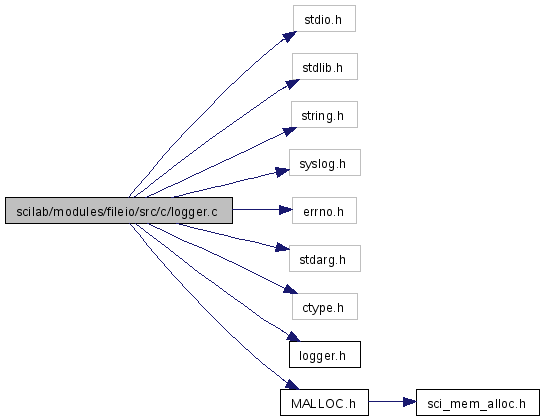
#include <stdio.h>#include <stdlib.h>#include <string.h>#include <syslog.h>#include <errno.h>#include <stdarg.h>#include <ctype.h>#include "logger.h"#include "MALLOC.h"Include dependency graph for logger.c:
Go to the source code of this file.
Data Structures | |
| struct | LOGGER_globals |
Functions | |
| FILE * | LOGGER_get_file (void) |
| int | LOGGER_set_output_mode (int modechoice) |
| int | LOGGER_set_output_file (FILE *f) |
| int | LOGGER_set_syslog_mode (int syslogmode) |
| int | LOGGER_set_logfile (char *lfname) |
| int | LOGGER_set_wraplength (int length) |
| int | LOGGER_set_wrap (int level) |
| int | LOGGER_close_logfile (void) |
| int | LOGGER_clean_output (char *string, char **buffer) |
| int | LOGGER_log (char *format,...) |
Variables | |
| static int | _LOGGER_mode = _LOGGER_SYSLOG |
| static int | _LOGGER_syslog_mode = LOG_MAIL|LOG_INFO |
| static FILE * | _LOGGER_outf |
| static struct LOGGER_globals | LOGGER_glb = { 0, 0 } |
| int LOGGER_clean_output | ( | char * | string, | |
| char ** | buffer | |||
| ) |
Definition at line 193 of file logger.c.
References LOGGER_glb, MALLOC, NULL, p, LOGGER_globals::wrap, and LOGGER_globals::wraplength.
Referenced by LOGGER_log().
00194 {
00195         char *newstr;
00196         char *p, *q;
00197         char *next_space;
00198
00199         int pc;
00200         int slen = strlen( string );
00201         int line_size;
00202         int maxsize = slen *2;
00203
00204         /* First up, allocate maxsize bytes for a temporary new string.*/
00205         newstr = MALLOC(slen *2 +1);
00206         if ( newstr == NULL )
00207         {
00208           /* FIXME - Report an error here ... to -somewhere-*/
00209                 return -1;
00210         }
00211
00212         p = newstr;
00213         q = string;
00214         pc = 0;
00215         line_size = 0;
00216
00217         while (slen--)
00218         {
00219
00220           /* Do we need to apply any wrapping to the output? If so then we*/
00221           /*            shall embark on a journey of strange space and distance*/
00222           /*            evaluations to determine if we should wrap now or later*/
00223
00224                 if ( LOGGER_glb.wrap > 0 )
00225                 {
00226                         if (isspace((int)*q))
00227                         {
00228                                 next_space = strpbrk( (q+1), "\t\r\n\v " );
00229                                 if (next_space != NULL)
00230                                 {
00231                                         if ((line_size +(next_space -q)) >= LOGGER_glb.wraplength)
00232                                         {
00233                                                 *p = '\n';
00234                                                 p++;
00235                                                 pc++;
00236                                                 line_size = 0;
00237                                         }
00238                                 }
00239                         }
00240
00241                         if ( line_size >= LOGGER_glb.wraplength )
00242                         {
00243                                 *p = '\n';
00244                                 p++;
00245                                 pc++;
00246                                 line_size = 0;
00247                         }
00248                 }
00249
00250                 /* If the string has a % in it, then we need to encode it as*/
00251                 /*      a DOUBLE % symbol.*/
00252
00253                 if (*q == '%') {
00254                   /*                    if (strchr("fdlsxXn",*(q+1)))*/
00255                   /*                    {*/
00256                                 *p = '%';
00257                                 p++;
00258                                 pc++;
00259                                 /*                      }*/
00260                 }
00261
00262                 /* Copy the character of the string in*/
00263                 *p = *q;
00264
00265                 /* Move everything along.*/
00266                 q++;
00267                 p++;
00268                 pc++;
00269                 line_size++;
00270
00271                 if ( pc > (maxsize -1) ) {
00272                         break;
00273                 }
00274         }
00275
00276         *p = '\0';
00277
00278         /* This will have to be deallocated later!*/
00279         if (newstr) *buffer = newstr;
00280
00281         return 0;
00282 }
Here is the caller graph for this function:

| int LOGGER_close_logfile | ( | void | ) |
Definition at line 172 of file logger.c.
References _LOGGER_outf, and result.
00173 {
00174         int result = 0;
00175
00176         if (_LOGGER_outf) fclose(_LOGGER_outf);
00177
00178         return result;
00179 }
| FILE* LOGGER_get_file | ( | void | ) |
Definition at line 50 of file logger.c.
References _LOGGER_outf.
00051 {
00052         return _LOGGER_outf;
00053 }
| int LOGGER_log | ( | char * | format, | |
| ... | ||||
| ) |
Definition at line 292 of file logger.c.
References _LOGGER_FILE, _LOGGER_mode, _LOGGER_outf, _LOGGER_STDERR, _LOGGER_STDOUT, _LOGGER_SYSLOG, _LOGGER_syslog_mode, FREE, LOGGER_clean_output(), output(), and vsnprintf().
Referenced by OLE_convert_directory(), OLE_decode_file(), OLE_decode_stream(), OLE_follow_chain(), OLE_follow_minichain(), OLE_get_block(), OLE_load_chain(), OLE_load_FAT(), OLE_load_minichain(), OLE_open_directory(), OLE_open_file(), OLE_set_debug(), OLE_store_stream(), OLEUNWRAP_decode_attachment(), OLEUNWRAP_decodestream(), OLEUNWRAP_save_stream(), PLD_strreplace_general(), ripole(), and ROLE_report_filename_decoded().
00293 {
00294         va_list ptr;
00295         char tmpoutput[10240];
00296         char linebreak[]="\n";
00297         char nolinebreak[]="";
00298         char *lineend;
00299         char *output;
00300
00301
00302         /* get our variable arguments*/
00303         va_start(ptr,format);
00304
00305         /* produce output, and spit to the log file*/
00306 #ifdef NO_SNPRINTF
00307         vsprintf(tmpoutput, format, ptr);
00308 #else
00309         vsnprintf(tmpoutput,10240,format,ptr);
00310 #endif
00311
00312         LOGGER_clean_output( tmpoutput, &output );
00313
00314         if ( output[strlen(output)-1] == '\n' ) {
00315                 lineend = nolinebreak;
00316         }
00317         else {
00318                 lineend = linebreak;
00319         }
00320
00321         if ( output[strlen(output)-1] == '\n' ) { lineend = nolinebreak; } else { lineend = linebreak; }
00322
00323         /* Send the output to the appropriate output destination*/
00324         switch (_LOGGER_mode) {
00325                 case _LOGGER_STDERR:
00326                         fprintf(stderr,"%s%s",output, lineend );
00327                         break;
00328                 case _LOGGER_SYSLOG:
00329                         #ifndef _MSC_VER
00330                         syslog(_LOGGER_syslog_mode,output);
00331                         #endif
00332                         break;
00333                 case _LOGGER_STDOUT:
00334                         fprintf(stdout,"%s%s",output, lineend);
00335                         fflush(stdout);
00336                         break;
00337                 case _LOGGER_FILE:
00338                         fprintf(_LOGGER_outf,"%s%s",output,lineend);
00339                         fflush(_LOGGER_outf);
00340                         break;
00341                 default:
00342                         fprintf(stdout,"LOGGER-Default: %s%s",output,lineend);
00343         }
00344
00345
00346         if (output) FREE(output);
00347
00348         return 0;
00349 }
Here is the call graph for this function:

Here is the caller graph for this function:

| int LOGGER_set_logfile | ( | char * | lfname | ) |
Definition at line 109 of file logger.c.
References _LOGGER_outf, errno, result, and strerror().
00110 {
00111         int result = 0;
00112
00113         _LOGGER_outf = fopen(lfname,"a");
00114         if (!_LOGGER_outf)
00115         {
00116 #ifndef _MSC_VER
00117                 syslog(1,"LOGGER_set_logfile: ERROR - Cannot open logfile '%s' (%s)",lfname,strerror(errno));
00118 #else
00119                 fprintf(stderr, "LOGGER_set_logfile: ERROR - Cannot open logfile '%s' (%s)\n", lfname, strerror(errno));
00120 #endif
00121                 result = -1;
00122         }
00123
00124         return result;
00125 }
Here is the call graph for this function:

| int LOGGER_set_output_file | ( | FILE * | f | ) |
Definition at line 78 of file logger.c.
References _LOGGER_outf.
00079 {
00080         _LOGGER_outf = f;
00081         return 0;
00082 }
Definition at line 64 of file logger.c.
References _LOGGER_mode.
Referenced by ripole().
00065 {
00066         _LOGGER_mode = modechoice;
00067         return 0;
00068 }
Here is the caller graph for this function:

Definition at line 92 of file logger.c.
References _LOGGER_syslog_mode.
00093 {
00094         _LOGGER_syslog_mode = syslogmode;
00095         return 0;
00096 }
Definition at line 153 of file logger.c.
References LOGGER_glb, and LOGGER_globals::wrap.
00154 {
00155         if ( level >= 0 )
00156         {
00157                 LOGGER_glb.wrap = level;
00158         }
00159
00160         return LOGGER_glb.wrap;
00161 }
Definition at line 136 of file logger.c.
References LOGGER_glb, and LOGGER_globals::wraplength.
00137 {
00138         if ( length >= 0 )
00139         {
00140                 LOGGER_glb.wraplength = length;
00141         }
00142
00143         return LOGGER_glb.wraplength;
00144 }
int _LOGGER_mode = _LOGGER_SYSLOG [static] |
FILE* _LOGGER_outf [static] |
Definition at line 27 of file logger.c.
Referenced by LOGGER_close_logfile(), LOGGER_get_file(), LOGGER_log(), LOGGER_set_logfile(), and LOGGER_set_output_file().
int _LOGGER_syslog_mode = LOG_MAIL|LOG_INFO [static] |
struct LOGGER_globals LOGGER_glb = { 0, 0 } [static] |
Definition at line 37 of file logger.c.
Referenced by LOGGER_clean_output(), LOGGER_set_wrap(), and LOGGER_set_wraplength().
 1.5.1
1.5.1