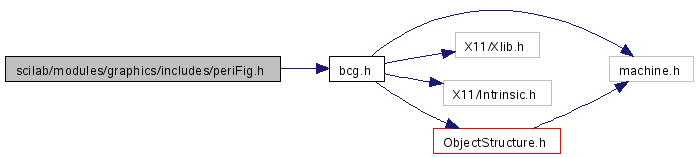
#include "bcg.h"Include dependency graph for periFig.h:
This graph shows which files directly or indirectly include this file:

Go to the source code of this file.
Functions | |
| void C2F() | drawarcXfig () |
| void C2F() | fillarcsXfig () |
| void C2F() | drawarcsXfig () |
| void C2F() | fillareaXfig () |
| void C2F() | drawaxisXfig () |
| void C2F() | clearareaXfig () |
| void C2F() | clearwindowXfig () |
| void C2F() | xclickXfig () |
| void C2F() | xclick_anyXfig () |
| void C2F() | xgetmouseXfig () |
| void C2F() | xendXfig () |
| void C2F() | fillarcXfig () |
| void C2F() | viderbuffXfig () |
| void C2F() | fillrectangleXfig () |
| void C2F() | scilabgcgetXfig () |
| void C2F() | initgraphicXfig () |
| void C2F() | initgraphicfromscreenXfig () |
| void C2F() | drawpolylineXfig () |
| void C2F() | drawClippedPolylineXfig () |
| void C2F() | drawpolylinesXfig () |
| void C2F() | fillpolylinesXfig () |
| void C2F() | fillpolylineXfig () |
| void C2F() | drawpolymarkXfig () |
| void C2F() | getFontMaxSizeXfig () |
| void C2F() | displaynumbersXfig () |
| void C2F() | drawrectangleXfig () |
| void C2F() | drawrectanglesXfig () |
| void C2F() | drawsegmentsXfig () |
| void C2F() | xselgraphicXfig () |
| void C2F() | scilabgcsetXfig () |
| void C2F() | SetDriverXfig () |
| void C2F() | displaystringXfig () |
| void C2F() | boundingboxXfig () |
| void C2F() | drawarrowsXfig () |
| void C2F() | loadfamilyXfig () |
| void C2F() | queryfamilyXfig () |
| void C2F() | getwindowdimXfig (integer *verbose, integer *x, integer *narg, double *dummy) |
| void C2F() | set_dash_or_color_Xfig (integer *value, integer *v2, integer *v3, integer *v4) |
| void C2F() | set_dash_and_color_Xfig (integer *value, integer *v2, integer *v3, integer *v4) |
| void C2F() | set_line_style_Xfig (integer *value, integer *v2, integer *v3, integer *v4) |
| void C2F() | setgccolormapXfig (struct BCG *Xgc, integer m, double *a, integer *v3) |
| void C2F() | getcolormapsizeXfig (integer *v1, integer *v2, integer *v3, double *val) |
| void C2F() | getcolormapXfig (integer *v1, integer *v2, integer *v3, double *val) |
| void C2F() | get_dash_or_color_Xfig (integer *verbose, integer *value, integer *narg, double *dummy) |
| void C2F() | get_dash_and_color_Xfig (integer *verbose, integer *value, integer *narg, double *dummy) |
| void C2F() | boundingboxXfig (char *string, integer *x, integer *y, integer *rect, integer *v5, integer *v6, integer *v7, double *dx1, double *dx2, double *dx3, double *dx4) |
| void C2F() | fillarcsXfig_old (char *str, integer *vects, integer *fillvect, integer *n, integer *v5, integer *v6, integer *v7, double *dx1, double *dx2, double *dx3, double *dx4) |
| void C2F() | drawarcsXfig_old (char *str, integer *vects, integer *style, integer *n, integer *v5, integer *v6, integer *v7, double *dv1, double *dv2, double *dv3, double *dv4) |
| void C2F() | drawClippedPolylineXfig (char *str, integer *n, integer *vx, integer *vy, integer *closeflag, integer *v6, integer *v7, double *dx1, double *dx2, double *dx3, double *dx4) |
| void C2F() | queryfamilyXfig (char *name, integer *j, integer *v3, integer *v4, integer *v5, integer *v6, integer *v7, double *dv1, double *dv2, double *dv3, double *dv4) |
| void C2F() | getFontMaxSizeXfig (char *str, integer *sizeMin, integer *sizeMax, integer *v1, integer *v2, integer *v3, integer *v4, double *dx1, double *dx2, double *dx3, double *dx4) |
| void C2F() | boundingboxXfigM (char *string, integer *x, integer *y, integer *rect, integer *v5, integer *v6, integer *v7, double *dx1, double *dx2, double *dx3, double *dx4) |
| void C2F() | drawarcXfig_old (char *str, integer *x, integer *y, integer *width, integer *height, integer *angle1, integer *angle2, double *dx1, double *dx2, double *dx3, double *dx4) |
| void C2F() | fillarcXfig_old (char *str, integer *x, integer *y, integer *width, integer *height, integer *angle1, integer *angle2, double *dx1, double *dx2, double *dx3, double *dx4) |
| void C2F() | initgraphicfromscreenXfig (char *string, integer *v2, integer *v3, integer *v4, integer *v5, integer *v6, integer *v7, double *dx1, double *dx2, double *dx3, double *dx4) |
| void C2F() boundingboxXfig | ( | char * | string, | |
| integer * | x, | |||
| integer * | y, | |||
| integer * | rect, | |||
| integer * | v5, | |||
| integer * | v6, | |||
| integer * | v7, | |||
| double * | dx1, | |||
| double * | dx2, | |||
| double * | dx3, | |||
| double * | dx4 | |||
| ) |
To get the bounding rectangle of a string
Definition at line 1314 of file periFig.c.
References C2F, int, prec_fact, vdouble, and xgetfontXfig().
01315 {integer verbose,nargs,font[2];
01316  verbose=0;
01317
01318  C2F(xgetfontXfig)(&verbose,font,&nargs,vdouble);
01319  rect[0]= (int)(*x+bsizeXfig_[font[1]][0]*((double) prec_fact));
01320  rect[1]= (int)(*y+bsizeXfig_[font[1]][1]*((double) prec_fact));
01321  rect[2]= (int)(((double)prec_fact)*(bsizeXfig_[font[1]][2]/100.0)*((double)strlen(string)));
01322  rect[3]= (int)(bsizeXfig_[font[1]][3]*((double) prec_fact));
01323 }
Here is the call graph for this function:

| void C2F() boundingboxXfig | ( | ) |
Referenced by displaystringXfig(), and xcall_in_word_set().
Here is the caller graph for this function:

| void C2F() boundingboxXfigM | ( | char * | string, | |
| integer * | x, | |||
| integer * | y, | |||
| integer * | rect, | |||
| integer * | v5, | |||
| integer * | v6, | |||
| integer * | v7, | |||
| double * | dx1, | |||
| double * | dx2, | |||
| double * | dx3, | |||
| double * | dx4 | |||
| ) |
To get the bounding rectangle of a symbol in fact just rect[3] is really used
Definition at line 1355 of file periFig.c.
References C2F, BCG::CurHardSymb, BCG::CurHardSymbSize, int, prec_fact, ScilabGCXfig, vdouble, and xgetfontXfig().
01356 {
01357   integer verbose,nargs,font[2];
01358   verbose=0;
01359   C2F(xgetfontXfig)(&verbose,font,&nargs,vdouble);
01360   rect[0]= (int)(*x+bsizeXfig_[font[1]][0]*((double) prec_fact));
01361   rect[1]= (int)(*y+bsizeXfig_[font[1]][1]*((double) prec_fact));
01362   rect[2]= (int)(symb_xw[ScilabGCXfig.CurHardSymbSize][ScilabGCXfig.CurHardSymb]);
01363   rect[3]= (int)(symb_yh[ScilabGCXfig.CurHardSymbSize][ScilabGCXfig.CurHardSymb]);
01364 }
Here is the call graph for this function:

| void C2F() clearareaXfig | ( | ) |
| void C2F() clearwindowXfig | ( | ) |
| void C2F() displaynumbersXfig | ( | ) |
| void C2F() displaystringXfig | ( | ) |
Referenced by displaynumbersXfig(), and xcall_in_word_set().
Here is the caller graph for this function:

| void C2F() drawarcsXfig | ( | ) |
| void C2F() drawarcsXfig_old | ( | char * | str, | |
| integer * | vects, | |||
| integer * | style, | |||
| integer * | n, | |||
| integer * | v5, | |||
| integer * | v6, | |||
| integer * | v7, | |||
| double * | dv1, | |||
| double * | dv2, | |||
| double * | dv3, | |||
| double * | dv4 | |||
| ) |
caution : angle=degreangle*64
Definition at line 1592 of file periFig.c.
References C2F, FALSE, getdashXfig(), L, PI0, ScilabGCXfig_is_initialized, sciprint(), setdashXfig(), vdouble, and WriteGenericXfig().
01593 {
01594   integer verbose=0,Dnarg,Dvalue[10];
01595   /* store the current values */
01596
01597   if ( ScilabGCXfig_is_initialized == FALSE ) {
01598     sciprint("xinit must be called before any action \r\n");
01599     return;
01600   }
01601
01602   C2F(getdashXfig)(&verbose,Dvalue,&Dnarg,vdouble);
01603   C2F(WriteGenericXfig)("Rdrawarc",*n,(integer)6L,vects,vects,6*(*n),(integer)0L,style);
01604   C2F(setdashXfig)( Dvalue,PI0,PI0,PI0);
01605 }
Here is the call graph for this function:

| void C2F() drawarcXfig | ( | ) |
| void C2F() drawarcXfig_old | ( | char * | str, | |
| integer * | x, | |||
| integer * | y, | |||
| integer * | width, | |||
| integer * | height, | |||
| integer * | angle1, | |||
| integer * | angle2, | |||
| double * | dx1, | |||
| double * | dx2, | |||
| double * | dx3, | |||
| double * | dx4 | |||
| ) |
caution angle=degreAngle*64
Definition at line 1637 of file periFig.c.
References C2F, FALSE, fillarcsXfig(), i, BCG::IDLastPattern, PD0, PI0, ScilabGCXfig, ScilabGCXfig_is_initialized, and sciprint().
01638 {
01639   integer i =1;
01640   integer fvect[1] ;
01641   integer vects[6];
01642
01643   if ( ScilabGCXfig_is_initialized == FALSE ) {
01644     sciprint("xinit must be called before any action \r\n");
01645     return;
01646   }
01647
01648   vects[0]= *x;vects[1]= *y;vects[2]= *width;
01649   vects[3]= *height;vects[4]= *angle1;vects[5]= *angle2;
01650   fvect[0] = ScilabGCXfig.IDLastPattern  +2;
01651   C2F(fillarcsXfig)(str,vects,fvect,&i,PI0,PI0,PI0,PD0,PD0,PD0,PD0);
01652 }
Here is the call graph for this function:

| void C2F() drawarrowsXfig | ( | ) |
| void C2F() drawaxisXfig | ( | ) |
| void C2F() drawClippedPolylineXfig | ( | char * | str, | |
| integer * | n, | |||
| integer * | vx, | |||
| integer * | vy, | |||
| integer * | closeflag, | |||
| integer * | v6, | |||
| integer * | v7, | |||
| double * | dx1, | |||
| double * | dx2, | |||
| double * | dx3, | |||
| double * | dx4 | |||
| ) |
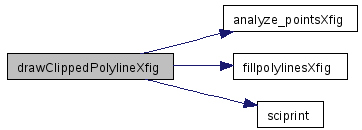
Definition at line 1927 of file periFig.c.
References analyze_pointsXfig(), C2F, BCG::ClipRegionSet, FALSE, file, fillpolylinesXfig(), FPRINTF, FREE, i, j, MALLOC, nb, NULL, PD0, PI0, ScilabGCXfig, ScilabGCXfig_is_initialized, and sciprint().
01928 {
01929   integer i=1,fvect=0;
01930   integer *vxtmp = NULL;
01931   integer *vytmp = NULL;
01932   int j;
01933
01934   if ( ScilabGCXfig_is_initialized == FALSE ) {
01935     sciprint("xinit must be called before any action \r\n");
01936     return;
01937   }
01938
01939   if((vxtmp=MALLOC(((*n)+1)*sizeof(integer)))==0){
01940     sciprint("Can not allocate vxtmp while exporting to Fig\n");
01941     return;
01942   }
01943
01944   if((vytmp=MALLOC(((*n)+1)*sizeof(integer)))==0){
01945     sciprint("Can not allocate vxtmp while exporting to Fig\n");
01946     return;
01947   }
01948
01949
01950   for( j = 0 ; j < (*n ) ; j++ )
01951   {
01952     vxtmp[j] = vx[j];
01953     vytmp[j] = vy[j];
01954   }
01955
01956   vxtmp[(*n)] = vx[0];
01957   vytmp[(*n)] = vy[0];
01958
01959   if (*closeflag == 1 ){
01960     int nb = (*n)+1;
01961     FPRINTF((file,"#/closeflag true def\n"));
01962     if (ScilabGCXfig.ClipRegionSet ==1 )
01963       {
01964         C2F(analyze_pointsXfig)(nb, vxtmp, vytmp, *closeflag);
01965       }
01966     else
01967     C2F(fillpolylinesXfig)(str,vxtmp,vytmp,&fvect,&i,&nb,PI0,PD0,PD0,PD0,PD0);
01968   }
01969   else {
01970     FPRINTF((file,"#/closeflag false def\n"));
01971     if (ScilabGCXfig.ClipRegionSet ==1 )
01972       {
01973         C2F(analyze_pointsXfig)(*n, vx, vy, *closeflag);
01974       }
01975     else
01976     C2F(fillpolylinesXfig)(str,vx,vy,&fvect,&i,n,PI0,PD0,PD0,PD0,PD0);
01977   }
01978
01979   FREE(vxtmp); vxtmp = NULL;
01980   FREE(vytmp); vytmp = NULL;
01981
01982   /*   if (*closeflag == 1 ) */
01983   /*     FPRINTF((file,"#/closeflag true def\n")); */
01984   /*   else  */
01985   /*     FPRINTF((file,"#/closeflag false def\n")); */
01986   /*   if (ScilabGCXfig.ClipRegionSet ==1 ) */
01987   /*     { */
01988   /*       C2F(analyze_pointsXfig)(*n, vx, vy, *closeflag); */
01989   /*     } */
01990   /*   else  */
01991   /*     C2F(fillpolylinesXfig)(str,vx,vy,&fvect,&i,n,PI0,PD0,PD0,PD0,PD0); */
01992 }
Here is the call graph for this function:
| void C2F() drawClippedPolylineXfig | ( | ) |
Referenced by drawarcXfig(), drawpolylinesXfig(), and xcall_in_word_set().
Here is the caller graph for this function:

| void C2F() drawpolylinesXfig | ( | ) |
| void C2F() drawpolylineXfig | ( | ) |
| void C2F() drawpolymarkXfig | ( | ) |
Referenced by drawpolylinesXfig(), and xcall_in_word_set().
Here is the caller graph for this function:

| void C2F() drawrectanglesXfig | ( | ) |
Referenced by clearwindowXfig(), drawrectangleXfig(), fillrectangleXfig(), and xcall_in_word_set().
Here is the caller graph for this function:

| void C2F() drawrectangleXfig | ( | ) |
Referenced by displaystringXfig(), and xcall_in_word_set().
Here is the caller graph for this function:

| void C2F() drawsegmentsXfig | ( | ) |
| void C2F() fillarcsXfig | ( | ) |
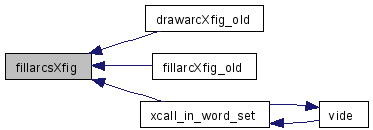
Referenced by drawarcXfig_old(), fillarcXfig_old(), and xcall_in_word_set().
Here is the caller graph for this function:
| void C2F() fillarcsXfig_old | ( | char * | str, | |
| integer * | vects, | |||
| integer * | fillvect, | |||
| integer * | n, | |||
| integer * | v5, | |||
| integer * | v6, | |||
| integer * | v7, | |||
| double * | dx1, | |||
| double * | dx2, | |||
| double * | dx3, | |||
| double * | dx4 | |||
| ) |
caution angle=degreangle*64
Definition at line 1543 of file periFig.c.
References C2F, FALSE, getpatternXfig(), L, PI0, ScilabGCXfig_is_initialized, sciprint(), setpatternXfig(), vdouble, and WriteGenericXfig().
01544 {
01545   integer cpat,verb,num;
01546   verb=0;
01547
01548   if ( ScilabGCXfig_is_initialized == FALSE ) {
01549     sciprint("xinit must be called before any action \r\n");
01550     return;
01551   }
01552
01553
01554   C2F(getpatternXfig)(&verb,&cpat,&num,vdouble);
01555   C2F(WriteGenericXfig)("drawarc",*n,(integer)6L,vects,vects,6*(*n),(integer)0L,fillvect);
01556   C2F(setpatternXfig)(&(cpat),PI0,PI0,PI0);
01557 }
Here is the call graph for this function:

| void C2F() fillarcXfig | ( | ) |
| void C2F() fillarcXfig_old | ( | char * | str, | |
| integer * | x, | |||
| integer * | y, | |||
| integer * | width, | |||
| integer * | height, | |||
| integer * | angle1, | |||
| integer * | angle2, | |||
| double * | dx1, | |||
| double * | dx2, | |||
| double * | dx3, | |||
| double * | dx4 | |||
| ) |
with current pattern
Definition at line 1684 of file periFig.c.
References C2F, FALSE, fillarcsXfig(), getpatternXfig(), i, PD0, PI0, ScilabGCXfig_is_initialized, sciprint(), and vdouble.
01685 {
01686   integer i =1;
01687   integer verb=0,cpat,num ;
01688   integer vects[6];
01689
01690   if ( ScilabGCXfig_is_initialized == FALSE ) {
01691     sciprint("xinit must be called before any action \r\n");
01692     return;
01693   }
01694
01695   vects[0]= *x;vects[1]= *y;vects[2]= *width;
01696   vects[3]= *height;vects[4]= *angle1;vects[5]= *angle2;
01697   C2F(getpatternXfig)(&verb,&cpat,&num,vdouble);
01698   C2F(fillarcsXfig)(str,vects,&cpat,&i,PI0,PI0,PI0,PD0,PD0,PD0,PD0);
01699  }
Here is the call graph for this function:

| void C2F() fillareaXfig | ( | ) |
| void C2F() fillpolylinesXfig | ( | ) |
Referenced by drawClippedPolylineXfig(), drawpolylineXfig(), fillpolylineXfig(), and xcall_in_word_set().
Here is the caller graph for this function:

| void C2F() fillpolylineXfig | ( | ) |
| void C2F() fillrectangleXfig | ( | ) |
| void C2F() get_dash_and_color_Xfig | ( | integer * | verbose, | |
| integer * | value, | |||
| integer * | narg, | |||
| double * | dummy | |||
| ) |
Definition at line 653 of file periFig.c.
References C2F, dummy, FALSE, getdashXfig(), getpatternXfig(), ScilabGCXfig_is_initialized, and sciprint().
Referenced by drawarcsXfig(), and drawpolylinesXfig().
00654 {
00655   /*may be improved replacing 6 by narg */
00656
00657   if ( ScilabGCXfig_is_initialized == FALSE ) {
00658     sciprint("xinit must be called before any action \r\n");
00659     return;
00660   }
00661
00662   C2F(getdashXfig)(verbose, value, narg,dummy);
00663   C2F(getpatternXfig)(verbose, value+6, narg,dummy);
00664   *narg = 6;
00665 }
Here is the call graph for this function:

Here is the caller graph for this function:

| void C2F() get_dash_or_color_Xfig | ( | integer * | verbose, | |
| integer * | value, | |||
| integer * | narg, | |||
| double * | dummy | |||
| ) |
to get the current dash-style
Definition at line 609 of file periFig.c.
References C2F, BCG::CurColor, BCG::CurColorStatus, dummy, FALSE, getdashXfig(), ScilabGCXfig, ScilabGCXfig_is_initialized, and sciprint().
00610 {
00611   *narg =1 ;
00612
00613   if ( ScilabGCXfig_is_initialized == FALSE ) {
00614     sciprint("xinit must be called before any action \r\n");
00615     return;
00616   }
00617
00618   if ( ScilabGCXfig.CurColorStatus ==1)
00619     {
00620       *value=ScilabGCXfig.CurColor + 1;
00621       if (*verbose == 1) sciprint("Color %d",(int)*value);
00622       return;
00623     }
00624
00625   C2F(getdashXfig)(verbose, value+1, narg,dummy);
00626   *narg=*narg+1;
00627
00628 }
Here is the call graph for this function:

Definition at line 815 of file periFig.c.
References FALSE, BCG::Numcolors, ScilabGCXfig, ScilabGCXfig_is_initialized, and sciprint().
00816 {
00817   if ( ScilabGCXfig_is_initialized == FALSE ) {
00818     sciprint("xinit must be called before any action \r\n");
00819     *v3 = 1;
00820     return;
00821   }
00822
00823   *v2 = ScilabGCXfig.Numcolors;
00824 }
Here is the call graph for this function:

Definition at line 828 of file periFig.c.
References BCG::Blue, FALSE, BCG::Green, i, BCG::Numcolors, BCG::Red, ScilabGCXfig, ScilabGCXfig_is_initialized, sciprint(), and val.
00829 {
00830   int m;
00831   int i;
00832   *v3 = 0;
00833
00834   if ( ScilabGCXfig_is_initialized == FALSE ) {
00835     sciprint("xinit must be called before any action \r\n");
00836     *v3 = 1;
00837     return;
00838   }
00839
00840
00841   m = ScilabGCXfig.Numcolors;
00842
00843   for (i = 0; i < m; i++) {
00844     val[i] = (double)ScilabGCXfig.Red[i];
00845     val[i+m] = (double)ScilabGCXfig.Green[i];
00846     val[i+2*m] = (double)ScilabGCXfig.Blue[i];
00847   }
00848 }
Here is the call graph for this function:

| void C2F() getFontMaxSizeXfig | ( | char * | str, | |
| integer * | sizeMin, | |||
| integer * | sizeMax, | |||
| integer * | v1, | |||
| integer * | v2, | |||
| integer * | v3, | |||
| integer * | v4, | |||
| double * | dx1, | |||
| double * | dx2, | |||
| double * | dx3, | |||
| double * | dx4 | |||
| ) |
get the minimal and maximal font size
Definition at line 2311 of file periFig.c.
References FONTMAXSIZE.
02312 {
02313   *sizeMin = 0 ;
02314   *sizeMax = FONTMAXSIZE ;
02315 }
| void C2F() getFontMaxSizeXfig | ( | ) |
Definition at line 185 of file periFig.c.
References prec_fact, sciprint(), and x.
Referenced by clearwindowXfig(), FileInitFromScreenXfig(), and FileInitXfig().
00186 {
00187   *narg = 2;
00188   x[0]= 600*prec_fact;
00189   x[1]= 424*prec_fact;
00190   if (*verbose == 1)
00191     sciprint("\n CWindow dim :%d,%d\r\n",(int)x[0],(int)x[1]);
00192 }
Here is the call graph for this function:

Here is the caller graph for this function:

| void C2F() initgraphicfromscreenXfig | ( | char * | string, | |
| integer * | v2, | |||
| integer * | v3, | |||
| integer * | v4, | |||
| integer * | v5, | |||
| integer * | v6, | |||
| integer * | v7, | |||
| double * | dx1, | |||
| double * | dx2, | |||
| double * | dx3, | |||
| double * | dx4 | |||
| ) |
Definition at line 2777 of file periFig.c.
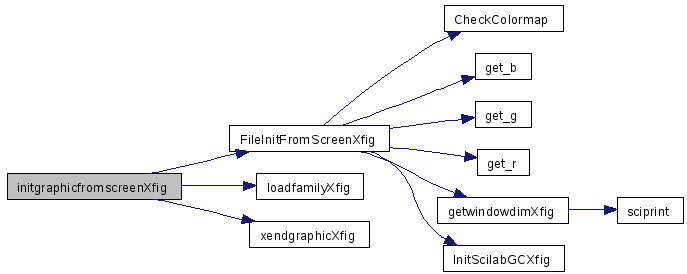
References C2F, BCG::CurWindow, FileInitFromScreenXfig(), loadfamilyXfig(), ScilabGCXfig, and xendgraphicXfig().
02778 {
02779   static integer EntryCounter = 0;
02780   integer fnum;
02781   *v3 = 0;
02782   if (EntryCounter >= 1) C2F(xendgraphicXfig)();
02783   file=fopen(string,"w");
02784   if (file == 0)
02785     {
02786       /*sciprint("Can't open file %s, I'll use stdout\r\n",string1);*/
02787       file = stdout;
02788       *v3 = 1;
02789       return;
02790     }
02791   if (EntryCounter == 0)
02792     {
02793       fnum=0;      C2F(loadfamilyXfig)("Courier",&fnum,PI0,PI0,PI0,PI0,PI0,PD0,PD0,PD0,PD0);
02794       fnum=1;      C2F(loadfamilyXfig)("Symbol",&fnum,PI0,PI0,PI0,PI0,PI0,PD0,PD0,PD0,PD0);
02795       fnum=2;      C2F(loadfamilyXfig)("Times-Roman",&fnum,PI0,PI0,PI0,PI0,PI0,PD0,PD0,PD0,PD0);
02796       fnum=3;      C2F(loadfamilyXfig)("Times-Italic",&fnum,PI0,PI0,PI0,PI0,PI0,PD0,PD0,PD0,PD0);
02797       fnum=4;      C2F(loadfamilyXfig)("Times-Bold",&fnum,PI0,PI0,PI0,PI0,PI0,PD0,PD0,PD0,PD0);
02798       fnum=5;      C2F(loadfamilyXfig)("Times-BoldItalic",&fnum,PI0,PI0,PI0,PI0,PI0,PD0,PD0,PD0,PD0);
02799       fnum=6;      C2F(loadfamilyXfig)("Helvetica",&fnum,PI0,PI0,PI0,PI0,PI0,PD0,PD0,PD0,PD0);
02800       fnum=7;      C2F(loadfamilyXfig)("Helvetica-Oblique",&fnum,PI0,PI0,PI0,PI0,PI0,PD0,PD0,PD0,PD0);
02801       fnum=8;      C2F(loadfamilyXfig)("Helvetica-Bold",&fnum,PI0,PI0,PI0,PI0,PI0,PD0,PD0,PD0,PD0);
02802       fnum=9;      C2F(loadfamilyXfig)("Helvetica-BoldOblique",&fnum,PI0,PI0,PI0,PI0,PI0,PD0,PD0,PD0,PD0);
02803     }
02804   C2F(FileInitFromScreenXfig)();
02805   ScilabGCXfig.CurWindow =EntryCounter;
02806   EntryCounter =EntryCounter +1;
02807 }
Here is the call graph for this function:
| void C2F() initgraphicfromscreenXfig | ( | ) |
| void C2F() initgraphicXfig | ( | ) |
| void C2F() loadfamilyXfig | ( | ) |
Referenced by initgraphicfromscreenXfig(), initgraphicXfig(), and xcall_in_word_set().
Here is the caller graph for this function:

| void C2F() queryfamilyXfig | ( | char * | name, | |
| integer * | j, | |||
| integer * | v3, | |||
| integer * | v4, | |||
| integer * | v5, | |||
| integer * | v6, | |||
| integer * | v7, | |||
| double * | dv1, | |||
| double * | dv2, | |||
| double * | dv3, | |||
| double * | dv4 | |||
| ) |
Definition at line 2206 of file periFig.c.
References fname, FontInfoTabXfig_, and FONTNUMBER.
02207 {
02208   integer i ;
02209   name[0]='\0';
02210   for (i=0;i<FONTNUMBER;i++) {
02211     strcat(name,FontInfoTabXfig_[i].fname);
02212     v3[i]=strlen(FontInfoTabXfig_[i].fname);
02213   }
02214   *j=FONTNUMBER;
02215 }
| void C2F() queryfamilyXfig | ( | ) |
| void C2F() scilabgcgetXfig | ( | ) |
| void C2F() scilabgcsetXfig | ( | ) |
Definition at line 573 of file periFig.c.
References C2F, FALSE, ScilabGCXfig_is_initialized, sciprint(), setdashXfig(), and setpatternXfig().
Referenced by drawarcsXfig(), and drawpolylinesXfig().
00574 {
00575   if ( ScilabGCXfig_is_initialized == FALSE ) {
00576     sciprint("xinit must be called before any action \r\n");
00577     return;
00578   }
00579
00580   C2F(setdashXfig)(value, v2, v3, v4);
00581   C2F(setpatternXfig)(value+6, v2, v3, v4);
00582 }
Here is the call graph for this function:

Here is the caller graph for this function:

Definition at line 535 of file periFig.c.
References C2F, BCG::CurColor, BCG::CurColorStatus, BCG::CurDashStyle, FALSE, i, Max, MAXDASH, Min, BCG::Numcolors, ScilabGCXfig, ScilabGCXfig_is_initialized, sciprint(), and set_cXfig().
00536 {
00537   integer maxdash = MAXDASH ;
00538   integer l3 ;
00539
00540   if ( ScilabGCXfig_is_initialized == FALSE ) {
00541     sciprint("xinit must be called before any action \r\n");
00542     return;
00543   }
00544
00545   if ( ScilabGCXfig.CurColorStatus ==1)
00546     {
00547       int i;
00548       i= Max(0,Min(*value-1,ScilabGCXfig.Numcolors+1));
00549       ScilabGCXfig.CurColor =i;
00550       C2F(set_cXfig)(i);
00551     }
00552   else
00553     {
00554       l3 = Max(0,Min(maxdash-1,(*value)-1));
00555       ScilabGCXfig.CurDashStyle = l3;
00556     }
00557 }
Here is the call graph for this function:

Definition at line 585 of file periFig.c.
References C2F, BCG::CurColorStatus, BCG::CurDashStyle, FALSE, j, PI0, ScilabGCXfig, ScilabGCXfig_is_initialized, sciprint(), setdashXfig(), and setpatternXfig().
Referenced by drawarcsXfig(), and drawpolylinesXfig().
00586 {
00587   integer j;
00588
00589   if ( ScilabGCXfig_is_initialized == FALSE ) {
00590     sciprint("xinit must be called before any action \r\n");
00591     return;
00592   }
00593
00594   if (ScilabGCXfig.CurColorStatus == 0) {
00595     C2F(setdashXfig)(value,PI0,PI0,PI0);
00596     C2F(setpatternXfig)((j=1,&j),PI0,PI0,PI0);
00597   }
00598   else {
00599     j= ScilabGCXfig.CurDashStyle + 1;
00600     C2F(setdashXfig)(&j,PI0,PI0,PI0);
00601     C2F(setpatternXfig)(value,PI0,PI0,PI0);
00602   }
00603 }
Here is the call graph for this function:

Here is the caller graph for this function:

| void C2F() SetDriverXfig | ( | ) |
Definition at line 739 of file periFig.c.
References BCG::Blue, C2F, FALSE, file, FPRINTF, FREE, BCG::Green, i, BCG::IDLastPattern, MALLOC, BCG::NumBackground, BCG::Numcolors, BCG::NumForeground, PI0, BCG::Red, ScilabGCXfig_is_initialized, sciprint(), setalufunction1Xfig(), setbackgroundXfig(), setforegroundXfig(), setpatternXfig(), and usecolorXfig().
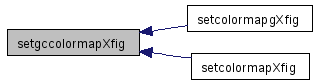
Referenced by setcolormapgXfig(), and setcolormapXfig().
00740 {
00741   int i,mm;
00742
00743   if ( ScilabGCXfig_is_initialized == FALSE ) {
00744     sciprint("xinit must be called before any action \r\n");
00745     return;
00746   }
00747
00748   sciprint("Warning : you will have to move the colors definition\n");
00749   sciprint(" at the top of the xfig file \n");
00750
00751   /* Checking RGB values */
00752   for (i = 0; i < m; i++) {
00753     if (a[i] < 0 || a[i] > 1 || a[i+m] < 0 || a[i+m] > 1 ||
00754         a[i+2*m] < 0 || a[i+2*m]> 1) {
00755       sciprint("RGB values must be between 0 and 1\n");
00756       *v3 = 1;
00757       return;
00758     }
00759   }
00760   Xgc->Numcolors = m;
00761   Xgc->IDLastPattern = m - 1;
00762   Xgc->NumForeground = m;
00763   Xgc->NumBackground = m + 1;
00764   for ( i=0; i < m ; i++)
00765     {
00766       unsigned short ur,ug,ub;
00767       ur = (unsigned short) (255.0*a[i]);
00768       ug = (unsigned short) (255.0*a[i+m]);
00769       ub = (unsigned short) (255.0*a[i+2*m]);
00770       FPRINTF((file,"0 %d #%02x%02x%02x \n",32+i,ur,ug,ub));
00771     }
00772   FPRINTF((file,"0 %d #%02x%02x%02x \n",32+m,0,0,0));
00773   FPRINTF((file,"0 %d #%02x%02x%02x \n",32+m+1,255,255,255));
00774   C2F(usecolorXfig)((i=1,&i) ,PI0,PI0,PI0);
00775   C2F(setalufunction1Xfig)((i=3,&i),PI0,PI0,PI0);
00776   C2F(setpatternXfig)((i=Xgc->NumForeground+1,&i),PI0,PI0,PI0);
00777   C2F(setforegroundXfig)((i=Xgc->NumForeground+1,&i),PI0,PI0,PI0);
00778   C2F(setbackgroundXfig)((i=Xgc->NumForeground+2,&i),PI0,PI0,PI0);
00779
00780
00781   /* -------------------------------------------------------- */
00782   /* store the colormap for the get command too */
00783   /* F.Leray 04.10.05 */
00784   FREE(Xgc->Red);
00785   FREE(Xgc->Green);
00786   FREE(Xgc->Blue);
00787
00788   /* don't forget black and white */
00789   mm = m;
00790   if (!(Xgc->Red = (float *) MALLOC(mm*sizeof(float)))) {
00791     sciprint("XgcAllocColors: unable to alloc\n");
00792     return;
00793   }
00794   if (!(Xgc->Green = (float *) MALLOC(mm*sizeof(float)))) {
00795     sciprint("XgcAllocColors: unable to alloc\n");
00796     FREE(Xgc->Red);
00797     return;
00798   }
00799   if (!(Xgc->Blue = (float *) MALLOC(mm*sizeof(float)))) {
00800     sciprint("XgcAllocColors: unable to alloc\n");
00801     FREE(Xgc->Red);
00802     FREE(Xgc->Green);
00803     return;
00804   }
00805
00806   for(i=0;i<m;i++){
00807     Xgc->Red[i] = (float)a[i];
00808     Xgc->Green[i] = (float)a[i+m];
00809     Xgc->Blue[i] = (float)a[i+2*m];
00810   }
00811   /* -------------------------------------------------------- */
00812
00813 }
Here is the call graph for this function:

Here is the caller graph for this function:
| void C2F() viderbuffXfig | ( | void | ) |
| void C2F() xclick_anyXfig | ( | ) |
| void C2F() xclickXfig | ( | ) |
| void C2F() xendXfig | ( | ) |
| void C2F() xgetmouseXfig | ( | ) |
| void C2F() xselgraphicXfig | ( | ) |
 1.5.1
1.5.1












