
#include "f2c.h"#include "fio.h"#include "fmt.h"Include dependency graph for fmt.c:
Go to the source code of this file.
Defines | |
| #define | skip(s) while(*s==' ') s++ |
| #define | SYLMX 300 |
| #define | GLITCH '\2' |
| #define | STKSZ 10 |
Functions | |
| static char * | ap_end (char *s) |
| static int | op_gen (int a, int b, int c, int d) |
| static char * | f_list (char *) |
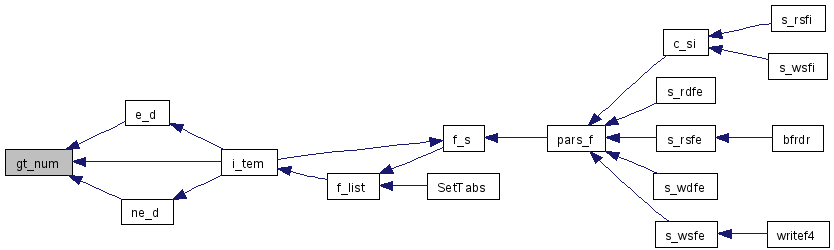
| static char * | gt_num (char *s, int *n, int n1) |
| static char * | f_s (char *s, int curloc) |
| static int | ne_d (char *s, char **p) |
| static int | e_d (char *s, char **p) |
| static char * | i_tem (char *s) |
| int | pars_f (char *s) |
| static int | type_f (int n) |
| integer | do_fio (ftnint *number, char *ptr, ftnlen len) |
| int | en_fio (Void) |
| VOID | fmt_bg (Void) |
Variables | |
| flag | f__cblank |
| flag | f__cplus |
| static struct syl | f__syl [SYLMX] |
| int | f__parenlvl |
| int | f__pc |
| int | f__revloc |
| int | f__cnt [STKSZ] |
| int | f__ret [STKSZ] |
| int | f__cp |
| int | f__rp |
| flag | f__workdone |
| flag | f__nonl |
Definition at line 7 of file fmt.c.
Referenced by __PARAMS(), e_d(), f_list(), f_s(), nextdata(), sciblk2(), and sciblk2i().
| static char* ap_end | ( | char * | s | ) | [static] |
Definition at line 30 of file fmt.c.
References cilist::cierr, errno, f__elist, NULL, and quote.
Referenced by ne_d().
00032 {       char quote;
00033         quote= *s++;
00034         for(;*s;s++)
00035         {       if(*s!=quote) continue;
00036                 if(*++s!=quote) return(s);
00037         }
00038         if(f__elist->cierr) {
00039                 errno = 100;
00040                 return(NULL);
00041         }
00042         f__fatal(100, "bad string");
00043         /*NOTREACHED*/ return 0;
00044 }
Here is the caller graph for this function:

Definition at line 418 of file fmt.c.
References BN, BZ, cilist::ciend, cilist::cierr, COLON, ED, err, errfl, errno, f__doed, f__doend, f__doned, f__dorevert, f__elist, f__fmtbuf, f__scale, f__syl, GOTO, i, NED, NONL, NULL, op, P, p, RET1, REVERT, S, SP, SS, STACK, and type_f().
Referenced by bfrdr(), en_fio(), and writef4().
00420 {       struct syl *p;
00421         int n,i;
00422         for(i=0;i<*number;i++,ptr+=len)
00423         {
00424 loop:   switch(type_f((p= &f__syl[f__pc])->op))
00425         {
00426         default:
00427                 fprintf(stderr,"unknown code in do_fio: %d\n%s\n",
00428                         p->op,f__fmtbuf);
00429                 err(f__elist->cierr,100,"do_fio");
00430         case NED:
00431                 if((*f__doned)(p))
00432                 {       f__pc++;
00433                         goto loop;
00434                 }
00435                 f__pc++;
00436                 continue;
00437         case ED:
00438                 if(f__cnt[f__cp]<=0)
00439                 {       f__cp--;
00440                         f__pc++;
00441                         goto loop;
00442                 }
00443                 if(ptr==NULL)
00444                         return((*f__doend)());
00445                 f__cnt[f__cp]--;
00446                 f__workdone=1;
00447                 if((n=(*f__doed)(p,ptr,len))>0)
00448                         errfl(f__elist->cierr,errno,"fmt");
00449                 if(n<0)
00450                         err(f__elist->ciend,(EOF),"fmt");
00451                 continue;
00452         case STACK:
00453                 f__cnt[++f__cp]=p->p1;
00454                 f__pc++;
00455                 goto loop;
00456         case RET1:
00457                 f__ret[++f__rp]=p->p1;
00458                 f__pc++;
00459                 goto loop;
00460         case GOTO:
00461                 if(--f__cnt[f__cp]<=0)
00462                 {       f__cp--;
00463                         f__rp--;
00464                         f__pc++;
00465                         goto loop;
00466                 }
00467                 f__pc=1+f__ret[f__rp--];
00468                 goto loop;
00469         case REVERT:
00470                 f__rp=f__cp=0;
00471                 f__pc = p->p1;
00472                 if(ptr==NULL)
00473                         return((*f__doend)());
00474                 if(!f__workdone) return(0);
00475                 if((n=(*f__dorevert)()) != 0) return(n);
00476                 goto loop;
00477         case COLON:
00478                 if(ptr==NULL)
00479                         return((*f__doend)());
00480                 f__pc++;
00481                 goto loop;
00482         case NONL:
00483                 f__nonl = 1;
00484                 f__pc++;
00485                 goto loop;
00486         case S:
00487         case SS:
00488                 f__cplus=0;
00489                 f__pc++;
00490                 goto loop;
00491         case SP:
00492                 f__cplus = 1;
00493                 f__pc++;
00494                 goto loop;
00495         case P: f__scale=p->p1;
00496                 f__pc++;
00497                 goto loop;
00498         case BN:
00499                 f__cblank=0;
00500                 f__pc++;
00501                 goto loop;
00502         case BZ:
00503                 f__cblank=1;
00504                 f__pc++;
00505                 goto loop;
00506         }
00507         }
00508         return(0);
00509 }
Here is the call graph for this function:

Here is the caller graph for this function:

| static int e_d | ( | char * | s, | |
| char ** | p | |||
| ) | [static] |
Definition at line 208 of file fmt.c.
References A, AW, D, E, EE, F, G, GE, gt_num(), I, i, IM, L, O, OM, op_gen(), skip, STACK, void(), w, x, Z, and ZM.
Referenced by i_tem().
00210 {       int i,im,n,w,d,e,found=0,x=0;
00211         char *sv=s;
00212         s=gt_num(s,&n,1);
00213         (void) op_gen(STACK,n,0,0);
00214         switch(*s++)
00215         {
00216         default: break;
00217         case 'E':
00218         case 'e':       x=1;
00219         case 'G':
00220         case 'g':
00221                 found=1;
00222                 if (!(s=gt_num(s,&w,0))) {
00223  bad:
00224                         *p = 0;
00225                         return 1;
00226                         }
00227                 if(w==0) break;
00228                 if(*s=='.') {
00229                         if (!(s=gt_num(s+1,&d,0)))
00230                                 goto bad;
00231                         }
00232                 else d=0;
00233                 if(*s!='E' && *s != 'e')
00234                         (void) op_gen(x==1?E:G,w,d,0);  /* default is Ew.dE2 */
00235                 else {
00236                         if (!(s=gt_num(s+1,&e,0)))
00237                                 goto bad;
00238                         (void) op_gen(x==1?EE:GE,w,d,e);
00239                         }
00240                 break;
00241         case 'O':
00242         case 'o':
00243                 i = O;
00244                 im = OM;
00245                 goto finish_I;
00246         case 'Z':
00247         case 'z':
00248                 i = Z;
00249                 im = ZM;
00250                 goto finish_I;
00251         case 'L':
00252         case 'l':
00253                 found=1;
00254                 if (!(s=gt_num(s,&w,0)))
00255                         goto bad;
00256                 if(w==0) break;
00257                 (void) op_gen(L,w,0,0);
00258                 break;
00259         case 'A':
00260         case 'a':
00261                 found=1;
00262                 skip(s);
00263                 if(*s>='0' && *s<='9')
00264                 {       s=gt_num(s,&w,1);
00265                         if(w==0) break;
00266                         (void) op_gen(AW,w,0,0);
00267                         break;
00268                 }
00269                 (void) op_gen(A,0,0,0);
00270                 break;
00271         case 'F':
00272         case 'f':
00273                 if (!(s=gt_num(s,&w,0)))
00274                         goto bad;
00275                 found=1;
00276                 if(w==0) break;
00277                 if(*s=='.') {
00278                         if (!(s=gt_num(s+1,&d,0)))
00279                                 goto bad;
00280                         }
00281                 else d=0;
00282                 (void) op_gen(F,w,d,0);
00283                 break;
00284         case 'D':
00285         case 'd':
00286                 found=1;
00287                 if (!(s=gt_num(s,&w,0)))
00288                         goto bad;
00289                 if(w==0) break;
00290                 if(*s=='.') {
00291                         if (!(s=gt_num(s+1,&d,0)))
00292                                 goto bad;
00293                         }
00294                 else d=0;
00295                 (void) op_gen(D,w,d,0);
00296                 break;
00297         case 'I':
00298         case 'i':
00299                 i = I;
00300                 im = IM;
00301  finish_I:
00302                 if (!(s=gt_num(s,&w,0)))
00303                         goto bad;
00304                 found=1;
00305                 if(w==0) break;
00306                 if(*s!='.')
00307                 {       (void) op_gen(i,w,0,0);
00308                         break;
00309                 }
00310                 if (!(s=gt_num(s+1,&d,0)))
00311                         goto bad;
00312                 (void) op_gen(im,w,d,0);
00313                 break;
00314         }
00315         if(found==0)
00316         {       f__pc--; /*unSTACK*/
00317                 *p=sv;
00318                 return(0);
00319         }
00320         *p=s;
00321         return(1);
00322 }
Here is the call graph for this function:

Here is the caller graph for this function:

| int en_fio | ( | Void | ) |
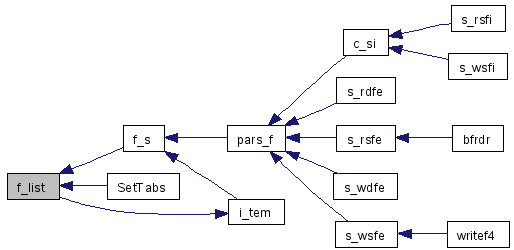
| static char * f_list | ( | char * | ) | [static] |
Definition at line 343 of file fmt.c.
References GOTO, i_tem(), NULL, op_gen(), REVERT, skip, and void().
Referenced by f_s(), and SetTabs().
00345 {
00346         for(;*s!=0;)
00347         {       skip(s);
00348                 if((s=i_tem(s))==NULL) return(NULL);
00349                 skip(s);
00350                 if(*s==',') s++;
00351                 else if(*s==')')
00352                 {       if(--f__parenlvl==0)
00353                         {
00354                                 (void) op_gen(REVERT,f__revloc,0,0);
00355                                 return(++s);
00356                         }
00357                         (void) op_gen(GOTO,0,0,0);
00358                         return(++s);
00359                 }
00360         }
00361         return(NULL);
00362 }
Here is the call graph for this function:

Here is the caller graph for this function:
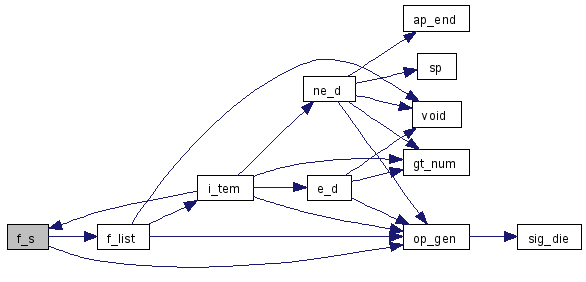
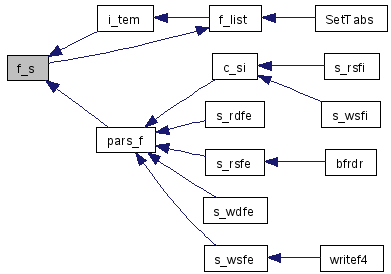
| static char* f_s | ( | char * | s, | |
| int | curloc | |||
| ) | [static] |
Definition at line 94 of file fmt.c.
References f_list(), NULL, op_gen(), RET1, and skip.
Referenced by i_tem(), and pars_f().
00096 {
00097         skip(s);
00098         if(*s++!='(')
00099         {
00100                 return(NULL);
00101         }
00102         if(f__parenlvl++ ==1) f__revloc=curloc;
00103         if(op_gen(RET1,curloc,0,0)<0 ||
00104                 (s=f_list(s))==NULL)
00105         {
00106                 return(NULL);
00107         }
00108         skip(s);
00109         return(s);
00110 }
Here is the call graph for this function:
Here is the caller graph for this function:
| VOID fmt_bg | ( | Void | ) |
Definition at line 67 of file fmt.c.
Referenced by e_d(), i_tem(), and ne_d().
00069 {       int m=0,f__cnt=0;
00070         char c;
00071         for(c= *s;;c = *s)
00072         {       if(c==' ')
00073                 {       s++;
00074                         continue;
00075                 }
00076                 if(c>'9' || c<'0') break;
00077                 m=10*m+c-'0';
00078                 f__cnt++;
00079                 s++;
00080         }
00081         if(f__cnt==0) {
00082                 if (!n1)
00083                         s = 0;
00084                 *n=n1;
00085                 }
00086         else *n=m;
00087         return(s);
00088 }
Here is the caller graph for this function:
| static char* i_tem | ( | char * | s | ) | [static] |
Definition at line 327 of file fmt.c.
References e_d(), f_s(), gt_num(), ne_d(), NULL, op_gen(), STACK, and t.
Referenced by f_list().
00329 {       char *t;
00330         int n,curloc;
00331         if(*s==')') return(s);
00332         if(ne_d(s,&t)) return(t);
00333         if(e_d(s,&t)) return(t);
00334         s=gt_num(s,&n,1);
00335         if((curloc=op_gen(STACK,n,0,0))<0) return(NULL);
00336         return(f_s(s,curloc));
00337 }
Here is the call graph for this function:

Here is the caller graph for this function:

| static int ne_d | ( | char * | s, | |
| char ** | p | |||
| ) | [static] |
Definition at line 116 of file fmt.c.
References ap_end(), APOS, BN, BZ, COLON, f__syl, GLITCH, gt_num(), H, NONL, NULL, op_gen(), P, S, sign, SLASH, SP, sp(), SS, T, TL, TR, void(), X, and x.
Referenced by i_tem().
00118 {       int n,x,sign=0;
00119         struct syl *sp;
00120         switch(*s)
00121         {
00122         default:
00123                 return(0);
00124         case ':': (void) op_gen(COLON,0,0,0); break;
00125         case '$':
00126                 (void) op_gen(NONL, 0, 0, 0); break;
00127         case 'B':
00128         case 'b':
00129                 if(*++s=='z' || *s == 'Z') (void) op_gen(BZ,0,0,0);
00130                 else (void) op_gen(BN,0,0,0);
00131                 break;
00132         case 'S':
00133         case 's':
00134                 if(*(s+1)=='s' || *(s+1) == 'S')
00135                 {       x=SS;
00136                         s++;
00137                 }
00138                 else if(*(s+1)=='p' || *(s+1) == 'P')
00139                 {       x=SP;
00140                         s++;
00141                 }
00142                 else x=S;
00143                 (void) op_gen(x,0,0,0);
00144                 break;
00145         case '/': (void) op_gen(SLASH,0,0,0); break;
00146         case '-': sign=1;
00147         case '+':       s++;    /*OUTRAGEOUS CODING TRICK*/
00148         case '0': case '1': case '2': case '3': case '4':
00149         case '5': case '6': case '7': case '8': case '9':
00150                 if (!(s=gt_num(s,&n,0))) {
00151  bad:                   *p = 0;
00152                         return 1;
00153                         }
00154                 switch(*s)
00155                 {
00156                 default:
00157                         return(0);
00158                 case 'P':
00159                 case 'p': if(sign) n= -n; (void) op_gen(P,n,0,0); break;
00160                 case 'X':
00161                 case 'x': (void) op_gen(X,n,0,0); break;
00162                 case 'H':
00163                 case 'h':
00164                         sp = &f__syl[op_gen(H,n,0,0)];
00165                         sp->p2.s = s + 1;
00166                         s+=n;
00167                         break;
00168                 }
00169                 break;
00170         case GLITCH:
00171         case '"':
00172         case '\'':
00173                 sp = &f__syl[op_gen(APOS,0,0,0)];
00174                 sp->p2.s = s;
00175                 if((*p = ap_end(s)) == NULL)
00176                         return(0);
00177                 return(1);
00178         case 'T':
00179         case 't':
00180                 if(*(s+1)=='l' || *(s+1) == 'L')
00181                 {       x=TL;
00182                         s++;
00183                 }
00184                 else if(*(s+1)=='r'|| *(s+1) == 'R')
00185                 {       x=TR;
00186                         s++;
00187                 }
00188                 else x=T;
00189                 if (!(s=gt_num(s+1,&n,0)))
00190                         goto bad;
00191                 s--;
00192                 (void) op_gen(x,n,0,0);
00193                 break;
00194         case 'X':
00195         case 'x': (void) op_gen(X,1,0,0); break;
00196         case 'P':
00197         case 'p': (void) op_gen(P,1,0,0); break;
00198         }
00199         s++;
00200         *p=s;
00201         return(1);
00202 }
Here is the call graph for this function:

Here is the caller graph for this function:

Definition at line 49 of file fmt.c.
References f__fmtbuf, f__syl, p, sig_die(), and SYLMX.
Referenced by e_d(), f_list(), f_s(), i_tem(), and ne_d().
00051 {       struct syl *p= &f__syl[f__pc];
00052         if(f__pc>=SYLMX)
00053         {       fprintf(stderr,"format too complicated:\n");
00054                 sig_die(f__fmtbuf, 1);
00055         }
00056         p->op=a;
00057         p->p1=b;
00058         p->p2.i[0]=c;
00059         p->p2.i[1]=d;
00060         return(f__pc++);
00061 }
Here is the call graph for this function:

Here is the caller graph for this function:

| int pars_f | ( | char * | s | ) |
Definition at line 368 of file fmt.c.
Referenced by c_si(), s_rdfe(), s_rsfe(), s_wdfe(), and s_wsfe().
00370 {
00371         f__parenlvl=f__revloc=f__pc=0;
00372         if(f_s(s,0) == NULL)
00373         {
00374                 return(-1);
00375         }
00376         return(0);
00377 }
Here is the call graph for this function:

Here is the caller graph for this function:

Definition at line 386 of file fmt.c.
References A, APOS, AW, D, E, ED, EE, F, G, GE, GOTO, H, I, IM, L, NED, O, OM, RET1, REVERT, SLASH, STACK, T, TL, TR, X, Z, and ZM.
Referenced by do_fio().
00388 {
00389         switch(n)
00390         {
00391         default:
00392                 return(n);
00393         case RET1:
00394                 return(RET1);
00395         case REVERT: return(REVERT);
00396         case GOTO: return(GOTO);
00397         case STACK: return(STACK);
00398         case X:
00399         case SLASH:
00400         case APOS: case H:
00401         case T: case TL: case TR:
00402                 return(NED);
00403         case F:
00404         case I:
00405         case IM:
00406         case A: case AW:
00407         case O: case OM:
00408         case L:
00409         case E: case EE: case D:
00410         case G: case GE:
00411         case Z: case ZM:
00412                 return(ED);
00413         }
00414 }
Here is the caller graph for this function:

 1.5.1
1.5.1

