
#include <stdio.h>#include <setjmp.h>#include <signal.h>#include <string.h>#include <stdlib.h>#include <conio.h>#include "wresource.h"#include "wcommon.h"#include "stack-c.h"#include "Os_specific.h"#include "Messages.h"#include "Warnings.h"#include "Errors.h"Include dependency graph for wtloop.c:
Go to the source code of this file.
Functions | |
| int C2F() | sciquit (void) |
| static void | interrupt_setup () |
| void | realmain (int nowin, int no_startup_flag, char *initial_script, int initial_script_type, int memory) |
| void | SignalCtrC (void) |
| void | inter (int an_int) |
| void | sci_windows_main (int nowin, int *nos, char *path, int pathtype, int *lpath, int memory) |
| void | sci_clear_and_exit (int n) |
| void | sci_usr1_signal (int n) |
| void | sci_sig_tstp (int n) |
Variables | |
| jmp_buf | env |
| void inter | ( | int | an_int | ) |
Definition at line 74 of file wtloop.c.
References env, sciprint(), TRUE, and void().
Referenced by interrupt_setup(), paksazi(), and test_interupt().
00075 {
00076   (void) signal (SIGINT, inter);
00077   (void) signal (SIGFPE, SIG_DFL);      /* turn off FPE trapping */
00078   (void) fflush (stdout);
00079   sciprint ("\n");
00080   longjmp (env, TRUE);          /* return to prompt  */
00081 }
Here is the call graph for this function:

Here is the caller graph for this function:

| static void interrupt_setup | ( | ) | [static] |
| void realmain | ( | int | nowin, | |
| int | no_startup_flag, | |||
| char * | initial_script, | |||
| int | initial_script_type, | |||
| int | memory | |||
| ) |
Definition at line 39 of file realmain.c.
References C2F, create_argv(), ExceptionMessage(), FREE, get_sci_data_strings(), ierr, inisci(), InitXsession(), IsNoInteractiveWindow(), main_sci(), MALLOC, NULL, PATH_MAX, sci_clear_and_exit(), sci_exit(), sci_usr1_signal(), sciquit(), scirun(), Set_no_startup_flag(), settmpdir(), SetXsciOn(), SIGHUP, and SIGQUIT.
00040 {
00041   static int ini=-1;
00042   int ierr=0;
00043   char *startup=(char*)MALLOC(sizeof(char)*PATH_MAX+1);
00044           //[256];
00045
00046   Set_no_startup_flag(no_startup_flag_l);
00047
00048   /* create temp directory */
00049   C2F(settmpdir)();
00050   /* signals */
00051   #ifdef ENABLESIG
00052   signal(SIGINT,sci_clear_and_exit);
00053   #ifdef SIGBUS
00054   signal(SIGBUS,sci_clear_and_exit);
00055   #endif
00056   signal(SIGSEGV,sci_clear_and_exit);
00057   #if SIGQUIT
00058   signal(SIGQUIT,sci_clear_and_exit);
00059   #endif
00060   #ifdef SIGHUP
00061   signal(SIGHUP,sci_clear_and_exit);
00062   #endif
00063   #ifdef SIGUSR1
00064   signal(SIGUSR1,sci_usr1_signal);
00065   #endif
00066
00067   #ifdef _MSC_VER
00068   signal(SIGILL,sci_clear_and_exit);
00069   signal(SIGFPE,sci_clear_and_exit);
00070   signal(SIGTERM,sci_clear_and_exit);
00071   signal(SIGBREAK,sci_clear_and_exit);
00072   signal(SIGABRT,sci_clear_and_exit);
00073   #endif
00074   #endif
00075
00076   /*  prepare startup script  */
00077
00078   if ( no_startup_flag_l == 0)
00079   {
00080         /* execute a startup */
00081     if ( initial_script != NULL ) switch ( initial_script_type )
00082         {
00083                 case 0 :
00084                         sprintf(startup,"%s;exec('%s',-1)",get_sci_data_strings(1),initial_script);
00085                 break;
00086                 case 1 :
00087                         sprintf(startup,"%s;%s;",get_sci_data_strings(1),initial_script);
00088                 break;
00089         }
00090     else sprintf(startup,"%s;",get_sci_data_strings(1));
00091   }
00092   else
00093   {
00094         /* No startup but maybe an initial script  */
00095     if ( initial_script != NULL ) switch ( initial_script_type )
00096         {
00097             case 0 :
00098               sprintf(startup,"exec('%s',-1)",initial_script); break;
00099             case 1 :
00100               sprintf(startup,"%s;",initial_script);   break;
00101         }
00102     else sprintf(startup," ");
00103   }
00104
00105   #ifndef _MSC_VER
00106   if ( nowin == 0 )
00107     {
00108       int argc=0;
00109       char **argv=NULL;
00110
00111       argv = create_argv(&argc);
00112
00113       /* we are in window mode */
00114       SetXsciOn();
00115       main_sci(argc,argv,startup,strlen(startup),memory);
00116     }
00117   else
00118     {
00119         if (! IsNoInteractiveWindow() )
00120         {
00121                 InitXsession();
00122         }
00123       /* initialize scilab interp  */
00124       C2F(inisci)(&ini, &memory, &ierr);
00125       if (ierr > 0) sci_exit(1) ;
00126       /* execute the initial script and enter scilab */
00127       C2F(scirun)(startup,strlen(startup));
00128     }
00129   #else
00130         /* initialize scilab interp  */
00131         C2F(inisci)(&ini, &memory, &ierr);
00132         if (ierr > 0) sci_exit(1) ;
00133
00134         /* execute the initial script and enter scilab */
00135         #ifndef _DEBUG
00136         _try
00137         {
00138                 C2F(scirun)(startup,strlen(startup));
00139         }
00140         _except (EXCEPTION_EXECUTE_HANDLER)
00141         {
00142                 Rerun:
00143                 {
00144                         ExceptionMessage(GetExceptionCode(),NULL);
00145                 }
00146                 _try
00147                 {
00148                         C2F(scirun)("",strlen(""));
00149                 }
00150                 _except (EXCEPTION_EXECUTE_HANDLER)
00151                 {
00152                         goto Rerun;
00153                 }
00154
00155         }
00156         #else
00157                 C2F(scirun)(startup,strlen(startup));
00158         #endif
00159   #endif
00160   FREE(startup);
00161   /* cleaning */
00162   C2F(sciquit)();
00163 }
Here is the call graph for this function:

| void sci_clear_and_exit | ( | int | n | ) |
Definition at line 108 of file wtloop.c.
References C2F, Message(), MSG_ERROR20, MSG_ERROR59, MSG_ERROR60, MSG_ERROR61, MSG_ERROR62, MSG_ERROR63, MSG_ERROR64, MSG_ERROR65, MSG_ERROR66, NULL, and sciquit().
00109 {
00110 #ifdef _DEBUG
00111   char Message[256];
00112   switch (n)
00113   {
00114           case SIGINT:
00115                   wsprintf(Message,MSG_ERROR59);
00116                   break;
00117           case SIGILL:
00118                   wsprintf(Message,MSG_ERROR60);
00119                   break;
00120           case SIGFPE:
00121                   wsprintf(Message,MSG_ERROR61);
00122                   break;
00123           case SIGSEGV:
00124                   wsprintf(Message,MSG_ERROR62);
00125                   break;
00126           case SIGTERM:
00127                   wsprintf(Message,MSG_ERROR63);
00128                   break;
00129           case SIGBREAK:
00130                   wsprintf(Message,MSG_ERROR64);
00131                   break;
00132           case SIGABRT:
00133                   wsprintf(Message,MSG_ERROR65);
00134                   break;
00135           default:
00136                   wsprintf(Message,MSG_ERROR66);
00137                   break;
00138   }
00139   MessageBox(NULL,Message,MSG_ERROR20,MB_ICONWARNING);
00140 #else
00141   /*MessageBox(NULL,MSG_WARNING30,MSG_WARNING22,MB_ICONWARNING);*/
00142 #endif
00143   C2F(sciquit)();
00144 }
Here is the call graph for this function:

| void sci_sig_tstp | ( | int | n | ) |
Ctrl-Z : stops the current computation or the current interface call
Definition at line 159 of file wtloop.c.
References MSG_ERROR67.
00160 {
00161   Scierror(999,MSG_ERROR67);
00162 }
| void sci_usr1_signal | ( | int | n | ) |
usr1 signal : used to transmit a Control C to scilab
Definition at line 150 of file wtloop.c.
References controlC_handler().
00151 {
00152   controlC_handler(n);
00153 }
Here is the call graph for this function:

Definition at line 89 of file wtloop.c.
References env, interrupt_setup(), NULL, and realmain().
Referenced by Console_Main(), and Windows_Main().
00090 {
00091   setbuf (stderr, (char *) NULL);
00092   if (!setjmp (env))
00093     {
00094       /* first time */
00095       interrupt_setup ();
00096     }
00097   else
00098     {
00099       /* come back here from int_error() */
00100       if (nowin != 1)
00101         SetCursor (LoadCursor ((HINSTANCE) NULL, IDC_ARROW));
00102     }
00103   /* take commands from stdin */
00104   realmain(nowin,*nos,path,pathtype,memory);
00105
00106 }
Here is the call graph for this function:

Here is the caller graph for this function:

| int C2F() sciquit | ( | void | ) |
TODO : comment
Definition at line 47 of file sciquit.c.
References ExitScilab(), and sci_exit().
00048 {
00049         int status = 0;
00050         ExitScilab();
00051         sci_exit(status) ;
00052         return 0;
00053 }
Here is the call graph for this function:

| void SignalCtrC | ( | void | ) |
Definition at line 66 of file wtloop.c.
References C2F, j, and sigbas().
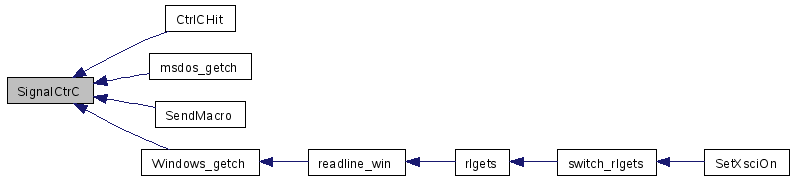
Referenced by CtrlCHit(), msdos_getch(), SendMacro(), and Windows_getch().
Here is the call graph for this function:

Here is the caller graph for this function:
 1.5.1
1.5.1

